

Order Total (1 Item Items):
Shipping Destination:

Igor Lerner Jonathan Keating David (22 results)
Skip to main search results
Search filters
Product Type
- All Product Types
- Books (22)
- Magazines & Periodicals (No further results match this refinement)
- Comics (No further results match this refinement)
- Sheet Music (No further results match this refinement)
- Art, Prints & Posters (No further results match this refinement)
- Photographs (No further results match this refinement)
- Maps (No further results match this refinement)
- Manuscripts & Paper Collectibles (No further results match this refinement)
Condition Learn more
- New (20)
- As New, Fine or Near Fine (1)
- Very Good or Good (1)
- Fair or Poor (No further results match this refinement)
- As Described (No further results match this refinement)
Binding
Collectible Attributes
- First Edition (2)
- Signed (No further results match this refinement)
- Dust Jacket (No further results match this refinement)
- Seller-Supplied Images (11)
- Not Print on Demand (12)
Language (1)
Price
- Any Price
- Under £ 20 (No further results match this refinement)
- £ 20 to £ 35 (No further results match this refinement)
- Over £ 35
Free Shipping
Seller Location
Seller Rating
-
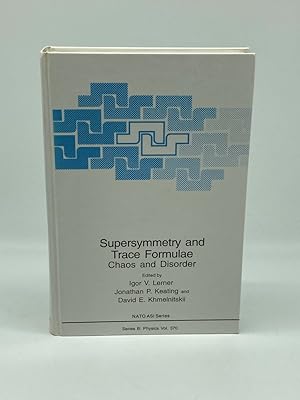
Supersymmetry and Trace Formulae Chaos and Disorder
Seller: True Oak Books, Highland, NY, U.S.A.
Association Member: IOBA
Seller rating 5 out of 5 stars

First Edition
Hardcover. Condition: Very Good-. First Edition; First Printing. NATO Science Series B: , 370; 404 pages; Previous owner's name inscribed on endpaper. Sticker on barcode. Minor stains to exterior edge of the pages. No writing or major defects. Covers in VG condition. ; - We're committed to your satisfaction. We offer free returns and respond promptly to all inquiries. Your item will be carefully wrapped in bubble wrap and securely boxed. All orders ship on the same or next business day. Buy with confidence.
-

Supersymmetry and Trace Formulae: Chaos and Disorder
Language: English
Published by Kluwer Academic/Plenum Publishers, 1999
ISBN 10: 0306459337 ISBN 13: 9780306459337
First Edition
Hardcover. Condition: Fine. 1st Edition. First printing. 8vo. 404 pp. Fine.
-
Condition: New. pp. 420.
-
Condition: New. pp. 420 68:B&W 7 x 10 in or 254 x 178 mm Case Laminate on White w/Gloss Lam.
-
Condition: New. pp. 420.
-
Supersymmetry and Trace Formulae: Chaos and Disorder (NATO Science Series B:, 370)
Seller: Ria Christie Collections, Uxbridge, United Kingdom
Seller rating 5 out of 5 stars
£ 136.79
£ 11.98 shipping
Ships from United Kingdom to U.S.A.Quantity: Over 20 available
Add to basketCondition: New. In English.
-

Supersymmetry and Trace Formulae: Chaos and Disorder (NATO Science Series B:)
Seller: Ria Christie Collections, Uxbridge, United Kingdom
Seller rating 5 out of 5 stars
£ 136.79
£ 11.98 shipping
Ships from United Kingdom to U.S.A.Quantity: Over 20 available
Add to basketCondition: New. In.
-
Condition: New. pp. 420.
-
Taschenbuch. Condition: Neu. Supersymmetry and Trace Formulae | Chaos and Disorder | Igor V. Lerner (u. a.) | Taschenbuch | ix | Englisch | 2012 | Springer | EAN 9781461372127 | Verantwortliche Person für die EU: Springer Verlag GmbH, Tiergartenstr. 17, 69121 Heidelberg, juergen[dot]hartmann[at]springer[dot]com | Anbieter: preigu.
-
Taschenbuch. Condition: Neu. Druck auf Anfrage Neuware - Printed after ordering - The motion of a particle in a random potential in two or more dimensions is chaotic, and the trajectories in deterministically chaotic systems are effectively random. It is therefore no surprise that there are links between the quantum properties of disordered systems and those of simple chaotic systems. The question is, how deep do the connec tions go And to what extent do the mathematical techniques designed to understand one problem lead to new insights into the other The canonical problem in the theory of disordered mesoscopic systems is that of a particle moving in a random array of scatterers. The aim is to calculate the statistical properties of, for example, the quantum energy levels, wavefunctions, and conductance fluctuations by averaging over different arrays; that is, by averaging over an ensemble of different realizations of the random potential. In some regimes, corresponding to energy scales that are large compared to the mean level spacing, this can be done using diagrammatic perturbation theory. In others, where the discreteness of the quantum spectrum becomes important, such an approach fails. A more powerful method, devel oped by Efetov, involves representing correlation functions in terms of a supersymmetric nonlinear sigma-model. This applies over a wider range of energy scales, covering both the perturbative and non-perturbative regimes. It was proved using this method that energy level correlations in disordered systems coincide with those of random matrix theory when the dimensionless conductance tends to infinity.
-
Supersymmetry and Trace Formulae : Chaos and Disorder
Language: English
Published by Springer US, Springer, 1999
ISBN 10: 0306459337 ISBN 13: 9780306459337
Buch. Condition: Neu. Druck auf Anfrage Neuware - Printed after ordering - The motion of a particle in a random potential in two or more dimensions is chaotic, and the trajectories in deterministically chaotic systems are effectively random. It is therefore no surprise that there are links between the quantum properties of disordered systems and those of simple chaotic systems. The question is, how deep do the connec tions go And to what extent do the mathematical techniques designed to understand one problem lead to new insights into the other The canonical problem in the theory of disordered mesoscopic systems is that of a particle moving in a random array of scatterers. The aim is to calculate the statistical properties of, for example, the quantum energy levels, wavefunctions, and conductance fluctuations by averaging over different arrays; that is, by averaging over an ensemble of different realizations of the random potential. In some regimes, corresponding to energy scales that are large compared to the mean level spacing, this can be done using diagrammatic perturbation theory. In others, where the discreteness of the quantum spectrum becomes important, such an approach fails. A more powerful method, devel oped by Efetov, involves representing correlation functions in terms of a supersymmetric nonlinear sigma-model. This applies over a wider range of energy scales, covering both the perturbative and non-perturbative regimes. It was proved using this method that energy level correlations in disordered systems coincide with those of random matrix theory when the dimensionless conductance tends to infinity.
-
 International Edition
Condition: New. Brand New ! Fast Delivery "International Edition " and ship within 24-48 hours. Deliver by FedEx and Dhl, & Aramex, UPS, & USPS and we do accept APO and PO BOX Addresses. Order can be delivered worldwide within 4-6 Working days .and we do have flat rate for up to 2LB. Extra shipping charges will be requested This Item May be shipped from India, United states & United Kingdom. Depending on your location and availability.
-
Condition: new. Questo è un articolo print on demand.
-
Supersymmetry and Trace Formulae
Language: English
Published by Springer US Apr 1999, 1999
ISBN 10: 0306459337 ISBN 13: 9780306459337
Seller: BuchWeltWeit Ludwig Meier e.K., Bergisch Gladbach, Germany
Seller rating 5 out of 5 stars
Buch. Condition: Neu. This item is printed on demand - it takes 3-4 days longer - Neuware -The motion of a particle in a random potential in two or more dimensions is chaotic, and the trajectories in deterministically chaotic systems are effectively random. It is therefore no surprise that there are links between the quantum properties of disordered systems and those of simple chaotic systems. The question is, how deep do the connec tions go And to what extent do the mathematical techniques designed to understand one problem lead to new insights into the other The canonical problem in the theory of disordered mesoscopic systems is that of a particle moving in a random array of scatterers. The aim is to calculate the statistical properties of, for example, the quantum energy levels, wavefunctions, and conductance fluctuations by averaging over different arrays; that is, by averaging over an ensemble of different realizations of the random potential. In some regimes, corresponding to energy scales that are large compared to the mean level spacing, this can be done using diagrammatic perturbation theory. In others, where the discreteness of the quantum spectrum becomes important, such an approach fails. A more powerful method, devel oped by Efetov, involves representing correlation functions in terms of a supersymmetric nonlinear sigma-model. This applies over a wider range of energy scales, covering both the perturbative and non-perturbative regimes. It was proved using this method that energy level correlations in disordered systems coincide with those of random matrix theory when the dimensionless conductance tends to infinity. 420 pp. Englisch.
-
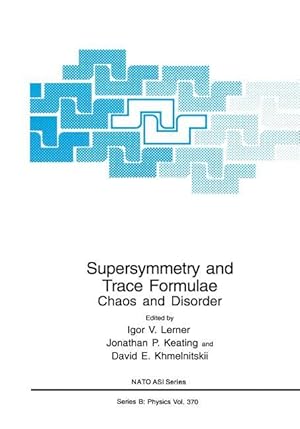
Condition: New. Dieser Artikel ist ein Print on Demand Artikel und wird nach Ihrer Bestellung fuer Sie gedruckt. Proceedings of a NATO ASI held in Cambridge, United Kingdom, September 8--20, 1997 The motion of a particle in a random potential in two or more dimensions is chaotic, and the trajectories in deterministically chaotic systems are effectively random.
-
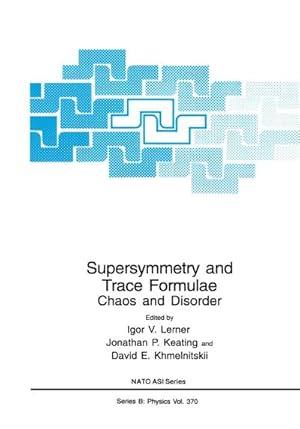
Supersymmetry and Trace Formulae
Language: English
Published by Springer US Okt 2012, 2012
ISBN 10: 1461372127 ISBN 13: 9781461372127
Seller: BuchWeltWeit Ludwig Meier e.K., Bergisch Gladbach, Germany
Seller rating 5 out of 5 stars
Taschenbuch. Condition: Neu. This item is printed on demand - it takes 3-4 days longer - Neuware -The motion of a particle in a random potential in two or more dimensions is chaotic, and the trajectories in deterministically chaotic systems are effectively random. It is therefore no surprise that there are links between the quantum properties of disordered systems and those of simple chaotic systems. The question is, how deep do the connec tions go And to what extent do the mathematical techniques designed to understand one problem lead to new insights into the other The canonical problem in the theory of disordered mesoscopic systems is that of a particle moving in a random array of scatterers. The aim is to calculate the statistical properties of, for example, the quantum energy levels, wavefunctions, and conductance fluctuations by averaging over different arrays; that is, by averaging over an ensemble of different realizations of the random potential. In some regimes, corresponding to energy scales that are large compared to the mean level spacing, this can be done using diagrammatic perturbation theory. In others, where the discreteness of the quantum spectrum becomes important, such an approach fails. A more powerful method, devel oped by Efetov, involves representing correlation functions in terms of a supersymmetric nonlinear sigma-model. This applies over a wider range of energy scales, covering both the perturbative and non-perturbative regimes. It was proved using this method that energy level correlations in disordered systems coincide with those of random matrix theory when the dimensionless conductance tends to infinity. 420 pp. Englisch.
-
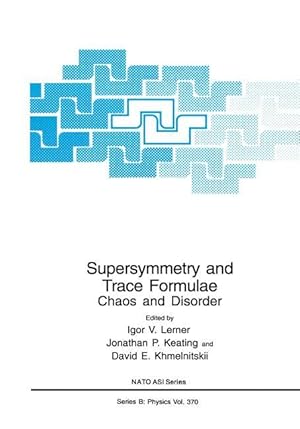
Condition: New. Dieser Artikel ist ein Print on Demand Artikel und wird nach Ihrer Bestellung fuer Sie gedruckt. Proceedings of a NATO ASI held in Cambridge, United Kingdom, September 8--20, 1997 The motion of a particle in a random potential in two or more dimensions is chaotic, and the trajectories in deterministically chaotic systems are effectively random.
-
Condition: New. Print on Demand pp. 420 66:B&W 7 x 10 in or 254 x 178 mm Perfect Bound on White w/Gloss Lam.
-
Buch. Condition: Neu. Supersymmetry and Trace Formulae | Chaos and Disorder | Igor V. Lerner (u. a.) | Buch | ix | Englisch | 1999 | Springer | EAN 9780306459337 | Verantwortliche Person für die EU: Springer Verlag GmbH, Tiergartenstr. 17, 69121 Heidelberg, juergen[dot]hartmann[at]springer[dot]com | Anbieter: preigu Print on Demand.
-
Condition: New. PRINT ON DEMAND pp. 420.
-

Supersymmetry and Trace Formulae
Language: English
Published by Springer, Springer Okt 2012, 2012
ISBN 10: 1461372127 ISBN 13: 9781461372127
Seller: buchversandmimpf2000, Emtmannsberg, BAYE, Germany
Seller rating 5 out of 5 stars
Taschenbuch. Condition: Neu. This item is printed on demand - Print on Demand Titel. Neuware -The motion of a particle in a random potential in two or more dimensions is chaotic, and the trajectories in deterministically chaotic systems are effectively random. It is therefore no surprise that there are links between the quantum properties of disordered systems and those of simple chaotic systems. The question is, how deep do the connec tions go And to what extent do the mathematical techniques designed to understand one problem lead to new insights into the other The canonical problem in the theory of disordered mesoscopic systems is that of a particle moving in a random array of scatterers. The aim is to calculate the statistical properties of, for example, the quantum energy levels, wavefunctions, and conductance fluctuations by averaging over different arrays; that is, by averaging over an ensemble of different realizations of the random potential. In some regimes, corresponding to energy scales that are large compared to the mean level spacing, this can be done using diagrammatic perturbation theory. In others, where the discreteness of the quantum spectrum becomes important, such an approach fails. A more powerful method, devel oped by Efetov, involves representing correlation functions in terms of a supersymmetric nonlinear sigma-model. This applies over a wider range of energy scales, covering both the perturbative and non-perturbative regimes. It was proved using this method that energy level correlations in disordered systems coincide with those of random matrix theory when the dimensionless conductance tends to infinity.Springer-Verlag KG, Sachsenplatz 4-6, 1201 Wien 420 pp. Englisch.
-

Supersymmetry and Trace Formulae
Language: English
Published by Springer US, Springer Apr 1999, 1999
ISBN 10: 0306459337 ISBN 13: 9780306459337
Seller: buchversandmimpf2000, Emtmannsberg, BAYE, Germany
Seller rating 5 out of 5 stars
Buch. Condition: Neu. This item is printed on demand - Print on Demand Titel. Neuware -The motion of a particle in a random potential in two or more dimensions is chaotic, and the trajectories in deterministically chaotic systems are effectively random. It is therefore no surprise that there are links between the quantum properties of disordered systems and those of simple chaotic systems. The question is, how deep do the connec tions go And to what extent do the mathematical techniques designed to understand one problem lead to new insights into the other The canonical problem in the theory of disordered mesoscopic systems is that of a particle moving in a random array of scatterers. The aim is to calculate the statistical properties of, for example, the quantum energy levels, wavefunctions, and conductance fluctuations by averaging over different arrays; that is, by averaging over an ensemble of different realizations of the random potential. In some regimes, corresponding to energy scales that are large compared to the mean level spacing, this can be done using diagrammatic perturbation theory. In others, where the discreteness of the quantum spectrum becomes important, such an approach fails. A more powerful method, devel oped by Efetov, involves representing correlation functions in terms of a supersymmetric nonlinear sigma-model. This applies over a wider range of energy scales, covering both the perturbative and non-perturbative regimes. It was proved using this method that energy level correlations in disordered systems coincide with those of random matrix theory when the dimensionless conductance tends to infinity.Springer-Verlag GmbH, Tiergartenstr. 17, 69121 Heidelberg 420 pp. Englisch.


