
Herman Spaink (15 results)

- Softcover
Seller: Revaluation Books, Exeter, , United KingdomRevaluation Books
Contact seller5-star sellerCondition: New
£ 66.94
£ 15.00 shippingShips from United Kingdom to U.S.A.Quantity: 1 available
Paperback. Condition: Brand New. 1st edition. 566 pages. 10.25x7.75x1.00 inches. In Stock.
- Softcover
Seller: Books Puddle, New York, NY, U.S.A.Books Puddle
Contact seller4-star sellerCondition: New
£ 90.87
£ 3.02 shippingShips within U.S.A.Quantity: 4 available
Condition: New. pp. 566 1st Edition.
- Softcover
Seller: Revaluation Books, Exeter, , United KingdomRevaluation Books
Contact seller5-star sellerCondition: New
£ 79.28
£ 15.00 shippingShips from United Kingdom to U.S.A.Quantity: 1 available
Paperback. Condition: Brand New. 1st edition. 566 pages. 10.25x7.75x1.00 inches. In Stock.

- Softcover
Seller: preigu, Osnabrück, Germanypreigu
Contact seller5-star sellerCondition: New
£ 44.92
£ 60.76 shippingShips from Germany to U.S.A.Quantity: 5 available
Taschenbuch. Condition: Neu. The Rhizobiaceae | Molecular Biology of Model Plant-Associated Bacteria | Herman P. Spaink (u. a.) | Taschenbuch | xxiv | Englisch | 1998 | Springer | EAN 9780792351801 | Verantwortliche Person für die EU: Springer Verlag GmbH, Tiergartenstr. 17, 69121 Heidelberg, juergen[dot]hartmann[at]springer[dot…]com | Anbieter: preigu.
- Softcover
Seller: Mispah books, Redhill, SURRE, United KingdomMispah books
Contact seller4-star sellerCondition: Used - As new
£ 85.00
£ 25.00 shippingShips from United Kingdom to U.S.A.Quantity: 1 available
Paperback. Condition: Like New. LIKE NEW. SHIPS FROM MULTIPLE LOCATIONS. book.

- Softcover
Seller: AHA-BUCH GmbH, Einbeck, GermanyAHA-BUCH GmbH
Contact seller5-star sellerCondition: New
£ 55.33
£ 58.07 shippingShips from Germany to U.S.A.Quantity: 1 available
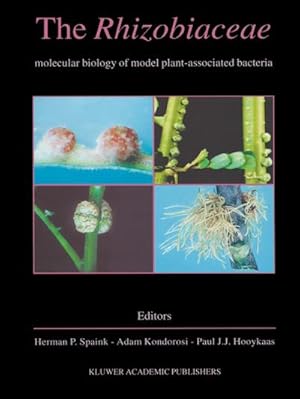
Taschenbuch. Condition: Neu. Druck auf Anfrage Neuware - Printed after ordering - The Rhizobiaceae, Molecular Biology of Model Plant-Associated Bacteria. This book gives a comprehensive overview on our present molecular biological knowledge about the Rhizobiaceae, which currently can be called the best-studied family of soil bac…teria. For many centuries they have attracted the attention of scientists because of their capacity to associate with plants and as a consequence also to specifically modify plant development. Some of these associations are beneficial for the plant, as is the case for the Rhizobiaceae subgroups collectively called rhizobia, which are able to fix nitrogen in a symbiosis with the plant hosts. This symbiosis results in the fonnation of root or stem nodules, as illustrated on the front cover. In contrast, several Rhizobiaceae subgroups can negatively affect plant development and evoke plant diseases. Examples are Agrobacterium tumefaciens andA. rhizogenes which induce the formation of crown galls or hairy roots on the stems of their host plants, respectively (bottom panels on front cover). In addition to the obvious importance of studies on the Rhizobiaceae for agronomy, this research field has resulted in the discovery of many fundamental scientific principles of general interest, which are highlighted in this book. To mention three examples: (i) the discovery of DNA transfer of A.

Language: English
Published by Springer 2001
Series: Natural Computing, Book 16 of 32. Book 16 of 32 - Natural Computing
- Hardcover
Seller: GreatBookPrices, Columbia, MD, U.S.A.GreatBookPrices
Contact seller5-star sellerCondition: New
£ 155.54
£ 2.00 shippingShips within U.S.A.Quantity: 15 available
Condition: New.

Language: English
Published by Springer 2001
Series: Natural Computing, Book 16 of 32. Book 16 of 32 - Natural Computing
- Hardcover
Seller: GreatBookPricesUK, Woodford Green, United KingdomGreatBookPricesUK
Contact seller5-star sellerCondition: New
£ 137.83
£ 15.00 shippingShips from United Kingdom to U.S.A.Quantity: Over 20 available
Condition: New.

Language: English
Published by Springer 2001
Series: Natural Computing, Book 16 of 32. Book 16 of 32 - Natural Computing
- Hardcover
Seller: GreatBookPricesUK, Woodford Green, United KingdomGreatBookPricesUK
Contact seller5-star sellerCondition: Used - As new
£ 194.99
£ 15.00 shippingShips from United Kingdom to U.S.A.Quantity: Over 20 available
Condition: As New. Unread book in perfect condition.
Language: English
Published by Springer 2001
Series: Natural Computing, Book 16 of 32. Book 16 of 32 - Natural Computing
- Hardcover
Seller: GreatBookPrices, Columbia, MD, U.S.A.GreatBookPrices
Contact seller5-star sellerCondition: Used - As new
£ 223.74
£ 2.00 shippingShips within U.S.A.Quantity: 15 available
Condition: As New. Unread book in perfect condition.

- Softcover
- Print on Demand
Seller: moluna, Greven, , Germanymoluna
Contact seller5-star sellerCondition: New
£ 43.24
£ 42.52 shippingShips from Germany to U.S.A.Quantity: Over 20 available
Kartoniert / Broschiert. Condition: New. Dieser Artikel ist ein Print on Demand Artikel und wird nach Ihrer Bestellung fuer Sie gedruckt. The Rhizobiaceae, Molecular Biology of Model Plant-Associated Bacteria. This book gives a comprehensive overview on our present molecular biological knowledge about the Rhizobiaceae, which cur…rently can be called the best-studied family of soil bacteria. Fo.
- Softcover
- Print on Demand
Seller: Majestic Books, Hounslow, , United KingdomMajestic Books
Contact seller4-star sellerCondition: New
£ 84.32
£ 6.50 shippingShips from United Kingdom to U.S.A.Quantity: 4 available
Condition: New. Print on Demand pp. 566.
- Softcover
- Print on Demand
Seller: Biblios, frankfurt am main, HESSE, GermanyBiblios
Contact seller4-star sellerCondition: New
£ 86.99
£ 8.64 shippingShips from Germany to U.S.A.Quantity: 4 available
Condition: New. PRINT ON DEMAND pp. 566.

- Softcover
- Print on Demand
Seller: buchversandmimpf2000, Emtmannsberg, BAYE, Germanybuchversandmimpf2000
Contact seller5-star sellerCondition: New
£ 47.82
£ 52.08 shippingShips from Germany to U.S.A.Quantity: 1 available
Taschenbuch. Condition: Neu. This item is printed on demand - Print on Demand Titel. Neuware -The Rhizobiaceae, Molecular Biology of Model Plant-Associated Bacteria. This book gives a comprehensive overview on our present molecular biological knowledge about the Rhizobiaceae, which currently can be called the best-studied family… of soil bacteria. For many centuries they have attracted the attention of scientists because of their capacity to associate with plants and as a consequence also to specifically modify plant development. Some of these associations are beneficial for the plant, as is the case for the Rhizobiaceae subgroups collectively called rhizobia, which are able to fix nitrogen in a symbiosis with the plant hosts. This symbiosis results in the fonnation of root or stem nodules, as illustrated on the front cover. In contrast, several Rhizobiaceae subgroups can negatively affect plant development and evoke plant diseases. Examples are Agrobacterium tumefaciens andA. rhizogenes which induce the formation of crown galls or hairy roots on the stems of their host plants, respectively (bottom panels on front cover). In addition to the obvious importance of studies on the Rhizobiaceae for agronomy, this research field has resulted in the discovery of many fundamental scientific principles of general interest, which are highlighted in this book. To mention three examples: (i) the discovery of DNA transfer of A.Springer-Verlag GmbH, Tiergartenstr. 17, 69121 Heidelberg 592 pp. Englisch.
- Softcover
- Print on Demand
Seller: BuchWeltWeit Ludwig Meier e.K., Bergisch Gladbach, , GermanyBuchWeltWeit Ludwig Meier e.K.
Contact seller5-star sellerCondition: New
£ 143.47
£ 19.96 shippingShips from Germany to U.S.A.Quantity: 2 available
Taschenbuch. Condition: Neu. This item is printed on demand - it takes 3-4 days longer - Neuware -The Rhizobiaceae, Molecular Biology of Model Plant-Associated Bacteria. This book gives a comprehensive overview on our present molecular biological knowledge about the Rhizobiaceae, which currently can be called the best-studied fa…mily of soil bacteria. For many centuries they have attracted the attention of scientists because of their capacity to associate with plants and as a consequence also to specifically modify plant development. Some of these associations are beneficial for the plant, as is the case for the Rhizobiaceae subgroups collectively called rhizobia, which are able to fix nitrogen in a symbiosis with the plant hosts. This symbiosis results in the fonnation of root or stem nodules, as illustrated on the front cover. In contrast, several Rhizobiaceae subgroups can negatively affect plant development and evoke plant diseases. Examples are Agrobacterium tumefaciens andA. rhizogenes which induce the formation of crown galls or hairy roots on the stems of their host plants, respectively (bottom panels on front cover). In addition to the obvious importance of studies on the Rhizobiaceae for agronomy, this research field has resulted in the discovery of many fundamental scientific principles of general interest, which are highlighted in this book. To mention three examples: (i) the discovery of DNA transfer of A. 592 pp. Englisch.


