
Items related to The Soul of a Chef: The Journey Toward Perfection
Synopsis
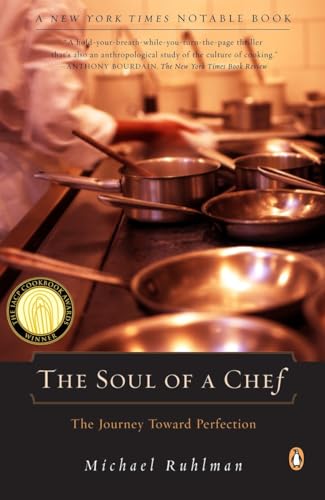
"...[An]adventure story, a hold-your-breath-while-you-turn-the-page thriller that's also an anthropological study of the culture of cooking" -- Anthony Bourdain, The New York Times
The classic account of what drives a chef to perfection by accaimed write Michael Ruhlman -- --winner of the IACP Cookbook AwardIn this in-depth foray into the world of professional cooking, Michael Ruhlman journeys into the heart of the profession. Observing the rigorous Certified Master Chef exam at the Culinary Institute of America, the most influential cooking school in the country, Ruhlman enters the lives and kitchens of rising star Michael Symon and renowned Thomas Keller of the French Laundry (and Per Se). This fascinating book will satisfy any reader's hunger for knowledge about cooking and food, the secrets of successful chefs, at what point cooking becomes an art form, and more. Like Ruhlman's The Making of a Chef, this is an instant classic in food writing.
"synopsis" may belong to another edition of this title.
About the Author
Michael Ruhlman is the author of nine non-fiction books, one collection of novellas, and nine cookbooks (most recently The Book of Cocktail Ratios) and co-author with various chefs of ten other cookbooks. Best known for writing about food, chefs and the work of professional cooking, he has also written for The New York Times, The New York Times Sunday Magazine, The Wall Street Journal, Gourmet magazine, and other publications.
Excerpt. © Reprinted by permission. All rights reserved.
The Soul of a Chef
The Journey Toward PerfectionBy Michael RuhlmanPenguin Books
Copyright © 2001 Michael RuhlmanAll right reserved.
ISBN: 0141001895
Chapter One
Certified Master Chef Exam (or the Objective Truth of Great Cooking)
Chef Dieter Doppelfeld leads the way to kitchen station four, followed by twomen in lab coats with clipboards. Brian Polcyn stands before these men attentivebut at ease in a paper toque and chef's whites. He has set his stainless steeltable with cutting board, slicing knife, bain-marie insert filled with hotwater, and latex gloves.
Ron DeSantis glances at his clipboard and says, "Chef, would you pleasetell us what you have prepared?"
"Duck terrine," Polcyn answers. "Straight forcemeat with seared duck andshiitake mushrooms."
"And the sauce?"
"Orange-ginger."
Polcyn then begins the presentation, first submerging the terrine moldfor several seconds in water simmering on the stove-just enough to warm andloosen it-then upending the terrine mold on his cutting board and lifting it offthe terrine itself. Dieter Doppelfeld, who has run this test for the past nineyears, Ron DeSantis, and the third master chef judge, Fritz Sonnenschmidt, anauthority on terrines, watch silently. Polcyn's movements are unnatural andstiff, almost robotic; clearly he doesn't stand this straight while moving fromstovetop to workstation at his restaurant or breathe so audibly. It's harder todrive a car perfectly when there's a cop on your tail.
Having successfully separated the terrine from its mold and pulled onthe gloves, Polcyn removes the slicing knife from the bain of hot water, driesthe blade. He places his left hand on the terrine, rests the knife on its centerin preparation for the first cut, and for a moment holds still.
Polcyn measures five feet ten inches between his laced black shoes andhis toque, which conceals abundant, wavy black hair. He is thethirty-seven-year-old chef-owner of Five Lakes Grill, a popular restaurant inthe hamlet of Milford, Michigan, forty-five miles northwest of Detroit. He hasbeen cooking professionally since high school and run the kitchens of some ofMichigan's finest restaurants. He is a food consultant for Northwest Airlinesalong with such luminary chefs as Waldy Malouf, Nancy Silverton, and ToddEnglish. He has twice been a guest chef at the James Beard House in New YorkCity. He has appeared three times in the prestigious Bocuse d'Or competition. Heonce prepared a private meal for twelve for which the host, at a charityauction, had paid twenty-four thousand dollars. But never before in histwenty-two-year cooking career has he been as nervous as he is at this moment,his knife blade paused above this duck terrine, which he has seasoned with aMadeira reduction, inlaid with mushrooms and whole duck breast, and roasted toan internal temperature of 145 degrees.
Polcyn inhales sharply, strokes once through the terrine, once back, andhe cannot believe his eyes. The knife has veered right. Polcyn stares at hishands as if they were not his own. The error ensures that the second slice willbe slightly thinner at one end as well.
But the interior garnish of the seared duck breast is pink andglistening; he has cooked the terrine perfectly. He places the slices on a whiteplate, spoons his smooth bright orange-ginger sauce onto the plate, and sets iton the cloth-covered rolling cart for the judges to taste. Each judge samplesthe terrine and the sauce. Fritz Sonnenschmidt, a man who is very nearly aperfect sphere, asks, "Were you to do this again, what would you dodifferently?"
"I might have added some pistachios for color," Polcyn says. But otherthan that, he thinks it's pretty good.
Sonnenschmidt nods and looks to his left, beyond DeSantis, and says,"Chef Doppelfeld?"
"I thought it was very pleasant to eat," Chef Doppelfeld says. "Nicecolor, nice flavor."
There are some discreet clicks of pencil tips on clipboards. Beforeleaving, Ron DeSantis, a certified master chef like the others, a CulinaryInstitute of America instructor, and a former head chef of the United StatesMarine Corps based in Okinawa, says, "The major thing is your knife skills." Helooks Polcyn dead in the eye and says, "You really need to have good knifeskills."
"Yes, Chef," Polcyn says. He swallows at the insult and cannot hold histongue. "Actually Chef, I do have the knife skills. It's just that sometimesthey don't come out."
DeSantis leans into Polcyn's face and with quiet menace says, "Duringthese ten days they have to come out."
"Yes, Chef."
The day before the Certified Master Chef examination began I arrived at theoffice of Tom Peer, food and beverage director at the Culinary Institute ofAmerica, the nation's most prominent cooking school. Peer was for years theexecutive chef at the Duquesne Club in Pittsburgh, and he was now thecertification chairman for the American Culinary Federation, a tradeorganization representing tens of thousands of chefs. Peer oversaw the masterchef certification program.
Peer had asked Dieter Doppelfeld to join us; Doppelfeld was aninstructor at the CIA and the man who had managed the daily operations of thecooking test for the past nine years. He wore thick glasses and spoke with amellifluous German accent. Doppelfeld wore chef's whites; Peer dressedcorporate.
The Certified Master Chef examination meant different things toeverybody who knew about it, the first clue to me that the test had some kind ofgenuine power. To Tom Peer it was a simple accreditation. "If you want anelectrician to wire your house, would you rather have an electrician who wascertified or one who wasn't?" he asked. Same thing with a chef; this test meantto certify that a chef had a specific range of skills and knowledge. But forothers the test carried a mystique that had less to do with skills than aconfirmation of some innate talent. For still others it was a like a mountainscaled, a solo ocean crossing. "There are two dates you never forget," RonDeSantis told me. "Your birthday and the day you earn your CMC." This from amarried man with two children.
Depending where in the industry chefs work, the CMC title can result ina higher salary, and in some circles it is a title of respect. But a large andvocal segment of the industry denigrates the test. There are clearly two camps,the public and well-known chefs who own popular restaurants and thecompetition-style chefs who teach in schools and compete in food shows. Theprominent chef-owners of successful restaurants and celebrity chefs dismiss theCMC test as being out of touch with reality, a waste of time and money, andabsolutely without meaning. Some well-known chefs like the idea of the test.David Burke, chef of New York City's Park Avenue Cafe, told me, "I think thetest is great. It's got a lot to do with theory and technique that a lot ofrestaurant chefs never get to learn." But most popular chefs, upon hearing itmentioned, turn their heads as if they'd smelled something nasty.
On its surface the Certified Master Chef exam was plainly a cookingtest, the only one of its kind anywhere, one that lasted ten full days andscarcely gave the chefs time to sleep. The chefs had to be great cooks in goodphysical condition, but they also had to be knowledgeable on subjects rangingfrom sanitation to restaurant management to tableside service. The goal of thistest was to establish an industry-wide standard of excellence in the profession.The main work of the next ten days, though, the reason I was excited to be here,was cooking. I would be observing a long, hard, slightly bizarre cooking test.Ten days of all kinds of cooking styles, methods, and techniques ranging fromAmerican cuisine to classical French, charcuterie preparations such as foie graspâtés and duck terrines, and baking and patisserie-by design all the kinds ofcooking that, when perfected, make someone a master chef.
This cooking would be undertaken by six men and one woman who wanted tobe called certified master chefs, or CMCs. I expected they'd be pretty damn goodcooks, and a little off-center. Who other than the slightly demented would takethis test? Each of these chefs had to travel hundreds of miles to the HudsonValley and spend ten days away from their families and jobs to work really hardin someone else's kitchen. Most of them worked really hard all the time anyway,cooking day and night in their own hot kitchens. But here they would workharder, cooking and taking written and oral tests for days, days that would lasttwelve to sixteen hours, each under strict observation and mind-bending stress.For this they would pay a "tuition" of twenty-six hundred dollars to theAmerican Culinary Federation. This did not include room and board, books, orequipment. Most of the chefs put themselves up in the Super 8 or the GoldenManor, two motels not known for luxury just down the road on Route 9. Some ofthese chefs had spent years studying for this test and spent money and time totravel to kitchens in other states to practice. With travel, room and board, andmiscellaneous expenses, the cost of the test would be between four and fivethousand dollars.
To review: ten days of grueling work, away from home and family, livingin a motel, and spending thousands of dollars to take a test that an importantpart of your industry openly denigrates. This is simply not something thatnormal people do. But seven chefs were committed to taking it this year.
The likely result: failure. Failure is not just possible for thesechefs; it is probable. Approximately 170 chefs have taken the test since it wasfirst given in 1981. Only 53 have passed it. According to these odds, 2 of the 7chefs here this year will be standing when the Day Ten mystery basket has beencooked, plated, served, and judged.
So not only did I expect to see close up some fascinating cooking thatranged from classical to modern, truly dramatic sauté and sauce work underpressure, but I figured I'd also be watching unusual souls in a struggle againstlikely defeat.
"I figured out where you're going to be from," Tom Peer said to me,leaning forward on his desk. "You're going to be from the National Council ofAccreditation." When I said I'd never heard of this group, he chuckled and said,"That's because I just made it up."
I would wear a lab coat each day in the kitchen, and Chef Doppelfeldwould loan me a clipboard. What my title was and what exactly I was doing forthe National Council of Accreditation, I'd have to figure out for myself, Peersaid.
In truth, I was a writer and freelance journalist who had asked toobserve this odd one-of-a-kind cooking test. No outsider had ever been admittedto it or been permitted the kind of access I'd been promised. (No one had askedbefore, as far as I knew.) The people who ran the test worried that if I simplyroamed the kitchens as a journalist, asking the chefs intimate questions andthen writing down their answers in my notebook, I might distract them. The testis hard enough as it is without their having to endure someone who is nosy byprofession. Also, they didn't want any chefs fretting over the possibility thatI might broadcast their failures all over the country.
That I would be undercover had its good and bad points. A common concerndogs any thoughtful journalist: Are you altering the story you're reporting byyour very presence as a journalist? This question would be moot since no onewould know I was a journalist. My reason for being here, my lie, was to examinethe test itself, not the chefs, for the "NCA," so no one would even notice orcare that I was taking notes continually. I would have free rein in thekitchens; I could stick my face in their simmering sauces, open the oven doorswhere rabbit bones were crackling in oil, stand beside the chefs, and learn howto butcher Dover sole, and no one would think twice.
The drawback was that I would have to lie daily, and I was a bad liar. Itended to shake and stammer while lying, certain my sham disguise would bediscovered and blow the whole deal.
A small price to pay, however, for what promised to be a thrillingassignment for someone who loves to cook. In Tom Peer's office I asked him andDoppelfeld how it was that so few people could actually pass this test.
Chef Doppelfeld, seated beside me in Peer's office, said, "Failure isusually that of basic cooking principles." All judges would stress to the chefs,and to me, that this test was all about the basics. Did the chefs braiseproperly? Did they season their food properly? When they were called in to theevaluation room, did they know that their artichoke hearts could have cooked alittle longer? There are several mystery basket situations throughout the test;the chefs are given trays of food they have not seen before and have four and ahalf hours to devise and then cook a four-course menu for ten. Did they use thefood intelligently and imaginatively? Was the meal properly cooked, wellbalanced, visually appealing, and delicious? You start with great meat, fruits,vegetables, and you do what it is your job to do: cook. How difficult is that?
Chef Doppelfeld's eyes enlarged behind his glasses, and he said, "I amnot going to put a sea turtle in your basket."
Yet less than a third of the chefs passed this test? Doppelfeld noddedand confided that you could pretty much tell who had a chance and who didn't byDay Five or Six.
"Is it possible that nobody will pass?" I asked.
Doppelfeld nodded, then said with genuine dismay, "If nobody passes,I'll weep."
This grueling cooking test, simply the idea of it, had completely captivated me,and it would become for me the beginning of a two-year immersion in the work ofthe American chef and professional cooking. But for a long while I couldn't getto the core of my fascination with the CMC exam. I asked Peer and Doppelfeld whythey thought this test was important. Doppelfeld explained that this profession,the profession of chef in America, was relatively young. For most of its historythe United States imported great chefs; we did not train our own because wedidn't have anyone to do the training; the country didn't even have a cuisine itcould call its own or any kind of tradition to speak of, beyond the homeec-style teachings of Fannie Farmer, perhaps, or the worldwide impact ofMcDonald's-style fast food. Yet in the past fifty years, most noticeably in thepast two decades, the culinary scene had exploded. Cooks had become chefs, andchefs had become celebrities. Food magazines proliferated. National and localradio shows devoted to food filled the air on weekends. An entire televisionnetwork was created to broadcast food and cooking shows twenty-four hours a day.Restaurants were becoming as famous as Broadway shows. And the work itself-oncethe labor of the lower classes-had become fashionable. Parents, once proud tosay that their child had entered law school, now boasted that their child was inculinary school. An industry that was still young, huge and growing ($336billion in overall food service sales in 1998, $376 billion expected in 2000)needed recognized standards of uncompromised excellence, standards that wereacknowledged by everyone. The Certified Master Chef exam aimed to create exactlythat.
Had it been successful? Only in part, it seems. Some in the industryvalued the credential. If a chef worked in a country club, a culinary school,research and development, or as a corporate or institutional chef-and many, manythousands did-the title might mean a salary increase of ten thousand dollars ormore. But some in the industry criticized the test for rewarding culinarycompetition-style chefs, chefs who do not cook to feed but who cook to compete.To support their claim that the CMC test is irrelevant, celebrity chef-ownersneeded only ask what Charlie Trotter, voicing the view of most restaurant chefs,asked: "There are some great certified master chefs, but how many of them runsuccessful restaurants?" (About 7 percent.)
Others noted that the test was not available to enough chefs to make itvaluable. How many chefs would be willing to spend ten days of their life thisway? How many would be willing and also be able to afford it? What if they werefrom a country outside the West? Some of the best chefs in the country,arguably, were neither American nor French but brought to America the cuisinesof their homelands: India, China, and other non-Western countries. How did thistest serve them? So perhaps the sheer low numbers of those to whom the test wasavailable rendered the test irrelevant or scarcely relevant.
Yet for all the good arguments to dismiss this test, my fascinationremained. While the reasons at the time were not immediately clear, the factswere these.
In February 1996 I entered Skill Development I at the Culinary Instituteof America, a writer in student attire, in order to learn what the mostprominent cooking school in the world said one had to know in order to be aprofessional chef and to write a true story about learning to cookprofessionally. One year later, having begun that first day by mincing an onionand having finished nine months later by working grill station at the school'sfinal restaurant, I shipped off the manuscript. Then I sat in my room bereft.This couldn't be the end. I was still empty, and ravenous. Indeed I'd juststarted. I'd come to the Culinary looking for the knowledge to cook, but when Ileft, I found I didn't have that knowledge. I thought I did. But I didn't.
What I did have, though, were tools to learn the rest. I had some basicinformation about how food behaves under specific circumstances and, moreimportant to me, information about how the human personality behaves under thosesame circumstances. This after all was why cooking mattered. It had less to dowith filling your stomach or pleasing your mouth than with connecting yourselfto something more powerful and extraordinary than sensual gratifications.
Don't ask me what! At the time I didn't know. But I knew it was outthere. I hadn't moved my wife and daughter five hundred miles to a cow town fora year to learn how to make a superlative brown veal stock. I'd thought this wasso, but after writing about the learning, I realized, again, that I needed toknow how to make a superlative brown veal stock in order to learn the rest. Whatwas the rest? I didn't know! But I meant to find out what it was and why cookingwas so obsessively important. That was why I hustled to finagle a magazineassignment to get back to the CIA to watch this extraordinary cooking test.There was something here.
All America, it seemed to me, was busting at the seams to learn moreabout cooking, announcing its own passions and beliefs with fire and brimstonevolume, dead passionate to eat at great restaurants, devouring celebrity chefcookbooks, filling supermarkets, from their own need, with products once unheardof there-Asian pears, taro roots, fresh morel mushrooms; would it be long beforeone could find fresh foie gras nestled between the Perdue chickens and LongIsland ducks at the local Stop 'n' Shop? All of it, I understood, America'secstatic clutching and cooking and feeding, was an attempt to fill its soul,each passionate cook's attempt to connect himself to a world that was recedingthrough the computer screen of his home office, receding in the rearview mirrorof his Jeep Cherokee sealed tight as a space shuttle from the atmosphereoutside. America was cooking and eating, yet I knew this cooking and eating weremerely the scratching of ghost itches on amputated limbs.
It was for me, anyway. And so I learned to make that basic brown stock.Once I knew how to make it, I not only realized how much more there was to knowabout food and cooking, but also sensed the fundamental importance of studyingthe work of professional cooking, to know the people who had been at this workall their adult lives. Somewhere in them was the answer to why cooking well wasso fundamentally important.
Three months after finishing my narrative of learning to cook, I hadreturned to the Culinary to witness a test that claimed both to measure and toevaluate the basics, from which all truly great cooking originates, and toacknowledge or deny absolutely one's abilities as a chef. A range of cooking wasperformed over a short period by a variety of chefs; a search for the soul of achef and the importance of great cooking might begin here. It became thebeginning of a journey that led me to the kitchens and work of three outstandingbut very different chefs, each of whom was distinctly American and, moreover,helped define what the American chef was, helped define the profession in thiscountry, the work and the food.
The reason why the CMC test gripped me and proved the perfect place tobegin my search for the soul of a chef at last became clear: It attempted todefine the truth of great cooking.
I came to understand that all the varying impressions and thoughts aboutthis test-from chefs who dismissed it out of hand as irrelevant, to those whorevered it, to those who feared it or despised it-were only impressions,perceptions. Each described a reflection thrown off by a different facet of whatI suspected might be a diamond. The very fact that the test existed was a claimthat something solid and valuable and unchanging happened here.
But the idea that a few people could evaluate a chef's food, itscreativity, its originality, and measure it objectively, evaluate it, compareand contrast its various attributes in order to render a final unarguableverdict about how good or bad this food was, and this chef was, was bothintriguing and ludicrous. Imagine, say, a Certified Master Poet examination inwhich poets from around the country-not the celebrity poets and commerciallysuccessful poets such as Maya Angelou and Rita Dove, but rather the academicstucked away in towers teaching college English, the poets struggling with theirwork in virtual anonymity, publishing only in small regional journals-convergedat one school and, under great stress and unusual conditions, were told to writepoetry, in various styles and with unusual constraints of time and method, thatwould be evaluated by their peers. Their peers, master poets (but not the likesof Robert Pinsky or Richard Wilbur) would read this work, discuss it behindclosed doors, critique it before the master poet candidates, and then, withabsolute authority, render the verdict: "You are now a certified master poet" or"You are not." Those deemed unworthy would return to their obscure toildiminished in the eyes of their family, their colleagues, forced to admit theydo not do master poet work, that they are and always will be mediocre poets.
Of course this is not ultimately what the CMC test does. Poetry is anart form. Cooking is a craft. (Oh, I know how the foodie blowhards-and even alot of chefs-love to talk about food as art! But I'm sorry, noodles spun intotowers and designs on plates with different-colored sauces do not equal art, sodon't talk to me about food as art or chefs as artistes.) As with any craft,there were artful levels and shared standards of excellence. The test's veryexistence implied that great cooking, cooking at so-called master chef level,was not art, was only craft, the result of physical skills that wereconsistently measurable and comparable from one chef to the next. The CertifiedMaster Chef exam aimed to set an objective standard of great cooking thatexisted regardless of this or that person's own taste and preferences, somethingthat you could not do with an art such as poetry. Here one sought an objectivestandard of cooking that was true for all chefs no matter who they were, wherethey cooked, or how or why or whom they pleased or offended. This was cooking asPlatonic form. Culinary essentialism. An objective standard. A truth.
This I wanted to see.
Peer and Doppelfeld had reiterated to me that this test measured"knowledge acquired over a period of time." But there was something more totheir claims, something a little presumptuous, but maybe true. FritzSonnenschmidt claimed that he was a master chef as soon as he finished hisapprenticeship in Germany; it was only a matter of learning the requisite skillsand acquiring the knowledge. CIA president Ferdinand Metz, who had conceived andcreated the test, noted that only one person who had ever retaken the test afterfailing had passed, hinting that the Master Chef exam measures something innate.The way these master chefs spoke about the test suggested that there was a gooddeal more here than basic cooking principles. The unspoken claim by all of themwas that you are either master chef material or you are not. You either have itor you don't, and if you don't, no amount of study and training can change that.When chefs earned their CMC, they were merely fulfilling what had been in themto accomplish all along. The Certified Master Chef exam measured and confirmedan inner greatness.—Reprinted from The Soul of a Chef by Michael Ruhlman by permission of VikingBooks, a member of Penguin Putnam Inc. Copyright (c) 2000 by Michael Ruhlman.All rights reserved. This excerpt, or any parts thereof, may not be reproducedin any form without permission.
Continues...
Excerpted from The Soul of a Chefby Michael Ruhlman Copyright © 2001 by Michael Ruhlman. Excerpted by permission.
All rights reserved. No part of this excerpt may be reproduced or reprinted without permission in writing from the publisher.
Excerpts are provided by Dial-A-Book Inc. solely for the personal use of visitors to this web site.
"About this title" may belong to another edition of this title.
Search results for The Soul of a Chef: The Journey Toward Perfection

Stock Image
The Soul of a Chef: The Journey Toward Perfection
Seller: World of Books (was SecondSale), Montgomery, IL, U.S.A.
Seller rating 5 out of 5 stars

Paperback. Condition: Fair. ".[An]adventure story, a hold-your-breath-while-you-turn-the-page thriller that's also an anthropological study of the culture of cooking" -- Anthony Bourdain, The New York Times The classic account of what drives a chef to perfection by accaimed write Michael Ruhlman -- --winner of the IACP Cookbook Award In this in-depth foray into the world of professional cooking, Michael Ruhlman journeys into the heart of the profession. Observing the rigorous Certified Master Chef exam at the Culinary Institute of America, the most influential cooking school in the country, Ruhlman enters the lives and kitchens of rising star Michael Symon and renowned Thomas Keller of the French Laundry (and Per Se). This fascinating book will satisfy any reader's hunger for knowledge about cooking and food, the secrets of successful chefs, at what point cooking becomes an art form, and more. Like Ruhlman's The Making of a Chef, this is an instant classic in food writing. Seller Inventory # 00098021348
Stock Image
The Soul of a Chef: The Journey Toward Perfection
Seller: World of Books (was SecondSale), Montgomery, IL, U.S.A.
Seller rating 5 out of 5 stars
Paperback. Condition: Good. ".[An]adventure story, a hold-your-breath-while-you-turn-the-page thriller that's also an anthropological study of the culture of cooking" -- Anthony Bourdain, The New York Times The classic account of what drives a chef to perfection by accaimed write Michael Ruhlman -- --winner of the IACP Cookbook Award In this in-depth foray into the world of professional cooking, Michael Ruhlman journeys into the heart of the profession. Observing the rigorous Certified Master Chef exam at the Culinary Institute of America, the most influential cooking school in the country, Ruhlman enters the lives and kitchens of rising star Michael Symon and renowned Thomas Keller of the French Laundry (and Per Se). This fascinating book will satisfy any reader's hunger for knowledge about cooking and food, the secrets of successful chefs, at what point cooking becomes an art form, and more. Like Ruhlman's The Making of a Chef, this is an instant classic in food writing. Seller Inventory # 00087655245
Seller Image
The Soul of a Chef: The Journey Toward Perfection
Seller: Zoom Books East, Glendale Heights, IL, U.S.A.
Seller rating 5 out of 5 stars
Condition: good. Book is in good condition and may include underlining highlighting and minimal wear. The book can also include "From the library of" labels. May not contain miscellaneous items toys, dvds, etc. . We offer 100% money back guarantee and 24 7 customer service. Seller Inventory # ZEV.0141001895.G
Stock Image
The Soul of a Chef: The Journey Toward Perfection
Seller: NW Book Rescue, Hubbard, OR, U.S.A.
Seller rating 2 out of 5 stars

paperback. Condition: Good. Good clean copy. Minimal signs of wear. Any images shown are stock photographs and product may differ from what is shown. Seller Inventory # SFRC-20260731-0094-249.2K-6A0254
Seller Image
The Soul of a Chef: The Journey Toward Perfection
Seller: Zoom Books Company, Lynden, WA, U.S.A.
Seller rating 5 out of 5 stars
Condition: very_good. Book is in very good condition and may include minimal underlining highlighting. The book can also include "From the library of" labels. May not contain miscellaneous items toys, dvds, etc. . We offer 100% money back guarantee and 24 7 customer service. Seller Inventory # ZBV.0141001895.VG
Seller Image
The Soul of a Chef: The Journey Toward Perfection
Seller: Zoom Books East, Glendale Heights, IL, U.S.A.
Seller rating 5 out of 5 stars
Condition: very_good. Book is in very good condition and may include minimal underlining highlighting. The book can also include "From the library of" labels. May not contain miscellaneous items toys, dvds, etc. . We offer 100% money back guarantee and 24 7 customer service. Seller Inventory # ZEV.0141001895.VG
Stock Image
The Soul of a Chef: The Journey Toward Perfection
Published by
Penguin Books (edition Reissue), 2001
ISBN 10: 0141001895
ISBN 13: 9780141001890
Used
Paperback
Seller: BooksRun, Philadelphia, PA, U.S.A.
Seller rating 5 out of 5 stars
Paperback. Condition: Fair. Reissue. The item might be beaten up but readable. May contain markings or highlighting, as well as stains, bent corners, or any other major defect, but the text is not obscured in any way. Seller Inventory # 0141001895-7-1-13
Seller Image
The Soul of a Chef: The Journey Toward Perfection
Seller: Greenworld Books, Arlington, TX, U.S.A.
Seller rating 5 out of 5 stars
Condition: good. Fast Free Shipping â" Good condition. It may show normal signs of use, such as light writing, highlighting, or library markings, but all pages are intact and the book is fully readable. A solid, complete copy that's ready to enjoy. Seller Inventory # GWV.0141001895.G
Stock Image
The Soul of a Chef: The Journey Toward Perfection
Published by
Penguin Books (edition Reissue), 2001
ISBN 10: 0141001895
ISBN 13: 9780141001890
Used
Paperback
Seller: BooksRun, Philadelphia, PA, U.S.A.
Seller rating 5 out of 5 stars
Paperback. Condition: Fair. Reissue. The item might be beaten up but readable. May contain markings or highlighting, as well as stains, bent corners, or any other major defect, but the text is not obscured in any way. Seller Inventory # 0141001895-7-1
Stock Image
The Soul of a Chef: The Journey Toward Perfection
Seller: World of Books Inc, Montgomery, IL, U.S.A.
Seller rating 4 out of 5 stars

Paperback. Condition: Good. ".[An]adventure story, a hold-your-breath-while-you-turn-the-page thriller that's also an anthropological study of the culture of cooking" -- Anthony Bourdain, The New York Times The classic account of what drives a chef to perfection by accaimed write Michael Ruhlman -- --winner of the IACP Cookbook Award In this in-depth foray into the world of professional cooking, Michael Ruhlman journeys into the heart of the profession. Observing the rigorous Certified Master Chef exam at the Culinary Institute of America, the most influential cooking school in the country, Ruhlman enters the lives and kitchens of rising star Michael Symon and renowned Thomas Keller of the French Laundry (and Per Se). This fascinating book will satisfy any reader's hunger for knowledge about cooking and food, the secrets of successful chefs, at what point cooking becomes an art form, and more. Like Ruhlman's The Making of a Chef, this is an instant classic in food writing. Seller Inventory # CIN0141001895G