
Order Total (1 Item Items):
Shipping Destination:

Simulation Fidelity Training System (22 results)
Skip to main search results
Search filters
Product Type
- All Product Types
- Books (22)
- Magazines & Periodicals (No further results match this refinement)
- Comics (No further results match this refinement)
- Sheet Music (No further results match this refinement)
- Art, Prints & Posters (No further results match this refinement)
- Photographs (No further results match this refinement)
- Maps (No further results match this refinement)
- Manuscripts & Paper Collectibles (No further results match this refinement)
Condition Learn more
- New (15)
- As New, Fine or Near Fine (2)
- Very Good or Good (5)
- Fair or Poor (No further results match this refinement)
- As Described (No further results match this refinement)
Binding
- All Bindings
- Hardcover (No further results match this refinement)
- Softcover (22)
Collectible Attributes
- First Edition (No further results match this refinement)
- Signed (No further results match this refinement)
- Dust Jacket (No further results match this refinement)
- Seller-Supplied Images (10)
- Not Print on Demand (16)
Language (1)
Free Shipping
Seller Location
Seller Rating
-

Condition: good. A copy that has been read, remains in good condition. All pages are intact, and the cover is intact. The spine and cover show signs of wear. Pages can include notes and highlighting and show signs of wear, and the copy can include "From the library of" labels or previous owner inscriptions. 100% GUARANTEE! Shipped with delivery confirmation, if you're not satisfied with purchase please return item for full refund. Ships via media mail.
-
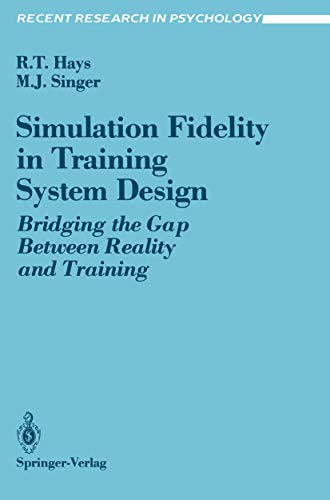
Paperback. Condition: Very Good. No Jacket. May have limited writing in cover pages. Pages are unmarked. ~ ThriftBooks: Read More, Spend Less.
-

Condition: Good. Most items will be dispatched the same or the next working day. A copy that has been read but remains in clean condition. All of the pages are intact and the cover is intact and the spine may show signs of wear. The book may have minor markings which are not specifically mentioned.
-
Paperback. Condition: UsedGood. Paperback; Recent Research in Psychology; light fading, light shelf wear to exterior; previous owner's stampings on the front end page and back of title page; otherwise in good condition with clean text and tight binding.
-
Simulation fidelity in training system design : bridging the gap between reality and training. Recent research in psychology
Book 33 of 61: Recent Research in PsychologyLanguage: English
Published by New York : Springer Verlag, 1989
ISBN 10: 3540968466 ISBN 13: 9783540968467
Seller: books4less (Versandantiquariat Petra Gros GmbH & Co. KG), Welling, Germany
Seller rating 5 out of 5 stars

Broschiert. Condition: Gut. XX, 415 Seiten : 18 graph. Darst. Der Erhaltungszustand des hier angebotenen Werks ist trotz seiner Bibliotheksnutzung sehr sauber. Es befindet sich neben dem Rückenschild lediglich ein Bibliotheksstempel im Buch; ordnungsgemäß entwidmet. In ENGLISCHER Sprache. Sprache: Englisch Gewicht in Gramm: 580.
-
-
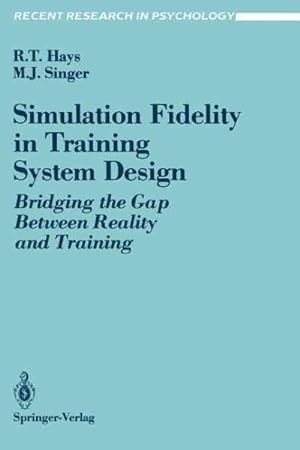
Simulation Fidelity in Training System Design (Paperback)
Book 33 of 61: Recent Research in PsychologyLanguage: English
Published by Springer-Verlag New York Inc., New York, NY, 1988
ISBN 10: 0387968466 ISBN 13: 9780387968469
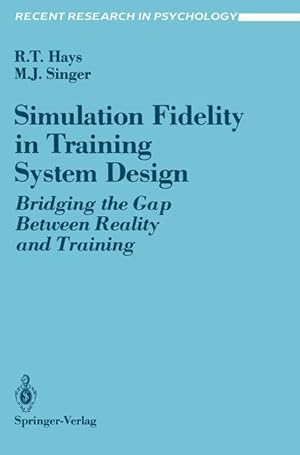
Paperback. Condition: new. Paperback. Business, academia, industry, and the military require well trained personnel to function in highly complex working environments. To reduce high training costs and to improve the effectiveness of training, training system developers often use sophisticated training media such as, simulators, videodisks, and computer-based instruction. The designers of these training media are continually striving to provide maximum training effectiveness at minimum cost. Although literature is available on the implementation and use of specific training media, there is little guidance on a major feature that is central to these media. All of these media present the learner with an interactive simulation of the real world. Effective training system design can be facilitated if the requirements of the real-world task are properly included in training. A conceptual bridge is necessary to link these actual task requirements to the characteristics of the training system. This book provides such a conceptual bridge. The need for improved training is critical in the area of equipment operation, maintenance, and decision making tasks. For example, the importance of improved operator training in the nuclear power industry has become paramount since the Three Mile Island accident and the more serious accident at the Chernobyl reactor in the U. S. S. R. Technology, such as the availability and power of computers,offers a wider variety of training options, but requires additional training system design decisions. Business, academia, industry, and the military require well trained personnel to function in highly complex working environments. To reduce high training costs and to improve the effectiveness of training, training system developers often use sophisticated training media such as, simulators, videodisks, and computer-based instruction. Shipping may be from multiple locations in the US or from the UK, depending on stock availability.
-
-
paperback. Condition: New. In shrink wrap. Looks like an interesting title!
-
Simulation Fidelity in Training System Design: Bridging the Gap Between Reality and Training (Recent Research in Psychology)
Book 33 of 61: Recent Research in PsychologySeller: Ria Christie Collections, Uxbridge, United Kingdom
Seller rating 5 out of 5 stars
£ 94.30
£ 11.98 shipping
Ships from United Kingdom to U.S.A.Quantity: Over 20 available
Add to basketCondition: New. In.
-
Condition: New. pp. 436.
-
Paperback. Condition: Brand New. 435 pages. 9.25x6.10x0.99 inches. In Stock.
-

Simulation Fidelity in Training System Design : Bridging the Gap Between Reality and Training
Book 33 of 61: Recent Research in PsychologyLanguage: English
Published by Springer New York, Springer US, 1988
ISBN 10: 0387968466 ISBN 13: 9780387968469
Taschenbuch. Condition: Neu. Druck auf Anfrage Neuware - Printed after ordering - Business, academia, industry, and the military require well trained personnel to function in highly complex working environments. To reduce high training costs and to improve the effectiveness of training, training system developers often use sophisticated training media such as, simulators, videodisks, and computer-based instruction. The designers of these training media are continually striving to provide maximum training effectiveness at minimum cost. Although literature is available on the implementation and use of specific training media, there is little guidance on a major feature that is central to these media. All of these media present the learner with an interactive simulation of the real world. Effective training system design can be facilitated if the requirements of the real-world task are properly included in training. A conceptual bridge is necessary to link these actual task requirements to the characteristics of the training system. This book provides such a conceptual bridge. The need for improved training is critical in the area of equipment operation, maintenance, and decision making tasks. For example, the importance of improved operator training in the nuclear power industry has become paramount since the Three Mile Island accident and the more serious accident at the Chernobyl reactor in the U. S. S. R. Technology, such as the availability and power of computers,offers a wider variety of training options, but requires additional training system design decisions.
-
Paperback. Condition: Like New. Like New. book.
-
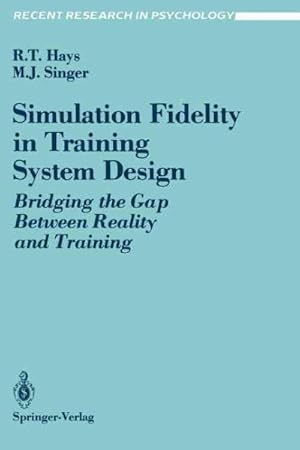
Condition: As New. Unread book in perfect condition.
-
Simulation Fidelity in Training System Design (Paperback)
Book 33 of 61: Recent Research in PsychologyLanguage: English
Published by Springer-Verlag New York Inc., New York, NY, 1988
ISBN 10: 0387968466 ISBN 13: 9780387968469
Paperback. Condition: new. Paperback. Business, academia, industry, and the military require well trained personnel to function in highly complex working environments. To reduce high training costs and to improve the effectiveness of training, training system developers often use sophisticated training media such as, simulators, videodisks, and computer-based instruction. The designers of these training media are continually striving to provide maximum training effectiveness at minimum cost. Although literature is available on the implementation and use of specific training media, there is little guidance on a major feature that is central to these media. All of these media present the learner with an interactive simulation of the real world. Effective training system design can be facilitated if the requirements of the real-world task are properly included in training. A conceptual bridge is necessary to link these actual task requirements to the characteristics of the training system. This book provides such a conceptual bridge. The need for improved training is critical in the area of equipment operation, maintenance, and decision making tasks. For example, the importance of improved operator training in the nuclear power industry has become paramount since the Three Mile Island accident and the more serious accident at the Chernobyl reactor in the U. S. S. R. Technology, such as the availability and power of computers,offers a wider variety of training options, but requires additional training system design decisions. Business, academia, industry, and the military require well trained personnel to function in highly complex working environments. To reduce high training costs and to improve the effectiveness of training, training system developers often use sophisticated training media such as, simulators, videodisks, and computer-based instruction. Shipping may be from our Sydney, NSW warehouse or from our UK or US warehouse, depending on stock availability.
-

Simulation Fidelity in Training System Design
Book 33 of 61: Recent Research in PsychologyLanguage: English
Published by Springer New York Okt 1988, 1988
ISBN 10: 0387968466 ISBN 13: 9780387968469
Seller: BuchWeltWeit Ludwig Meier e.K., Bergisch Gladbach, Germany
Seller rating 5 out of 5 stars
Taschenbuch. Condition: Neu. This item is printed on demand - it takes 3-4 days longer - Neuware -Business, academia, industry, and the military require well trained personnel to function in highly complex working environments. To reduce high training costs and to improve the effectiveness of training, training system developers often use sophisticated training media such as, simulators, videodisks, and computer-based instruction. The designers of these training media are continually striving to provide maximum training effectiveness at minimum cost. Although literature is available on the implementation and use of specific training media, there is little guidance on a major feature that is central to these media. All of these media present the learner with an interactive simulation of the real world. Effective training system design can be facilitated if the requirements of the real-world task are properly included in training. A conceptual bridge is necessary to link these actual task requirements to the characteristics of the training system. This book provides such a conceptual bridge. The need for improved training is critical in the area of equipment operation, maintenance, and decision making tasks. For example, the importance of improved operator training in the nuclear power industry has become paramount since the Three Mile Island accident and the more serious accident at the Chernobyl reactor in the U. S. S. R. Technology, such as the availability and power of computers,offers a wider variety of training options, but requires additional training system design decisions. 436 pp. Englisch.
-
Condition: New. Dieser Artikel ist ein Print on Demand Artikel und wird nach Ihrer Bestellung fuer Sie gedruckt. Business, academia, industry, and the military require well trained personnel to function in highly complex working environments. To reduce high training costs and to improve the effectiveness of training, training system developers often use sophisticated .
-
Condition: New. Print on Demand pp. 436 49:B&W 6.14 x 9.21 in or 234 x 156 mm (Royal 8vo) Perfect Bound on White w/Gloss Lam.
-
Condition: New. PRINT ON DEMAND pp. 436.
-
Taschenbuch. Condition: Neu. Simulation Fidelity in Training System Design | Bridging the Gap Between Reality and Training | Michael J. Singer (u. a.) | Taschenbuch | xx | Englisch | 1988 | Humana | EAN 9780387968469 | Verantwortliche Person für die EU: Springer Verlag GmbH, Tiergartenstr. 17, 69121 Heidelberg, juergen[dot]hartmann[at]springer[dot]com | Anbieter: preigu Print on Demand.
-

Simulation Fidelity in Training System Design
Book 33 of 61: Recent Research in PsychologyLanguage: English
Published by Springer New York, Springer US Okt 1988, 1988
ISBN 10: 0387968466 ISBN 13: 9780387968469
Seller: buchversandmimpf2000, Emtmannsberg, BAYE, Germany
Seller rating 5 out of 5 stars
Taschenbuch. Condition: Neu. This item is printed on demand - Print on Demand Titel. Neuware -Business, academia, industry, and the military require well trained personnel to function in highly complex working environments. To reduce high training costs and to improve the effectiveness of training, training system developers often use sophisticated training media such as, simulators, videodisks, and computer-based instruction. The designers of these training media are continually striving to provide maximum training effectiveness at minimum cost. Although literature is available on the implementation and use of specific training media, there is little guidance on a major feature that is central to these media. All of these media present the learner with an interactive simulation of the real world. Effective training system design can be facilitated if the requirements of the real-world task are properly included in training. A conceptual bridge is necessary to link these actual task requirements to the characteristics of the training system. This book provides such a conceptual bridge. The need for improved training is critical in the area of equipment operation, maintenance, and decision making tasks. For example, the importance of improved operator training in the nuclear power industry has become paramount since the Three Mile Island accident and the more serious accident at the Chernobyl reactor in the U. S. S. R. Technology, such as the availability and power of computers,offers a wider variety of training options, but requires additional training system design decisions.Springer Verlag GmbH, Tiergartenstr. 17, 69121 Heidelberg 436 pp. Englisch.


