

Order Total (1 Item Items):
Shipping Destination:

Rethinking Infrastructure Design Multi Use by Maksimovi Edo (7 results)
Skip to main search results
Search filters
Product Type
- All Product Types
- Books (7)
- Magazines & Periodicals (No further results match this refinement)
- Comics (No further results match this refinement)
- Sheet Music (No further results match this refinement)
- Art, Prints & Posters (No further results match this refinement)
- Photographs (No further results match this refinement)
- Maps (No further results match this refinement)
- Manuscripts & Paper Collectibles (No further results match this refinement)
Condition Learn more
- New (7)
- As New, Fine or Near Fine (No further results match this refinement)
- Very Good or Good (No further results match this refinement)
- Fair or Poor (No further results match this refinement)
- As Described (No further results match this refinement)
Binding
- All Bindings
- Hardcover (No further results match this refinement)
- Softcover (7)
Collectible Attributes
- First Edition (No further results match this refinement)
- Signed (No further results match this refinement)
- Dust Jacket (No further results match this refinement)
- Seller-Supplied Images (4)
- Not Print on Demand (3)
Language (1)
Price
- Any Price
- Under £ 20 (No further results match this refinement)
- £ 20 to £ 35 (No further results match this refinement)
- Over £ 35
Free Shipping
- Free Shipping to U.S.A. (No further results match this refinement)
Seller Location
Seller Rating
-
-
Rethinking Infrastructure Design for Multi-Use Water Services
Book 23 of 99: SpringerBriefs in Environmental ScienceLanguage: English
Published by Springer International Publishing, Springer, 2014
ISBN 10: 3319062743 ISBN 13: 9783319062747
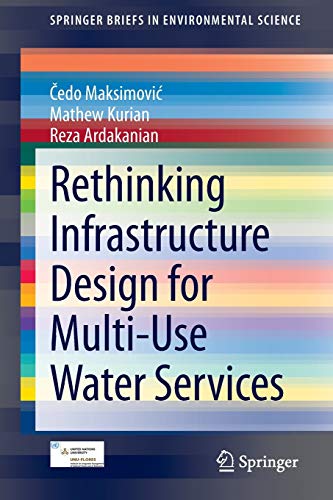
Taschenbuch. Condition: Neu. Druck auf Anfrage Neuware - Printed after ordering - As we approach a historic tipping point in the global trend toward urbanisation - within two decades urban dwellers will increase from 49% to 60% of the planet's population - this book identifies and addresses a critical problem: water. The editors show how cities can shift from being water consumers to resource managers, applying urban water management principles to ensure access to water and sanitation infrastructure and services; manage rainwater, wastewater, storm water drainage, and runoff pollution; control waterborne diseases and epidemics; and reduce the risk of such water-related hazards as floods, droughts and landslides.The book explores the Multiple-Use Water Services (MUS) paradigm, offering a section on the MUS approach and a means of calculating the value of MUS systems, as well as tools and resources to support decision-making. Case studies illustrate MUS in selected urban and rural contexts. Each case study breaks out the challenges, policy framework, benefits, benchmarks, lessons learned (success and failures) and potential next steps.The contributors consider the main options for applying the Multiple-Use Water Services (MUS) paradigm, breaking down its components and offering cost-benefit analyses along with challenges and considerations for both the short and long term. Also discussed are methods by which mutual interactions of water infrastructure and vegetated areas are taken into account in the synergy of spatial planning and optimised modelling of ecosystems' performance indicators. This method of planning should make future developments cheaper to build; their users will pay lower utility bills for water, energy and heating. These developments will be more pleasant to live in and property value would likely be higher.The brief includes a section on the MUS approach and a means to calculate the value of MUS systems, as well as provides tools and resources to support decision-making. Case studies are included to illustrate MUS in selected urban and rural contexts. Each case study breaks out the challenges, policy framework, benefits, benchmarks, lessons learned (success and failures) and potential next steps.
-
Taschenbuch. Condition: Neu. Rethinking Infrastructure Design for Multi-Use Water Services | ¿Edo Maksimovi¿ (u. a.) | Taschenbuch | SpringerBriefs in Environmental Science | xi | Englisch | 2014 | Springer | EAN 9783319062747 | Verantwortliche Person für die EU: Springer Verlag GmbH, Tiergartenstr. 17, 69121 Heidelberg, juergen[dot]hartmann[at]springer[dot]com | Anbieter: preigu.
-
Condition: New. Print on Demand.
-
Rethinking Infrastructure Design for Multi-Use Water Services
Book 23 of 99: SpringerBriefs in Environmental ScienceLanguage: English
Published by Springer International Publishing Sep 2014, 2014
ISBN 10: 3319062743 ISBN 13: 9783319062747
Seller: BuchWeltWeit Ludwig Meier e.K., Bergisch Gladbach, Germany
Seller rating 5 out of 5 stars

Taschenbuch. Condition: Neu. This item is printed on demand - it takes 3-4 days longer - Neuware -As we approach a historic tipping point in the global trend toward urbanisation - within two decades urban dwellers will increase from 49% to 60% of the planet's population - this book identifies and addresses a critical problem: water. The editors show how cities can shift from being water consumers to resource managers, applying urban water management principles to ensure access to water and sanitation infrastructure and services; manage rainwater, wastewater, storm water drainage, and runoff pollution; control waterborne diseases and epidemics; and reduce the risk of such water-related hazards as floods, droughts and landslides.The book explores the Multiple-Use Water Services (MUS) paradigm, offering a section on the MUS approach and a means of calculating the value of MUS systems, as well as tools and resources to support decision-making. Case studies illustrate MUS in selected urban and rural contexts. Each case study breaks out the challenges, policy framework, benefits, benchmarks, lessons learned (success and failures) and potential next steps.The contributors consider the main options for applying the Multiple-Use Water Services (MUS) paradigm, breaking down its components and offering cost-benefit analyses along with challenges and considerations for both the short and long term. Also discussed are methods by which mutual interactions of water infrastructure and vegetated areas are taken into account in the synergy of spatial planning and optimised modelling of ecosystems' performance indicators. This method of planning should make future developments cheaper to build; their users will pay lower utility bills for water, energy and heating. These developments will be more pleasant to live in and property value would likely be higher.The brief includes a section on the MUS approach and a means to calculate the value of MUS systems, as well as provides tools and resources to support decision-making. Case studies are included to illustrate MUS in selected urban and rural contexts. Each case study breaks out the challenges, policy framework, benefits, benchmarks, lessons learned (success and failures) and potential next steps. 104 pp. Englisch.
-
Condition: New. PRINT ON DEMAND.
-

Rethinking Infrastructure Design for Multi-Use Water Services
Book 23 of 99: SpringerBriefs in Environmental ScienceLanguage: English
Published by Springer, Palgrave Macmillan Sep 2014, 2014
ISBN 10: 3319062743 ISBN 13: 9783319062747
Seller: buchversandmimpf2000, Emtmannsberg, BAYE, Germany
Seller rating 5 out of 5 stars
Taschenbuch. Condition: Neu. This item is printed on demand - Print on Demand Titel. Neuware -As we approach a historic tipping point in the global trend toward urbanisation ¿ within two decades urban dwellers will increase from 49% to 60% of the planet¿s population ¿ this book identifies and addresses a critical problem: water. The editors show how cities can shift from being water consumers to resource managers, applying urban water management principles to ensure access to water and sanitation infrastructure and services; manage rainwater, wastewater, storm water drainage, and runoff pollution; control waterborne diseases and epidemics; and reduce the risk of such water-related hazards as floods, droughts and landslides.The book explores the Multiple-Use Water Services (MUS) paradigm, offering a section on the MUS approach and a means of calculating the value of MUS systems, as well as tools and resources to support decision-making. Case studies illustrate MUS in selected urban and rural contexts. Each case study breaks out the challenges, policy framework, benefits, benchmarks, lessons learned (success and failures) and potential next steps.The contributors consider the main options for applying the Multiple-Use Water Services (MUS) paradigm, breaking down its components and offering cost-benefit analyses along with challenges and considerations for both the short and long term. Also discussed are methods by which mutual interactions of water infrastructure and vegetated areas are taken into account in the synergy of spatial planning and optimised modelling of ecosystems¿ performance indicators. This method of planning should make future developments cheaper to build; their users will pay lower utility bills for water, energy and heating. These developments will be more pleasant to live in and property value would likely be higher.The brief includes a section on the MUS approach and a means to calculate the value of MUS systems, as well as provides tools and resources to support decision-making. Case studies are included to illustrate MUS in selected urban and rural contexts. Each case study breaks out the challenges, policy framework, benefits, benchmarks, lessons learned (success and failures) and potential next steps.Springer-Verlag KG, Sachsenplatz 4-6, 1201 Wien 104 pp. Englisch.


