

Order Total (1 Item Items):
Shipping Destination:

9789811917967 - Privacy Preservation in Iot: Machine Learning Approaches: a Comprehensive Survey and Use Cases Springerbriefs in Computer Science by Qu, Youyang; Gao, Longxiang; Yu... (21 results)
Skip to main search results
Search filters
Product Type
- All Product Types
- Books (21)
- Magazines & Periodicals (No further results match this refinement)
- Comics (No further results match this refinement)
- Sheet Music (No further results match this refinement)
- Art, Prints & Posters (No further results match this refinement)
- Photographs (No further results match this refinement)
- Maps (No further results match this refinement)
- Manuscripts & Paper Collectibles (No further results match this refinement)
Condition Learn more
- New (18)
- As New, Fine or Near Fine (2)
- Very Good or Good (No further results match this refinement)
- Fair or Poor (No further results match this refinement)
- As Described (1)
Binding
- All Bindings
- Hardcover (No further results match this refinement)
- Softcover (21)
Collectible Attributes
- First Edition (2)
- Signed (No further results match this refinement)
- Dust Jacket (No further results match this refinement)
- Seller-Supplied Images (9)
- Not Print on Demand (15)
Language (1)
Free Shipping
Seller Location
Seller Rating
-

-
Privacy Preservation in IoT: Machine Learning Approaches (Paperback)
Book 8 of 83: SpringerBriefs in Computer ScienceLanguage: English
Published by Springer Verlag, Singapore, Singapore, 2022
ISBN 10: 9811917965 ISBN 13: 9789811917967
First Edition
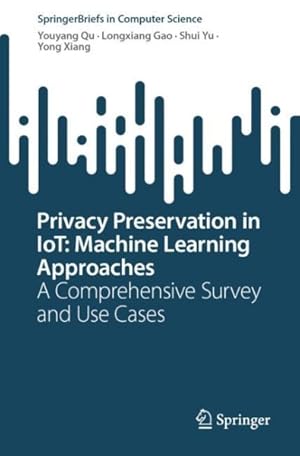
Paperback. Condition: new. Paperback. This book aims to sort out the clear logic of the development of machine learning-driven privacy preservation in IoTs, including the advantages and disadvantages, as well as the future directions in this under-explored domain. In big data era, an increasingly massive volume of data is generated and transmitted in Internet of Things (IoTs), which poses great threats to privacy protection. Motivated by this, an emerging research topic, machine learning-driven privacy preservation, is fast booming to address various and diverse demands of IoTs. However, there is no existing literature discussion on this topic in a systematically manner.The issues of existing privacy protection methods (differential privacy, clustering, anonymity, etc.) for IoTs, such as low data utility, high communication overload, and unbalanced trade-off, are identified to the necessity of machine learning-driven privacy preservation. Besides, the leading and emerging attacks pose further threats to privacy protection in this scenario. To mitigate the negative impact, machine learning-driven privacy preservation methods for IoTs are discussed in detail on both the advantages and flaws, which is followed by potentially promising research directions.Readers may trace timely contributions on machine learning-driven privacy preservation in IoTs. The advances cover different applications, such as cyber-physical systems, fog computing, and location-based services. This book will be of interest to forthcoming scientists, policymakers, researchers, and postgraduates. This book aims to sort out the clear logic of the development of machine learning-driven privacy preservation in IoTs, including the advantages and disadvantages, as well as the future directions in this under-explored domain. Shipping may be from multiple locations in the US or from the UK, depending on stock availability.
-
-
Condition: As New. Unread book in perfect condition.
-

Privacy Preservation in Iot - Machine Learning Approaches : A Comprehensive Survey and Use Cases
Book 8 of 83: SpringerBriefs in Computer ScienceSeller: GreatBookPricesUK, Woodford Green, United Kingdom
Seller rating 5 out of 5 stars

Condition: New.
-
Privacy Preservation in IoT: Machine Learning Approaches: A Comprehensive Survey and Use Cases (SpringerBriefs in Computer Science)
Book 8 of 83: SpringerBriefs in Computer ScienceSeller: Ria Christie Collections, Uxbridge, United Kingdom
Seller rating 5 out of 5 stars
£ 50.43
£ 11.98 shipping
Ships from United Kingdom to U.S.A.Quantity: Over 20 available
Add to basketCondition: New. In.
-
-
Condition: New. 1st ed. 2022 edition NO-PA16APR2015-KAP.
-
Privacy Preservation In Iot: Machine Lea
Book 8 of 83: SpringerBriefs in Computer ScienceSeller: Kennys Bookshop and Art Galleries Ltd., Galway, GY, Ireland
Seller rating 5 out of 5 stars
Condition: New.
-

Privacy Preservation in Iot - Machine Learning Approaches : A Comprehensive Survey and Use Cases
Book 8 of 83: SpringerBriefs in Computer ScienceSeller: GreatBookPricesUK, Woodford Green, United Kingdom
Seller rating 5 out of 5 stars
Condition: As New. Unread book in perfect condition.
-
-
Privacy Preservation in IoT: Machine Learning Approaches (Paperback)
Book 8 of 83: SpringerBriefs in Computer ScienceLanguage: English
Published by Springer Verlag, Singapore, Singapore, 2022
ISBN 10: 9811917965 ISBN 13: 9789811917967
First Edition
Paperback. Condition: new. Paperback. This book aims to sort out the clear logic of the development of machine learning-driven privacy preservation in IoTs, including the advantages and disadvantages, as well as the future directions in this under-explored domain. In big data era, an increasingly massive volume of data is generated and transmitted in Internet of Things (IoTs), which poses great threats to privacy protection. Motivated by this, an emerging research topic, machine learning-driven privacy preservation, is fast booming to address various and diverse demands of IoTs. However, there is no existing literature discussion on this topic in a systematically manner.The issues of existing privacy protection methods (differential privacy, clustering, anonymity, etc.) for IoTs, such as low data utility, high communication overload, and unbalanced trade-off, are identified to the necessity of machine learning-driven privacy preservation. Besides, the leading and emerging attacks pose further threats to privacy protection in this scenario. To mitigate the negative impact, machine learning-driven privacy preservation methods for IoTs are discussed in detail on both the advantages and flaws, which is followed by potentially promising research directions.Readers may trace timely contributions on machine learning-driven privacy preservation in IoTs. The advances cover different applications, such as cyber-physical systems, fog computing, and location-based services. This book will be of interest to forthcoming scientists, policymakers, researchers, and postgraduates. This book aims to sort out the clear logic of the development of machine learning-driven privacy preservation in IoTs, including the advantages and disadvantages, as well as the future directions in this under-explored domain. Shipping may be from our Sydney, NSW warehouse or from our UK or US warehouse, depending on stock availability.
-
Taschenbuch. Condition: Neu. Privacy Preservation in IoT: Machine Learning Approaches | A Comprehensive Survey and Use Cases | Youyang Qu (u. a.) | Taschenbuch | xi | Englisch | 2022 | Springer | EAN 9789811917967 | Verantwortliche Person für die EU: Springer Verlag GmbH, Tiergartenstr. 17, 69121 Heidelberg, juergen[dot]hartmann[at]springer[dot]com | Anbieter: preigu.
-

Taschenbuch. Condition: Neu. Druck auf Anfrage Neuware - Printed after ordering - This book aims to sort out the clear logic of the development of machine learning-driven privacy preservation in IoTs, including the advantages and disadvantages, as well as the future directions in this under-explored domain. In big data era, an increasingly massive volume of data is generated and transmitted in Internet of Things (IoTs), which poses great threats to privacy protection. Motivated by this, an emerging research topic, machine learning-driven privacy preservation, is fast booming to address various and diverse demands of IoTs. However, there is no existing literature discussion on this topic in a systematically manner.The issues of existing privacy protection methods (differential privacy, clustering, anonymity, etc.) for IoTs, such as low data utility, high communication overload, and unbalanced trade-off, are identified to the necessity of machine learning-driven privacy preservation. Besides, the leading and emerging attacks pose further threats to privacy protection in this scenario. To mitigate the negative impact, machine learning-driven privacy preservation methods for IoTs are discussed in detail on both the advantages and flaws, which is followed by potentially promising research directions.Readers may trace timely contributions on machine learning-driven privacy preservation in IoTs. The advances cover different applications, such as cyber-physical systems, fog computing, and location-based services. This book will be of interest to forthcoming scientists, policymakers, researchers, and postgraduates.
-
Privacy Preservation in IoT: Machine Learning Approaches : A Comprehensive Survey and Use Cases
Book 8 of 83: SpringerBriefs in Computer ScienceLanguage: English
Published by Springer Nature Singapore, 2022
ISBN 10: 9811917965 ISBN 13: 9789811917967
Condition: Hervorragend. Zustand: Hervorragend | Sprache: Englisch | Produktart: Bücher | This book aims to sort out the clear logic of the development of machine learning-driven privacy preservation in IoTs, including the advantages and disadvantages, as well as the future directions in this under-explored domain. In big data era, an increasingly massive volume of data is generated and transmitted in Internet of Things (IoTs), which poses great threats to privacy protection. Motivated by this, an emerging research topic, machine learning-driven privacy preservation, is fast booming to address various and diverse demands of IoTs. However, there is no existing literature discussion on this topic in a systematically manner.The issues of existing privacy protection methods (differential privacy, clustering, anonymity, etc.) for IoTs, such as low data utility, high communication overload, and unbalanced trade-off, are identified to the necessity of machine learning-driven privacy preservation. Besides, the leading and emerging attacks pose further threats to privacy protection in this scenario. To mitigate the negative impact, machine learning-driven privacy preservation methods for IoTs are discussed in detail on both the advantages and flaws, which is followed by potentially promising research directions.Readers may trace timely contributions on machine learning-driven privacy preservation in IoTs. The advances cover different applications, such as cyber-physical systems, fog computing, and location-based services. This book will be of interest to forthcoming scientists, policymakers, researchers, and postgraduates.
-
Privacy Preservation in Iot - Machine Learning Approaches: A Comprehensive Survey and Use Cases
Book 8 of 83: SpringerBriefs in Computer ScienceLanguage: English
Published by Springer-Nature New York Inc, 2022
ISBN 10: 9811917965 ISBN 13: 9789811917967
Paperback. Condition: Brand New. 130 pages. 9.25x6.10x0.28 inches. In Stock. This item is printed on demand.
-
-

Privacy Preservation in IoT: Machine Learning Approaches
Book 8 of 83: SpringerBriefs in Computer ScienceLanguage: English
Published by Springer Nature Singapore Apr 2022, 2022
ISBN 10: 9811917965 ISBN 13: 9789811917967
Seller: BuchWeltWeit Ludwig Meier e.K., Bergisch Gladbach, Germany
Seller rating 5 out of 5 stars
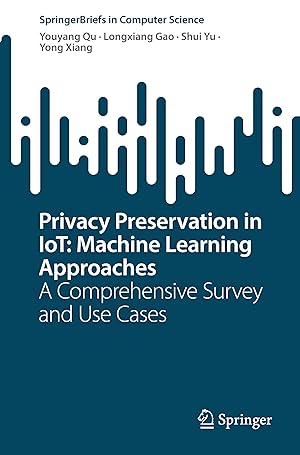
Taschenbuch. Condition: Neu. This item is printed on demand - it takes 3-4 days longer - Neuware -This book aims to sort out the clear logic of the development of machine learning-driven privacy preservation in IoTs, including the advantages and disadvantages, as well as the future directions in this under-explored domain. In big data era, an increasingly massive volume of data is generated and transmitted in Internet of Things (IoTs), which poses great threats to privacy protection. Motivated by this, an emerging research topic, machine learning-driven privacy preservation, is fast booming to address various and diverse demands of IoTs. However, there is no existing literature discussion on this topic in a systematically manner.The issues of existing privacy protection methods (differential privacy, clustering, anonymity, etc.) for IoTs, such as low data utility, high communication overload, and unbalanced trade-off, are identified to the necessity of machine learning-driven privacy preservation. Besides, the leading and emerging attacks pose further threats to privacy protection in this scenario. To mitigate the negative impact, machine learning-driven privacy preservation methods for IoTs are discussed in detail on both the advantages and flaws, which is followed by potentially promising research directions.Readers may trace timely contributions on machine learning-driven privacy preservation in IoTs. The advances cover different applications, such as cyber-physical systems, fog computing, and location-based services. This book will be of interest to forthcoming scientists, policymakers, researchers, and postgraduates. 132 pp. Englisch.
-
-
Privacy Preservation in IoT: Machine Learning Approaches
Book 8 of 83: SpringerBriefs in Computer ScienceLanguage: English
Published by Springer, Berlin|Springer Nature Singapore|Springer, 2022
ISBN 10: 9811917965 ISBN 13: 9789811917967
Condition: New. Dieser Artikel ist ein Print on Demand Artikel und wird nach Ihrer Bestellung fuer Sie gedruckt. This book aims to sort out the clear logic of the development of machine learning-driven privacy preservation in IoTs, including the advantages and disadvantages, as well as the future directions in this under-explored domain. In big data era, an increas.
-

Privacy Preservation in IoT: Machine Learning Approaches
Book 8 of 83: SpringerBriefs in Computer ScienceLanguage: English
Published by Springer, Springer Apr 2022, 2022
ISBN 10: 9811917965 ISBN 13: 9789811917967
Seller: buchversandmimpf2000, Emtmannsberg, BAYE, Germany
Seller rating 5 out of 5 stars
Taschenbuch. Condition: Neu. This item is printed on demand - Print on Demand Titel. Neuware -This book aims to sort out the clear logic of the development of machine learning-driven privacy preservation in IoTs, including the advantages and disadvantages, as well as the future directions in this under-explored domain. In big data era, an increasingly massive volume of data is generated and transmitted in Internet of Things (IoTs), which poses great threats to privacy protection. Motivated by this, an emerging research topic, machine learning-driven privacy preservation, is fast booming to address various and diverse demands of IoTs. However, there is no existing literature discussion on this topic in a systematically manner.The issues of existing privacy protection methods (differential privacy, clustering, anonymity, etc.) for IoTs, such as low data utility, high communication overload, and unbalanced trade-off, are identified to the necessity of machine learning-driven privacy preservation. Besides, the leading and emerging attacks pose further threats to privacy protection in this scenario. To mitigate the negative impact, machine learning-driven privacy preservation methods for IoTs are discussed in detail on both the advantages and flaws, which is followed by potentially promising research directions.Readers may trace timely contributions on machine learning-driven privacy preservation in IoTs. The advances cover different applications, such as cyber-physical systems, fog computing, and location-based services. This book will be of interest to forthcoming scientists, policymakers, researchers, and postgraduates.Springer-Verlag KG, Sachsenplatz 4-6, 1201 Wien 132 pp. Englisch.


