

Order Total (1 Item Items):
Shipping Destination:

9783110184525 - Markedness and Language Change: the Romani Sample: 32 Empirical Approaches to Language Typology Ealt , 32 by El?ik (20 results)
Skip to main search results
Search filters
Product Type
- All Product Types
- Books (20)
- Magazines & Periodicals (No further results match this refinement)
- Comics (No further results match this refinement)
- Sheet Music (No further results match this refinement)
- Art, Prints & Posters (No further results match this refinement)
- Photographs (No further results match this refinement)
- Maps (No further results match this refinement)
- Manuscripts & Paper Collectibles (No further results match this refinement)
Condition Learn more
- New (18)
- As New, Fine or Near Fine (2)
- Very Good or Good (No further results match this refinement)
- Fair or Poor (No further results match this refinement)
- As Described (No further results match this refinement)
Binding
Collectible Attributes
- First Edition (No further results match this refinement)
- Signed (No further results match this refinement)
- Dust Jacket (No further results match this refinement)
- Seller-Supplied Images (10)
- Not Print on Demand (15)
Language (1)
Price
- Any Price
- Under £ 20 (No further results match this refinement)
- £ 20 to £ 35 (No further results match this refinement)
- Over £ 35
Free Shipping
Seller Location
Seller Rating
-

Markedness And Language Change: The Romani Sample (Empirical Approaches to Language Typology)
Seller: Books From California, Simi Valley, CA, U.S.A.
Seller rating 4 out of 5 stars

Hardcover. Condition: New.
-

Condition: New.
-
Markedness and Language Change: The Romani Sample (Empirical Approaches to Language Typology [EALT], 32)
Seller: Ria Christie Collections, Uxbridge, United Kingdom
Seller rating 5 out of 5 stars

£ 181
£ 11.98 shipping
Ships from United Kingdom to U.S.A.Quantity: Over 20 available
Add to basketCondition: New. In.
-

Markedness And Language Change : The Romani Sample
Seller: GreatBookPricesUK, Woodford Green, United Kingdom
Seller rating 5 out of 5 stars
£ 180.99
£ 15 shipping
Ships from United Kingdom to U.S.A.Quantity: Over 20 available
Add to basketCondition: New.
-

Condition: As New. Unread book in perfect condition.
-
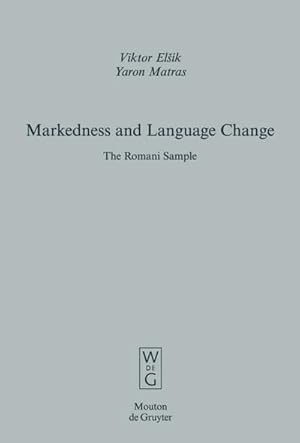
Buch. Condition: Neu. Druck auf Anfrage Neuware - Printed after ordering - 'Markedness' is a central notion in linguistic theory. This book is the first to provide a comprehensive survey of markedness relations across various grammatical categories, in a sample of closely-related speech varieties. It is based on a sample of over 100 dialects of Romani, collected and processed via the Romani Morpho-Syntax (RMS) Database - a comparative grammatical outline in electronic form, constructed by the authors between 2000-2004. Romani dialects provide an exciting sample of language change phenomena: they are oral languages, which have been separated and dispersed from some six centuries, and are strongly shaped by the influence of diverse contact languages. The book takes a typological approach to markedness, viewing it as a hierarchy among values that is conditioned by conceptual and cognitive universals. But it introduces a functional-pragmatic notion of markedness, as a grammaticalised strategy employed in order to priositise information. In what is referred to as 'dynamic', such prioritisation is influenced by an interplay of factors: the values within a category and the conceptual notions that they represent, the grammatical structure onto which the category values are mapped, and the kind of strategy that is applied in order to prioritise certain value. Consequently, the book contains a thorough survey of some 20 categories (e.g Person, Number, Gender, and so on) and their formal representation in various grammatical structures across the sample. The various accepted criteria for markedness (e.g. Complexity, Differentiation, Erosion, and so on) are examined systematically in relation to the values of each and every category, for each relevant structure. The outcome is a novel picture of how different markedness criteria may cluster for certain categories, giving a concrete reality to the hitherto rather vague notion of markedness. Borrowing and its relation to markedness is also examined, offering new insights into the motivations behind contact-induced change.
-

Markedness And Language Change : The Romani Sample
Seller: GreatBookPricesUK, Woodford Green, United Kingdom
Seller rating 5 out of 5 stars
£ 210.36
£ 15 shipping
Ships from United Kingdom to U.S.A.Quantity: Over 20 available
Add to basketCondition: As New. Unread book in perfect condition.
-
Markedness and Language Change
Language: English
Published by Walter de Gruyter, Incorporated, 2006
ISBN 10: 3110184524 ISBN 13: 9783110184525
Condition: New. pp. xxiii + 475 4 Figures, Illus., 2 Maps.
-
Hardcover. Condition: Brand New. 475 pages. 9.75x6.75x1.25 inches. In Stock.
-
Markedness and Language Change
Language: English
Published by Walter de Gruyter, Incorporated, 2006
ISBN 10: 3110184524 ISBN 13: 9783110184525
Condition: New. pp. xxiii + 475, 2 Maps.
-
Condition: new.
-
Markedness and Language Change: The Romani Sample
Seller: Kennys Bookshop and Art Galleries Ltd., Galway, GY, Ireland
Seller rating 5 out of 5 stars
Condition: New. 2006. Hardcover. . . . . .
-

Hardback. Condition: New. 'Markedness' is a central notion in linguistic theory. This book is the first to provide a comprehensive survey of markedness relations across various grammatical categories, in a sample of closely-related speech varieties. It is based on a sample of over 100 dialects of Romani, collected and processed via the Romani Morpho-Syntax (RMS) Database - a comparative grammatical outline in electronic form, constructed by the authors between 2000-2004. Romani dialects provide an exciting sample of language change phenomena: they are oral languages, which have been separated and dispersed from some six centuries, and are strongly shaped by the influence of diverse contact languages. The book takes a typological approach to markedness, viewing it as a hierarchy among values that is conditioned by conceptual and cognitive universals. But it introduces a functional-pragmatic notion of markedness, as a grammaticalised strategy employed in order to priositise information. In what is referred to as 'dynamic', such prioritisation is influenced by an interplay of factors: the values within a category and the conceptual notions that they represent, the grammatical structure onto which the category values are mapped, and the kind of strategy that is applied in order to prioritise certain value. Consequently, the book contains a thorough survey of some 20 categories (e.g Person, Number, Gender, and so on) and their formal representation in various grammatical structures across the sample. The various accepted criteria for markedness (e.g. Complexity, Differentiation, Erosion, and so on) are examined systematically in relation to the values of each and every category, for each relevant structure. The outcome is a novel picture of how different markedness criteria may cluster for certain categories, giving a concrete reality to the hitherto rather vague notion of markedness. Borrowing and its relation to markedness is also examined, offering new insights into the motivations behind contact-induced change.
-

Hardback. Condition: New. 'Markedness' is a central notion in linguistic theory. This book is the first to provide a comprehensive survey of markedness relations across various grammatical categories, in a sample of closely-related speech varieties. It is based on a sample of over 100 dialects of Romani, collected and processed via the Romani Morpho-Syntax (RMS) Database - a comparative grammatical outline in electronic form, constructed by the authors between 2000-2004. Romani dialects provide an exciting sample of language change phenomena: they are oral languages, which have been separated and dispersed from some six centuries, and are strongly shaped by the influence of diverse contact languages. The book takes a typological approach to markedness, viewing it as a hierarchy among values that is conditioned by conceptual and cognitive universals. But it introduces a functional-pragmatic notion of markedness, as a grammaticalised strategy employed in order to priositise information. In what is referred to as 'dynamic', such prioritisation is influenced by an interplay of factors: the values within a category and the conceptual notions that they represent, the grammatical structure onto which the category values are mapped, and the kind of strategy that is applied in order to prioritise certain value. Consequently, the book contains a thorough survey of some 20 categories (e.g Person, Number, Gender, and so on) and their formal representation in various grammatical structures across the sample. The various accepted criteria for markedness (e.g. Complexity, Differentiation, Erosion, and so on) are examined systematically in relation to the values of each and every category, for each relevant structure. The outcome is a novel picture of how different markedness criteria may cluster for certain categories, giving a concrete reality to the hitherto rather vague notion of markedness. Borrowing and its relation to markedness is also examined, offering new insights into the motivations behind contact-induced change.
-
Condition: New. 2006. Hardcover. . . . . . Books ship from the US and Ireland.
-

Hardcover. Condition: New. Dieser Artikel ist ein Print on Demand Artikel und wird nach Ihrer Bestellung fuer Sie gedruckt. Viktor Elsik ist Lehrbeauftragter an der Karls-Universitaet Prag, Tschechische Republik. Yaron Matras ist Professor fuer.
-
HRD. Condition: New. New Book. Shipped from UK. THIS BOOK IS PRINTED ON DEMAND. Established seller since 2000.
-
Markedness and Language Change
Seller: PBShop.store UK, Fairford, GLOS, United Kingdom
Seller rating 5 out of 5 stars
£ 184.98
£ 5.87 shipping
Ships from United Kingdom to U.S.A.Quantity: Over 20 available
Add to basketHRD. Condition: New. New Book. Delivered from our UK warehouse in 4 to 14 business days. THIS BOOK IS PRINTED ON DEMAND. Established seller since 2000.
-

Buch. Condition: Neu. Markedness and Language Change | The Romani Sample | Yaron Matras (u. a.) | Buch | XXIII | Englisch | 2006 | De Gruyter Mouton | EAN 9783110184525 | Verantwortliche Person für die EU: Walter de Gruyter GmbH, De Gruyter GmbH, Genthiner Str. 13, 10785 Berlin, productsafety[at]degruyterbrill[dot]com | Anbieter: preigu Print on Demand.
-

Markedness and Language Change
Language: English
Published by De Gruyter Mouton, De Gruyter Mouton Feb 2006, 2006
ISBN 10: 3110184524 ISBN 13: 9783110184525
Seller: BuchWeltWeit Ludwig Meier e.K., Bergisch Gladbach, Germany
Seller rating 5 out of 5 stars
Buch. Condition: Neu. This item is printed on demand - it takes 3-4 days longer - Neuware - 'Markedness' is a central notion in linguistic theory. This book is the first to provide a comprehensive survey of markedness relations across various grammatical categories, in a sample of closely-related speech varieties. It is based on a sample of over 100 dialects of Romani, collected and processed via the Romani Morpho-Syntax (RMS) Database - a comparative grammatical outline in electronic form, constructed by the authors between 2000-2004. Romani dialects provide an exciting sample of language change phenomena: they are oral languages, which have been separated and dispersed from some six centuries, and are strongly shaped by the influence of diverse contact languages. The book takes a typological approach to markedness, viewing it as a hierarchy among values that is conditioned by conceptual and cognitive universals. But it introduces a functional-pragmatic notion of markedness, as a grammaticalised strategy employed in order to priositise information. In what is referred to as 'dynamic', such prioritisation is influenced by an interplay of factors: the values within a category and the conceptual notions that they represent, the grammatical structure onto which the category values are mapped, and the kind of strategy that is applied in order to prioritise certain value. Consequently, the book contains a thorough survey of some 20 categories (e.g Person, Number, Gender, and so on) and their formal representation in various grammatical structures across the sample. The various accepted criteria for markedness (e.g. Complexity, Differentiation, Erosion, and so on) are examined systematically in relation to the values of each and every category, for each relevant structure. The outcome is a novel picture of how different markedness criteria may cluster for certain categories, giving a concrete reality to the hitherto rather vague notion of markedness. Borrowing and its relation to markedness is also examined, offering new insights into the motivations behind contact-induced change. 500 pp. Englisch.

