

Order Total (1 Item Items):
Shipping Destination:

9781484255391 - Database Design and Relational Theory: Normal Forms and All That Jazz by Date, C J (27 results)
Skip to main search results
Search filters
Product Type
- All Product Types
- Books (27)
- Magazines & Periodicals (No further results match this refinement)
- Comics (No further results match this refinement)
- Sheet Music (No further results match this refinement)
- Art, Prints & Posters (No further results match this refinement)
- Photographs (No further results match this refinement)
- Maps (No further results match this refinement)
- Manuscripts & Paper Collectibles (No further results match this refinement)
Condition Learn more
- New (22)
- As New, Fine or Near Fine (3)
- Very Good or Good (2)
- Fair or Poor (No further results match this refinement)
- As Described (No further results match this refinement)
Binding
- All Bindings
- Hardcover (No further results match this refinement)
- Softcover (27)
Collectible Attributes
- First Edition (No further results match this refinement)
- Signed (No further results match this refinement)
- Dust Jacket (No further results match this refinement)
- Seller-Supplied Images (14)
- Not Print on Demand (21)
Language (1)
Free Shipping
Seller Location
Seller Rating
-

paperback. Condition: Good. Connecting readers with great books since 1972! Used textbooks may not include companion materials such as access codes, etc. May have some wear or writing/highlighting. We ship orders daily and Customer Service is our top priority!
-

-
Condition: New. Brand New! Not Overstocks or Low Quality Book Club Editions! Direct From the Publisher! We're not a giant, faceless warehouse organization! We're a small town bookstore that loves books and loves it's customers! Buy from Lakeside Books!
-
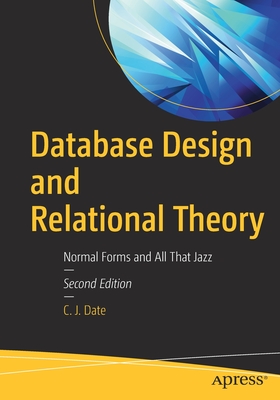
Paperback or Softback. Condition: New. Database Design and Relational Theory: Normal Forms and All That Jazz. Book.
-

Condition: As New. Unread book in perfect condition.
-

Paperback. Condition: New. Second Edition. Create database designs that scale, meet business requirements, and inherently work toward keeping your data structured and usable in the face of changing business models and software systems.This book is about database design theory. Design theory is the scientific foundation for database design, just as the relational model is the scientific foundation for database technology in general. Databases lie at the heart of so much of what we do in the computing world that negative impacts of poor design can be extraordinarily widespread. This second edition includes greatly expanded coverage of exotic and little understood normal forms such as: essential tuple normal form (ETNF), redundancy free normal form (RFNF), superkey normal form (SKNF), sixth normal form (6NF), and domain key normal form (DKNF). Also included are new appendixes, including one that provides an in-depth look into the crucial notion of data consistency.Sequencing of topics has been improved, and many explanations and examples have been rewritten and clarified based upon the author's teaching of the content in instructor-led courses. This book aims to be different from other books on design by bridging the gap between the theory of design and the practice of design. The book explains theory in a way that practitioners should be able to understand, and it explains why that theory is of considerable practical importance. Reading this book provides you with an important theoretical grounding on which to do the practical work of database design. Reading the book also helps you in going to and understanding the more academic texts as you build your base of knowledge and expertise. Anyone with a professional interest in database design can benefit from using this book as a stepping-stone toward a more rigorous design approach and more lasting database models.What You Will LearnUnderstand what design theory is and is notBe aware of the two different goals of normalizationKnow which normal forms are truly significant Apply design theory in practice Be familiar with techniques for dealing with redundancy Understand what consistency is and why it is crucially important Who This Book Is ForThose having a professional interest in database design, including data and database administrators; educators and students specializing in database matters; information modelers and database designers; DBMS designers, implementers, and other database vendor personnel; and database consultants. The book is product independent.
-
Condition: very good. Gut/Very good: Buch bzw. Schutzumschlag mit wenigen Gebrauchsspuren an Einband, Schutzumschlag oder Seiten. / Describes a book or dust jacket that does show some signs of wear on either the binding, dust jacket or pages.
-

Database Design and Relational Theory
Seller: Rarewaves.com USA, London, LONDO, United Kingdom
Seller rating 5 out of 5 stars

Paperback. Condition: New. Second Edition. Create database designs that scale, meet business requirements, and inherently work toward keeping your data structured and usable in the face of changing business models and software systems.This book is about database design theory. Design theory is the scientific foundation for database design, just as the relational model is the scientific foundation for database technology in general. Databases lie at the heart of so much of what we do in the computing world that negative impacts of poor design can be extraordinarily widespread. This second edition includes greatly expanded coverage of exotic and little understood normal forms such as: essential tuple normal form (ETNF), redundancy free normal form (RFNF), superkey normal form (SKNF), sixth normal form (6NF), and domain key normal form (DKNF). Also included are new appendixes, including one that provides an in-depth look into the crucial notion of data consistency.Sequencing of topics has been improved, and many explanations and examples have been rewritten and clarified based upon the author's teaching of the content in instructor-led courses. This book aims to be different from other books on design by bridging the gap between the theory of design and the practice of design. The book explains theory in a way that practitioners should be able to understand, and it explains why that theory is of considerable practical importance. Reading this book provides you with an important theoretical grounding on which to do the practical work of database design. Reading the book also helps you in going to and understanding the more academic texts as you build your base of knowledge and expertise. Anyone with a professional interest in database design can benefit from using this book as a stepping-stone toward a more rigorous design approach and more lasting database models.What You Will LearnUnderstand what design theory is and is notBe aware of the two different goals of normalizationKnow which normal forms are truly significant Apply design theory in practice Be familiar with techniques for dealing with redundancy Understand what consistency is and why it is crucially important Who This Book Is ForThose having a professional interest in database design, including data and database administrators; educators and students specializing in database matters; information modelers and database designers; DBMS designers, implementers, and other database vendor personnel; and database consultants. The book is product independent.
-
Database Design and Relational Theory: Normal Forms and All That Jazz
Seller: Kennys Bookshop and Art Galleries Ltd., Galway, GY, Ireland
Seller rating 5 out of 5 stars
Condition: New. 2019. 2nd ed. Paperback. . . . . .
-

Database Design and Relational Theory : Normal Forms and All That Jazz
Seller: GreatBookPricesUK, Woodford Green, United Kingdom
Seller rating 5 out of 5 stars
Condition: As New. Unread book in perfect condition.
-
Condition: New.
-

Database Design and Relational Theory : Normal Forms and All That Jazz
Seller: GreatBookPricesUK, Woodford Green, United Kingdom
Seller rating 5 out of 5 stars
Condition: New.
-
Condition: New.
-
Database Design and Relational Theory: Normal Forms and All That Jazz
Seller: Ria Christie Collections, Uxbridge, United Kingdom
Seller rating 5 out of 5 stars
£ 45.35
£ 11.98 shipping
Ships from United Kingdom to U.S.A.Quantity: Over 20 available
Add to basketCondition: New. In English.
-
PF. Condition: New.
-
Condition: New. 2019. 2nd ed. Paperback. . . . . . Books ship from the US and Ireland.
-
Paperback. Condition: Brand New. 2nd edition. 451 pages. 9.75x7.00x1.00 inches. In Stock.
-

Paperback. Condition: New. Second Edition. Create database designs that scale, meet business requirements, and inherently work toward keeping your data structured and usable in the face of changing business models and software systems.This book is about database design theory. Design theory is the scientific foundation for database design, just as the relational model is the scientific foundation for database technology in general. Databases lie at the heart of so much of what we do in the computing world that negative impacts of poor design can be extraordinarily widespread. This second edition includes greatly expanded coverage of exotic and little understood normal forms such as: essential tuple normal form (ETNF), redundancy free normal form (RFNF), superkey normal form (SKNF), sixth normal form (6NF), and domain key normal form (DKNF). Also included are new appendixes, including one that provides an in-depth look into the crucial notion of data consistency.Sequencing of topics has been improved, and many explanations and examples have been rewritten and clarified based upon the author's teaching of the content in instructor-led courses. This book aims to be different from other books on design by bridging the gap between the theory of design and the practice of design. The book explains theory in a way that practitioners should be able to understand, and it explains why that theory is of considerable practical importance. Reading this book provides you with an important theoretical grounding on which to do the practical work of database design. Reading the book also helps you in going to and understanding the more academic texts as you build your base of knowledge and expertise. Anyone with a professional interest in database design can benefit from using this book as a stepping-stone toward a more rigorous design approach and more lasting database models.What You Will LearnUnderstand what design theory is and is notBe aware of the two different goals of normalizationKnow which normal forms are truly significant Apply design theory in practice Be familiar with techniques for dealing with redundancy Understand what consistency is and why it is crucially important Who This Book Is ForThose having a professional interest in database design, including data and database administrators; educators and students specializing in database matters; information modelers and database designers; DBMS designers, implementers, and other database vendor personnel; and database consultants. The book is product independent.
-
Condition: fine. l'article peut presenter de tres legers signes d'usure, petites rayures ou imperfections esthetiques. vendeur professionnel; envoi soigne en 24/48h.
-

Paperback. Condition: New. Second Edition. Create database designs that scale, meet business requirements, and inherently work toward keeping your data structured and usable in the face of changing business models and software systems.This book is about database design theory. Design theory is the scientific foundation for database design, just as the relational model is the scientific foundation for database technology in general. Databases lie at the heart of so much of what we do in the computing world that negative impacts of poor design can be extraordinarily widespread. This second edition includes greatly expanded coverage of exotic and little understood normal forms such as: essential tuple normal form (ETNF), redundancy free normal form (RFNF), superkey normal form (SKNF), sixth normal form (6NF), and domain key normal form (DKNF). Also included are new appendixes, including one that provides an in-depth look into the crucial notion of data consistency.Sequencing of topics has been improved, and many explanations and examples have been rewritten and clarified based upon the author's teaching of the content in instructor-led courses. This book aims to be different from other books on design by bridging the gap between the theory of design and the practice of design. The book explains theory in a way that practitioners should be able to understand, and it explains why that theory is of considerable practical importance. Reading this book provides you with an important theoretical grounding on which to do the practical work of database design. Reading the book also helps you in going to and understanding the more academic texts as you build your base of knowledge and expertise. Anyone with a professional interest in database design can benefit from using this book as a stepping-stone toward a more rigorous design approach and more lasting database models.What You Will LearnUnderstand what design theory is and is notBe aware of the two different goals of normalizationKnow which normal forms are truly significant Apply design theory in practice Be familiar with techniques for dealing with redundancy Understand what consistency is and why it is crucially important Who This Book Is ForThose having a professional interest in database design, including data and database administrators; educators and students specializing in database matters; information modelers and database designers; DBMS designers, implementers, and other database vendor personnel; and database consultants. The book is product independent.
-

Taschenbuch. Condition: Neu. Database Design and Relational Theory | Normal Forms and All That Jazz | C. J. Date | Taschenbuch | xix | Englisch | 2019 | Apress | EAN 9781484255391 | Verantwortliche Person für die EU: APress in Springer Science + Business Media, Heidelberger Platz 3, 14197 Berlin, juergen[dot]hartmann[at]springer[dot]com | Anbieter: preigu.
-
Condition: new. Questo è un articolo print on demand.
-

Database Design and Relational Theory
Seller: BuchWeltWeit Ludwig Meier e.K., Bergisch Gladbach, Germany
Seller rating 5 out of 5 stars
Taschenbuch. Condition: Neu. This item is printed on demand - it takes 3-4 days longer - Neuware -Create database designs that scale, meet business requirements, and inherently work toward keeping your data structured and usable in the face of changing business models and software systems.This book is about database design theory. Design theory is the scientific foundation for database design, just as the relational model is the scientific foundation for database technology in general. Databases lie at the heart of so much of what we do in the computing world that negative impacts of poor design can be extraordinarily widespread.This second edition includes greatly expanded coverage of exotic and little understood normal forms such as: essential tuple normal form (ETNF), redundancy free normal form (RFNF), superkey normal form (SKNF), sixth normal form (6NF), and domain key normal form (DKNF). Also included are new appendixes, including one that provides an in-depth look into the crucial notion of data consistency. Sequencing of topics has been improved, and many explanations and examples have been rewritten and clarified based upon the author's teaching of the content in instructor-led courses.This book aims to be different from other books on design by bridging the gap between the theory of design and the practice of design. The book explains theory in a way that practitioners should be able to understand, and it explains why that theory is of considerable practical importance. Reading this book provides you with an important theoretical grounding on which to do the practical work of database design. Reading the book also helps you in going to and understanding the more academic texts as you build your base of knowledge and expertise. Anyone with a professional interest in database design can benefit from using this book as a stepping-stone toward a more rigorous design approach and more lasting database models.What You Will LearnUnderstand what design theory is and is notBe aware of the two different goals of normalizationKnow which normal forms are truly significantApply design theory in practiceBe familiar with techniques for dealing with redundancyUnderstand what consistency is and why it is crucially importantWho This Book Is ForThose having a professional interest in database design, including data and database administrators; educators and students specializing in database matters; information modelers and database designers; DBMS designers, implementers, and other database vendor personnel; and database consultants. The book is product independent. 472 pp. Englisch.
-

Condition: New. Dieser Artikel ist ein Print on Demand Artikel und wird nach Ihrer Bestellung fuer Sie gedruckt. Intermediate-Advanced user level|Covers all normal forms in depth up to the sixth normal formDescribes aspects of design theory such as dependency preservation and orthogonalityProvides friendly examples of theory wit.
-
Condition: New. PRINT ON DEMAND.
-

Database Design and Relational Theory
Language: English
Published by Apress, Apress Dez 2019, 2019
ISBN 10: 1484255399 ISBN 13: 9781484255391
Seller: buchversandmimpf2000, Emtmannsberg, BAYE, Germany
Seller rating 5 out of 5 stars
Taschenbuch. Condition: Neu. This item is printed on demand - Print on Demand Titel. Neuware -This second edition includes greatly expanded coverage of exotic and little understood normal forms such as: essential tuple normal form (ETNF), redundancy free normal form (RFNF), superkey normal form (SKNF), sixth normal form (6NF), and domain key normal form (DKNF). Also included are new appendixes, including one that provides an in-depth look into the crucial notion of data consistency.Sequencing of topics has been improved, and many explanations and examples have been rewritten and clarified based upon the author's teaching of the content in instructor-led courses.Springer-Verlag GmbH, Tiergartenstr. 17, 69121 Heidelberg 472 pp. Englisch.
-

Taschenbuch. Condition: Neu. nach der Bestellung gedruckt Neuware - Printed after ordering - Create database designs that scale, meet business requirements, and inherently work toward keeping your data structured and usable in the face of changing business models and software systems.This book is about database design theory. Design theory is the scientific foundation for database design, just as the relational model is the scientific foundation for database technology in general. Databases lie at the heart of so much of what we do in the computing world that negative impacts of poor design can be extraordinarily widespread.This second edition includes greatly expanded coverage of exotic and little understood normal forms such as: essential tuple normal form (ETNF), redundancy free normal form (RFNF), superkey normal form (SKNF), sixth normal form (6NF), and domain key normal form (DKNF). Also included are new appendixes, including one that provides an in-depth look into the crucial notion of data consistency.Sequencing of topics has been improved, and many explanations and examples have been rewritten and clarified based upon the author's teaching of the content in instructor-led courses.This book aims to be different from other books on design by bridging the gap between the theory of design and the practice of design. The book explains theory in a way that practitioners should be able to understand, and it explains why that theory is of considerable practical importance. Reading this book provides you with an important theoretical grounding on which to do the practical work of database design. Reading the book also helps you in going to and understanding the more academic texts as you build your base of knowledge and expertise. Anyone with a professional interest in database design can benefit from using this book as a stepping-stone toward a more rigorous design approach and more lasting database models.What You Will LearnUnderstand what design theory is and is notBe aware of the two different goals of normalizationKnow which normal forms are truly significantApply design theory in practiceBe familiar with techniques for dealing with redundancyUnderstand what consistency is and why it is crucially importantWho This Book Is ForThose having a professional interest in database design, including data and database administrators; educators and students specializing in database matters; information modelers and database designers; DBMS designers, implementers, and other database vendor personnel; and database consultants. The book is product independent.

