

Order Total (1 Item Items):
Shipping Destination:

Walter Bothe (3 results)
Skip to main search results
Search filters
Product Type
- All Product Types
- Books (3)
- Magazines & Periodicals (No further results match this refinement)
- Comics (No further results match this refinement)
- Sheet Music (No further results match this refinement)
- Art, Prints & Posters (No further results match this refinement)
- Photographs (No further results match this refinement)
- Maps (No further results match this refinement)
- Manuscripts & Paper Collectibles (No further results match this refinement)
Condition Learn more
- New (No further results match this refinement)
- As New, Fine or Near Fine (No further results match this refinement)
- Very Good or Good (No further results match this refinement)
- Fair or Poor (No further results match this refinement)
- As Described (3)
Binding
Collectible Attributes
- First Edition (3)
- Signed (No further results match this refinement)
- Dust Jacket (No further results match this refinement)
- Seller-Supplied Images (1)
- Not Print on Demand (3)
Language (1)
Free Shipping
- Free Shipping to U.S.A. (No further results match this refinement)
Seller Location
Seller Rating
-

Drei Osnabrücker Maler - Paul Uwe Dreyer, Johannes Eidt, Hinnerk Wehberg - Katalog - Ausstellung vom 24.März - 5. Mai 1963
Published by o.O. (o.V.) [ ] (= Erste Ausgabe), 1963
First Edition
1. Auflage. 8°, illustrierte Originalbroschur ( Paperback) 12 S. + 14 schwarz-weiße Bildtafeln leicht bestaubt, leicht lichtrandig, leicht angerändert, sonst gutes Exemplar.
-
Die zerstreuung von (-strahlen.
Published by Zeitschrift fur physik, 6 (1921)., In:, 1921
Seller: Jeff Weber Rare Books, Neuchatel, NEUCH, Switzerland
Seller rating 4 out of 5 stars

First Edition
231 x 160 mm. 8vo. pp. 204-212. Entire volume: iv, 416 pp. 6 figs., 2 tables. Navy blue cloth, gilt-stamped. Ex library Carnegie Institution of Washington Mount Wilson Observatory with call number gilt stamped on spine and library blind-stamp on front free end paper. Clean copy. FINE. RARE. FIRST EDITION. This is the first paper in the Zeitschrift fur physik in which Geiger and Bothe published the results of their collaboration which began in November 1913 at the Physikalisch-Technische Reichsanstalt in Berlin. In 1908 Geiger and Rutherford investigated the charge and nature of the ( particle. They devised an electrical technique in order to count the individual ( particles and compare results with those obtained by Erich Regener, who used the scintillation technique. Their ionization chamber was a cylinder at low pressure with a thin wire stretched coaxially. The wall of the cylinder had an entrance window at one end and was at high negative potential to the wire. An ( particle entering parallel to the wire generated a secondary avalanche, multiplying the primary ionization effect a thousandfold. The resulting voltage step on the central wire was measured by a sensitive electrometer. In October 1912, Geiger went to Berlin and continued experiments on the counting of ( particles. Varying the form and dimensions of the central electrode, he found an arrangement which came to be known as the Spitzenzahler or "point counter," since "the whole working of the apparatus depends on the point of the needle." The great advantage of this device was that in addition to ( particles, it could for the first time, count ( particles as well as other types of radiation. Geiger became the editor of the Zeitschrift fur physik beginning in 1936. DSB, V, pp. 330-333.
-
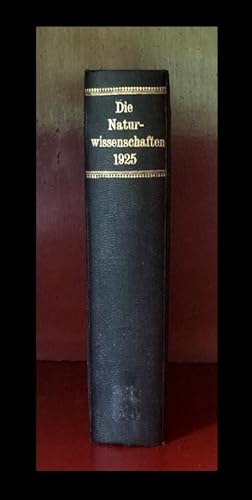
1st Edition. Full volume. FIRST EDITIONS OF THREE IMPORTANT PAPERS: (1) WALTHER BOTHE AND HANS GEIGER show that energy is conserved in quantum interactions. (2) WALTER ELSASSER proposes the Davisson-Germer experiment. (3) GEORGE UHLENBECK & SAMUEL GOUDSMIT introduce the concept of electron spin. BOTHE & GEIGER, in this paper, announced the results of the test demonstrating strict conservation of energy and momentum at the quantum level. "Among the topics that Bothe studied in 1924 was the ejection of electrons by X rays, and it was in connection with this phenomenon that he and Geiger performed an important experiment. In an effort to reconcile the particulate and wavelike properties of radiation, Bohr, Kramers, and Slater in 1924 formulated a new quantum theory of radiation. According to the hypothesis, momentum and energy are conserved only statistically in interactions between radiation and matter. "Bothe and Geiger suggested that this could be tested experimentally by examining individual Compton collisions. Bothe introduced a modification into the Geiger counter that made it appropriate for use in coincidence experiments . . . using two counters, they studied the coincidences between the scattered X ray and the recoiling electron. Correlating photons with electrons, Bothe and Geiger found a coincidence rate of one in eleven; since the chance coincidence rate for the situation was 10-5, the experimental results contradicted the theoretical predictions and indicated small-scale conservation of energy and momentum" (Dictionary of Scientific Biography). WALTER ELSASSER, came to the ideas in this paper after he had been "browsing in the Göttingen library in 1925 at the age of 21 [and] found a newly completed dissertation by Louis de Broglie containing the suggestion that matter such as electrons might also behave as waves. Elsasser made the fundamental observation that the hitherto confusing and unexplained experimental results of electron interaction with metals from Bell Laboratories were in fact confirmation of de Broglie's hypothesis" Marsh, memorial to Elsasser, 1991). "With the encouragement of his colleagues, he wrote a short paper in [this paper] suggesting that de Broglie's theory could be tested through an improved crystal diffraction experiment" (History of Physics: The Wenner Collection). This discovery characterized Walter and established him as a scientist of world class, though as sometimes happens, two others later received the Nobel Prize for making the same observation two years after Elsasser did. UHLENBECK & GOUDSMIT, in this paper, introduced electron spin, which posits intrinsic angular momentum for all electrons. "While still students studying at Leiden under Paul Ehrenfest, two Dutch physicists, George Uhlenbeck and Samuel Goudsmit postulated that the electron must have an intrinsic angular momentum (â??spin') and therefore a magnetic moment because the electron is charged. Each electron, they argued, spins with an angular momentum of ½ Planck constant and carries a magnetic moment of one Bohr magneton" (Instituut-Lorentz, Leiden". Commentary by Bohr follows their paper. WE ALSO OFFER THE FIRST ENGLISH TRANSLATION OF THIS PAPER SEPARATELY: Uhlenbeck & Goudsmit "Spinning Electrons and the Structure of Spectra" Nature 117 No. 2938 pp. 264-265, February 20, 1926. CONDITION & DETAILS: Complete. 4to. 1092 pp. Very small institutional stamp on the title page; very slight ghosting at the spine from the removal of a label. Tightly bound in contemporary leather and marbled boards . Gilt-lettered at the spine. Clean and bright throughout. Indexed. Near fine.


