Order Total (1 Item Items):
Shipping Destination:

Thomson Rutherford (8 results)
Skip to main search results
Search filters
Product Type
- All Product Types
- Books (8)
- Magazines & Periodicals (No further results match this refinement)
- Comics (No further results match this refinement)
- Sheet Music (No further results match this refinement)
- Art, Prints & Posters (No further results match this refinement)
- Photographs (No further results match this refinement)
- Maps (No further results match this refinement)
- Manuscripts & Paper Collectibles (No further results match this refinement)
Condition Learn more
- New (No further results match this refinement)
- As New, Fine or Near Fine (3)
- Very Good or Good (3)
- Fair or Poor (No further results match this refinement)
- As Described (2)
Binding
Collectible Attributes
- First Edition (5)
- Signed (No further results match this refinement)
- Dust Jacket (No further results match this refinement)
- Seller-Supplied Images (7)
- Not Print on Demand (8)
Language (2)
Free Shipping
- Free Shipping to U.S.A. (No further results match this refinement)
Seller Location
Seller Rating
-
![Seller image for The Question Of The Atom: From The Karlsruhe Congress To The First Solvay Conference, 1860 - 1911: A Compilation Of Primary Sources [ The History Of Modern Physics, 1800-1950, Volume 4] for sale by Arroyo Seco Books, Pasadena, Member IOBA](https://pictures.abebooks.com/inventory/md/md31583771781.jpg)
The Question Of The Atom: From The Karlsruhe Congress To The First Solvay Conference, 1860 - 1911: A Compilation Of Primary Sources [ The History Of Modern Physics, 1800-1950, Volume 4]
Language: English
Published by American Institute Of Physics / Tomash Publishers, 1986
ISBN 10: 0938228072 ISBN 13: 9780938228073
Seller: Arroyo Seco Books, Pasadena, Member IOBA, Pasadena, CA, U.S.A.
Association Member: IOBA
Seller rating 4 out of 5 stars

First Edition
Hardcover. Condition: Fine. 1st Edition. Xxxi, 654 Pp. Blue Cloth. Second Printing Stated. Fine, No Wear, No Marks.
-
Phases of Modern Science : British Empire Exhibition 1924 -1925
Language: English
Published by A. and F. Denny, London, 1925
First Edition
Hardback. Condition: Very Good. Dust Jacket Condition: No Jacket as issued. First Edition. Published in connexion with the Science Exhibition in the Pavilion of His Majesty's Government at the British Empire Exhibition. Endpapers slightly toned. Name stamp of Gerald Ponsoby Lenox Conyngham on the front free endpaper superimposed by a slightly later neat signature otherwise clean unmarked copy with fold-out frontispiece of Range of Electromagnetic Waves.
-

James Tissot 1836-1902
Published by Musée du Petit Palais - Barbican Art Gallery, Londres, 1985
Seller: Librairie de l'Avenue - Henri Veyrier, Saint-Ouen, FR, France
Seller rating 4 out of 5 stars
Couverture souple. Condition: Bon état. In-8, broché couv. illustrée, photographies en noir et en couleurs, 256 pp. Bon état d'occasion. Exposition présentée à la Barbican Art Gallery de Londres du 15 novembre 1984 au 20 janvier 1985, à la Whitworth Art Gallery de Manchester du 1er février au 16 mars 1985 et au Musée du Petit Palais à Paris du 5 avril au 30 juin 1985. in-8°.
-
![Seller image for The London, Edinburgh and Dublin Philosophical Magazine and Journal of Science. Vol. XVI, July-December 1908. [Rutherford and Royds: Experiments with Radium Emanation; F. Soddy: The Relation Between Radium and Uranium; J.J. Thomson: Positive Rays.] for sale by Tinakori Books](https://pictures.abebooks.com/inventory/md/md207777870.jpg)
The London, Edinburgh and Dublin Philosophical Magazine and Journal of Science. Vol. XVI, July-December 1908. [Rutherford and Royds: Experiments with Radium Emanation; F. Soddy: The Relation Between Radium and Uranium; J.J. Thomson: Positive Rays.]
Language: English
Published by Taylor and Francis, London, 1908
First Edition
Hardcover. Condition: Very Good. 1st Edition. Cloth Spine, Papered Boards. July - December 1908, 984 pages, diagrams, figures, 28 plates. Cancelled copy from "Sternwarte Berlin-Babelsberg". Frontcover partially faded, but altogether a very nice copy. Contains important articles by Ernest Rutherford and T.Royds on nuclear physics: Experiments with Radium Emanation. The volume of Emanation; The Spectrum of radium Emanation (with 2 plates); The Action of Radium Emanation upon Water. Also by F. Soddy: Attempts to detect the production of helium from the primary radio Elements; The Relation between Radium and Uranium;
-

Handbook to the Exhibition of Pure Science Arranged by the Royal Society (The Electron/Electricity and Matter/Atoms and Isotopes, and many others)
Published by British Empire Exhibition, 1924
Seller: JF Ptak Science Books, Hendersonville, NC, U.S.A.
Seller rating 5 out of 5 stars

Soft cover. Condition: Very Good. Handbook to the Exhibition of Pure Science Arranged by the Royal Society. British Empire Exhibition, 1924. 8"x6", 244pp. Original wrappers. Provenance: Smithsonian Institution, Library of Congress. Nice copy, with two institutional stamps on the front wrapper. VG __+__ Pages 1-140 contains the historical appreciations of JJ Thomson on the electron, William Bragg on X-rays and crystal structures, Ernest Rutherford on electricity and matter, F.W. Aston on atoms and isotopes, Frank Dyson on the verification of the theory of relativity, A.Eddington on the interior of a star, JA Fleming on thermionic valve, R. Glazebrook on the origins of wireless, and a dozen others. All very high calibre contributions on the leading-edge material of the day. Surprising to see such an assembly. Pp 143-244 is Part II, "Descriptive Catalog of Exhibits", relating in some detail the scientific instruments and artifacts on display at the exhibition. Remarkable!
-
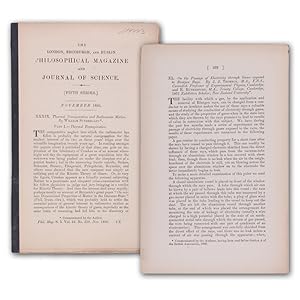
On the Passage of Electricity through Gases exposed to Röntgen Rays. SS. 392-407. In: Philosophical Magazine and Journal of Science. 5th Series. Vol. 42.
Language: English
Published by (London), 1896
Seller: Antiquariat Gerhard Gruber, Heilbronn, Germany
Seller rating 5 out of 5 stars
First Edition
(22,5 x 14,5 cm). SS. (373)-452. Mit 2 gefalteten Tafeln. Rückenbroschur, unbeschnitten. Erste Ausgabe dieser epochalen Arbeit über die Entstehung von Ionen in Gasen durch Röntgenstrahlen. - Gut erhalten.
-
Phases Of Modern Science Published In Connection With The Science Exhibit Arranged By A Committee Of The Royal Society In The Pavilion Of His Majesty's Government At The British Empire Exhibition 1925. SCARCE
Published by A & E Denny Ltd Strand London, 1925
First Edition
Hardcover. Condition: Near Fine. 1st Edition. 1st edition. Large 8vo. vii + (1) + 232pp. 5 section fold our frontis. Publisher's plain blue cloth covers, white printed label with blue lettering on front + spine. Original white eps. Covers : very slight 0.1cm shelf knocks top/bottom of spin, faint rubs corners else bright. Contents : very clean & tight. Bright copy. VG+.
-
![Seller image for On the passage of Electricity through Gases exposed to Röntgen Rays, in The London, Edinburgh, and Dublin Philosophical Magazine and Journal of Science, Vol. XLII, 5th Series, November Issue, 1896, pp. 392-407 [EXTRACT] for sale by Atticus Rare Books](https://pictures.abebooks.com/inventory/md/md18007008514.jpg)
FIRST EDITION EXTRACT (complete July issue) of Thomson and Rutherford's 1896 "epoch-making investigation on the ions produced in gases exposed to X-rays" (Science in the Making, Volume 2: 1850-1900, 312). Thomson and Rutherford's collaborative investigation "made important progress in understanding the conduction of electricity through gases by using X-rays to create charged species in various gases. The experiments confirmed Thomson's developing view that conduction in gaseous discharges occurred via charged portions of the molecules and served to show that the process was analogous to that occurring in dilute solutions of electrolytes" (ibid). Röntgen's 1895 discovery of X-rays stimulated global interest not only in the use of X-rays for medical purposes, but for inducing electrical conductivity in gases exposed to them. Thomson had already established that â??Röntgenised' gases showed unexpected conductivity, thus "it was only natural that [Thomson] assisted this time by Rutherford, would undertake similar experimental studies to the ones he had done for over a decade, this time using X-rays, in order to get new ideas for building a definitive theory of electric conduction in gases. The radical novelty was that Thomson and Rutherford managed to put forward a quantitative theory of conduction, as opposed to the only qualitative suggestions of previous theories. With this, they could calculate, for instance, the number of particles into which the molecules of a gas would dissociate or the rate at which a â??Röntgenised' gas would leak (i. e., would cease to be a conductor). "Following Thomson's understanding of the passage of electricity through gases as involving electrified particles, and with the new quantitative methods, Rutherford and Thomson inferred that â??the charged particles in the gas exposed to the Röntgen rays are the centres of an aggregation of a considerable number of [neutral] molecules' (Thomson & Rutherford, 1896, 402). In other words, Thomson [and Rutherford] thought that conduction was due to the movement of aggregations, the size of which seemed to be much larger than the ordinary structure of the gas molecules" (Navarro, History of the Electron, 77). Thomson's next step, of course - and one that would have unexpected consequences, "was to see if his new theory of electric currents in gases was also valid, as he had hoped, for cathode rays, thinking that they might also be aggregates of molecules around a charged atom and, therefore, bigger than atoms" (ibid). Building on his 1896 research with Rutherford, Thomson designed a series of experiments specifically to study the nature of electric discharge in a high-vacuum cathode-ray tube - and in so doing would, in 1897, discover the electron. "Even with today's knowledge, detailed interpretation of the results of this paper is not easy. The charged species were likely to have been atoms and molecules; free electrons (not discovered until later) were probably also present and these would have had a much higher mobility (velocity per unit field) than the value give above. No doubt the gases used were not pure and associations with foreign molecules might have occurred. The important features of the paper, however, reside in the clear demonstration of gaseous ionization by X-rays, the theoretical analysis of the current-voltage characteristics, and the estimates of the degree of ionization and of the velocity of the ions" (Science in the Making, 316). Perhaps most importantly, however, and as Falconer pointed out, the lessons Thomson and Rutherford learned from these experiments were critical to their later work, namely Thomson's discovery of the electron just [a year] later and to nearly all aspects of Rutherford's work. Falconer wrote: "J. J. learnt that a less fundamental approach may be more productive than a fundamental one; and he acquired the basis of a mathematical formulation of ionization theory which he built on extensively. Rutherford gained practical expertise in designing and performing discharge experiments; he learnt how to work in the comparison of orders of magnitude; [and] he learnt ionization theory" (Falconer 1987). CONDITION & DETAILS: Extract complete November 1896 issue. (8.5 x 5.5 inches; 213 x 138mm). One library stamp on the first page of the issue (not the Thomson and Rutherford paper). Otherwise bright and very clean throughout.