
Order Total (1 Item Items):
Shipping Destination:

Sergey Ilya (113 results)
Skip to main search results
Search filters
Product Type
- All Product Types
- Books (113)
- Magazines & Periodicals (No further results match this refinement)
- Comics (No further results match this refinement)
- Sheet Music (No further results match this refinement)
- Art, Prints & Posters (No further results match this refinement)
- Photographs (No further results match this refinement)
- Maps (No further results match this refinement)
- Manuscripts & Paper Collectibles (No further results match this refinement)
Condition Learn more
- New (90)
- As New, Fine or Near Fine (14)
- Very Good or Good (4)
- Fair or Poor (No further results match this refinement)
- As Described (5)
Binding
Collectible Attributes
- First Edition (2)
- Signed (No further results match this refinement)
- Dust Jacket (No further results match this refinement)
- Seller-Supplied Images (58)
- Not Print on Demand (84)
Language (3)
Free Shipping
Seller Location
Seller Rating
-

Programming Languages and Systems (Lecture Notes in Computer Science)
Seller: World of Books (was SecondSale), Montgomery, IL, U.S.A.
Seller rating 5 out of 5 stars

Condition: Good. Item in good condition. Textbooks may not include supplemental items i.e. CDs, access codes etc.
-

Condition: As New. Unread book in perfect condition.
-

-
Condition: new.
-

-
Programming Languages and Systems (Paperback)
Language: English
Published by Springer Nature Switzerland AG, Cham, 2022
ISBN 10: 3030993353 ISBN 13: 9783030993351
First Edition
Paperback. Condition: new. Paperback. This open access book constitutes the proceedings of the 31st European Symposium on Programming, ESOP 2022, which was held during April 5-7, 2022, in Munich, Germany, as part of the European Joint Conferences on Theory and Practice of Software, ETAPS 2022. The 21 regular papers presented in this volume were carefully reviewed and selected from 64 submissions. They deal with fundamental issues in the specification, design, analysis, and implementation of programming languages and systems. This open access book constitutes the proceedings of the 31st European Symposium on Programming, ESOP 2022, which was held during April 5-7, 2022, in Munich, Germany, as part of the European Joint Conferences on Theory and Practice of Software, ETAPS 2022. Shipping may be from multiple locations in the US or from the UK, depending on stock availability.
-
The Stories of the Great Steppe: The Anthology of Modern Kazakh Literature
Language: English
Published by Cognella Academic Publishing, 2013
ISBN 10: 1621318370 ISBN 13: 9781621318378
Paperback. Condition: Good. No Jacket. Shelf and handling wear to cover and binding, with general signs of previous use. Binding and pages are intact. All pages are free from any markings. Creasing visible across covers of paperback. Secure packaging for safe delivery.
-
-

Condition: As New. Unread book in perfect condition.
-

New Imperial History of Northern Eurasia, 600-1700 : From Russian to Global History
Seller: GreatBookPricesUK, Woodford Green, United Kingdom
Seller rating 5 out of 5 stars
Condition: New.
-

Achtung! Cthulhu: Guide To Eastern Front
Language: English
Published by Modiphius Entertainment, 2014
ISBN 10: 1910132039 ISBN 13: 9781910132036
Seller: Chris Korczak, Bookseller, IOBA, Easthampton, MA, U.S.A.
Association Member: IOBA SNEAB
Seller rating 5 out of 5 stars
paperback. Condition: Very Good. Very mild shelfwear. I note every flaw I find, so buy with confidence.
-
Programming Languages and Systems (Lecture Notes in Computer Science)
Seller: Ria Christie Collections, Uxbridge, United Kingdom
Seller rating 5 out of 5 stars
£ 39.30
£ 11.98 shipping
Ships from United Kingdom to U.S.A.Quantity: Over 20 available
Add to basketCondition: New. In.
-
-

Metallogenesis and Tectonics of the Russian Far East, Alaska, and the Canadian Cordillera Professional Paper 1697
Published by USGS, 2005
ISBN 10: 0607984074 ISBN 13: 9780607984071
Condition: new. "The Proterozoic and Phanerozoic metallogenic and tectonic evolution of the Russian Far East, Alaska, and the Canadian Cordillera is recorded in the cratons, craton margins, and orogenic collages of the Circum-North Pacific mountain belts that separate the North Pacific from the eastern North Asian and western North American Cratons. The collages consist of tectonostratigraphic terranes and contained metallogenic belts, which are composed of fragments of igneous arcs, accretionary-wedge and subduction-zone complexes, passive continental margins, and cratons. The terranes are overlapped by continental-margin-arc and sedimentary-basin assemblages and contained metallogenic belts. The metallogenic and geologic history of terranes, overlap assemblages, cratons, and craton margins has been complicated by postaccretion dismemberment and translation during strike-slip faulting that occurred subparallel to continental margins. Seven processes overlapping in time were responsible for most of metallogenic and geologic complexities of the region (1) In the Early and Middle Proterozoic, marine sedimentary basins developed on major cratons and were the loci for ironstone (Superior Fe) deposits and sediment-hosted Cu deposits that occur along both the North Asia Craton and North American Craton Margin. (2) In the Late Proterozoic, Late Devonian, and Early Carboniferous, major periods of rifting occurred along the ancestral margins of present-day Northeast Asia and northwestern North America. The rifting resulted in fragmentation of each continent, and formation of cratonal and passive continental-margin terranes that eventually migrated and accreted to other sites along the evolving margins of the original or adjacent continents. The rifting also resulted in formation of various massive-sulfide metallogenic belts. (3) From about the late Paleozoic through the mid-Cretaceous, a succession of island arcs and contained igneous-arc-related metallogenic belts and tectonically paired subduction zones formed near continental margins. (4) From about mainly the mid-Cretaceous through the present, a succession of continental-margin igneous arcs (some extending offshore into island arcs) and contained metallogenic belts, and tectonically paired subduction zones formed along the continental margins. (5) From about the Jurassic to the present, oblique convergence and rotations caused orogen-parallel sinistral, and then dextral displacements within the plate margins of the Northeast Asian and North American Cratons. The oblique convergences and rotations resulted in the fragmentation, displacement, and duplication of formerly more continuous arcs, subduction zones, passive continental margins, and contained metallogenic belts. These fragments were subsequently accreted along the margins of the expanding continental margins. (6) From the Early Jurassic through Tertiary, movement of the upper continental plates toward subduction zones resulted in strong plate coupling and accretion of the former island arcs, subduction zones, and contained metallogenic belts to continental margins. In this region, the multiple arc accretions were accompanied and followed by crustal thickening, anatexis, metamorphism, formation of collision-related metallogenic belts, and uplift; this resulted in the substantial growth of the North Asian and North American continents. (7) In the middle and late Cenozoic, oblique to orthogonal convergence of the Pacific Plate with present-day Alaska and Northeast Asia resulted in formation of the present ring of volcanoes and contained metallogenic belts around the Circum-North Pacific. Oblique convergence between the Pacific Plate and Alaska also resulted in major dextral-slip faulting in interior and southern Alaska and along the western part of the Aleutian- Wrangell arc. Associated with dextral-slip faulting was crustal extrusion of terranes from western Alaska into the Bering Sea. " DV2. softcover, wrapped in shrink wrap, tight, crisp, 429 pages.
-

Metallogenesis and Tectonics of the Russian Far East, Alaska, and the Canadian Cordillera Professional Paper 1697
Published by USGS, 2005
ISBN 10: 0607984074 ISBN 13: 9780607984071
Condition: new. "The Proterozoic and Phanerozoic metallogenic and tectonic evolution of the Russian Far East, Alaska, and the Canadian Cordillera is recorded in the cratons, craton margins, and orogenic collages of the Circum-North Pacific mountain belts that separate the North Pacific from the eastern North Asian and western North American Cratons. The collages consist of tectonostratigraphic terranes and contained metallogenic belts, which are composed of fragments of igneous arcs, accretionary-wedge and subduction-zone complexes, passive continental margins, and cratons. The terranes are overlapped by continental-margin-arc and sedimentary-basin assemblages and contained metallogenic belts. The metallogenic and geologic history of terranes, overlap assemblages, cratons, and craton margins has been complicated by postaccretion dismemberment and translation during strike-slip faulting that occurred subparallel to continental margins. Seven processes overlapping in time were responsible for most of metallogenic and geologic complexities of the region (1) In the Early and Middle Proterozoic, marine sedimentary basins developed on major cratons and were the loci for ironstone (Superior Fe) deposits and sediment-hosted Cu deposits that occur along both the North Asia Craton and North American Craton Margin. (2) In the Late Proterozoic, Late Devonian, and Early Carboniferous, major periods of rifting occurred along the ancestral margins of present-day Northeast Asia and northwestern North America. The rifting resulted in fragmentation of each continent, and formation of cratonal and passive continental-margin terranes that eventually migrated and accreted to other sites along the evolving margins of the original or adjacent continents. The rifting also resulted in formation of various massive-sulfide metallogenic belts. (3) From about the late Paleozoic through the mid-Cretaceous, a succession of island arcs and contained igneous-arc-related metallogenic belts and tectonically paired subduction zones formed near continental margins. (4) From about mainly the mid-Cretaceous through the present, a succession of continental-margin igneous arcs (some extending offshore into island arcs) and contained metallogenic belts, and tectonically paired subduction zones formed along the continental margins. (5) From about the Jurassic to the present, oblique convergence and rotations caused orogen-parallel sinistral, and then dextral displacements within the plate margins of the Northeast Asian and North American Cratons. The oblique convergences and rotations resulted in the fragmentation, displacement, and duplication of formerly more continuous arcs, subduction zones, passive continental margins, and contained metallogenic belts. These fragments were subsequently accreted along the margins of the expanding continental margins. (6) From the Early Jurassic through Tertiary, movement of the upper continental plates toward subduction zones resulted in strong plate coupling and accretion of the former island arcs, subduction zones, and contained metallogenic belts to continental margins. In this region, the multiple arc accretions were accompanied and followed by crustal thickening, anatexis, metamorphism, formation of collision-related metallogenic belts, and uplift; this resulted in the substantial growth of the North Asian and North American continents. (7) In the middle and late Cenozoic, oblique to orthogonal convergence of the Pacific Plate with present-day Alaska and Northeast Asia resulted in formation of the present ring of volcanoes and contained metallogenic belts around the Circum-North Pacific. Oblique convergence between the Pacific Plate and Alaska also resulted in major dextral-slip faulting in interior and southern Alaska and along the western part of the Aleutian- Wrangell arc. Associated with dextral-slip faulting was crustal extrusion of terranes from western Alaska into the Bering Sea. " DV1. softcover, wrapped in shrink wrap, tight, crisp, 429 pages.
-

Metallogenesis and Tectonics of the Russian Far East, Alaska, and the Canadian Cordillera Professional Paper 1697
Published by USGS, 2005
ISBN 10: 0607984074 ISBN 13: 9780607984071
Condition: new. "The Proterozoic and Phanerozoic metallogenic and tectonic evolution of the Russian Far East, Alaska, and the Canadian Cordillera is recorded in the cratons, craton margins, and orogenic collages of the Circum-North Pacific mountain belts that separate the North Pacific from the eastern North Asian and western North American Cratons. The collages consist of tectonostratigraphic terranes and contained metallogenic belts, which are composed of fragments of igneous arcs, accretionary-wedge and subduction-zone complexes, passive continental margins, and cratons. The terranes are overlapped by continental-margin-arc and sedimentary-basin assemblages and contained metallogenic belts. The metallogenic and geologic history of terranes, overlap assemblages, cratons, and craton margins has been complicated by postaccretion dismemberment and translation during strike-slip faulting that occurred subparallel to continental margins. Seven processes overlapping in time were responsible for most of metallogenic and geologic complexities of the region (1) In the Early and Middle Proterozoic, marine sedimentary basins developed on major cratons and were the loci for ironstone (Superior Fe) deposits and sediment-hosted Cu deposits that occur along both the North Asia Craton and North American Craton Margin. (2) In the Late Proterozoic, Late Devonian, and Early Carboniferous, major periods of rifting occurred along the ancestral margins of present-day Northeast Asia and northwestern North America. The rifting resulted in fragmentation of each continent, and formation of cratonal and passive continental-margin terranes that eventually migrated and accreted to other sites along the evolving margins of the original or adjacent continents. The rifting also resulted in formation of various massive-sulfide metallogenic belts. (3) From about the late Paleozoic through the mid-Cretaceous, a succession of island arcs and contained igneous-arc-related metallogenic belts and tectonically paired subduction zones formed near continental margins. (4) From about mainly the mid-Cretaceous through the present, a succession of continental-margin igneous arcs (some extending offshore into island arcs) and contained metallogenic belts, and tectonically paired subduction zones formed along the continental margins. (5) From about the Jurassic to the present, oblique convergence and rotations caused orogen-parallel sinistral, and then dextral displacements within the plate margins of the Northeast Asian and North American Cratons. The oblique convergences and rotations resulted in the fragmentation, displacement, and duplication of formerly more continuous arcs, subduction zones, passive continental margins, and contained metallogenic belts. These fragments were subsequently accreted along the margins of the expanding continental margins. (6) From the Early Jurassic through Tertiary, movement of the upper continental plates toward subduction zones resulted in strong plate coupling and accretion of the former island arcs, subduction zones, and contained metallogenic belts to continental margins. In this region, the multiple arc accretions were accompanied and followed by crustal thickening, anatexis, metamorphism, formation of collision-related metallogenic belts, and uplift; this resulted in the substantial growth of the North Asian and North American continents. (7) In the middle and late Cenozoic, oblique to orthogonal convergence of the Pacific Plate with present-day Alaska and Northeast Asia resulted in formation of the present ring of volcanoes and contained metallogenic belts around the Circum-North Pacific. Oblique convergence between the Pacific Plate and Alaska also resulted in major dextral-slip faulting in interior and southern Alaska and along the western part of the Aleutian- Wrangell arc. Associated with dextral-slip faulting was crustal extrusion of terranes from western Alaska into the Bering Sea." DV4. softcover, wrapped in shrink wrap, tight, crisp, 429 pages.
-

Metallogenesis and Tectonics of the Russian Far East, Alaska, and the Canadian Cordillera Professional Paper 1697
Published by USGS, 2005
ISBN 10: 0607984074 ISBN 13: 9780607984071
Condition: new. The Proterozoic and Phanerozoic metallogenic and tectonic evolution of the Russian Far East, Alaska, and the Canadian Cordillera is recorded in the cratons, craton margins, and orogenic collages of the Circum-North Pacific mountain belts that separate the North Pacific from the eastern North Asian and western North American Cratons. The collages consist of tectonostratigraphic terranes and contained metallogenic belts, which are composed of fragments of igneous arcs, accretionary-wedge and subduction-zone complexes, passive continental margins, and cratons. The terranes are overlapped by continental-margin-arc and sedimentary-basin assemblages and contained metallogenic belts. The metallogenic and geologic history of terranes, overlap assemblages, cratons, and craton margins has been complicated by postaccretion dismemberment and translation during strike-slip faulting that occurred subparallel to continental margins. Seven processes overlapping in time were responsible for most of metallogenic and geologic complexities of the region (1) In the Early and Middle Proterozoic, marine sedimentary basins developed on major cratons and were the loci for ironstone (Superior Fe) deposits and sediment-hosted Cu deposits that occur along both the North Asia Craton and North American Craton Margin. (2) In the Late Proterozoic, Late Devonian, and Early Carboniferous, major periods of rifting occurred along the ancestral margins of present-day Northeast Asia and northwestern North America. The rifting resulted in fragmentation of each continent, and formation of cratonal and passive continental-margin terranes that eventually migrated and accreted to other sites along the evolving margins of the original or adjacent continents. The rifting also resulted in formation of various massive-sulfide metallogenic belts. (3) From about the late Paleozoic through the mid-Cretaceous, a succession of island arcs and contained igneous-arc-related metallogenic belts and tectonically paired subduction zones formed near continental margins. (4) From about mainly the mid-Cretaceous through the present, a succession of continental-margin igneous arcs (some extending offshore into island arcs) and contained metallogenic belts, and tectonically paired subduction zones formed along the continental margins. (5) From about the Jurassic to the present, oblique convergence and rotations caused orogen-parallel sinistral, and then dextral displacements within the plate margins of the Northeast Asian and North American Cratons. The oblique convergences and rotations resulted in the fragmentation, displacement, and duplication of formerly more continuous arcs, subduction zones, passive continental margins, and contained metallogenic belts. These fragments were subsequently accreted along the margins of the expanding continental margins. (6) From the Early Jurassic through Tertiary, movement of the upper continental plates toward subduction zones resulted in strong plate coupling and accretion of the former island arcs, subduction zones, and contained metallogenic belts to continental margins. In this region, the multiple arc accretions were accompanied and followed by crustal thickening, anatexis, metamorphism, formation of collision-related metallogenic belts, and uplift; this resulted in the substantial growth of the North Asian and North American continents. (7) In the middle and late Cenozoic, oblique to orthogonal convergence of the Pacific Plate with present-day Alaska and Northeast Asia resulted in formation of the present ring of volcanoes and contained metallogenic belts around the Circum-North Pacific. Oblique convergence between the Pacific Plate and Alaska also resulted in major dextral-slip faulting in interior and southern Alaska and along the western part of the Aleutian- Wrangell arc. Associated with dextral-slip faulting was crustal extrusion of terranes from western Alaska into the Bering Sea. DX1. softcover, wrapped in shrink wrap, tight, crisp, 429 pages.
-
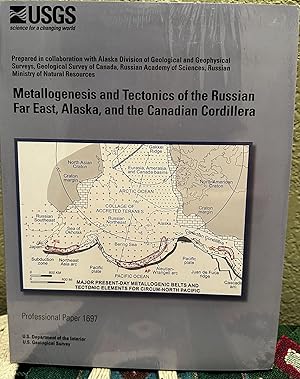
Metallogenesis and Tectonics of the Russian Far East, Alaska, and the Canadian Cordillera Professional Paper 1697
Published by USGS, 2005
ISBN 10: 0607984074 ISBN 13: 9780607984071
Condition: new. The Proterozoic and Phanerozoic metallogenic and tectonic evolution of the Russian Far East, Alaska, and the Canadian Cordillera is recorded in the cratons, craton margins, and orogenic collages of the Circum-North Pacific mountain belts that separate the North Pacific from the eastern North Asian and western North American Cratons. The collages consist of tectonostratigraphic terranes and contained metallogenic belts, which are composed of fragments of igneous arcs, accretionary-wedge and subduction-zone complexes, passive continental margins, and cratons. The terranes are overlapped by continental-margin-arc and sedimentary-basin assemblages and contained metallogenic belts. The metallogenic and geologic history of terranes, overlap assemblages, cratons, and craton margins has been complicated by postaccretion dismemberment and translation during strike-slip faulting that occurred subparallel to continental margins. Seven processes overlapping in time were responsible for most of metallogenic and geologic complexities of the region (1) In the Early and Middle Proterozoic, marine sedimentary basins developed on major cratons and were the loci for ironstone (Superior Fe) deposits and sediment-hosted Cu deposits that occur along both the North Asia Craton and North American Craton Margin. (2) In the Late Proterozoic, Late Devonian, and Early Carboniferous, major periods of rifting occurred along the ancestral margins of present-day Northeast Asia and northwestern North America. The rifting resulted in fragmentation of each continent, and formation of cratonal and passive continental-margin terranes that eventually migrated and accreted to other sites along the evolving margins of the original or adjacent continents. The rifting also resulted in formation of various massive-sulfide metallogenic belts. (3) From about the late Paleozoic through the mid-Cretaceous, a succession of island arcs and contained igneous-arc-related metallogenic belts and tectonically paired subduction zones formed near continental margins. (4) From about mainly the mid-Cretaceous through the present, a succession of continental-margin igneous arcs (some extending offshore into island arcs) and contained metallogenic belts, and tectonically paired subduction zones formed along the continental margins. (5) From about the Jurassic to the present, oblique convergence and rotations caused orogen-parallel sinistral, and then dextral displacements within the plate margins of the Northeast Asian and North American Cratons. The oblique convergences and rotations resulted in the fragmentation, displacement, and duplication of formerly more continuous arcs, subduction zones, passive continental margins, and contained metallogenic belts. These fragments were subsequently accreted along the margins of the expanding continental margins. (6) From the Early Jurassic through Tertiary, movement of the upper continental plates toward subduction zones resulted in strong plate coupling and accretion of the former island arcs, subduction zones, and contained metallogenic belts to continental margins. In this region, the multiple arc accretions were accompanied and followed by crustal thickening, anatexis, metamorphism, formation of collision-related metallogenic belts, and uplift; this resulted in the substantial growth of the North Asian and North American continents. (7) In the middle and late Cenozoic, oblique to orthogonal convergence of the Pacific Plate with present-day Alaska and Northeast Asia resulted in formation of the present ring of volcanoes and contained metallogenic belts around the Circum-North Pacific. Oblique convergence between the Pacific Plate and Alaska also resulted in major dextral-slip faulting in interior and southern Alaska and along the western part of the Aleutian- Wrangell arc. Associated with dextral-slip faulting was crustal extrusion of terranes from western Alaska into the Bering Sea. softcover, wrapped in shrink wrap, tight, crisp, 429 pages.
-

New Imperial History of Northern Eurasia, 600-1700 : From Russian to Global History
Seller: GreatBookPricesUK, Woodford Green, United Kingdom
Seller rating 5 out of 5 stars
Condition: As New. Unread book in perfect condition.
-
Condition: new.
-

Programming Languages and Systems : 31st European Symposium on Programming, ESOP 2022, Held as Part of the European Joint Conferences on Theory and Pr
Seller: GreatBookPricesUK, Woodford Green, United Kingdom
Seller rating 5 out of 5 stars
Condition: New.
-

Programming Languages and Systems : 31st European Symposium on Programming, ESOP 2022, Held as Part of the European Joint Conferences on Theory and Pr
Seller: GreatBookPricesUK, Woodford Green, United Kingdom
Seller rating 5 out of 5 stars
Condition: As New. Unread book in perfect condition.
-
Condition: New. 1st ed. 2022 edition NO-PA16APR2015-KAP.
-

Condition: As New. Unread book in perfect condition.
-
-
-

A New Imperial History of Northern Eurasia, 600-1700: From Russian to Global History: Vol 1
Language: English
Published by Bloomsbury USA Academic, 2025
ISBN 10: 1350196800 ISBN 13: 9781350196803
Paperback. Condition: Brand New. 306 pages. 9.22x6.14x1.00 inches. In Stock.
-
Practical Aspects of Declarative Languages: 26th International Symposium, PADL 2024, London, UK, January 15-16, 2024, Proceedings (Lecture Notes in Computer Science)
Seller: Ria Christie Collections, Uxbridge, United Kingdom
Seller rating 5 out of 5 stars
£ 54.30
£ 11.98 shipping
Ships from United Kingdom to U.S.A.Quantity: Over 20 available
Add to basketCondition: New. In.
-

Programming Languages and Systems: 20th Asian Symposium, APLAS 2022, Auckland, New Zealand, December 5, 2022, Proceedings (Lecture Notes in Computer Science)
Seller: Ria Christie Collections, Uxbridge, United Kingdom
Seller rating 5 out of 5 stars
£ 54.30
£ 11.98 shipping
Ships from United Kingdom to U.S.A.Quantity: Over 20 available
Add to basketCondition: New. In.
-


