
Order Total (1 Item Items):
Shipping Destination:

Rumold Mercator (16 results)
Skip to main search results
Search filters
Product Type
- All Product Types
- Books (14)
- Magazines & Periodicals (No further results match this refinement)
- Comics (No further results match this refinement)
- Sheet Music (No further results match this refinement)
- Art, Prints & Posters (No further results match this refinement)
- Photographs (No further results match this refinement)
- Maps (2)
- Manuscripts & Paper Collectibles (No further results match this refinement)
Condition Learn more
- New (7)
- As New, Fine or Near Fine (No further results match this refinement)
- Very Good or Good (4)
- Fair or Poor (No further results match this refinement)
- As Described (5)
Binding
Collectible Attributes
- First Edition (2)
- Signed (No further results match this refinement)
- Dust Jacket (1)
- Seller-Supplied Images (8)
- Not Print on Demand (12)
Language (2)
Free Shipping
Seller Location
Seller Rating
-
Atlas Siue Cosmographicae Meditationes De Fabrica Mundi Et Fabricati Figura. Gerardo Mercatore Rupelmontano . Authore (Paperback or Softback)
Language: English
Published by Legare Street Press 9/10/2021, 2021
ISBN 10: 1015363504 ISBN 13: 9781015363502
Paperback or Softback. Condition: New. Atlas Siue Cosmographicae Meditationes De Fabrica Mundi Et Fabricati Figura. Gerardo Mercatore Rupelmontano . Authore. Book.
-

Atlas Siue Cosmographicae Meditationes De Fabrica Mundi Et Fabricati Figura. Gerardo Mercatore Rupelmontano . Authore
Language: English
Published by Legare Street Press 2021-09, 2021
ISBN 10: 1015363504 ISBN 13: 9781015363502
PF. Condition: New.
-

Atlas Siue Cosmographicae Meditationes De Fabrica Mundi Et Fabricati Figura. Gerardo Mercatore Rupelmontano . Authore
Language: English
Published by Creative Media Partners, LLC Sep 2021, 2021
ISBN 10: 1015363504 ISBN 13: 9781015363502
Taschenbuch. Condition: Neu. Neuware.
-
Atlas Siue Cosmographicae Meditationes De Fabrica Mundi Et Fabricati Figura. Gerardo Mercatore Rupelmontano . Authore
Seller: Ria Christie Collections, Uxbridge, United Kingdom
Seller rating 5 out of 5 stars

£ 14.67
£ 11.98 shipping
Ships from United Kingdom to U.S.A.Quantity: Over 20 available
Add to basketCondition: New. PRINT ON DEMAND Book; New; Fast Shipping from the UK. No. book.
-
Atlas Siue Cosmographicae Meditationes De Fabrica Mundi Et Fabricati Figura. Gerardo Mercatore Rupelmontano . Authore
Seller: THE SAINT BOOKSTORE, Southport, United Kingdom
Seller rating 5 out of 5 stars
£ 18.70
£ 12.31 shipping
Ships from United Kingdom to U.S.A.Quantity: Over 20 available
Add to basketPaperback / softback. Condition: New. This item is printed on demand. New copy - Usually dispatched within 5-9 working days.
-

Orbis terrae compendiosa Descriptio
Published by Duisberg: 1587 [1603 or later], 1603
Seller: Arader Galleries - AraderNYC, New York, NY, U.S.A.
Seller rating 5 out of 5 stars
Soft cover. Condition: Good. Engraved double-page double hemispheric world map with later hand coloring and in outline (Image: 11 1/4 x 20 1/2 in.; 28.6 x 52 cm; 16 1/2 x 22 in.; 41.9 x 55.9 cm), wide margins, Latin text on verso. BINDING/CONDITION: Floated on sturdy card stock and enclosed in mylar. Several cracks in plate evident in cartouche. (65B1A) The present work is a reduced version of the 1569 wall map of the world, on which the Mercator Projection was introduced. In the western hemisphere on the left, the prominent bulge in South America, a characteristic introduced by Gerard Mercator and evident on his 1569 world map, has been retained here. Tierra del Fuego forms part of a gigantic southern continent that continues in the eastern hemisphere. At the north pole, two of the four islands that Gerard Mercator thought surrounded the pole are evident. There is also a suggestion of a Northwest Passage via the Straits of Anian. Anian derives from Ania, a Chinese province on a large gulf mentioned in Marco Polo's travels. The gulf Polo described was actually the Gulf of Tonkin, but the province's description was transposed from Vietnam to the northwest coast of North America. The first map showing the transposition was Giacomo Gastaldi's world map (1562), followed by Zaltieri and Mercator. The Strait thus became synonymous with the Northwest Passage, i.e., a passage to China. It appeared on maps until the 18th century. Quivira, south of Anian, refers to the Seven Cities of Gold sought by Spanish explorer Francisco Vasquez de Coronado in 1541. Although he never found these fabulous cities, the name remained on maps of southwest North America. In the eastern hemisphere, Japan appears as a large, round island. The islands of Southeast Asia are arrayed with relative accuracy for the time. To the south, the names of Beach, Maletur, and Lucach reveal again Mercator's use of toponyms from Marco Polo. PROVENANCE: Swann Galleries, 6 June 2013, lot 137. REFERENCE: Shirley 157.
-

Orbis Terrae Compendiosa Descriptio Quam ex Magna Universali Gerardi Mercatoris. Domino Richardo Gartho, Geographic ac ceterarum bonarum artium amatori ac fautori summo, in veteris amicitie ac familiaritatis memoria Rumoldus Mercator fieri curabat A.o M.D. Lxxxvii.
Published by Eustathius Vignon],
Seller: Daniel Crouch Rare Books Ltd, London, United Kingdom
Association Member: ABA ILAB PBFA
Seller rating 1 out of 5 stars

Map
A separately-published world map, issued prior to its inclusion in the first "atlas" to be so called First issue. Double-page folding engraved map, with no text beneath, nor on verso. This double-hemisphere map of the world is a reduced version of Gerard Mercator's revolutionary wall map of the world (1569), and was first published in Strabo's 'Geographicarum libr XVII', with text beneath the map headed "Lectori S.P.", and without text on the verso. It may have also been published separately, and in the final part of Mercator's atlas, before being included in Rumold Mercator's complete five-volume edition of the atlas from 1595. However, the Mercator family were beaten to the post, in popularizing (and capitalizing on) this modern world view, by Abraham Ortelius, who included it as a simplified single sheet map in his atlas of the world, 'Theatrum Orbis Terrarum' (1570). California shown as part of the mainland, there is the distinctive bulge in South America, and the kingdoms of Beach, Lucach and Maletur are shown as part of the mythical southern continent "Terra Australis", which is shown as an entirely separate landmass: it "wraps around the fullest expanse of the southern latitudes possible, save for New Guinea, which is correctly shown as a separate island. 'Terra Australis' has, in addition, become a dumping ground for errors. It harbours a realm of parrots, 'Psittacorum regio', and serves as the refuge for lands reported by Marco Polo but which have been displaced because they are now duplicated by more recent data. On the opposite pole, Mercator has depicted the Arctic according to the four-island theory previously used by Ruysch and Finaeus" (Suarez). The mapmaker Gerard Mercator (1512-1594) would not begin his great 'Atlas' or "Cosmography" until relatively late in life. The impetus for this came when he was employed as cosmographer to Duke William IV of Kleve, in 1563. Mercator's intention was to produce a work that consisted of five books and encompassed the whole world. The first book would cover the creation; the second the heavens; the third geography; the fourth history; and the fifth chronology. He intended to draw all the maps, write all the text and cut all the plates himself. Unsurprisingly, the ambitious project would require more time than he could afford to give it, and he was only able to complete a few of the parts: the creation; the maps for Ptolemy's 'Geographia' part of the geographical section in 1578; and four of the modern parts. The first three were published together in 1585 and included France, the Low Countries, and Germany. The fourth part, of Italy, the Balkans, and Greece, appeared in 1589. Mercator died on December 2, 1594, leaving the responsibility for completion of the cosmography to his son Rumold. A number of maps still had to be engraved, and he employed various members of the Mercator family as engravers, including Gerard's grandsons Gerard and Michel. Mercator's work is referred to as the first atlas, because he was the first to give a collection of curated maps this name, reflected in the famous engraved title-page showing King Atlas measuring the world with a pair of dividers. It is often wrongly thought that the word"atlas" refers to the Titan of the same name, whose punishment for fighting against the Olympian gods was to hold the heavens on his shoulders. It is instead a reference to King Atlas of the mythical Mauritania, a mathematician and philosopher who supposedly made the first celestial globe. Literature: Clancy, 'The Mapping of Terra Australis', 5.11, and page 70; Shirley, 'The mapping of the world: early printed world maps, 1472-1700', 157; Suarez, 'Shedding the Veil', 31.
-
Orbis Terrae Compendiosa Descriptio ex ea, quam ex Magna Universali Mercatoris Rumoldus.
Published by Antonii Magini c.1617, Arnhem, The Netherlands, 1617
Seller: Alexandre Antique Prints, Maps & Books, Toronto, ON, Canada
Seller rating 5 out of 5 stars
Map
Condition: Very Good. Latin text and blank verso.Rare World map, taken from Ioannis Antonii Magini's Geographia Tum Veteris, Tum Nova. It is published in Arnhem in 1617 and edited by Jan Janssonius. The map is specially engraved for this publication by Abraham Goos, inspired by the map of Girolamo Porro of 1597, a reduction of the Mercator globe., Size : 172x246 (mm), 6.77x9.69 (Inches), Black & White.
-
Strabonis Rerum Geographicarum Libri XVII. Isaacus Casabonus recensuit, summoque studio & diligentia, ope etiam veterum codicum, emendavit, ac Commentariis illustravit. Accessit & Tabula Orbis totius descriptionem complectens. Adiecta est etiam Guilielmi Xylandri Augustani Latina versio, cum necessariis Indicibus. [With ] Isaaci Casauboni Commentarius et Castigationes ad lib. Strabonis Geograph. XVII. S. l. First edition with the Mercator World Map .
Published by Geneva: Eustathius Vignon., 1587
Seller: Wittenborn Art Books, San Francisco, CA, U.S.A.
Seller rating 5 out of 5 stars
First Edition
Condition: Good. Folio. 34 x 21 cm. Original contemporary stiff vellum with 6 raised bands. [2], viii, 602, [10], 224pp. Two columns printed in Latin and Greek in the first part and Latin only in the second part. Waterstain in the lower right corner throughout. The map is bound in front of page 1 and is in fine and fresh condition.This unique map was first printed as part of Isaac Casaubon's edition of Strabo's Geographia in 1587. In this, the first printing there are columns of text underneath rhe map with the heading, "Lectori S. P." In later editions the map was included in the well known Mercator atlas, which Rumold compiled. In 1603, the plate developed cracks in the top edge of the plate; two distinct cracks can be seen in the title.The preeminent example of Rumold Mercator's map of the world, first printed in this edition in Geneva in 1587. It is based on Gerard Mercator's celebrated 1569 world map and was made while Gerard was still alive (1512- 1594). This is the only collectible world map with direct input from Gerard Mercator, the greatest geographer of his era. Both his 1538 and 1569 world maps are unobtainable rarities.The present work is a reduced version of the 1569 wall map of the world, on which the revolutionary Mercator Projection was introduced. This edition makes the map into a double-hemisphere format, rather than the projection style.To the left is the western hemisphere. The prominent bulge in South America, a characteristic introduced by Gerard Mercator and evident on his 1569 world map, has been retained here. Tierra del Fuego forms part of a gigantic southern continent that continues in the eastern hemisphere. At the north pole, two of the four islands that Gerard Mercator thought surrounded the pole are evident. There is also a suggestion of a Northwest Passage via the Straits of Anian.Isaac Casaubon, (1559, Geneva ?died July 1, 1614, London). French classical scholar and theologian who was one of the leading scholars of the era.He was born in Geneva on 18th February 1559, a son of Huguenot parents Arnaud and Jeanne. He was educated at the university in his home town and taught Greek there. His first wife was Marie Prolyst but she and their daughter died. In 1586 in Geneva he married Florence, daughter of Henry Estienne and they had seventeen children, of whom about half did not survive infancy. His first major published work was on the Greek geographer Strabo and many other works followed. The invitation to come to England seems to have come from Richard Bancroft, Archbishop of Canterbury. Isaac was later made a prebendary of Canterbury but died in London on 1st July 1614.References: This first edition not in OCLC. Shirley, The Mapping of the World - Early Printed World Maps 1472 - 1700, Nr. 157; van der Krogt, Koeman's Atlantes Neerlandici, Vol. I, 0001:1A; Adams S-1908; Graesse VI:505. (Map) Koeman Me12; Moreland & Bannister p. 243; Shirley 157; Wagner Northwest Coast 146 . In-folio, reliure de l'époque vélin, dos à 6 nerfs, titre à l'encre dans le caisson de tête. Qq. taches, petites déchirures (nerfs et coiffe inférieure), coins usés. (8)-602-(2 bl.)-(8)-223 pp. et planisphère à double page rempliée. Trace de mouillure dans la partie inférieure droite sur tout l'ouvrage, marquée sur le premier quart puis s'amenuisant et s'estompant jusqu'à la fin du volume. Planisphère en belle condition (mouillure à peine visible, pas de déchirure, impression contrastée). Exemplaire complet des deux pages de titre gravées sur bois à décor identique de cariatides soutenant une couronne et de la planisphère (Orbis Terrae Compendiosa Descriptio) gravée par Rumold Mercator d'après la carte de son père Gérard Mercator et légendée en latin.Expertise by Christine CHATON Expertise en livres anciens et modernes (C.N.E.S.), 17100 SAINTES.
-
Strabonis Rerum Geographicarum Libri XVII. Isaacus Casaubonis Recensuit, Summoque Studio & Diligentia, Ope Etiam Veterum Codicum, Emendauit, Ac Commentariis Illustrauit.
Published by Eustathius Vignon, Geneva, 1587
Seller: Arader Galleries - AraderNYC, New York, NY, U.S.A.
Seller rating 5 out of 5 stars
First Edition
Two parts in one, volume. Folio (13 4/8 x 8 4/8 inches). Titles within historiated woodcut borders, printed in Greek and Latin in double columns, engraved double-page double-hemispherical world map: Mercator's "Orbis Terrae Compendiosa Descriptio", Geneva 1587 (13 ¼ x 20 ¼ inches) (supplied, small marginal tear just affecting the image repaired on verso), (some pale marginal dampstains, and one or two wormstracks). 19th-century red paneled morocco antique, spine in five compartments with four raised bands, an 18th-century morocco lettering piece in one (extremities, front paste-down removed, endpapers stained). Provenance: Contemporary marginal annotations to Casaubon's commentary, and a leaf of manuscript notes at the end. First edition of Isaac Casaubon's famous edition of Strabo's "Geography", one of the earliest and most important scientific treatises of historical geography, containing the FIRST APPEARANCE OF MERCATOR'S CELEBRATED AND ONLY AVAILABLE WORLD MAP "Orbis Terrae Compendiosa Descriptio" Geneva 1587. This variant without text on the verso and with Latin text in the bottom margin. "Gerard Mercator's great world map of 1569 was condensed into double hemispherical form by his son Rumold. The engraving is a model of clarity and neatness, with typical cursive flourishes to the lettering of the sea names." (Shirley). This map was later incorporated in Mercator's influential atlas of 1595. Adams S-1908; Graesse VI:505. (Map) Koeman Me12; Moreland & Bannister p. 243; Shirley 157; Wagner Northwest Coast 146.
-
Orbis Terr Compendiosa Descriptio
Published by Duisburg, 1587
Seller: Arader Galleries of Philadelphia, PA, Philadelphia, PA, U.S.A.
Seller rating 5 out of 5 stars
N/A. Condition: Very Good. Dust Jacket Condition: N/A. Engraving with original hand-color. For nearly sixty years, during the most important and exciting period in the history of modern map making, Gerard Mercator was the supreme cartographer, his name, second only to Ptolemy, synonymous with forms of map projection still in use today. Although not the inventor of this type of projection, he was the first to apply it to navigational charts in such a form that compass bearing could be plotted on charts in straight lines, thereby providing seamen with a solution to an age-old problem of navigation at sea. Mercator's monumental world map of 1569, which survives today in only three copies, was his major statement propounding the use of such a projection, and demonstrating how it might be drafted. The influence of his revolutionary ideas as illustrated by that map transformed land surveying, and his research and calculations led him to break away from Ptolemy's conception of the size and outline of the continents. This drastically reduced the longitudinal length of Europe and Asia and altered the shape of the Old World as visualized in the early sixteenth century. Unlike the work of Abraham Ortelius, a contemporary (and equally celebrated) cartographer, Mercator's maps are original. Ortelius did what most of the atlas-makers of our time engaged in: the reduction and generalization of already existing maps. Gerard Mercator, with his sense that scientific work should be original and new, checked the current knowledge of the earth's topography agaist its fundamental sources and drew maps in an original manner. This splendid map represents a re-working of Mercator's great world map of 1569 by his son and successor Rumold, who transformed it into double-hemispherical form in 1587 and incorporated it into editions of Mercator's long-lived and inlfuential Atlas from 1595 onwards. It had first appeared in Isaac Casaubon's edition of Strabo's Geographia in 1587. The engraving is a model of clarity and neatness, with typical cursive flourishes to the lettering of the sea names. Surrounding the hemispheres is a strapwork border, while between them at the top margin is an armillary sphere and at the bottom an elaborate compass rose. Gerard Mercator's prominent south-west bulge to the coastline of South America is retained. This superb map represents a seminal moment in the history of cartography, for it was primarily this map that diffused knowledge of Mercator's Projection throughout the world. Sheet size: 22 x 24 1/4". Frame size: 33 x 36". Inventory#: p1921pfat. 0.
-
Orbis terrae compendiosa descriptio.
Published by [Geneva:] Rumold Mercator, 1587 (but Amsterdam:, Jocodius Hondius, Ca 1620., 1620
Seller: Arader Galleries - AraderNYC, New York, NY, U.S.A.
Seller rating 5 out of 5 stars
Single sheet, float mounted and framed (11 2/8 x 20 4/8 inches to the neat line). Fine engraved double-hemisphere map of the world set within an elaborate strapwork border with an armillary sphere and a compass rose in the cusps, all with original hand-colour in full (side margins renewed, one or two other repairs). THE FIRST DOUBLE-HEMISPHERE MAP OF THE WORLD. This striking map represents a re-working of Mercator's great world map of 1569 by his son and successor Rumold, who transformed it into double-hemispherical form in 1587 and incorporated it into editions of Mercator's influential atlas from 1595. This issue dates from the 1620s as the break marks at the top of the copper plate now extend through the title. Showing New Guinea as an island and Beach as a peninsula of Terra Australis. The engraving is a model of clarity and neatness, with typical cursive flourishes to the lettering of the sea names. Surrounding the hemispheres is a strapwork border, while between them at the top margin is an armillary sphere and at the bottom an elaborate compass rose. Gerard Mercator's prominent south-west bulge on the coastline of South America, which was soon to be corrected, is retained. This superb map represents a seminal moment in the history of cartography, for it was the primary instrument by which knowledge of Mercator's projection was diffused throughout Europe. Shirley 157. Catalogued by Kate Hunter.
-
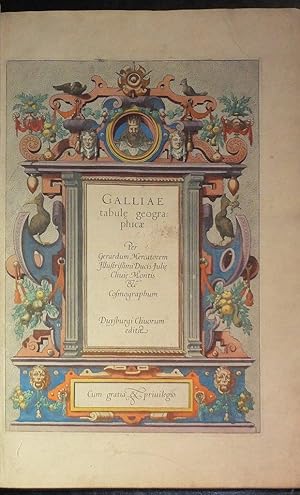
Galliae Tabule Geographicae. -- Belgii Inferiores Geographicae Tabule -- Germaniae Tabule Geographicae - Italiae, Sclavoniae, et Graecie
Published by Duisburg: [1585 - 1589]., 1589
Seller: Arader Galleries - AraderNYC, New York, NY, U.S.A.
Seller rating 5 out of 5 stars
Folio (15 x 11 inches). Dedication dated 1585. Frontispiece portrait of Mercator by Hogenberg dated 1574 (preliminaries quite loose), four engraved title-pages with broad and elaborate allegorical borders with classical and mannerist motifs (the first remargined at an early date and with later insect damage) and 59 fine double-page engraved maps (of 73, without from part one: Gallia, Britannia & Normandia, Aquitania, France Picardie, Poictou; from part II: Belgii Inferioris; part III: Germania, Austria Archiducatus; part IV: Italia, Forum Iulium, Tuscia, Marchia Anconitana, and Morea), and one single page, all with fine contemporary hand-color, descriptive letterpress on the recto of each map, each verso blank, woodcut initials (some marginal waterstaining, a few maps with brittle areas caused by oxidation, one or two early repairs to versos). Early full sheep with large arabesque design in blind and lettered "Atlas 1745" on each cover (quite worn, with the remains of two pairs of silk ties). Provenance: with the 18th-century ownership inscriptions of J.I. Becker, "pastoris", 1760 and W.W. Wolff, "vicarii", 1761, above the portrait of Mercator; ink library stamp of Schloss Rimburg, Aachen, on the front paste-down; Swann Galleries, 5th December, 2013, lot 101 The Mercator firm's earliest collection of modern maps, first issued in 1585 by Gerard Mercator, initially issued separately or combined with the second part "Italia" published in 1589. Mercator was born in Rupelmonde in East Flanders. He studied in Louvain under Gemma Frisius, a Dutch astronomer and mathematician, and began his career as a cartographer in that city, where the excellence of his work eventually won him the patronage of Charles V. In order to escape religious persecution, he moved in 1552 to Duisburg. There, he continued to produce maps, globes and instruments, including his most celebrated work, a world map on eighteen sheets drawn to his new projection (1569). In later life he devoted himself to the preparation of his three-volume collection of maps to which, for the first time, the word "atlas" was applied. The word was chosen, he wrote, "to honor the Titan, Atlas, King of Mauritania, a learned philosopher, mathematician, and astronomer." Mercator's sons and grandsons were all cartographers and made their contributions in various ways to the great atlas. His son Rumold, in particular, was responsible for the complete edition of 1595. Koeman Me 9 and Me 11. Catalogued by Kate Hunter.
-
Galliae Tabule Geographicae. -- Belgii Inferiores Geographicae Tabule -- Germaniae Tabule Geographicae.
Published by Duisburg: [not after 1595]., 1595
Seller: Arader Galleries - AraderNYC, New York, NY, U.S.A.
Seller rating 5 out of 5 stars
Folio (16 2/8 x 11 2/8 inches). Three engraved title-pages (the first with early abrasion where ownership inscription has been erased) and 50 fine double-page engraved maps, and one full page, all with fine contemporary hand-color, descriptive letterpress on the recto of each map, each verso blank, woodcut initials, single blank leaves bound in before the first maps in the Netherlands (Belgii) and Germany sections (last map of Hungary, with early hot wax stains to verso affecting the image). Contemporary limp vellum, yapp fore-edges, title in manuscript on the spine, map of Germany with symetrical closed marginal tears, extending 4 inches into the image). Provenance: early marginal note to +v. Mercator's earliest collection of modern maps, first issued in 1585 by Gerard Mercator, initially issued separately or combined with the second part "Italia" published in 1589. This copy conforms with Koeman's collation for the issue of the three parts as they were published as part of the first Mercator atlas "Atlas sive Cosmographicae", 1595, issue A [Koeman Me13A], although this copy does not include the portrait and has the dedication dated 1585. Koeman argued that the resetting of the text was indicative of the later 1595 issues. Other authorities have argued against this hard and fast rule. The uncolored copy in the Nordenskiold Collection [Nordenskiold 2, 138] conforms broadly to this copy, although with its later binding may well have been taken from a 1595 issue of the larger atlas. It is highly likely, given the popularity of Mercator's work, that the stocks of the 1585 issue ran out before Mercator's death in 1594. Gerard Mercator was paralysed by a stroke in 1590, and the existence of this atlas in its contemporary binding suggests that Gerard or Rumold had the text reset well in advance of the completion of the full atlas, and had continued to sell the three parts as a single volume. Mercator was born in Rupelmonde in East Flanders. He studied in Louvain under Gemma Frisius, a Dutch astronomer and mathematician, and began his career as a cartographer in that city, where the excellence of his work eventually won him the patronage of Charles V. In order to escape religious persecution, he moved in 1552 to Duisburg. There, he continued to produce maps, globes and instruments, including his most celebrated work, a world map on eighteen sheets drawn to his new projection (1569). In later life he devoted himself to the preparation of his three-volume collection of maps to which, for the first time, the word "atlas" was applied. The word was chosen, he wrote, "to honor the Titan, Atlas, King of Mauritania, a learned philosopher, mathematician, and astronomer." Mercator's sons and grandsons were all cartographers and made their contributions in various ways to the great atlas. His son Rumold, in particular, was responsible for the complete edition of 1595. Koeman Me13A. Catalogued by Kate Hunter.
-
![Seller image for Atlas siue Cosmographicae meditationes de fabrica mundi et fabricati figura. Gerardo Mercatore Rupelmontano . authore 1602 [LeatherBound] for sale by True World of Books](https://pictures.abebooks.com/inventory/md/md31657261552.jpg)
LeatherBound. Condition: New. BOOKS ARE EXEMPT FROM IMPORT DUTIES AND TARIFFS; NO EXTRA CHARGES APPLY. LeatherBound edition. Condition: New. Reprinted from 1602 edition. Leather Binding on Spine and Corners with Golden leaf printing on spine. Bound in genuine leather with Satin ribbon page markers and Spine with raised gilt bands. A perfect gift for your loved ones. Pages: 198 NO changes have been made to the original text. This is NOT a retyped or an ocr'd reprint. Illustrations, Index, if any, are included in black and white. Each page is checked manually before printing. As this print on demand book is reprinted from a very old book, there could be some missing or flawed pages, but we always try to make the book as complete as possible. Fold-outs, if any, are not part of the book. If the original book was published in multiple volumes then this reprint is of only one volume, not the whole set. Sewing binding for longer life, where the book block is actually sewn (smythe sewn/section sewn) with thread before binding which results in a more durable type of binding. Pages: 198 Rumold Mercator.
-
Leather Bound. Condition: New. Language: English. Presenting an Exquisite Leather-Bound Edition, expertly crafted with Original Natural Leather that gracefully adorns the spine and corners. The allure continues with Golden Leaf Printing that adds a touch of elegance, while Hand Embossing on the rounded spine lends an artistic flair. This masterpiece has been meticulously reprinted in 2024, utilizing the invaluable guidance of the original edition published many years ago in 1602. The contents of this book are presented in classic black and white. Its durability is ensured through a meticulous sewing binding technique, enhancing its longevity. Imprinted on top-tier quality paper. A team of professionals has expertly processed each page, delicately preserving its content without alteration. Due to the vintage nature of these books, every page has been manually restored for legibility. However, in certain instances, occasional blurriness, missing segments, or faint black spots might persist. We sincerely hope for your understanding of the challenges we faced with these books. Recognizing their significance for readers seeking insight into our historical treasure, we've diligently restored and reissued them. Our intention is to offer this valuable resource once again. We eagerly await your feedback, hoping that you'll find it appealing and will generously share your thoughts and recommendations. Lang: - English, Pages: - 198, Print on Demand. If it is a multi-volume set, then it is only a single volume. We are specialised in Customisation of books, if you wish to opt different color leather binding, you may contact us. This service is chargeable. Product Disclaimer: Kindly be informed that, owing to the inherent nature of leather as a natural material, minor discolorations or textural variations may be perceptible. Explore the FOLIO EDITION (12x19 Inches): Available Upon Request. 198.


![Seller image for Strabonis Rerum Geographicarum Libri XVII. Isaacus Casabonus recensuit, summoque studio & diligentia, ope etiam veterum codicum, emendavit, ac Commentariis illustravit. Accessit & Tabula Orbis totius descriptionem complectens. Adiecta est etiam Guilielmi Xylandri Augustani Latina versio, cum necessariis Indicibus. [With ] Isaaci Casauboni Commentarius et Castigationes ad lib. Strabonis Geograph. XVII. S. l. First edition with the Mercator World Map . for sale by Wittenborn Art Books](https://pictures.abebooks.com/inventory/md/md30723499184.jpg)

![Seller image for Atlas siue Cosmographicae meditationes de fabrica mundi et fabricati figura. Gerardo Mercatore Rupelmontano . authore 1602 [Leather Bound] for sale by Gyan Books Pvt. Ltd.](https://pictures.abebooks.com/inventory/md/md31432610106.jpg)