

Order Total (1 Item Items):
Shipping Destination:

Pollard After James (9 results)
Skip to main search results
Search filters
Product Type
- All Product Types
- Books (No further results match this refinement)
- Magazines & Periodicals (No further results match this refinement)
- Comics (No further results match this refinement)
- Sheet Music (No further results match this refinement)
- Art, Prints & Posters (5)
- Photographs (4)
- Maps (No further results match this refinement)
- Manuscripts & Paper Collectibles (No further results match this refinement)
Condition Learn more
- New (No further results match this refinement)
- As New, Fine or Near Fine (No further results match this refinement)
- Very Good or Good (No further results match this refinement)
- Fair or Poor (No further results match this refinement)
- As Described (9)
Binding
- All Bindings
- Hardcover (No further results match this refinement)
- Softcover (No further results match this refinement)
Collectible Attributes
- First Edition (No further results match this refinement)
- Signed (No further results match this refinement)
- Dust Jacket (No further results match this refinement)
- Seller-Supplied Images (9)
- Not Print on Demand (9)
Language (1)
Price
- Any Price
- Under £ 20 (No further results match this refinement)
- £ 20 to £ 35 (No further results match this refinement)
- Over £ 35
Free Shipping
- Free Shipping to U.S.A. (No further results match this refinement)
Seller Location
Seller Rating
-
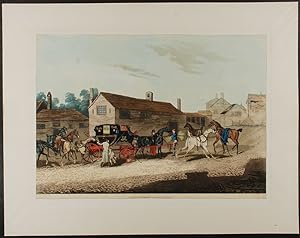
Changing Horses to the Mail Coach
Published by [N.p., but London, 1815
Seller: Donald A. Heald Rare Books (ABAA), New York, NY, U.S.A.
Seller rating 5 out of 5 stars

Art / Print / Poster
Aquatint printed in brown, coloured by hand, by R. Havell. (Trimmed to the image and mounted). A classic Pollard image from the great age of coaching. James Pollard was the youngest son of the London engraver and print-seller Robert Pollard. He began work at the age of fifteen as a painter but quickly turned to engraving as well. In the 1820s his coaching scenes became both fashionable and lucrative. From 1821 he exhibited a small number of pictures at the Royal Academy and the British Institution which brought him more patrons. Between 1830 and 1840, Pollard also painted a number of racing pictures and some of the earliest scenes of steeplechasing. In all his work he took great pains over accuracy. "Changing Horses to the Mail Coach is the first of four prints after James Pollard illustrating this familiar scene on the road" (Selway, The Regency Road, p. 50). Mail was transported in Great Britain via Royal Mail coaches beginning in 1784. They traveled over ever improving roads, thanks to "macadamized" roads, until 1838 when the task was given to the railways. The changing of the mail horses is said to have been accomplished in later years in as little as 45 seconds. Selway James Pollard , p. 40; Selway, Regency Road I.
-

His Majesty King George IV Travelling View Hyde Park
Published by Published & Sold by Edwd Orme, Publisher to the King, Bond Street, Corner of Brook Street,, London,, 1821
Seller: Daniel Crouch Rare Books Ltd, London, United Kingdom
Association Member: ABA ILAB PBFA
Seller rating 4 out of 5 stars

Photograph
Hyde Park Engraving and etching with aquatint and original hand colour. George IV is shown travelling through Hyde Park in a carriage, the year after he became king. The riders and walkers in the park are lifting their hats in greeting and respect. George had spent a long time waiting for the throne. He had been acting as Prince Regent since 1810, after his father George III was stricken by mental illness. The Prince Regent resented his father for not giving him enough money, sending his brothers away for their education, and for making him marry his cousin, Caroline of Brunswick, whom he separated from as soon as they had a child together. He retaliated during his regency by taking several mistresses, the most famous amongst them Maria Fitzherbert, and spending lavishly on grandiose projects like the Brighton Pavilion. George IV enjoyed Hyde Park, and soon after he came to the throne he initiated a plan of improvements, including a new entrance at Hyde Park Corner, railings and John Rennie's bridge over the Serpentine. BM 1966,1210.2. Image: 310 by 450mm (12.25 by 17.75 inches). Sheet: 508 by 648mm (20 by 25.5 inches).
-

Epsom Races. Here they come. To the Noblemen and Gentlemen of the Turf, and the Subscribers this print representing the Horses passing Tattenham Corner for the Derby Stakes is most respectfully dedicated by their obedient and most obliged Servants, S. and J. Fuller
Published by S. & J. Fuller, London, 1834
Seller: Donald A. Heald Rare Books (ABAA), New York, NY, U.S.A.
Seller rating 5 out of 5 stars
Art / Print / Poster
Aquatint, printed in colours and finished by hand, by R.W. Smart and C. Hunt. Image size: 14 x 23 1/2 inches. Early issue on Whatman paper. A fine image capturing the excitement of the moment during the running of the most famous classic race in the world of racing. Lane notes that this is one of a pair of prints, Siltzer and Selway both record a series of four. Pollard here shows the scene as the runners turn into the finishing straight. The crowd is cheering and spectators on horseback urge their mounts on as they dash across towards the inside rails in an effort to get a view of the finish of the race. James Pollard was the youngest son of the London engraver and print-seller Robert Pollard. He began work at the age of fifteen as a painter but quickly turned to engraving as well. In the 1820s his coaching scenes became both fashionable and lucrative. "A stream of coaching paintings followed, many of which he engraved himself. From 1821 he exhibited a small number of pictures at the Royal Academy and the British Institution which brought him more patrons. Between 1830 and 1840, Pollard also painted a number of racing pictures and some of the earliest scenes of steeplechasing on purpose-made courses, many recording the prowess of the few professional and more amateur riders of the day. [In all his work Pollard took great pains over accuracy, this is particularly true of his large scale works and] it is Pollard's large racing scenes which really take off and into which one can gaze and discover a microcosm of the turf" (Charles Lane British Racing Prints p.146) Lane British Racing Prints p.150 (2 prints in the series); cf. SelwayJames Pollard 1792-1867 p.46 (variant title); Siltzer p.221 (4 prints in the series).
-
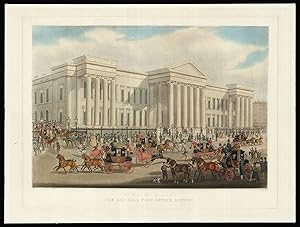
The Royal Mail's Departure from the General Post Office, London
Published by Published by W. Soffe, 288 Strand, [c1830]., London,, 1830
Seller: Daniel Crouch Rare Books Ltd, London, United Kingdom
Association Member: ABA ILAB PBFA
Seller rating 4 out of 5 stars
Photograph
The General's Post Office Engraving with aquatint and hand colour. A view of the General Post Office in the City of London, showing the mail coaches departing. The Post Office was designed by Sir Robert Smirke and built between 1823 and 1829, suggesting that the print was made soon after to celebrate its opening. The British Library holds copies by a further two different publishers, suggesting that the print was popular. James Pollard (1792-1867) was a British painter well known for his sporting and mail coach scenes. BM 1917,1208.2253 and 1873,0712.534 (different publisher); LOC 96507261; Selway 47. Image: 425 by 620mm (16.75 by 24.5 inches). Sheet: 575 by 765mm (22.75 by 30 inches).
-

The Grand Entrance to Hyde Park.
Published by Published by Messrs. Fores at their Sporting and Fine Print Repository and Frame Manufactory, 41 Piccadilly, corner of Sackville Street,, London,, 1844
Seller: Daniel Crouch Rare Books Ltd, London, United Kingdom
Association Member: ABA ILAB PBFA
Seller rating 4 out of 5 stars
Photograph
The Grand Entrance to Hyde Park Engraving with etching and aquatint, original hand colour. A print of the new entrance to Hyde Park, commissioned by George III and designed by Decimus Burton. This is the second state of the print; the first was published in 1828. James Pollard (1792-1867) was a sporting painter and engraver. He began his career engraving his father Robert's pictures, and gained a reputation for his own sporting and coaching scenes after receiving a commission from Edward Orme, the royal printseller, for an inn signboard. BM 1949,0411.5256; Selway 33. Image: 417 by 667mm (16.5 by 26.25 inches). Sheet: 530 by 700mm (20.75 by 27.5 inches).
-

The Elephant and Castle on the Road to Brighton.
Published by Published by J. Watson, 7 Vere Street, Feb. 7th, 1826., London,, 1826
Seller: Daniel Crouch Rare Books Ltd, London, United Kingdom
Association Member: ABA ILAB PBFA
Seller rating 4 out of 5 stars
Photograph
The Elephant and Castle Engraving with aquatint and hand-colour. The Elephant and Castle Inn was a public house and busy staging post, probably deriving its name from the coat of arms of the Cutler's Guild, which feature an elephant as a nod to the use of ivory in cutlery handles. It gives its name to the present area of London. There are a variety of vehicles going past the inn, including a private coach, stage coaches going to Bognor and Brighton, and a wagon. Museum of London 002039. Image: 540 by 766mm (21.25 by 30.25 inches). Sheet: 626 by 815mm (24.75 by 32 inches).
-
![Seller image for [St. Leger. Passing the Judges' Stand] Doncaster Races. To the Noblemen and Gentlemen of the Turf and the Subscribers to the Great St. Leger Stakes, this print representing the Horses passing the Judges Stand, is most respectfully dedicated by their Obedient and most obliged Servants, S. and J. Fuller for sale by Donald A. Heald Rare Books (ABAA)](https://pictures.abebooks.com/inventory/md/md3163727216.jpg)
[St. Leger. Passing the Judges' Stand] Doncaster Races. To the Noblemen and Gentlemen of the Turf and the Subscribers to the Great St. Leger Stakes, this print representing the Horses passing the Judges Stand, is most respectfully dedicated by their Obedient and most obliged Servants, S. and J. Fuller
Published by S. & J. Fuller, London, 1864
Seller: Donald A. Heald Rare Books (ABAA), New York, NY, U.S.A.
Seller rating 5 out of 5 stars
Art / Print / Poster
Aquatint, printed in colours and finished by hand, by R.W. Smart and C. Hunt. A fine image of the horses passing the judges' stand, heading toward the finish. "Passing the Judges' Stand" is a pair with "The Horses Starting for the Great St. Leger." (#18678) The St Leger, known world wide as the oldest classic turf race, was first entitled 'A sweepstake of 25 guineas' and was not given its present name until 3 years later. It was first run on 25 September 1776, as a sweepstake of 2 miles on Cantley Common in Doncaster. (Colts to carry 8 stone and fillies 7 stone 12 pounds). The first race was won by Allabaculia, a brown filly, owned by the Marquess of Rockingham. The second horse past the post was owned by a military gentleman, Lt Colonel Anthony St Leger, of Park Hill estate, near Firbeck, 9 miles from Doncaster. There is some controversy over the naming of the St Leger, some claim it occurred over a meal at The Red Lion in the Market place, others claim it was at the Salutation on South Parade, others at Warmsworth Hall or at Wentworth Woodhouse, the seat of the Marquess of Rotherham. When it was suggested that it should be called the Rockingham Stakes, the Marquess is said to have replied, ' No it was my friend St Leger who suggested the thing to me - call it after him.' The first official St Leger, was won by Hollandaise ridden by George Herring and owned by Sir Thomas Gascoigne. James Pollard was the youngest son of the London engraver and print-seller Robert Pollard. He began work at the age of fifteen as a painter but quickly turned to engraving as well. In the 1820s his coaching scenes became both fashionable and lucrative. "A stream of coaching paintings followed, many of which he engraved himself. From 1821 he exhibited a small number of pictures at the Royal Academy and the British Institution which brought him more patrons. Between 1830 and 1840, Pollard also painted a number of racing pictures and some of the earliest scenes of steeplechasing on purpose-made courses, many recording the prowess of the few professional and more amateur riders of the day. [In all his work Pollard took great pains over accuracy, this is particularly true of his large scale works and] it is Pollard's large racing scenes which really take off and into which one can gaze and discover a microcosm of the turf" (Charles Lane British Racing Prints p.146) Lane British Racing Prints p.149; Selway James Pollard p.45; Siltzer p.221.
-
![Seller image for [St. Leger The Start] Doncaster Races. To the Noblemen and Gentlemen of the Turf, and the Subscribers this print representing the Horses starting for the Great St. Ledger [sic.] Stakes, is most respectfully dedicated by their obedient and most obliged Servants, S. and J. Fuller for sale by Donald A. Heald Rare Books (ABAA)](https://pictures.abebooks.com/inventory/md/md3163727198.jpg)
[St. Leger The Start] Doncaster Races. To the Noblemen and Gentlemen of the Turf, and the Subscribers this print representing the Horses starting for the Great St. Ledger [sic.] Stakes, is most respectfully dedicated by their obedient and most obliged Servants, S. and J. Fuller
Published by S. & J. Fuller, London, 1864
Seller: Donald A. Heald Rare Books (ABAA), New York, NY, U.S.A.
Seller rating 5 out of 5 stars
Art / Print / Poster
Aquatint, printed in colours and finished by hand, by R.W. Smart and C. Hunt. A fine image capturing the excitement of the moment before the pistol is fired to start the St. Leger. ".the Horses starting for the Great St Leger." is a pair with (#18679) ".passing the Judges' stand." also by the great James Pollard The St Leger, known world wide as the oldest classic turf race, was first entitled 'A sweepstake of 25 guineas' and was not given its present name until 3 years later. It was first run on 25 September 1776, as a sweepstake of 2 miles on Cantley Common in Doncaster. (Colts to carry 8 stone and fillies 7 stone 12 pounds). The first race was won by Allabaculia, a brown filly, owned by the Marquess of Rockingham. The second horse past the post was owned by a military gentleman, Lt Colonel Anthony St Leger, of Park Hill estate, near Firbeck, 9 miles from Doncaster. There is some controversy over the naming of the St Leger, some claim it occurred over a meal at The Red Lion in the Market place, others claim it was at the Salutation on South Parade, others at Warmsworth Hall or at Wentworth Woodhouse, the seat of the Marquess of Rotherham. When it was suggested that it should be called the Rockingham Stakes, the Marquess is said to have replied, ' No it was my friend St Leger who suggested the thing to me - call it after him.' The first official St Leger, was won by Hollandaise ridden by George Herring and owned by Sir Thomas Gascoigne. James Pollard was the youngest son of the London engraver and print-seller Robert Pollard. He began work at the age of fifteen as a painter but quickly turned to engraving as well. In the 1820s his coaching scenes became both fashionable and lucrative. "A stream of coaching paintings followed, many of which he engraved himself. From 1821 he exhibited a small number of pictures at the Royal Academy and the British Institution which brought him more patrons. Between 1830 and 1840, Pollard also painted a number of racing pictures and some of the earliest scenes of steeplechasing on purpose-made courses, many recording the prowess of the few professional and more amateur riders of the day. [In all his work Pollard took great pains over accuracy, this is particularly true of his large scale works and] it is Pollard's large racing scenes which really take off and into which one can gaze and discover a microcosm of the turf" (Charles Lane British Racing Prints p.146) Lane British Racing Prints p.149; Selway James Pollard p.45; Siltzer p.221.
-
![Seller image for Epsom Races. (PAIR) Now they're off To the Noblemen and Gentlemen of the Turf, and the Subscribers this print representing the Start for the Derby Stakes. [and] Here they come. To the Noblemen and Gentlemen of the Turf, and the Subscribers this print representing the Horses passing Tattenham Corner for the Derby Stakes. for sale by Donald A. Heald Rare Books (ABAA)](https://pictures.abebooks.com/inventory/md/md3163727202.jpg)
Epsom Races. (PAIR) Now they're off To the Noblemen and Gentlemen of the Turf, and the Subscribers this print representing the Start for the Derby Stakes. [and] Here they come. To the Noblemen and Gentlemen of the Turf, and the Subscribers this print representing the Horses passing Tattenham Corner for the Derby Stakes.
Published by S. & J. Fuller, London, 1834
Seller: Donald A. Heald Rare Books (ABAA), New York, NY, U.S.A.
Seller rating 5 out of 5 stars
Art / Print / Poster
Aquatints, printed in colours and finished by hand, by R.W. Smart and C. Hunt. A fine pair of images capturing the excitement of the start and final turn during the running of one of the five Classic English horse races This sequence of plates depicting two moments in the Derby Stakes could hardly be more exciting. In Now They're Off , anticipation is over, the fierce, thundering movement has begun. In Here They Come, the final stretch is ahead. The horses appear to be moving more quickly than at the beginning. The cheering crowd is jammed against the inner railing, and spectators are riding madly to witness the finish.In fact, a number have fallen off their horses and are sailing through the air. It all takes place on a beautiful afternoon, sky is blue, there are hills in the distance. But all attention is riveted to horses and riders as they go all out for victory. James Pollard was the youngest son of the London engraver and print-seller Robert Pollard. He began work at the age of fifteen as a painter but quickly turned to engraving as well. In the 1820s his coaching scenes became both fashionable and lucrative. "A stream of coaching paintings followed, many of which he engraved himself. From 1821 he exhibited a small number of pictures at the Royal Academy and the British Institution which brought him more patrons. Between 1830 and 1840, Pollard also painted a number of racing pictures and some of the earliest scenes of steeple-chasing on purpose-made courses, many recording the prowess of the few professional and more amateur riders of the day. [In all his work Pollard took great pains over accuracy, this is particularly true of his large scale works and] it is Pollard's large racing scenes which really take off and into which one can gaze and discover a microcosm of the turf" (Charles Lane British Racing Prints p.146) Lane British Racing Prints p.150 (2 prints in the series); cf. SelwayJames Pollard 1792-1867 p.46 (variant title).

