
Melrose Henry (3 results)

Social Mentor Publications Complete 6-Booklet Set: 1) How to Prepare and Serve a Meal and Interior Decoration; 2) Sex: Avoided Subjects Discussed in Plain English; 3) Color Harmony and Design in Dress; 4) The Book of Culture; 5) Physical Beauty: How to Develop and Preserve It; 6) How to Make Money
Lansdown, Lillian B.; Stanton, Henry; Melrose, Millicent; Lane, Harriet; Courtenay, Florence; Dunlap, John V.
Published by Social Mentor Publications, 1922
- Softcover
- First Edition
Seller: Stillwater Books, West Warwick, RI, U.S.A.Stillwater Books
Contact seller5-star sellerSoft cover. Condition: Fair. No Jacket. 1st Edition. Text is free of rips, folds, and marks. Sunbleached spines, encroaching on cover edges, entire front cover #3, 5-6. Cover pulling from textblock #4-6.
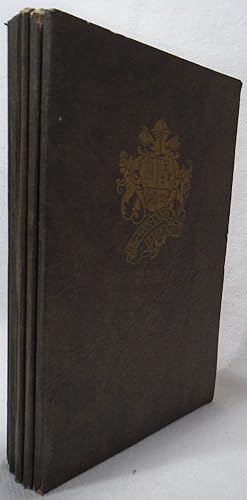
The Womans Library
STANTON, Henry; MELROSE, Millicent; LANSDOWN, Lillian B.; COURTENAY, Florence; LANE, Harriet
Published by Social Culture Publications, New York, 1922
- Hardcover
Seller: Yesterday's Gallery, ABAA, East Woodstock, CT, U.S.A.Yesterday's Gallery, ABAA
Contact seller5-star sellerHardcover. First Edtion. Small Octavo. Brown paper softcovers with gilt decorations on front covers. Five Volumes Entitled The Book of Culture; Physical Beauty: How to Develop and Preserve It; Interior Decoration: How to Prepare and Serve a Meal; Interior Decoration: Color Harmony and Designs in Dress; Avoided Subjects Discussed… in Plain English: Sex. Very good, very light wear to softcovers, Physical Beauty chipped at top spine edge, pages agetoned.

Published by Boston: 9 January 1862, 1862
- Signed
- Manuscript
Seller: James Arsenault & Company, ABAA, Arrowsic, ME, U.S.A.James Arsenault & Company, ABAA
Contact seller5-star sellerNewspaper, 24" x 18.5", 4 pp. CONDITION: Fair, toned and dampstained at upper right, separations along old folds with small losses to text. A scarce issue of this controversial newspaper operated by a white abolitionist to promote the movement of Haitian colonization. This January 9th issue of The Pine and Palm, published just f…ive weeks after John Brown was executed for his raid on Harpers Ferry, contains an account of "The Affair At Ossawatomie, as related by Capt. John Brown to R. N. Rust." The Battle of Osawatomie took place when John Brown and fewer than fifty allies attempted to defend the Free-State community at Osawatomie, Kansas from attack by several hundred pro-slavery men. It also contains pieces on the history of "The Revolutions of Haiti," by M. Saint Amand, "Advocate, former Member of the Constitutional Assembly of Hayti"; "Notes of the Movement" of Haitian colonization from the "Haytian Bureau Department" (run by the paper's proprietor, James Redpath); accounts of Haitian education, religion, agriculture by Bureau agent Henry Melrose; a promotion of Redpath's recently-published Guide to Hayti (1860); several "Haytian Advertisements," as well as a number of circulars on emigration, all signed in print by Redpath; and two "Haytian Melodies" in translation. Before it was purchased and renamed by Scottish-born abolitionist and journalistic firebrand James Redpath in early 1860, The Pine and Palm was the Weekly Anglo-African, founded in 1859 by Thomas Hamilton, a Black New Yorker who ran it as an open forum for African Americans "to give vent to our opinions and feelingsto compare notes with each otherto discus the best plans to pursue, to sympathize if suffering come, to rejoice if victory come" (Fielder et al). When Redpath took over the paper, it became the primary organ for the movement of Haitian colonization. In contrast to many abolitionists, who opposed colonization schemes, and unlike the American Colonization Society, which promoted African colonization (often for racist reasons), Redpath championed Haiti as the country where the Black and the man of color are indisputed lordswhere neither laws, nor prejudice, nor historical memories press cruelly on persons of African descent; where the people whom America degrades and drives from her are rulers, judges, and generalsauthors, artists, and legislators." (A Guide to Hayti, p. 9) After three visits to the island nation in 1859 and 1860, Redpath devised a plan with Haitian President Fabre Geffrard for "inviting an immigration into Hayti of all the enlightened and industrious men of African descent" in North America, and became the official diplomatic agent for the cause. The paper's Black readership, however, was unconvinced, publishing a statement in the Christian Recorder that we firmly, flatly, uncompromisingly oppose, condemn and denounce as unfair and unjust, as unwise and as unchristian, the fleeing, colonizing efforts urged by James Redpath, the white, seconded by George Lawrence, Jr., the black, who is employed by him[and] we do declare that he is not justified in the deceptive policy of placing at the head of the paper, like the figure-head of a ship, the name of George Lawrence, Jr., a colored man, although he has him in his employ; nor is he justified as a professed anti-slavery man, in closing the columns of the paper to a discussion of matters of public and general interest to the colored people, neither in making personal attacks upon individuals without permitting a reply. (May 25, 1861) Operated by Redpath, financed by the Haitian government, editedat least nominallyby George Lawrence Jr., and printed out of the same building as William Lloyd Garrison's Liberator, The Pine and Palm became what scholars Brigitte Fielder, Cassander Smith, and Derrick R. Spires call "a concentrated case study of all of the fault lines invoked in the terms 'black press,' 'black print culture,' and 'black community.'" Hamilton and his brother Robert revived t.

