

Order Total (1 Item Items):
Shipping Destination:

Mark Seligman (110 results)
Skip to main search results
Search filters
Product Type
- All Product Types
- Books (110)
- Magazines & Periodicals (No further results match this refinement)
- Comics (No further results match this refinement)
- Sheet Music (No further results match this refinement)
- Art, Prints & Posters (No further results match this refinement)
- Photographs (No further results match this refinement)
- Maps (No further results match this refinement)
- Manuscripts & Paper Collectibles (No further results match this refinement)
Condition Learn more
Binding
Collectible Attributes
- First Edition (5)
- Signed (No further results match this refinement)
- Dust Jacket (No further results match this refinement)
- Seller-Supplied Images (32)
- Not Print on Demand (86)
Language (2)
Free Shipping
Seller Location
Seller Rating
-
Hardcover. Condition: Fair. No Jacket. Readable copy. Pages may have considerable notes/highlighting. ~ ThriftBooks: Read More, Spend Less.
-

Market and Community: The Bases of Social Order, Revolution, and Relegitimation
Language: English
Published by Penn State University Press, 2000
ISBN 10: 0271020814 ISBN 13: 9780271020815
paperback. Condition: Good. Used items may contain, highlighting, writing, and other previous signs of use. Used items may not contain CD's. access codes and other accompanying items when applicable. **MAY BE AN EX LIBRARY COPY**.
-
Hardcover. Condition: Good. No Jacket. Pages can have notes/highlighting. Spine may show signs of wear. ~ ThriftBooks: Read More, Spend Less.
-

Condition: good. Missing dust cover, otherwise book is in good condition with some wear from normal use.
-
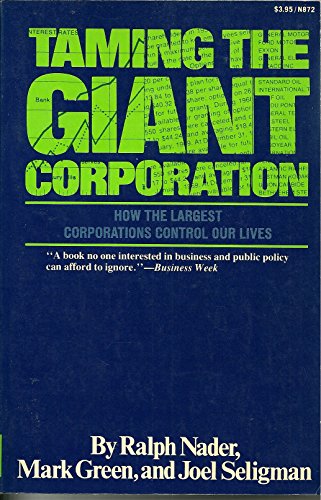
Taming the Giant Corporation
Language: English
Published by Norton & Company, Incorporated, W. W., 1976
ISBN 10: 0393087530 ISBN 13: 9780393087536
Seller: Better World Books Ltd, Dunfermline, United Kingdom
Seller rating 5 out of 5 stars

Condition: Good. Pages intact with minimal writing/highlighting. The binding may be loose and creased. Dust jackets/supplements are not included. Stock photo provided. Product includes identifying sticker. Better World Books: Buy Books. Do Good.
-

Paperback. Condition: Very Good. No Jacket. May have limited writing in cover pages. Pages are unmarked. ~ ThriftBooks: Read More, Spend Less.
-
Taming the Giant Corporation
Language: English
Published by W. W. Norton & Company, Inc., New York, 1976
ISBN 10: 0393087530 ISBN 13: 9780393087536
Seller: BookEnds Bookstore & Curiosities, Ojai, CA, U.S.A.
Seller rating 5 out of 5 stars
First Edition
Hardcover. Condition: Very Good +. 1st Edition. Very Good + condition Hardcover black boards with gilt lettering on the spine. Includes Notes and Index, 312 pages. The DJ is in Very Good + condition.
-

Condition: New.
-

AI and ADA: Artificial Translation and Creation of Literature (Paperback or Softback)
Language: English
Published by First Hill Books 10/7/2025, 2025
ISBN 10: 183999438X ISBN 13: 9781839994388
Paperback or Softback. Condition: New. AI and ADA: Artificial Translation and Creation of Literature. Book.
-

Condition: As New. Unread book in perfect condition.
-

Taming the Giant Corporation : How the Largest Corporations Control Our Lives
Language: English
Published by W. W. Norton & Company, 1977
ISBN 10: 039300872X ISBN 13: 9780393008722
Condition: New.
-
Condition: New.
-

Taming the Giant Corporation : How the Largest Corporations Control Our Lives
Language: English
Published by W. W. Norton & Company, 1977
ISBN 10: 039300872X ISBN 13: 9780393008722
Condition: As New. Unread book in perfect condition.
-

Taming the Giant Corporation: How the Largest Corporations Control Our LIves
Published by W.W. Norton & Company
Seller: Wonder Book, Frederick, MD, U.S.A.
Seller rating 5 out of 5 stars
Condition: Good. Good condition. (Business, Corporation Law, Industrial Policy).
-

Paperback. Condition: New. PrefaceThe book's Preface places the current AI explosion in the context of other technological cataclysms and recounts the author's personal (and not always deadly serious) AI journey.Chapter One: "Extracting the Essence: Toward Machine Translation of Literature" This 2019 essay rashly inquired whether artificial intelligence (AI) and machine translation (MT) might eventually be applied to literary translation. Such translation strives to somehow preserve the essence of a work while carrying it over to a different language and culture and giving it rebirth there. To recognize that essence, the translator must accurately capture the meaning of the original; appreciate its metaphors, connotations, register, references, and other abstract or associative factors; and choose among available target language expressions by exercising esthetic judgments. Computers, however, have until recently remained incapable of such accuracy, abstraction, and judgment. We revisited these shortfalls in light of developments in MT and AI. We teased apart several separable aspects of literary translation - literal meaning, meter, rhyme, and the abovementioned associative elements - with reference to arguments about Vladimir Nabokov's hyper-literal translation of Pushkin's poem Eugene Onegin. Prompted by this debate, we came to analyze translation as an optimization problem: because it will often prove impossible to perfectly convey all aspects or essences of a text in a single translation, the translator must search for some optimal compromise. Then we discussed several avenues for improvement in MT which could help to extract these aspects of a text's essence - first, those which might enhance textually grounded MT (i.e., MT trained on text only), leading to delivery of high-quality literal translations; and second, those related to perceptually grounded MT (i.e., MT trained on simulated perception, e.g. of audiovisual input, as well as text), which might extract more abstract or associative elements of a text. We suggested that recognition of categories would prove central to the essence extraction sought by translators. As this categorization improves, MT should increasingly support literary, and thus cultural, preservation. However, the deepest artificial esthetic judgments will await artificial emotion. Chapter One concluded with two appendices, the first sampling numerous competing translations of Pushkin verses and the second displaying widely varying translations of a short French poem.Chapter Two: "Toward an Artificial Nabokov"Chapter One inquired whether artificial translation of literature might be at all possible. The cautious conclusion was that while high-quality literal translation might be achievable through foreseeable development of current techniques, artistic translation would await artificial emotion, a more distant prospect. This 2021 sequel went on to ask whether an artificial intelligence might eventually gain the ability to actually create work.
-
PAP. Condition: New. New Book. Shipped from UK. Established seller since 2000.
-
Mark Tobey: Exhibition -- December 1965
Published by Otto Seligman Gallery, [Seattle, WA], 1965
First Edition
Paperback. Condition: Very Good. Color and b/w Illustrations (illustrator). First Edition. 4to - over 9¾" - 12" Tall (small). In tan wraps with pictorial upper cover, 4to, 36pp. Illustrated with color tipped-in illustrations. (light fading to covers at spine).
-
PAP. Condition: New. New Book. Shipped from UK. Established seller since 2000.
-

Market and Community : The Bases of Social Order, Revolution, and Relegitimation
Language: English
Published by Penn State University Press, 2000
ISBN 10: 0271020814 ISBN 13: 9780271020815
Condition: New.
-
Market and Community: The Bases of Social Order, Revolution, and Relegitimation
Language: English
Published by Penn State University Press, 2000
ISBN 10: 0271020814 ISBN 13: 9780271020815
Condition: New.
-

Condition: Very Good. Very Good Condition. Five star seller - Buy with confidence!
-
Paperback. Condition: Good. No Jacket. Pages can have notes/highlighting. Spine may show signs of wear. ~ ThriftBooks: Read More, Spend Less.
-
Paperback. Condition: Very Good. No Jacket. May have limited writing in cover pages. Pages are unmarked. ~ ThriftBooks: Read More, Spend Less.
-
Mommy, When Will The Lord be Two? A Child's Eye View of Being Jewish Today.
Language: English
Published by Kensington Books New York, 1999
ISBN 10: 1575664704 ISBN 13: 9781575664705
Pb. New.
-

Market and Community : The Bases of Social Order, Revolution, and Relegitimation
Language: English
Published by Penn State University Press, 2000
ISBN 10: 0271020814 ISBN 13: 9780271020815
Condition: As New. Unread book in perfect condition.
-
AI and Ada (Paperback)
Language: English
Published by Anthem Press, London, 2025
ISBN 10: 183999438X ISBN 13: 9781839994388
Paperback. Condition: new. Paperback. Taking recent spectacular progress in AI fully into account, this book explores prospects for artificial literary translation and composition, with frequent reference to the hyperconscious literary art of Vladimir Nabokov. The exploration balances reader-friendly explanation ('What are transformers?') and original insights ('What is intelligence? What is language?') with personal and playful notes, and culminates in an assortment of striking demos.This volume first explores the potential of machine translation of literature; goes on to explore possibilities for artificial literary creation; and finishes by assessing recent spectacular progress in generative artificial intelligence (AI) throughout, with reference to Vladimir Nabokov's hyperconscious literary art. This volume first explores the potential of machine translation of literature; goes on to explore possibilities for artificial literary creation; and finishes by assessing recent spectacular progress in generative artificial intelligence (AI) throughout, with reference to Vladimir Nabokov's hyperconscious literary art. Shipping may be from multiple locations in the US or from the UK, depending on stock availability.
-

The Psychology of Values: The Ontario Symposium, Volume 8 (Ontario Symposia on Personality and Social Psychology Series)
Book 2 of 9: Ontario Symposia on Personality and Social Psychology SeriesLanguage: English
Published by Lawrence Erlbaum Assoociates, 1996
ISBN 10: 0805815740 ISBN 13: 9780805815740
Seller: Rosario Beach Rare Books, Lake Stevens, WA, U.S.A.
Association Member: CBA ESA IOBA
Seller rating 5 out of 5 stars
First Edition
Hardcover. Condition: Good. 1st Edition. *Veteran-Owned, Family-Run, Small Book Store in the Pacific Northwest* / Former library book, but clean text, no markings in text, no underlining, no highlighting, tight binding.
-
Paperback. Condition: Brand New. 200 pages. 8.50x5.51x0.50 inches. In Stock.
-

Paperback. Condition: New. PrefaceThe book's Preface places the current AI explosion in the context of other technological cataclysms and recounts the author's personal (and not always deadly serious) AI journey.Chapter One: "Extracting the Essence: Toward Machine Translation of Literature" This 2019 essay rashly inquired whether artificial intelligence (AI) and machine translation (MT) might eventually be applied to literary translation. Such translation strives to somehow preserve the essence of a work while carrying it over to a different language and culture and giving it rebirth there. To recognize that essence, the translator must accurately capture the meaning of the original; appreciate its metaphors, connotations, register, references, and other abstract or associative factors; and choose among available target language expressions by exercising esthetic judgments. Computers, however, have until recently remained incapable of such accuracy, abstraction, and judgment. We revisited these shortfalls in light of developments in MT and AI. We teased apart several separable aspects of literary translation - literal meaning, meter, rhyme, and the abovementioned associative elements - with reference to arguments about Vladimir Nabokov's hyper-literal translation of Pushkin's poem Eugene Onegin. Prompted by this debate, we came to analyze translation as an optimization problem: because it will often prove impossible to perfectly convey all aspects or essences of a text in a single translation, the translator must search for some optimal compromise. Then we discussed several avenues for improvement in MT which could help to extract these aspects of a text's essence - first, those which might enhance textually grounded MT (i.e., MT trained on text only), leading to delivery of high-quality literal translations; and second, those related to perceptually grounded MT (i.e., MT trained on simulated perception, e.g. of audiovisual input, as well as text), which might extract more abstract or associative elements of a text. We suggested that recognition of categories would prove central to the essence extraction sought by translators. As this categorization improves, MT should increasingly support literary, and thus cultural, preservation. However, the deepest artificial esthetic judgments will await artificial emotion. Chapter One concluded with two appendices, the first sampling numerous competing translations of Pushkin verses and the second displaying widely varying translations of a short French poem.Chapter Two: "Toward an Artificial Nabokov"Chapter One inquired whether artificial translation of literature might be at all possible. The cautious conclusion was that while high-quality literal translation might be achievable through foreseeable development of current techniques, artistic translation would await artificial emotion, a more distant prospect. This 2021 sequel went on to ask whether an artificial intelligence might eventually gain the ability to actually create work.
-
Mommy, When Will The Lord Be Two?: A Child's Eye View of Being Jewish Today
Seller: Robinson Street Books, IOBA, Binghamton, NY, U.S.A.
Association Member: IOBA
Seller rating 4 out of 5 stars

Paperback. Condition: Very Good. Prompt Shipment, shipped in Boxes, Tracking PROVIDEDReligion - Judaism Very good. Minor creasing. Clean copy.


