
Order Total (1 Item Items):
Shipping Destination:

Linderoth Bengt (21 results)
Skip to main search results
Search filters
Product Type
- All Product Types
- Books (21)
- Magazines & Periodicals (No further results match this refinement)
- Comics (No further results match this refinement)
- Sheet Music (No further results match this refinement)
- Art, Prints & Posters (No further results match this refinement)
- Photographs (No further results match this refinement)
- Maps (No further results match this refinement)
- Manuscripts & Paper Collectibles (No further results match this refinement)
Condition Learn more
- New (18)
- As New, Fine or Near Fine (2)
- Very Good or Good (1)
- Fair or Poor (No further results match this refinement)
- As Described (No further results match this refinement)
Binding
Collectible Attributes
- First Edition (No further results match this refinement)
- Signed (No further results match this refinement)
- Dust Jacket (No further results match this refinement)
- Seller-Supplied Images (9)
- Not Print on Demand (14)
Language (1)
Free Shipping
Seller Location
Seller Rating
-
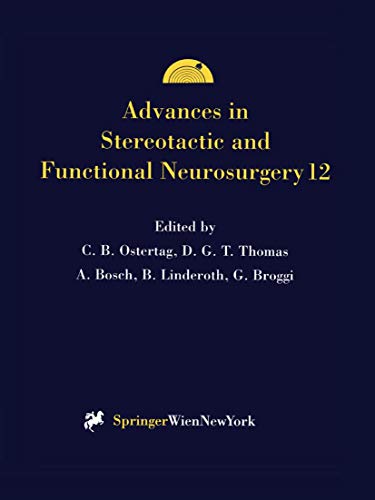
Advances in Stereotactic and Functional Neurosurgery 12: Proceedings of the 12th Meeting of the European Society for Stereotactic and Functional . (Acta Neurochirurgica Supplement) (v. 12)
Book 44 of 91: Acta Neurochirurgica SupplementSeller: The Book Bin, Salem, OR, U.S.A.
Association Member: ABAA CBA ILAB
Seller rating 5 out of 5 stars

Hardcover. Condition: Very Good. Book is in very good condition. Light corner and edge wear. Interior pages are crisp and clean. Dust Jacket has shelf wear and light edge wear.
-
Advances in Stereotactic and Functional Neurosurgery 12: Proceedings of the 12th Meeting of the European Society for Stereotactic and Functional . (Acta Neurochirurgica Supplement) (v. 12)
Book 44 of 91: Acta Neurochirurgica SupplementSeller: The Book Bin, Salem, OR, U.S.A.
Association Member: ABAA CBA ILAB
Seller rating 5 out of 5 stars
Hardcover. Condition: As New. In manufacturer's shrink wrap.
-
Condition: Brand New. New. US edition. Expediting shipping for all USA and Europe orders excluding PO Box. Excellent Customer Service.
-
Condition: New. This is a Brand-new US Edition. This Item may be shipped from US or any other country as we have multiple locations worldwide.
-
-
-
Brand new book. Fast ship. Please provide full street address as we are not able to ship to P O box address.
-
-

-
Advances in Stereotactic and Functional Neurosurgery 12: Proceedings of the 12th Meeting of the European Society for Stereotactic and Functional Neurosurgery, Milan 1996
Book 44 of 91: Acta Neurochirurgica SupplementSeller: Ria Christie Collections, Uxbridge, United Kingdom
Seller rating 5 out of 5 stars
£ 134.30
£ 11.98 shipping
Ships from United Kingdom to U.S.A.Quantity: Over 20 available
Add to basketCondition: New. In.
-
-

Taschenbuch. Condition: Neu. Druck auf Anfrage Neuware - Printed after ordering - Neurosurgery o/the Future: Computers and Robots in Clinical Neurosurgical Practice and in Training - a Philosophical Journey into the Future Many present day neurosurgeons believe that they already obtain good results in operative surgery with the benefit of the operating microscope and other aids which have become available in the last three decades and that the introduction of computers and robots to the operating theatre is superfluous. However, it is clear from analogy with the function of the airline pilot, another profession where there are great demands on manual skill and on spatial awareness, that these devices do have much to offer neurosurgery. Classical neurosurgery, in the time of Cushing, Dandy and Scarff, was based on a three dimensional picture of the patient's brain formed in the surgeon's mind and often illustrated in elegant drawings. Such pictures were based on neuroradiological studies by pneumoencephalography, ventriculography or by angiography. Generally these stud ies showed the presence and position of a lesion by displacement of normal brain structures and the picture was built up by interference. This was then converted by the experienced neurosurgeon into a plan for the craniotomy site and the trajectory of the surgical approach. Once the brain was exposed further pre-operative information was obtained by visual inspection and by palpation with the brain needle. These classical forms ofneuroradiology have largely been superseded by computerised tomography and by magnetic resonance imaging.
-

Buch. Condition: Neu. Druck auf Anfrage Neuware - Printed after ordering - Neurosurgery o/the Future: Computers and Robots in Clinical Neurosurgical Practice and in Training - a Philosophical Journey into the Future Many present day neurosurgeons believe that they already obtain good results in operative surgery with the benefit of the operating microscope and other aids which have become available in the last three decades and that the introduction of computers and robots to the operating theatre is superfluous. However, it is clear from analogy with the function of the airline pilot, another profession where there are great demands on manual skill and on spatial awareness, that these devices do have much to offer neurosurgery. Classical neurosurgery, in the time of Cushing, Dandy and Scarff, was based on a three dimensional picture of the patient's brain formed in the surgeon's mind and often illustrated in elegant drawings. Such pictures were based on neuroradiological studies by pneumoencephalography, ventriculography or by angiography. Generally these stud ies showed the presence and position of a lesion by displacement of normal brain structures and the picture was built up by interference. This was then converted by the experienced neurosurgeon into a plan for the craniotomy site and the trajectory of the surgical approach. Once the brain was exposed further pre-operative information was obtained by visual inspection and by palpation with the brain needle. These classical forms ofneuroradiology have largely been superseded by computerised tomography and by magnetic resonance imaging.
-
-

Advances in Stereotactic and Functional Neurosurgery 12
Book 44 of 91: Acta Neurochirurgica SupplementLanguage: English
Published by Springer Vienna Okt 2012, 2012
ISBN 10: 3709173418 ISBN 13: 9783709173411
Seller: BuchWeltWeit Ludwig Meier e.K., Bergisch Gladbach, Germany
Seller rating 5 out of 5 stars
Taschenbuch. Condition: Neu. This item is printed on demand - it takes 3-4 days longer - Neuware -Neurosurgery o/the Future: Computers and Robots in Clinical Neurosurgical Practice and in Training - a Philosophical Journey into the Future Many present day neurosurgeons believe that they already obtain good results in operative surgery with the benefit of the operating microscope and other aids which have become available in the last three decades and that the introduction of computers and robots to the operating theatre is superfluous. However, it is clear from analogy with the function of the airline pilot, another profession where there are great demands on manual skill and on spatial awareness, that these devices do have much to offer neurosurgery. Classical neurosurgery, in the time of Cushing, Dandy and Scarff, was based on a three dimensional picture of the patient's brain formed in the surgeon's mind and often illustrated in elegant drawings. Such pictures were based on neuroradiological studies by pneumoencephalography, ventriculography or by angiography. Generally these stud ies showed the presence and position of a lesion by displacement of normal brain structures and the picture was built up by interference. This was then converted by the experienced neurosurgeon into a plan for the craniotomy site and the trajectory of the surgical approach. Once the brain was exposed further pre-operative information was obtained by visual inspection and by palpation with the brain needle. These classical forms ofneuroradiology have largely been superseded by computerised tomography and by magnetic resonance imaging. 160 pp. Englisch.
-

Advances in Stereotactic and Functional Neurosurgery 12
Book 44 of 91: Acta Neurochirurgica SupplementLanguage: English
Published by Springer Vienna Jun 1997, 1997
ISBN 10: 3211829784 ISBN 13: 9783211829783
Seller: BuchWeltWeit Ludwig Meier e.K., Bergisch Gladbach, Germany
Seller rating 5 out of 5 stars
Buch. Condition: Neu. This item is printed on demand - it takes 3-4 days longer - Neuware -Neurosurgery o/the Future: Computers and Robots in Clinical Neurosurgical Practice and in Training - a Philosophical Journey into the Future Many present day neurosurgeons believe that they already obtain good results in operative surgery with the benefit of the operating microscope and other aids which have become available in the last three decades and that the introduction of computers and robots to the operating theatre is superfluous. However, it is clear from analogy with the function of the airline pilot, another profession where there are great demands on manual skill and on spatial awareness, that these devices do have much to offer neurosurgery. Classical neurosurgery, in the time of Cushing, Dandy and Scarff, was based on a three dimensional picture of the patient's brain formed in the surgeon's mind and often illustrated in elegant drawings. Such pictures were based on neuroradiological studies by pneumoencephalography, ventriculography or by angiography. Generally these stud ies showed the presence and position of a lesion by displacement of normal brain structures and the picture was built up by interference. This was then converted by the experienced neurosurgeon into a plan for the craniotomy site and the trajectory of the surgical approach. Once the brain was exposed further pre-operative information was obtained by visual inspection and by palpation with the brain needle. These classical forms ofneuroradiology have largely been superseded by computerised tomography and by magnetic resonance imaging. 160 pp. Englisch.
-

Condition: New. Dieser Artikel ist ein Print on Demand Artikel und wird nach Ihrer Bestellung fuer Sie gedruckt. Neurosurgery o/the Future: Computers and Robots in Clinical Neurosurgical Practice and in Training - a Philosophical Journey into the Future Many present day neurosurgeons believe that they already obtain good results in operative surgery with the benefit o.
-

Condition: New. Dieser Artikel ist ein Print on Demand Artikel und wird nach Ihrer Bestellung fuer Sie gedruckt. Neurosurgery o/the Future: Computers and Robots in Clinical Neurosurgical Practice and in Training - a Philosophical Journey into the Future Many present day neurosurgeons believe that they already obtain good results in operative surgery with the benefit o.
-
Taschenbuch. Condition: Neu. Advances in Stereotactic and Functional Neurosurgery 12 | Proceedings of the 12th Meeting of the European Society for Stereotactic and Functional Neurosurgery, Milan 1996 | Christoph B. Ostertag (u. a.) | Taschenbuch | x | Englisch | 2012 | Springer | EAN 9783709173411 | Verantwortliche Person für die EU: Springer Verlag GmbH, Tiergartenstr. 17, 69121 Heidelberg, juergen[dot]hartmann[at]springer[dot]com | Anbieter: preigu Print on Demand.
-

Advances in Stereotactic and Functional Neurosurgery 12
Book 44 of 91: Acta Neurochirurgica SupplementLanguage: English
Published by Springer Vienna Jun 1997, 1997
ISBN 10: 3211829784 ISBN 13: 9783211829783
Seller: buchversandmimpf2000, Emtmannsberg, BAYE, Germany
Seller rating 5 out of 5 stars
Buch. Condition: Neu. This item is printed on demand - Print on Demand Titel. Neuware -Neurosurgery o/the Future: Computers and Robots in Clinical Neurosurgical Practice and in Training - a Philosophical Journey into the Future Many present day neurosurgeons believe that they already obtain good results in operative surgery with the benefit of the operating microscope and other aids which have become available in the last three decades and that the introduction of computers and robots to the operating theatre is superfluous. However, it is clear from analogy with the function of the airline pilot, another profession where there are great demands on manual skill and on spatial awareness, that these devices do have much to offer neurosurgery. Classical neurosurgery, in the time of Cushing, Dandy and Scarff, was based on a three dimensional picture of the patient's brain formed in the surgeon's mind and often illustrated in elegant drawings. Such pictures were based on neuroradiological studies by pneumoencephalography, ventriculography or by angiography. Generally these stud ies showed the presence and position of a lesion by displacement of normal brain structures and the picture was built up by interference. This was then converted by the experienced neurosurgeon into a plan for the craniotomy site and the trajectory of the surgical approach. Once the brain was exposed further pre-operative information was obtained by visual inspection and by palpation with the brain needle. These classical forms ofneuroradiology have largely been superseded by computerised tomography and by magnetic resonance imaging. 160 pp. Englisch.
-

Advances in Stereotactic and Functional Neurosurgery 12
Book 44 of 91: Acta Neurochirurgica SupplementLanguage: English
Published by Springer Vienna Okt 2012, 2012
ISBN 10: 3709173418 ISBN 13: 9783709173411
Seller: buchversandmimpf2000, Emtmannsberg, BAYE, Germany
Seller rating 5 out of 5 stars
Taschenbuch. Condition: Neu. This item is printed on demand - Print on Demand Titel. Neuware -Neurosurgery o/the Future: Computers and Robots in Clinical Neurosurgical Practice and in Training - a Philosophical Journey into the Future Many present day neurosurgeons believe that they already obtain good results in operative surgery with the benefit of the operating microscope and other aids which have become available in the last three decades and that the introduction of computers and robots to the operating theatre is superfluous. However, it is clear from analogy with the function of the airline pilot, another profession where there are great demands on manual skill and on spatial awareness, that these devices do have much to offer neurosurgery. Classical neurosurgery, in the time of Cushing, Dandy and Scarff, was based on a three dimensional picture of the patient's brain formed in the surgeon's mind and often illustrated in elegant drawings. Such pictures were based on neuroradiological studies by pneumoencephalography, ventriculography or by angiography. Generally these stud ies showed the presence and position of a lesion by displacement of normal brain structures and the picture was built up by interference. This was then converted by the experienced neurosurgeon into a plan for the craniotomy site and the trajectory of the surgical approach. Once the brain was exposed further pre-operative information was obtained by visual inspection and by palpation with the brain needle. These classical forms ofneuroradiology have largely been superseded by computerised tomography and by magnetic resonance imaging.Springer Verlag GmbH, Tiergartenstr. 17, 69121 Heidelberg 160 pp. Englisch.


