

Order Total (1 Item Items):
Shipping Destination:

Kraye Saarinen (23 results)
Skip to main search results
Search filters
Product Type
- All Product Types
- Books (23)
- Magazines & Periodicals (No further results match this refinement)
- Comics (No further results match this refinement)
- Sheet Music (No further results match this refinement)
- Art, Prints & Posters (No further results match this refinement)
- Photographs (No further results match this refinement)
- Maps (No further results match this refinement)
- Manuscripts & Paper Collectibles (No further results match this refinement)
Condition Learn more
- New (19)
- As New, Fine or Near Fine (3)
- Very Good or Good (No further results match this refinement)
- Fair or Poor (No further results match this refinement)
- As Described (1)
Binding
Collectible Attributes
- First Edition (No further results match this refinement)
- Signed (No further results match this refinement)
- Dust Jacket (No further results match this refinement)
- Seller-Supplied Images (11)
- Not Print on Demand (19)
Language (2)
Price
- Any Price
- Under £ 20 (No further results match this refinement)
- £ 20 to £ 35 (No further results match this refinement)
- Over £ 35
Free Shipping
Seller Location
Seller Rating
-

Moral Philosophy on the Threshold of Modernity (The New Synthese Historical Library, 57)
Book 5 of 60: Synthese Historical LibrarySeller: Ria Christie Collections, Uxbridge, United Kingdom
Seller rating 5 out of 5 stars

£ 137.84
£ 11.98 shipping
Ships from United Kingdom to U.S.A.Quantity: Over 20 available
Add to basketCondition: New. In.
-

-
-
Condition: As New. Unread book in perfect condition.
-

Moral Philosophy On The Threshold Of Modernity
Book 5 of 60: Synthese Historical LibrarySeller: GreatBookPricesUK, Woodford Green, United Kingdom
Seller rating 5 out of 5 stars
£ 137.83
£ 15 shipping
Ships from United Kingdom to U.S.A.Quantity: Over 20 available
Add to basketCondition: New.
-
Moral Philosophy On The Threshold Of Modernity
Book 5 of 60: Synthese Historical LibrarySeller: GreatBookPricesUK, Woodford Green, United Kingdom
Seller rating 5 out of 5 stars
£ 152.32
£ 15 shipping
Ships from United Kingdom to U.S.A.Quantity: Over 20 available
Add to basketCondition: As New. Unread book in perfect condition.
-

Moral Philosophy on the Threshold of Modernity
Book 5 of 60: Synthese Historical LibraryLanguage: English
Published by Springer-Verlag New York Inc., US, 2005
ISBN 10: 1402030002 ISBN 13: 9781402030000
Seller: Rarewaves.com USA, London, LONDO, United Kingdom
Seller rating 5 out of 5 stars
£ 179.37
Free Shipping
Ships from United Kingdom to U.S.A.Quantity: Over 20 available
Add to basketHardback. Condition: New. 2005 ed.
-
Condition: New. pp. 352.
-
Taschenbuch. Condition: Neu. Moral Philosophy on the Threshold of Modernity | Jill Kraye (u. a.) | Taschenbuch | The New Synthese Historical Library | vi | Englisch | 2010 | Springer | EAN 9789048167654 | Verantwortliche Person für die EU: Springer Verlag GmbH, Tiergartenstr. 17, 69121 Heidelberg, juergen[dot]hartmann[at]springer[dot]com | Anbieter: preigu.
-
Condition: New. pp. 352 52:B&W 6.14 x 9.21in or 234 x 156mm (Royal 8vo) Case Laminate on White w/Gloss Lam.
-

Moral Philosophy on the Threshold of Modernity (The New Synthese Historical Library, 57)
Book 5 of 60: Synthese Historical LibrarySeller: Ria Christie Collections, Uxbridge, United Kingdom
Seller rating 5 out of 5 stars
£ 184.44
£ 11.98 shipping
Ships from United Kingdom to U.S.A.Quantity: Over 20 available
Add to basketCondition: New. In.
-

Moral Philosophy on the Threshold of Modernity
Book 5 of 60: Synthese Historical LibraryLanguage: English
Published by Springer Netherlands, 2005
ISBN 10: 1402030002 ISBN 13: 9781402030000
Condition: New. Over the past twenty years the transition from the late Middle Ages to the early modern era has received increasing attention from experts in the history of philosophy. In part, this new interest arises from claims, made in literature aimed at a less specia.
-
Condition: New. pp. 352.
-
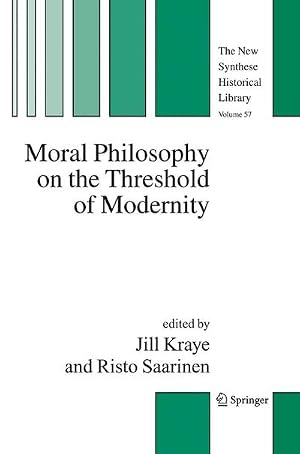
Taschenbuch. Condition: Neu. Druck auf Anfrage Neuware - Printed after ordering - Over the past twenty years the transition from the late Middle Ages to the early modern era has received increasing attention from experts in the history of philosophy. In part, this new interest arises from claims, made in literature aimed at a less specialist readership, that this transition was responsible for the subsequent philosophical and theological problems of the Enlightenment. Philosophers like Alasdair MacIntyre and theologians like John Milbank display a certain nostalgia for the medieval synthesis of Thomas Aquinas and, consequently, evaluate the period from 1300 to 1700 in rather negative terms. Other historians of philosophy writing for the general public, such as Charles Taylor, take a more positive view of the Reformation but nevertheless conclude that modernity has been shaped by 1 conflicts which stem from early modern times. Ethics and moral thought occupy a central place in these theories. It is assumed that we have lost something - the concept of virtue, for instance, or the source of common morality. Yet those who put forward such notions do not treat the history of ethics in detail. From the historian's perspective, their far-reaching theoretical assumptions are based on a quite small body of textual evidence. In reality, there was a rich variety of approaches to moral thinking and ethical theories during the period from 1400 to 1600.
-
Paperback. Condition: Brand New. 350 pages. 9.45x6.30x0.80 inches. In Stock.
-
Paperback. Condition: Like New. LIKE NEW. SHIPS FROM MULTIPLE LOCATIONS. book.
-
Moral Philosophy on the Threshold of Modernity: 57 (The New Synthese Historical Library, 57)
Book 5 of 60: Synthese Historical Library£ 164.39
£ 65 shipping
Ships from United Kingdom to U.S.A.Quantity: Over 20 available
Add to basketPaperback. Condition: New. 2005th.
-

Buch. Condition: Neu. Neuware - Over the past twenty years the transition from the late Middle Ages to the early modern era has received increasing attention from experts in the history of philosophy. In part, this new interest arises from claims, made in literature aimed at a less specialist readership, that this transition was responsible for the subsequent philosophical and theological problems of the Enlightenment. Philosophers like Alasdair MacIntyre and theologians like John Milbank display a certain nostalgia for the medieval synthesis of Thomas Aquinas and, consequently, evaluate the period from 1300 to 1700 in rather negative terms. Other historians of philosophy writing for the general public, such as Charles Taylor, take a more positive view of the Reformation but nevertheless conclude that modernity has been shaped by 1 conflicts which stem from early modern times. Ethics and moral thought occupy a central place in these theories. It is assumed that we have lost something - the concept of virtue, for instance, or the source of common morality. Yet those who put forward such notions do not treat the history of ethics in detail. From the historian's perspective, their far-reaching theoretical assumptions are based on a quite small body of textual evidence. In reality, there was a rich variety of approaches to moral thinking and ethical theories during the period from 1400 to 1600.
-

Moral philosophy on the threshold of modernity.
Seller: Antiquariaat Isis, Groningen, Netherlands
Seller rating 5 out of 5 stars
Dordrecht, Springer, 2005. (VI) 340 pp. Hardcover. (NSHL, 57) *fine condition* Contributors: David Lines, M.W.F. Stone, S.K. Knebel, J. Varkemaa a.o.
-
Condition: new. Questo è un articolo print on demand.
-

Moral Philosophy on the Threshold of Modernity
Book 5 of 60: Synthese Historical LibraryLanguage: English
Published by Springer Netherlands Okt 2010, 2010
ISBN 10: 9048167655 ISBN 13: 9789048167654
Seller: BuchWeltWeit Ludwig Meier e.K., Bergisch Gladbach, Germany
Seller rating 5 out of 5 stars
Taschenbuch. Condition: Neu. This item is printed on demand - it takes 3-4 days longer - Neuware -Over the past twenty years the transition from the late Middle Ages to the early modern era has received increasing attention from experts in the history of philosophy. In part, this new interest arises from claims, made in literature aimed at a less specialist readership, that this transition was responsible for the subsequent philosophical and theological problems of the Enlightenment. Philosophers like Alasdair MacIntyre and theologians like John Milbank display a certain nostalgia for the medieval synthesis of Thomas Aquinas and, consequently, evaluate the period from 1300 to 1700 in rather negative terms. Other historians of philosophy writing for the general public, such as Charles Taylor, take a more positive view of the Reformation but nevertheless conclude that modernity has been shaped by 1 conflicts which stem from early modern times. Ethics and moral thought occupy a central place in these theories. It is assumed that we have lost something - the concept of virtue, for instance, or the source of common morality. Yet those who put forward such notions do not treat the history of ethics in detail. From the historian's perspective, their far-reaching theoretical assumptions are based on a quite small body of textual evidence. In reality, there was a rich variety of approaches to moral thinking and ethical theories during the period from 1400 to 1600. 352 pp. Englisch.
-

Moral Philosophy on the Threshold of Modernity
Book 5 of 60: Synthese Historical LibraryLanguage: English
Published by Springer Netherlands, 2010
ISBN 10: 9048167655 ISBN 13: 9789048167654
Condition: New. Dieser Artikel ist ein Print on Demand Artikel und wird nach Ihrer Bestellung fuer Sie gedruckt. Over the past twenty years the transition from the late Middle Ages to the early modern era has received increasing attention from experts in the history of philosophy. In part, this new interest arises from claims, made in literature aimed at a less specia.
-

Moral Philosophy on the Threshold of Modernity
Book 5 of 60: Synthese Historical LibraryLanguage: English
Published by Springer, Springer Okt 2010, 2010
ISBN 10: 9048167655 ISBN 13: 9789048167654
Seller: buchversandmimpf2000, Emtmannsberg, BAYE, Germany
Seller rating 5 out of 5 stars
Taschenbuch. Condition: Neu. This item is printed on demand - Print on Demand Titel. Neuware -Over the past twenty years the transition from the late Middle Ages to the early modern era has received increasing attention from experts in the history of philosophy. In part, this new interest arises from claims, made in literature aimed at a less specialist readership, that this transition was responsible for the subsequent philosophical and theological problems of the Enlightenment. Philosophers like Alasdair MacIntyre and theologians like John Milbank display a certain nostalgia for the medieval synthesis of Thomas Aquinas and, consequently, evaluate the period from 1300 to 1700 in rather negative terms. Other historians of philosophy writing for the general public, such as Charles Taylor, take a more positive view of the Reformation but nevertheless conclude that modernity has been shaped by 1 conflicts which stem from early modern times. Ethics and moral thought occupy a central place in these theories. It is assumed that we have lost something ¿ the concept of virtue, for instance, or the source of common morality. Yet those who put forward such notions do not treat the history of ethics in detail. From the historian¿s perspective, their far-reaching theoretical assumptions are based on a quite small body of textual evidence. In reality, there was a rich variety of approaches to moral thinking and ethical theories during the period from 1400 to 1600.Springer-Verlag KG, Sachsenplatz 4-6, 1201 Wien 352 pp. Englisch.


