

Order Total (1 Item Items):
Shipping Destination:

Koch K F (80 results)
Author:
koch k f
Refine with Advanced Search
Skip to main search results
Search filters
Product Type
- All Product Types
- Books (80)
- Magazines & Periodicals (No further results match this refinement)
- Comics (No further results match this refinement)
- Sheet Music (No further results match this refinement)
- Art, Prints & Posters (No further results match this refinement)
- Photographs (No further results match this refinement)
- Maps (No further results match this refinement)
- Manuscripts & Paper Collectibles (No further results match this refinement)
Condition Learn more
Binding
Collectible Attributes
Language (3)
Free Shipping
Seller Location
Seller Rating
-

Condition: Very Good. Pages intact with possible writing/highlighting. Binding strong with minor wear. Dust jackets/supplements may not be included. Stock photo provided. Product includes identifying sticker. Better World Books: Buy Books. Do Good.
-
Condition: Good. Pages intact with minimal writing/highlighting. The binding may be loose and creased. Dust jackets/supplements are not included. Stock photo provided. Product includes identifying sticker. Better World Books: Buy Books. Do Good.
-
The Cognitive Neurosciences III (MIT Press)
Seller: Wonder Book, Frederick, MD, U.S.A.
Seller rating 5 out of 5 stars

Condition: Very Good. Very Good condition. 3rd edition. A copy that may have a few cosmetic defects. May also contain light spine creasing or a few markings such as an owner's name, short gifter's inscription or light stamp. NOT AVAILABLE FOR SHIPMENT OUTSIDE OF THE UNITED STATES.
-
The Cognitive Neurosciences
Seller: Better World Books Ltd, Dunfermline, United Kingdom
Seller rating 5 out of 5 stars
Condition: Good. Former library copy. Pages intact with minimal writing/highlighting. The binding may be loose and creased. Dust jackets/supplements are not included. Includes library markings. Stock photo provided. Product includes identifying sticker. Better World Books: Buy Books. Do Good.
-
The Cognitive Neurosciences III (MIT Press)
Seller: Midtown Scholar Bookstore, Harrisburg, PA, U.S.A.
Seller rating 5 out of 5 stars
Hardcover. Condition: Good. HARDCOVER Good - Bumped and creased book with tears to the extremities, but not affecting the text block, may have remainder mark or previous owner's name - GOOD Oversized.
-
The Cognitive Neurosciences III (MIT Press)
Seller: Midtown Scholar Bookstore, Harrisburg, PA, U.S.A.
Seller rating 5 out of 5 stars
Hardcover. Condition: Acceptable. HARDCOVER Acceptable - This is a significantly damaged book. It should be considered a reading copy only. Please order this book only if you are interested in the content and not the condition. May be ex-library. Oversized.
-
Hardcover. Condition: Très bon. Ancien livre de bibliothèque avec équipements. Edition 2004. Tome 3. Ammareal reverse jusqu'à 15% du prix net de cet article à des organisations caritatives. ENGLISH DESCRIPTION Book Condition: Used, Very good. Former library book. Edition 2004. Volume 3. Ammareal gives back up to 15% of this item's net price to charity organizations.
-

The Humboldt Forum in the Berliner Schloss
Seller: Rarewaves.com USA, London, LONDO, United Kingdom
Seller rating 5 out of 5 stars
Paperback. Condition: New. The Humboldt Forum, embodying the cosmopolitan world view of the brothers Humboldt, is to be housed in the historic, reconstructed Berlin Palace on Berlin's Museum Island. It will be a unique space for art, culture, education and science. This publication provides a glimpse behind the scenes of this great construction project, developed by Italian architect Franco Stella.
-
Condition: Fair. This is an ex-library book and may have the usual library/used-book markings inside.This book has hardback covers. Clean from markings. In fair condition, suitable as a study copy. Please note the Image in this listing is a stock photo and may not match the covers of the actual item,3500grams, ISBN:9780262072540.
-
Condition: Fair. This is an ex-library book and may have the usual library/used-book markings inside.This book has hardback covers. Clean from markings. In fair condition, suitable as a study copy. Library sticker on front cover. Please note the Image in this listing is a stock photo and may not match the covers of the actual item,3500grams, ISBN:9780262072540.
-

ISBN 3-8237-5550-1 448 S 23,5x16,5cm, illustr. Hardcover, Fotos und Abbildungen im Text, gutes Exemplar.
-
5 VOLUME SET - Von Deutscher Art in Sprache und Dichtung. Band 1-5
Published by W. Kohlhammer Verlag, Stuttgart & Berlin, 1941
Condition: Very Good. 5 Volumes, total of 1718 pages, very good matching hardbacks, publisher's original grey cloth bindings with green lettering to the spines and front covers, from a uk university.
-
Hardcover. Condition: new. New Copy. Customer Service Guaranteed.
-

Zeitschrift der Deutschen Geologischen Gesellschaft. Band 85, Heft 9, 10. Februar 1934. Hauptversammlung in Lübeck am 5. bis 6. August 1933 und mit Vorträgen der wissenschaftlichen Sitzung am 5. und 6. August 1933 von: W. Wolff (Grundsätzliches über Endmoränen in Schleswig-Holstein), K. Gripp, W. Wassmund, F. Dewers, E. Koch, W.G. Simon, O. Pratje, K. Richter, H. Brockmeier, W. Passarge, P.G. Krause.
Published by Stuttgart: Verlag Ferdinand Enke, 1934., 1934
Seller: Antiquariat Carl Wegner, Berlin, B, Germany
Association Member: GIAQ
Seller rating 5 out of 5 stars
First Edition
Softcover. Seiten 669 - 756 der fortlaufenden Jahrgangspaginierung mit mehreren Textabbildungen und den Tafeln 58 - 61. Gelbes Originalheft. 25 x 17,5 cm. Durchgehend wellig und minimal feuchtrandig. Insgesamt jedoch sauberes Exemplar in noch gutem Zustand. -- Bitte Portokosten außerhalb EU erfragen! / Please ask for postage costs outside EU! / S ' il vous plait demander des frais de port en dehors de l ' UE! // Bitte beachten Sie auch unsere Fotos! / Please also note our photos! / Veuillez noter nos photos -- Lesen Sie etwas Schönes auf einer Bank in der Frühlingssonne! Wir haben die passende Lektüre. -- Wir kaufen Ihre werthaltigen Bücher! K21696-209872.
-
PSYCHOLOGY : A STUDY OF A SCIENCE Volume 4. Biologically Oriented Fields: Their Place in Psychology and Biological Science
Language: English
Published by McGraw-Hill, New York etc., 1962
Seller: Douglas Books, Tunbridge Wells, United Kingdom
Seller rating 4 out of 5 stars

Hardcover. Condition: Good+. No Jacket. Prob. a later issue. xxxix+731; ex-lib. with markings to t.p., verso t.p., and rear endpapers, otherwise clean, tight & unmarked. Green cloth covers clean & unworn but lib.no. plus two sm. white label backs bottom sp. Like other volumes this remains very useful for the position statements of eminent psychologists. Allow for some additional postage due to size.
-

Zu "Fachwissen Metall": Fragen, Aufgaben, Projekte: Grundstufe und Fachstufe 1.
Language: German
Published by Stam Verlag;, 1996
Seller: books4less (Versandantiquariat Petra Gros GmbH & Co. KG), Welling, Germany
Seller rating 5 out of 5 stars
Broschiert. Condition: Gut. 5. völlig neu bearbeitete Auflage. 264 Seiten; Das hier angebotene Buch stammt aus einer teilaufgelösten Bibliothek und kann die entsprechenden Kennzeichnungen aufweisen (Rückenschild, Instituts-Stempel.); der Buchzustand ist ansonsten ordentlich und dem Alter entsprechend gut. Sprache: Deutsch Gewicht in Gramm: 380.
-
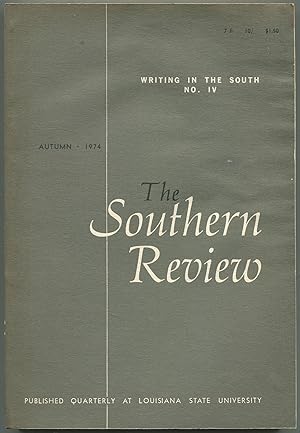
The Southern Review Volume X, Number 4, October 1974
Published by Louisiana State University, Baton Rouge, 1974
Seller: Between the Covers-Rare Books, Inc. ABAA, Gloucester City, NJ, U.S.A.
Association Member: ABAA ESA ILAB IOBA
Seller rating 5 out of 5 stars
First Edition
Softcover. Condition: Very Good. First edition. Small quarto. Wrappers. xvi, 787-1023pp. Tear in gutter of preliminary page, scattered foxing on pages, spine age-toned and creased, about very good. Featuring "Uncle Remus and the Ubiquitous Rabbit" by Louis D. Rubin, Jr.; "An Interview with William Styron" by Ben Forkner and Gilbert Schricke. Poetry by Wendell Berry entitled *Song*; *The Cold Pane*; *Goods*; *A Dance*; and *A Purification*. Contributions by Louis D. Rubin, Jr., William Bedford Clark, William C. Havard, William F. Steirer, Jr., Jerry H. Bryant, Speer Morgan, Richard P. Adams, Andre Malraux, Max Webb, Edwin Mims, Donald Davidson, Ben Forkner, Gilbert Schricke, Wendell Berry, Thomas H. Landess, Pinkie, Gordon Lane, Kathryn Stripling, Frank Manley, Van K. Brock, Claude Koch, Larry Rubin, Michael Cass, Louis Dollarhide, and Ingrid Smith.
-

Hardcover. Condition: New.
-

Condensed Systems of Low Dimensionality: Workshop Proceedings ( NATO Science Series B: Physics)
Seller: Green Ink Booksellers, Hay-on-Wye, POWYS, United Kingdom
Seller rating 5 out of 5 stars
First Edition
Condition: Very Good. No Jacket. 1st Edition. Nice clean bright tight book 844 pages.
-
3. Aufl. 730 S 23,2x16,5cm, illustr. Hardcover, Fotos und Abbildungen im Text, gutes Exemplar.
-
A Handful of Herbs.
Published by Bay Books., 1994
Seller: Antiquariat Löwenstein, Göllersdorf, NÖ, Austria
Seller rating 5 out of 5 stars
4°. 96 pages. Color illustrations. Paperback.
-
Condition: Fair. Volume 3. This is an ex-library book and may have the usual library/used-book markings inside.This book has hardback covers. In fair condition, suitable as a study copy. No dust jacket. Please note the Image in this listing is a stock photo and may not match the covers of the actual item,3450grams, ISBN:9780262072540.
-

Fachwissen für Industriemechaniker. Fachstufe 2.
Language: German
Published by Köln und München, Stam Verlag,, 1991
ISBN 10: 3823755501 ISBN 13: 9783823755500
1990. 448 S., Sehr guter, verlagsfrischer Zustand. Sprache: Deutsch Gewicht in Gramm: 900 24 cm, gebunden Pp., mit Beilage,
-
Fachwissen für Industriemechaniker. Fachstufe 2.
Language: German
Published by Köln und München, Stam Verlag,, 1991
ISBN 10: 3823755501 ISBN 13: 9783823755500
2. Auflage. 448 S., Sehr guter, verlagsfrischer Zustand. Sprache: Deutsch Gewicht in Gramm: 900 24 cm, gebunden Pp., mit Beilage,
-
speciation (S. A. Theor. Appl. Genet. 68) S. 365 - 367. gr8. m. 1 Abb.) Sonderabdruck Offprint. 1984. Guter Zustand/Good condition. Broschur/Softcover. Sprache: - - -/.
-

Metallogenesis and Tectonics of the Russian Far East, Alaska, and the Canadian Cordillera Professional Paper 1697
Published by USGS, 2005
ISBN 10: 0607984074 ISBN 13: 9780607984071
Condition: new. "The Proterozoic and Phanerozoic metallogenic and tectonic evolution of the Russian Far East, Alaska, and the Canadian Cordillera is recorded in the cratons, craton margins, and orogenic collages of the Circum-North Pacific mountain belts that separate the North Pacific from the eastern North Asian and western North American Cratons. The collages consist of tectonostratigraphic terranes and contained metallogenic belts, which are composed of fragments of igneous arcs, accretionary-wedge and subduction-zone complexes, passive continental margins, and cratons. The terranes are overlapped by continental-margin-arc and sedimentary-basin assemblages and contained metallogenic belts. The metallogenic and geologic history of terranes, overlap assemblages, cratons, and craton margins has been complicated by postaccretion dismemberment and translation during strike-slip faulting that occurred subparallel to continental margins. Seven processes overlapping in time were responsible for most of metallogenic and geologic complexities of the region (1) In the Early and Middle Proterozoic, marine sedimentary basins developed on major cratons and were the loci for ironstone (Superior Fe) deposits and sediment-hosted Cu deposits that occur along both the North Asia Craton and North American Craton Margin. (2) In the Late Proterozoic, Late Devonian, and Early Carboniferous, major periods of rifting occurred along the ancestral margins of present-day Northeast Asia and northwestern North America. The rifting resulted in fragmentation of each continent, and formation of cratonal and passive continental-margin terranes that eventually migrated and accreted to other sites along the evolving margins of the original or adjacent continents. The rifting also resulted in formation of various massive-sulfide metallogenic belts. (3) From about the late Paleozoic through the mid-Cretaceous, a succession of island arcs and contained igneous-arc-related metallogenic belts and tectonically paired subduction zones formed near continental margins. (4) From about mainly the mid-Cretaceous through the present, a succession of continental-margin igneous arcs (some extending offshore into island arcs) and contained metallogenic belts, and tectonically paired subduction zones formed along the continental margins. (5) From about the Jurassic to the present, oblique convergence and rotations caused orogen-parallel sinistral, and then dextral displacements within the plate margins of the Northeast Asian and North American Cratons. The oblique convergences and rotations resulted in the fragmentation, displacement, and duplication of formerly more continuous arcs, subduction zones, passive continental margins, and contained metallogenic belts. These fragments were subsequently accreted along the margins of the expanding continental margins. (6) From the Early Jurassic through Tertiary, movement of the upper continental plates toward subduction zones resulted in strong plate coupling and accretion of the former island arcs, subduction zones, and contained metallogenic belts to continental margins. In this region, the multiple arc accretions were accompanied and followed by crustal thickening, anatexis, metamorphism, formation of collision-related metallogenic belts, and uplift; this resulted in the substantial growth of the North Asian and North American continents. (7) In the middle and late Cenozoic, oblique to orthogonal convergence of the Pacific Plate with present-day Alaska and Northeast Asia resulted in formation of the present ring of volcanoes and contained metallogenic belts around the Circum-North Pacific. Oblique convergence between the Pacific Plate and Alaska also resulted in major dextral-slip faulting in interior and southern Alaska and along the western part of the Aleutian- Wrangell arc. Associated with dextral-slip faulting was crustal extrusion of terranes from western Alaska into the Bering Sea. " DV2. softcover, wrapped in shrink wrap, tight, crisp, 429 pages.
-

Metallogenesis and Tectonics of the Russian Far East, Alaska, and the Canadian Cordillera Professional Paper 1697
Published by USGS, 2005
ISBN 10: 0607984074 ISBN 13: 9780607984071
Condition: new. "The Proterozoic and Phanerozoic metallogenic and tectonic evolution of the Russian Far East, Alaska, and the Canadian Cordillera is recorded in the cratons, craton margins, and orogenic collages of the Circum-North Pacific mountain belts that separate the North Pacific from the eastern North Asian and western North American Cratons. The collages consist of tectonostratigraphic terranes and contained metallogenic belts, which are composed of fragments of igneous arcs, accretionary-wedge and subduction-zone complexes, passive continental margins, and cratons. The terranes are overlapped by continental-margin-arc and sedimentary-basin assemblages and contained metallogenic belts. The metallogenic and geologic history of terranes, overlap assemblages, cratons, and craton margins has been complicated by postaccretion dismemberment and translation during strike-slip faulting that occurred subparallel to continental margins. Seven processes overlapping in time were responsible for most of metallogenic and geologic complexities of the region (1) In the Early and Middle Proterozoic, marine sedimentary basins developed on major cratons and were the loci for ironstone (Superior Fe) deposits and sediment-hosted Cu deposits that occur along both the North Asia Craton and North American Craton Margin. (2) In the Late Proterozoic, Late Devonian, and Early Carboniferous, major periods of rifting occurred along the ancestral margins of present-day Northeast Asia and northwestern North America. The rifting resulted in fragmentation of each continent, and formation of cratonal and passive continental-margin terranes that eventually migrated and accreted to other sites along the evolving margins of the original or adjacent continents. The rifting also resulted in formation of various massive-sulfide metallogenic belts. (3) From about the late Paleozoic through the mid-Cretaceous, a succession of island arcs and contained igneous-arc-related metallogenic belts and tectonically paired subduction zones formed near continental margins. (4) From about mainly the mid-Cretaceous through the present, a succession of continental-margin igneous arcs (some extending offshore into island arcs) and contained metallogenic belts, and tectonically paired subduction zones formed along the continental margins. (5) From about the Jurassic to the present, oblique convergence and rotations caused orogen-parallel sinistral, and then dextral displacements within the plate margins of the Northeast Asian and North American Cratons. The oblique convergences and rotations resulted in the fragmentation, displacement, and duplication of formerly more continuous arcs, subduction zones, passive continental margins, and contained metallogenic belts. These fragments were subsequently accreted along the margins of the expanding continental margins. (6) From the Early Jurassic through Tertiary, movement of the upper continental plates toward subduction zones resulted in strong plate coupling and accretion of the former island arcs, subduction zones, and contained metallogenic belts to continental margins. In this region, the multiple arc accretions were accompanied and followed by crustal thickening, anatexis, metamorphism, formation of collision-related metallogenic belts, and uplift; this resulted in the substantial growth of the North Asian and North American continents. (7) In the middle and late Cenozoic, oblique to orthogonal convergence of the Pacific Plate with present-day Alaska and Northeast Asia resulted in formation of the present ring of volcanoes and contained metallogenic belts around the Circum-North Pacific. Oblique convergence between the Pacific Plate and Alaska also resulted in major dextral-slip faulting in interior and southern Alaska and along the western part of the Aleutian- Wrangell arc. Associated with dextral-slip faulting was crustal extrusion of terranes from western Alaska into the Bering Sea. " DV1. softcover, wrapped in shrink wrap, tight, crisp, 429 pages.
-

Metallogenesis and Tectonics of the Russian Far East, Alaska, and the Canadian Cordillera Professional Paper 1697
Published by USGS, 2005
ISBN 10: 0607984074 ISBN 13: 9780607984071
Condition: new. "The Proterozoic and Phanerozoic metallogenic and tectonic evolution of the Russian Far East, Alaska, and the Canadian Cordillera is recorded in the cratons, craton margins, and orogenic collages of the Circum-North Pacific mountain belts that separate the North Pacific from the eastern North Asian and western North American Cratons. The collages consist of tectonostratigraphic terranes and contained metallogenic belts, which are composed of fragments of igneous arcs, accretionary-wedge and subduction-zone complexes, passive continental margins, and cratons. The terranes are overlapped by continental-margin-arc and sedimentary-basin assemblages and contained metallogenic belts. The metallogenic and geologic history of terranes, overlap assemblages, cratons, and craton margins has been complicated by postaccretion dismemberment and translation during strike-slip faulting that occurred subparallel to continental margins. Seven processes overlapping in time were responsible for most of metallogenic and geologic complexities of the region (1) In the Early and Middle Proterozoic, marine sedimentary basins developed on major cratons and were the loci for ironstone (Superior Fe) deposits and sediment-hosted Cu deposits that occur along both the North Asia Craton and North American Craton Margin. (2) In the Late Proterozoic, Late Devonian, and Early Carboniferous, major periods of rifting occurred along the ancestral margins of present-day Northeast Asia and northwestern North America. The rifting resulted in fragmentation of each continent, and formation of cratonal and passive continental-margin terranes that eventually migrated and accreted to other sites along the evolving margins of the original or adjacent continents. The rifting also resulted in formation of various massive-sulfide metallogenic belts. (3) From about the late Paleozoic through the mid-Cretaceous, a succession of island arcs and contained igneous-arc-related metallogenic belts and tectonically paired subduction zones formed near continental margins. (4) From about mainly the mid-Cretaceous through the present, a succession of continental-margin igneous arcs (some extending offshore into island arcs) and contained metallogenic belts, and tectonically paired subduction zones formed along the continental margins. (5) From about the Jurassic to the present, oblique convergence and rotations caused orogen-parallel sinistral, and then dextral displacements within the plate margins of the Northeast Asian and North American Cratons. The oblique convergences and rotations resulted in the fragmentation, displacement, and duplication of formerly more continuous arcs, subduction zones, passive continental margins, and contained metallogenic belts. These fragments were subsequently accreted along the margins of the expanding continental margins. (6) From the Early Jurassic through Tertiary, movement of the upper continental plates toward subduction zones resulted in strong plate coupling and accretion of the former island arcs, subduction zones, and contained metallogenic belts to continental margins. In this region, the multiple arc accretions were accompanied and followed by crustal thickening, anatexis, metamorphism, formation of collision-related metallogenic belts, and uplift; this resulted in the substantial growth of the North Asian and North American continents. (7) In the middle and late Cenozoic, oblique to orthogonal convergence of the Pacific Plate with present-day Alaska and Northeast Asia resulted in formation of the present ring of volcanoes and contained metallogenic belts around the Circum-North Pacific. Oblique convergence between the Pacific Plate and Alaska also resulted in major dextral-slip faulting in interior and southern Alaska and along the western part of the Aleutian- Wrangell arc. Associated with dextral-slip faulting was crustal extrusion of terranes from western Alaska into the Bering Sea." DV4. softcover, wrapped in shrink wrap, tight, crisp, 429 pages.
-

Metallogenesis and Tectonics of the Russian Far East, Alaska, and the Canadian Cordillera Professional Paper 1697
Published by USGS, 2005
ISBN 10: 0607984074 ISBN 13: 9780607984071
Condition: new. The Proterozoic and Phanerozoic metallogenic and tectonic evolution of the Russian Far East, Alaska, and the Canadian Cordillera is recorded in the cratons, craton margins, and orogenic collages of the Circum-North Pacific mountain belts that separate the North Pacific from the eastern North Asian and western North American Cratons. The collages consist of tectonostratigraphic terranes and contained metallogenic belts, which are composed of fragments of igneous arcs, accretionary-wedge and subduction-zone complexes, passive continental margins, and cratons. The terranes are overlapped by continental-margin-arc and sedimentary-basin assemblages and contained metallogenic belts. The metallogenic and geologic history of terranes, overlap assemblages, cratons, and craton margins has been complicated by postaccretion dismemberment and translation during strike-slip faulting that occurred subparallel to continental margins. Seven processes overlapping in time were responsible for most of metallogenic and geologic complexities of the region (1) In the Early and Middle Proterozoic, marine sedimentary basins developed on major cratons and were the loci for ironstone (Superior Fe) deposits and sediment-hosted Cu deposits that occur along both the North Asia Craton and North American Craton Margin. (2) In the Late Proterozoic, Late Devonian, and Early Carboniferous, major periods of rifting occurred along the ancestral margins of present-day Northeast Asia and northwestern North America. The rifting resulted in fragmentation of each continent, and formation of cratonal and passive continental-margin terranes that eventually migrated and accreted to other sites along the evolving margins of the original or adjacent continents. The rifting also resulted in formation of various massive-sulfide metallogenic belts. (3) From about the late Paleozoic through the mid-Cretaceous, a succession of island arcs and contained igneous-arc-related metallogenic belts and tectonically paired subduction zones formed near continental margins. (4) From about mainly the mid-Cretaceous through the present, a succession of continental-margin igneous arcs (some extending offshore into island arcs) and contained metallogenic belts, and tectonically paired subduction zones formed along the continental margins. (5) From about the Jurassic to the present, oblique convergence and rotations caused orogen-parallel sinistral, and then dextral displacements within the plate margins of the Northeast Asian and North American Cratons. The oblique convergences and rotations resulted in the fragmentation, displacement, and duplication of formerly more continuous arcs, subduction zones, passive continental margins, and contained metallogenic belts. These fragments were subsequently accreted along the margins of the expanding continental margins. (6) From the Early Jurassic through Tertiary, movement of the upper continental plates toward subduction zones resulted in strong plate coupling and accretion of the former island arcs, subduction zones, and contained metallogenic belts to continental margins. In this region, the multiple arc accretions were accompanied and followed by crustal thickening, anatexis, metamorphism, formation of collision-related metallogenic belts, and uplift; this resulted in the substantial growth of the North Asian and North American continents. (7) In the middle and late Cenozoic, oblique to orthogonal convergence of the Pacific Plate with present-day Alaska and Northeast Asia resulted in formation of the present ring of volcanoes and contained metallogenic belts around the Circum-North Pacific. Oblique convergence between the Pacific Plate and Alaska also resulted in major dextral-slip faulting in interior and southern Alaska and along the western part of the Aleutian- Wrangell arc. Associated with dextral-slip faulting was crustal extrusion of terranes from western Alaska into the Bering Sea. DX1. softcover, wrapped in shrink wrap, tight, crisp, 429 pages.
-
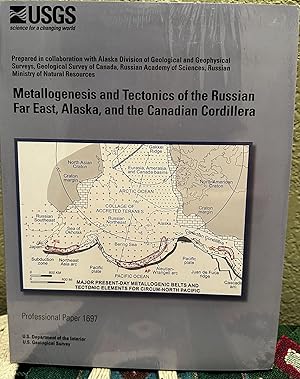
Metallogenesis and Tectonics of the Russian Far East, Alaska, and the Canadian Cordillera Professional Paper 1697
Published by USGS, 2005
ISBN 10: 0607984074 ISBN 13: 9780607984071
Condition: new. The Proterozoic and Phanerozoic metallogenic and tectonic evolution of the Russian Far East, Alaska, and the Canadian Cordillera is recorded in the cratons, craton margins, and orogenic collages of the Circum-North Pacific mountain belts that separate the North Pacific from the eastern North Asian and western North American Cratons. The collages consist of tectonostratigraphic terranes and contained metallogenic belts, which are composed of fragments of igneous arcs, accretionary-wedge and subduction-zone complexes, passive continental margins, and cratons. The terranes are overlapped by continental-margin-arc and sedimentary-basin assemblages and contained metallogenic belts. The metallogenic and geologic history of terranes, overlap assemblages, cratons, and craton margins has been complicated by postaccretion dismemberment and translation during strike-slip faulting that occurred subparallel to continental margins. Seven processes overlapping in time were responsible for most of metallogenic and geologic complexities of the region (1) In the Early and Middle Proterozoic, marine sedimentary basins developed on major cratons and were the loci for ironstone (Superior Fe) deposits and sediment-hosted Cu deposits that occur along both the North Asia Craton and North American Craton Margin. (2) In the Late Proterozoic, Late Devonian, and Early Carboniferous, major periods of rifting occurred along the ancestral margins of present-day Northeast Asia and northwestern North America. The rifting resulted in fragmentation of each continent, and formation of cratonal and passive continental-margin terranes that eventually migrated and accreted to other sites along the evolving margins of the original or adjacent continents. The rifting also resulted in formation of various massive-sulfide metallogenic belts. (3) From about the late Paleozoic through the mid-Cretaceous, a succession of island arcs and contained igneous-arc-related metallogenic belts and tectonically paired subduction zones formed near continental margins. (4) From about mainly the mid-Cretaceous through the present, a succession of continental-margin igneous arcs (some extending offshore into island arcs) and contained metallogenic belts, and tectonically paired subduction zones formed along the continental margins. (5) From about the Jurassic to the present, oblique convergence and rotations caused orogen-parallel sinistral, and then dextral displacements within the plate margins of the Northeast Asian and North American Cratons. The oblique convergences and rotations resulted in the fragmentation, displacement, and duplication of formerly more continuous arcs, subduction zones, passive continental margins, and contained metallogenic belts. These fragments were subsequently accreted along the margins of the expanding continental margins. (6) From the Early Jurassic through Tertiary, movement of the upper continental plates toward subduction zones resulted in strong plate coupling and accretion of the former island arcs, subduction zones, and contained metallogenic belts to continental margins. In this region, the multiple arc accretions were accompanied and followed by crustal thickening, anatexis, metamorphism, formation of collision-related metallogenic belts, and uplift; this resulted in the substantial growth of the North Asian and North American continents. (7) In the middle and late Cenozoic, oblique to orthogonal convergence of the Pacific Plate with present-day Alaska and Northeast Asia resulted in formation of the present ring of volcanoes and contained metallogenic belts around the Circum-North Pacific. Oblique convergence between the Pacific Plate and Alaska also resulted in major dextral-slip faulting in interior and southern Alaska and along the western part of the Aleutian- Wrangell arc. Associated with dextral-slip faulting was crustal extrusion of terranes from western Alaska into the Bering Sea. softcover, wrapped in shrink wrap, tight, crisp, 429 pages.


