Order Total (1 Item Items):
Shipping Destination:

Kaminka Aharon (7 results)
Skip to main search results
Search filters
Product Type
- All Product Types
- Books (7)
- Magazines & Periodicals (No further results match this refinement)
- Comics (No further results match this refinement)
- Sheet Music (No further results match this refinement)
- Art, Prints & Posters (No further results match this refinement)
- Photographs (No further results match this refinement)
- Maps (No further results match this refinement)
- Manuscripts & Paper Collectibles (No further results match this refinement)
Condition Learn more
- New (No further results match this refinement)
- As New, Fine or Near Fine (No further results match this refinement)
- Very Good or Good (7)
- Fair or Poor (No further results match this refinement)
- As Described (No further results match this refinement)
Binding
- All Bindings
- Hardcover (7)
- Softcover (No further results match this refinement)
Collectible Attributes
- First Edition (No further results match this refinement)
- Signed (No further results match this refinement)
- Dust Jacket (2)
- Seller-Supplied Images (4)
- Not Print on Demand (7)
Language (2)
Free Shipping
- Free Shipping to U.S.A. (No further results match this refinement)
Seller Location
Seller Rating
-

Mehkarim: ba-Mikra uva-Talmud uva-sifrut ha-rabanit: Sefer Rishon.
Published by Hotsaat Dvir, Tel Aviv, 1938
Seller: Henry Hollander, Bookseller, Los Angeles, CA, U.S.A.
Seller rating 4 out of 5 stars

Hardbound. Condition: Very Good-. Octavo in edgeworn and soiled dust jacket with a few short tears, frontispiece photo, 196 pp. Text is in Hebrew.
-
Kitve bikoret historit: ma'amarim nivharim.
Published by Hotsaat "Sefarim, New York, 1944
Seller: Henry Hollander, Bookseller, Los Angeles, CA, U.S.A.
Seller rating 4 out of 5 stars
Hardbound. Condition: Very Good. Octavo, black cloth with worn lettering, 276 pp. Text is in Hebrew.
-
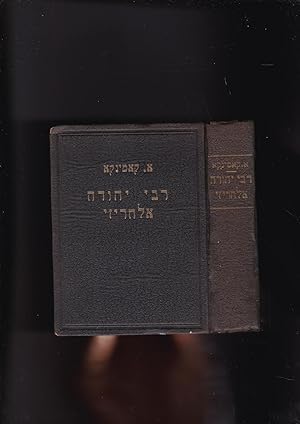
Rabbi Yehuda ben Shlomo Elkharizi : Takhkemoni
Language: Hebrew
Published by Achiasaf Publishing House Ltd., Warsaw Warszawa, Varsha, 1899
Hardcover. Condition: Good. No Jacket. In Hebrew. LVII, 538 pages. 147 x 115 mm. First and last two leaves deatched. Paper yellowed and brittle.
-
Sefer Chazonot Issar Shealtiel (The Book of the Visions of Issar Shealtiel - Hebrew)
Published by Dvir Publishing House, Tel Aviv, 1936
Hardcover. Condition: Very Good. This book is known by other names, such as Chazon Ezra (The Vision of Ezra) and Ezra Revii (Ezra 4). It describes the desolation of Jerusalem after the Roman conquest of Judea. Likely originally written in Hebrew, it survived in Syriac, Greek, and Latin form. In this version, it has been retranslated into Hebrew by famed Jewish scholar Aharon Kaminka. Corners are slightly bent, cover is basic but in good condition.
-
MEKHKARIM bemikra vebaTalmud vebasafrut harabanit sefer sheni mekhkarim baTalmud [Volume 2 only]
Language: Hebrew
Published by Dvir, Tel Aviv, Israel, 1951
Hardcover. Condition: Very Good. Dust Jacket Condition: Very Good. In Hebrew. (1), 214 pages. 217 x 148 mm. Aharon (Armand) Kaminka (1866 Berdichev, Kiev Province - 1950 Eretz Israel) was a Hebrew poet, playwright, translator, and scholar. In 1880, he was sent to Berlin to study at the rabbinical college founded by Esriel Hildesheimer. At the age of 17, in Hamburg, he founded a society called Ahavat Tsiyon (Love of Zion). Kaminka's debut in the field of Jewish studies occurred in 1887, when the annual publication Keneset Yisra'el, edited by Sha'ul Pin?as Rabbinowitz, published two of his essays. One of these articles described a group who had immigrated to Palestine during the middle ages. The other essay, "Mavo le-shirat ha-Yevanim" (Introduction to [Ancient] Greek Poetry), marked Kaminka's initial venture into his career as a translator. For the first time in the history of Hebrew literature, he provided scientific information about the prosody of Ancient Greek poetry. In 1888, Kaminka traveled to Paris, where he continued his studies and published Asefat shirim (Poem Collection; 1888), an anthology that included a section of translated poems. After being ordained in 1893, he served congregations in Frankfurt-an-der-Oder, Prague, and subsequently (between 1897 and 1900) Esseg (now Osijek, Croatia). In 1897, he attended the first Zionist Congress as a delegate, and delivered a Hebrew lecture on Jewish settlements in Palestine. Kaminka distanced himself from public Zionist activity after quarreling with Theodor Herzl on the question of practical versus diplomatic approaches to the movement. In 1900, Kaminka moved to Vienna, where he served as secretary of the Austrian chapter of the Alliance Israélite Universelle. In this capacity, he assisted immigrants and refugees from Russia and Romania. In 1909, Kaminka's poetry book Tsohorayim (Noon) was published in Drogobych. In 1924, he founded Makhon Maimon (Maimonides) College for adult Jewish studies in Vienna. In 1927, he produced another poetry collection, Raze olam (The World's Secrets). His writings described personal experiences and addressed philosophical and public issues. Following the Nazi annexation of Austria, Kaminka managed to escape with his wife and, in 1938, settled in Palestine.
-
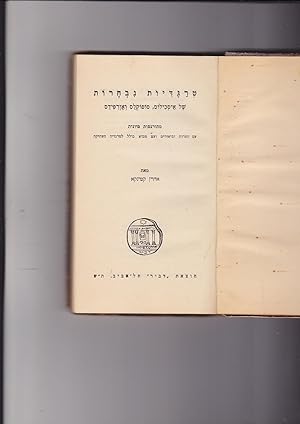
Tragediot Nivkharot. Tragoediae Selectae Aeschyli, Sophoclis, Euripidis: Ex Graeco in Hebraicum Sermonem Vertit Adnotationibus et Introdctione Instruxit
Language: Hebrew
Published by Dvir Co. Ltd., Tel Aviv, 1940
Hardcover. Condition: Very Good. No Jacket. In (vowelized) Hebrew. 255 pages. 185 x 110 mm Aharon (Armand) Kaminka (1866 Berdichev, Kiev Province - 1950 Eretz Israel) was a Hebrew poet, playwright, translator, and scholar. In 1880, he was sent to Berlin to study at the rabbinical college founded by Esriel Hildesheimer. At the age of 17, in Hamburg, he founded a society called Ahavat Tsiyon (Love of Zion). Kaminka's debut in the field of Jewish studies occurred in 1887, when the annual publication Keneset Yisra'el, edited by Sha'ul Pin?as Rabbinowitz, published two of his essays. One of these articles described a group who had immigrated to Palestine during the middle ages. The other essay, "Mavo le-shirat ha-Yevanim" (Introduction to [Ancient] Greek Poetry), marked Kaminka's initial venture into his career as a translator. For the first time in the history of Hebrew literature, he provided scientific information about the prosody of Ancient Greek poetry. In 1888, Kaminka traveled to Paris, where he continued his studies and published Asefat shirim (Poem Collection; 1888), an anthology that included a section of translated poems. After being ordained in 1893, he served congregations in Frankfurt-an-der-Oder, Prague, and subsequently (between 1897 and 1900) Esseg (now Osijek, Croatia). In 1897, he attended the first Zionist Congress as a delegate, and delivered a Hebrew lecture on Jewish settlements in Palestine. Kaminka distanced himself from public Zionist activity after quarreling with Theodor Herzl on the question of practical versus diplomatic approaches to the movement. In 1900, Kaminka moved to Vienna, where he served as secretary of the Austrian chapter of the Alliance Israélite Universelle. In this capacity, he assisted immigrants and refugees from Russia and Romania. In 1909, Kaminka's poetry book Tsohorayim (Noon) was published in Drogobych. In 1924, he founded Makhon Maimon (Maimonides) College for adult Jewish studies in Vienna. In 1927, he produced another poetry collection, Raze olam (The World's Secrets). His writings described personal experiences and addressed philosophical and public issues. Following the Nazi annexation of Austria, Kaminka managed to escape with his wife and, in 1938, settled in Palestine.
-
Hardcover. Condition: Very Good. No Jacket. In vowelized Hebrew. IV, 76 pages. 158 x 114 mm. WorldCat: Liibraries worldwide that own this item: 5.



![Seller image for MEKHKARIM bemikra vebaTalmud vebasafrut harabanit sefer sheni mekhkarim baTalmud [Volume 2 only] for sale by Meir Turner](https://pictures.abebooks.com/inventory/md/md30431179977.jpg)