

Order Total (1 Item Items):
Shipping Destination:

Jonas Braasch (26 results)
Skip to main search results
Search filters
Product Type
- All Product Types
- Books (26)
- Magazines & Periodicals (No further results match this refinement)
- Comics (No further results match this refinement)
- Sheet Music (No further results match this refinement)
- Art, Prints & Posters (No further results match this refinement)
- Photographs (No further results match this refinement)
- Maps (No further results match this refinement)
- Manuscripts & Paper Collectibles (No further results match this refinement)
Condition Learn more
- New (20)
- As New, Fine or Near Fine (3)
- Very Good or Good (3)
- Fair or Poor (No further results match this refinement)
- As Described (No further results match this refinement)
Binding
Collectible Attributes
- First Edition (No further results match this refinement)
- Signed (No further results match this refinement)
- Dust Jacket (No further results match this refinement)
- Seller-Supplied Images (14)
- Not Print on Demand (19)
Language (3)
Free Shipping
Seller Location
Seller Rating
-
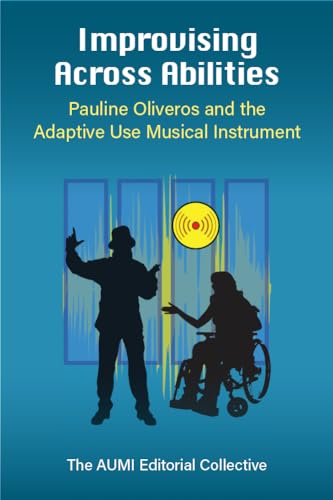
Improvising Across Abilities: Pauline Oliveros and the Adaptive Use Musical Instrument (Music and Social Justice)
Language: English
Published by The University of Michigan Press 2024-01-22, 2024
ISBN 10: 0472055739 ISBN 13: 9780472055739
Paperback. Condition: New.
-
Programming EMPAC: The First 4,158 Days
Published by Curtis R. Priem Experimental Media and Performing Arts Center, Rensselaer Polytechnic Institute, 2015
Hardcover. Condition: Very Good. Large, heavy (7 lbs.) white hardcover without dust jacket. Presents a vivid mosaic of all the events, projects, and works developed and presented at the Curtis R. Priem Experimental Media and Performing Arts Center from 2014 back to inception. No markings noted. Book is heavy, so extra charges for shipping and handling may be requested.
-
Hardcover. Condition: Very Good. 2020 Springer hardcover edition. Light reading wear else very good condition.
-

Hyper-specializing in Saxophone Using Acoustical Insight and Deep Listening Skills (Current Research in Systematic Musicology, 6)
Book 5 of 9: Current Research in Systematic MusicologySeller: Ria Christie Collections, Uxbridge, United Kingdom
Seller rating 5 out of 5 stars

£ 134.30
£ 11.98 shipping
Ships from United Kingdom to U.S.A.Quantity: Over 20 available
Add to basketCondition: New. In.
-
Hyper-specializing In Saxophone Using Ac
Book 5 of 9: Current Research in Systematic MusicologySeller: Kennys Bookshop and Art Galleries Ltd., Galway, GY, Ireland
Seller rating 5 out of 5 stars
Condition: New.
-

Hyper-specializing in Saxophone Using Acoustical Insight and Deep Listening Skills
Book 5 of 9: Current Research in Systematic MusicologyLanguage: English
Published by Springer International Publishing, 2019
ISBN 10: 3030150453 ISBN 13: 9783030150457
Buch. Condition: Neu. Druck auf Anfrage Neuware - Printed after ordering - This book presents a novel method of grafting musical wind instruments by exchanging an instrument's standard mouthpiece with different tone generators. Using the concrete example of the soprano saxophone, it describes how, with six other tone generators, including brass, double reed, and free reed mechanisms, the saxophone can be extended to nearly every wind instrument category in the von Hornbostel and Sachs classification system. The book demonstrates how it is possible to play these instrument variations with high proficiency, and describes the method of hyper-specialization, including acoustical insights, conservatory training methods and the underlying philosophy. The latter is based on the cultural traditions of the different wind instrument prototypes and the Deep Listening philosophy of cultivating internal diversity, and approach that leads to a new level of wind instrument virtuosity that offers great timbral variety combined with the flexibility of a regular acoustic wind instrument.
-

The Technology of Binaural Understanding (Modern Acoustics and Signal Processing)
Book 19 of 20: Modern Acoustics and Signal ProcessingSeller: Ria Christie Collections, Uxbridge, United Kingdom
Seller rating 5 out of 5 stars
£ 204.30
£ 11.98 shipping
Ships from United Kingdom to U.S.A.Quantity: Over 20 available
Add to basketCondition: New. In.
-
Hardcover. Condition: Brand New. 205 pages. 9.25x6.25x0.75 inches. In Stock.
-

Technology of Binaural Understanding
Book 19 of 20: Modern Acoustics and Signal ProcessingSeller: GreatBookPricesUK, Woodford Green, United Kingdom
Seller rating 5 out of 5 stars
£ 204.29
£ 15 shipping
Ships from United Kingdom to U.S.A.Quantity: Over 20 available
Add to basketCondition: New.
-

-
-
-

Condition: As New. Unread book in perfect condition.
-

Technology of Binaural Understanding
Book 19 of 20: Modern Acoustics and Signal ProcessingSeller: GreatBookPricesUK, Woodford Green, United Kingdom
Seller rating 5 out of 5 stars
£ 232.61
£ 15 shipping
Ships from United Kingdom to U.S.A.Quantity: Over 20 available
Add to basketCondition: As New. Unread book in perfect condition.
-

Buch. Condition: Neu. Druck auf Anfrage Neuware - Printed after ordering - Sound, devoid of meaning, would not matter to us. It is the information sound conveys that helps the brain to understand its environment. Sound and its underlying meaning are always associated with time and space. There is no sound without spatial properties, and the brain always organizes this information within a temporal-spatial framework. This book is devoted to understanding the importance of meaning for spatial and related further aspects of hearing, including cross-modal inference.People, when exposed to acoustic stimuli, do not react directly to what theyhear but rather to what they hear means to them.This semiotic maxim may not always apply, for instance, when the reactions are reflexive. But, where it does apply, it poses a major challenge to the builders of models of the auditory system. Take, for example, an auditory model that is meant to be implemented on a robotic agent for autonomous search-&-rescue actions. Or think of a system that can performjudgments on the sound quality of multimedia-reproduction systems. It becomes immediately clear that such a system needs- Cognitive capabilities, including substantial inherent knowledge- The ability to integrate information across different sensory modalitiesTo realize these functions, the auditory system provides a pair of sensory organs, the two ears, and the means to perform adequate preprocessing of the signals provided by the ears. This is realized in the subcortical parts of the auditory system. In the title of a prior book, the term Binaural Listening is used to indicate a focus on sub-cortical functions. Psychoacoustics and auditory signal processing contribute substantially to this area.The preprocessed signals are then forwarded to the cortical parts of the auditory system where, among other things, recognition, classification, localization, scene analysis, assignment of meaning, quality assessment, and action planning take place. Also, information from different sensory modalities is integrated at this level. Between sub-cortical and cortical regions of the auditory system, numerous feedback loops exist that ultimately support the high complexity and plasticity of the auditory system.The current book concentrates on these cognitive functions. Instead of processing signals, processing symbols is now the predominant modeling task. Substantial contributions to the field draw upon the knowledge acquired by cognitive psychology. The keyword Binaural Understanding in the book title characterizesthis shift.Both books, The Technology of Binaural Listening and the current one, have been stimulated and supported by AABBA, an open research group devoted to the development and application of models of binaural hearing. The current book is dedicated to technologies that help explain, facilitate, apply, and support various aspects of binaural understanding. It is organized into five parts, each containing three to six chapters in order to provide a comprehensive overview of this emerging area. Each chapter was thoroughly reviewed by at leasttwo anonymous, external experts.The first part deals with the psychophysical and physiological effects of Forming and Interpreting Aural Objects as well as the underlying models. The fundamental concepts of reflexive and reflective auditory feedback are introduced. Mechanisms of binaural attention and attention switching are covered-as well as how auditory Gestalt rules facilitate binaural understanding. A general blackboard architecture is introduced as an example of how machines can learn to form and interpret aural objects to simulate human cognitive listening.The second part, Configuring and Understanding Aural Space, focuses on the human understanding of complex three-dimensional environments-covering the psychological and biological fundamentals of auditory space formation. This part further addresses the human mechani.
-
Hardcover. Condition: Brand New. 828 pages. 9.25x6.10x2.01 inches. In Stock.
-
Hardcover. Condition: New. NEW. SHIPS FROM MULTIPLE LOCATIONS. book.
-

-
Orgelregister mit Durchschlagzungen. Geschichte, Konstruktion und akustische Eigenschaften;Inauguraldissertation
Published by ohne Angabe, 2004
Hardcover. Condition: Sehr gut. 14,50 x 0,00 x 21,01 private Bindung, Einband mit leichten Knicken, sonst SEHR GUTES EXEMPLAR---Mit 230 Abbildungen. Die europäische Durchschlagzunge fand Ende des 18. Jahrhunderts in einer von Christian Gottlieb Kratzenstein entworfenen Sprachmaschine ihre erste Anwendung. Nur wenige Jahre später verbreitete sie sich auch im Orgelbau, wo sie insbesondere durch Abbé Vogler stark propagiert wurde. Neben den charakteristischen klanglichen Eigenschaften der Durchschlagzunge war vor allem die Stimmstabilität bei Winddruckveränderungen für ihre Verbreitung von großer Bedeutung, weil sie im Gegensatz zu den bisherigen Orgelregistern mit einem Windschweller kombiniert werden konnte. Nach ihrer anfänglichen Beliebtheit nahm die Verbreitung der Durchschlagzunge jedoch Ende des 19. Jahrhunderts stark ab, und Anfang des 20. Jahrhunderts wurde dieser Registertyp dann innerhalb der Orgelbewegung ganz aus den Orgelneubauten verbannt. Erst seit Ende des 20. Jahrhunderts werden Durchschlagzungen wieder vereinzelt in neuerbauten Orgeln berücksichtigt. Die Frage, warum das nach seiner Erfindung zunächst so beliebte Instrument wieder relativ schnell an Bedeutung verlor, ist das zentrale Thema dieses Buches. Es zeigt sich, daß für den interessanten geschichtlichen Verlauf mehrere Gründe ausschlaggebend sind. Zum einem machten technische Verbesserungen an Jalousieschwellersystemen und neue Klangkonzepte in der Orgelmusik den Windschweller überflüssig. Während der Windschweller meist auf ein bis zwei Register beschränkt ist, besteht beim Jalousieschweller die Möglichkeit, alle Registertypen einschließlich beliebiger Mehrfachregistrierungen mit einzubeziehen. Andere Gründe, die zur Verbannung der Durchschlagzunge führten, waren eher ideologischer Natur. Hier kann vor allem die Kritik am charakteristischen Klang der Durchschlagzunge und die Ablehnung von fabrikmäßigen Fertigungstechniken in der Orgelbewegung aufgeführt werden. Letzteres war für die ökonomische Herstellung von Durchschlagzungenregistern unabdingbar. Für Ihre Zufriedenheit versenden wir mit DHL und ausschließlich mit Trackingcode für eine sichere Sendungsverfolgung! Weitere Angebote unter antiquariat-kastanienhof , 446 Seiten. nein.
-
Condition: new. Questo è un articolo print on demand.
-

Hyper-specializing in Saxophone Using Acoustical Insight and Deep Listening Skills
Book 5 of 9: Current Research in Systematic MusicologyLanguage: English
Published by Springer International Publishing Mai 2019, 2019
ISBN 10: 3030150453 ISBN 13: 9783030150457
Seller: BuchWeltWeit Ludwig Meier e.K., Bergisch Gladbach, Germany
Seller rating 5 out of 5 stars
Buch. Condition: Neu. This item is printed on demand - it takes 3-4 days longer - Neuware -This book presents a novel method of grafting musical wind instruments by exchanging an instrument's standard mouthpiece with different tone generators. Using the concrete example of the soprano saxophone, it describes how, with six other tone generators, including brass, double reed, and free reed mechanisms, the saxophone can be extended to nearly every wind instrument category in the von Hornbostel and Sachs classification system. The book demonstrates how it is possible to play these instrument variations with high proficiency, and describes the method of hyper-specialization, including acoustical insights, conservatory training methods and the underlying philosophy. The latter is based on the cultural traditions of the different wind instrument prototypes and the Deep Listening philosophy of cultivating internal diversity, and approach that leads to a new level of wind instrument virtuosity that offers great timbral variety combined with the flexibility of a regular acoustic wind instrument. 220 pp. Englisch.
-
Condition: new. Questo è un articolo print on demand.
-
Hyper-specializing in Saxophone Using Acoustical Insight and Deep Listening Skills
Book 5 of 9: Current Research in Systematic MusicologyLanguage: English
Published by Springer International Publishing, 2019
ISBN 10: 3030150453 ISBN 13: 9783030150457
Buch. Condition: Neu. Hyper-specializing in Saxophone Using Acoustical Insight and Deep Listening Skills | Jonas Braasch | Buch | xii | Englisch | 2019 | Springer International Publishing | EAN 9783030150457 | Verantwortliche Person für die EU: Springer Verlag GmbH, Tiergartenstr. 17, 69121 Heidelberg, juergen[dot]hartmann[at]springer[dot]com | Anbieter: preigu Print on Demand.
-

Hyper-specializing in Saxophone Using Acoustical Insight and Deep Listening Skills
Book 5 of 9: Current Research in Systematic MusicologyLanguage: English
Published by Springer International Publishing, Springer International Publishing Mai 2019, 2019
ISBN 10: 3030150453 ISBN 13: 9783030150457
Seller: buchversandmimpf2000, Emtmannsberg, BAYE, Germany
Seller rating 5 out of 5 stars
Buch. Condition: Neu. This item is printed on demand - Print on Demand Titel. Neuware -This book presents a novel method of grafting musical wind instruments by exchanging an instrument¿s standard mouthpiece with different tone generators. Using the concrete example of the soprano saxophone, it describes how, with six other tone generators, including brass, double reed, and free reed mechanisms, the saxophone can be extended to nearly every wind instrument category in the von Hornbostel and Sachs classification system. The book demonstrates how it is possible to play these instrument variations with high proficiency, and describes the method of hyper-specialization, including acoustical insights, conservatory training methods and the underlying philosophy. The latter is based on the cultural traditions of the different wind instrument prototypes and the Deep Listening philosophy of cultivating internal diversity, and approach that leads to a new level of wind instrument virtuosity that offers great timbral variety combined with the flexibility of a regular acoustic wind instrument.Springer Verlag GmbH, Tiergartenstr. 17, 69121 Heidelberg 220 pp. Englisch.
-

The Technology of Binaural Understanding
Book 19 of 20: Modern Acoustics and Signal ProcessingLanguage: English
Published by Springer International Publishing, 2020
ISBN 10: 303000385X ISBN 13: 9783030003852
Condition: New. Dieser Artikel ist ein Print on Demand Artikel und wird nach Ihrer Bestellung fuer Sie gedruckt. Offers a computational framework for modeling active exploratory listening that assigns meaning to auditory scenes  Presents a model that incorporates both signal-driven (bottom-up), and hypothesis-driven (top-down) processing.
-

The Technology of Binaural Understanding
Book 19 of 20: Modern Acoustics and Signal ProcessingLanguage: English
Published by Springer-Verlag Gmbh Aug 2020, 2020
ISBN 10: 303000385X ISBN 13: 9783030003852
Seller: BuchWeltWeit Ludwig Meier e.K., Bergisch Gladbach, Germany
Seller rating 5 out of 5 stars
Buch. Condition: Neu. This item is printed on demand - it takes 3-4 days longer - Neuware -Sound, devoid of meaning, would not matter to us. It is the information sound conveys that helps the brain to understand its environment. Sound and its underlying meaning are always associated with time and space. There is no sound without spatial properties, and the brain always organizes this information within a temporal-spatial framework. This book is devoted to understanding the importance of meaning for spatial and related further aspects of hearing, including cross-modal inference.People, when exposed to acoustic stimuli, do not react directly to what theyhear but rather to what they hear means to them.This semiotic maxim may not always apply, for instance, when the reactions are reflexive. But, where it does apply, it poses a major challenge to the builders of models of the auditory system. Take, for example, an auditory model that is meant to be implemented on a robotic agent for autonomous search-&-rescue actions. Or think of a system that can performjudgments on the sound quality of multimedia-reproduction systems. It becomes immediately clear that such a system needs- Cognitive capabilities, including substantial inherent knowledge- The ability to integrate information across different sensory modalitiesTo realize these functions, the auditory system provides a pair of sensory organs, the two ears, and the means to perform adequate preprocessing of the signals provided by the ears. This is realized in the subcortical parts of the auditory system. In the title of a prior book, the term Binaural Listening is used to indicate a focus on sub-cortical functions. Psychoacoustics and auditory signal processing contribute substantially to this area.The preprocessed signals are then forwarded to the cortical parts of the auditory system where, among other things, recognition, classification, localization, scene analysis, assignment of meaning, quality assessment, and action planning take place. Also, information from different sensory modalities is integrated at this level. Between sub-cortical and cortical regions of the auditory system, numerous feedback loops exist that ultimately support the high complexity and plasticity of the auditory system.The current book concentrates on these cognitive functions. Instead of processing signals, processing symbols is now the predominant modeling task. Substantial contributions to the field draw upon the knowledge acquired by cognitive psychology. The keyword Binaural Understanding in the book title characterizesthis shift.Both books, The Technology of Binaural Listening and the current one, have been stimulated and supported by AABBA, an open research group devoted to the development and application of models of binaural hearing. The current book is dedicated to technologies that help explain, facilitate, apply, and support various aspects of binaural understanding. It is organized into five parts, each containing three to six chapters in order to provide a comprehensive overview of this emerging area. Each chapter was thoroughly reviewed by at leasttwo anonymous, external experts.The first part deals with the psychophysical and physiological effects of Forming and Interpreting Aural Objects as well as the underlying models. The fundamental concepts of reflexive and reflective auditory feedback are introduced. Mechanisms of binaural attention and attention switching are covered-as well as how auditory Gestalt rules facilitate binaural understanding. A general blackboard architecture is introduced as an example of how machines can learn to form and interpret aural objects to simulate human cognitive listening.The second part, Configuring and Understanding Aural Space, focuses on the human understanding of complex three-dimensional environments-covering the psychological and biological fundamentals of auditory space formation. This part further addresses the human mechani 815 pp. Englisch.


