

Order Total (1 Item Items):
Shipping Destination:

Henry Romano (26 results)
Skip to main search results
Search filters
Product Type
- All Product Types
- Books (26)
- Magazines & Periodicals (No further results match this refinement)
- Comics (No further results match this refinement)
- Sheet Music (No further results match this refinement)
- Art, Prints & Posters (No further results match this refinement)
- Photographs (No further results match this refinement)
- Maps (No further results match this refinement)
- Manuscripts & Paper Collectibles (No further results match this refinement)
Condition Learn more
- New (13)
- As New, Fine or Near Fine (3)
- Very Good or Good (4)
- Fair or Poor (No further results match this refinement)
- As Described (6)
Binding
Collectible Attributes
- First Edition (1)
- Signed (No further results match this refinement)
- Dust Jacket (No further results match this refinement)
- Seller-Supplied Images (11)
- Not Print on Demand (26)
Language (3)
Free Shipping
Seller Location
Seller Rating
-

Condition: As New. Unread book in perfect condition.
-

Mysteries of the Rig Veda (Paperback or Softback)
Language: English
Published by Dttv Publications 8/20/2022, 2022
ISBN 10: 1393290809 ISBN 13: 9781393290803
Paperback or Softback. Condition: New. Mysteries of the Rig Veda. Book.
-
Condition: New.
-

The Rise of Civilizations Concerning Vedic Knowledge
Seller: Rarewaves.com USA, London, LONDO, United Kingdom
Seller rating 5 out of 5 stars

Paperback. Condition: New.
-
PAP. Condition: New. New Book. Shipped from UK. Established seller since 2000.
-
The Rise of Civilizations Concerning Vedic Knowledge
Seller: PBShop.store UK, Fairford, GLOS, United Kingdom
Seller rating 5 out of 5 stars
PAP. Condition: New. New Book. Shipped from UK. Established seller since 2000.
-
The Rise of Civilizations Concerning Vedic Knowledge
Seller: Ria Christie Collections, Uxbridge, United Kingdom
Seller rating 5 out of 5 stars
Condition: New. In.
-
PF. Condition: New.
-
The Rise of Civilizations Concerning Vedic Knowledge
Seller: GreatBookPricesUK, Woodford Green, United Kingdom
Seller rating 5 out of 5 stars
Condition: New.
-
The Rise of Civilizations Concerning Vedic Knowledge
Seller: GreatBookPricesUK, Woodford Green, United Kingdom
Seller rating 5 out of 5 stars
Condition: As New. Unread book in perfect condition.
-

Hardcover. Condition: Good.
-

50 Jahre Grünewald-Bücher, 50 Jahre Erneuerung der Theologie 1918-1968. Ein Almanach. - aus dem Inhalt: Johann Adam Möhler über Schrift und Tradition / John Henry Kardinal Newman: Das Gewissen und der Papst / Romano Guardini: Kirche und Persönlichkeit / Josef Maria Reuss: Die Grenzen der Unfehlbarkeit des Lehramts / Walter Kaper: Dogma und Heilige Schrift
Published by Mainz, Matthias-Grünewald-Verlag, 1968., 1968
Seller: Antiquariat Carl Wegner, Berlin, B, Germany
Association Member: GIAQ
Seller rating 5 out of 5 stars
First Edition
Softcover. 8°, rotbraune Originalbroschur, etwas berieben und randbestoßen. 142 Seiten. Sauberes, gutes Exemplar. mit Titelverzeichnis 1918-1968 -- Bitte Portokosten außerhalb EU erfragen! / Please ask for postage costs outside EU! / S ' il vous plait demander des frais de port en dehors de l ' UE! // Bitte beachten Sie auch unsere Fotos! / Please also note our photos! / Veuillez noter nos photos -- Ob Sonnenschein oder warmer Regen: mit einem interessanten Buch kommen Sie immer gut durch den Tag. -- Wir kaufen Ihre werthaltigen Bücher! BuWe.
-
Eternal Egypt: Masterworks of Ancient Art from the British Museum
Published by University of California Press in association with the American Federation of Arts, Berkeley, California, 2001
Seller: Andover Books and Antiquities, Andover, MA, U.S.A.
Seller rating 4 out of 5 stars

Softcover. Condition: Very good condition. 288 pp. Catalogue of the exhibition: The Toledo Museum of Art in Ohio, 1 March to 27 May 2001; Wonders, Memphis International Culture Series in Tennessee, 28 June to 21 October 2001; Brooklyn Museum of Art, 223 November 2001 to 24 February 2002; Nelson-Atkins Museum of Art, Kansas City, 12 April to 7 July 2002; The Fine Arts Museum of San Fransisco and the California Palace of the Legion of Honor, 10 August to 3 November 2002; The Minneapolis Institute of Art, 22 December 2002 to 16 March 2003; The Field Museum, Chicago, 26 April to 10 August 2003; Walters Art Museum, Baltimore, 21 September 2003 to 4 January 2004. Softcover. LCC: 67590.
-
Condition: NEW.
-

Condition: Good. Paperback, oblong, illustrations in b/w, unpaged.
-

Condition: New. Über den AutorrnrnHenry Romano, also known in India as Manu Radhesh, was educated in Hertfordshire, in England, formally trained as a British archaeologist, who subsequently excavated the numerous ruins of the ancient cities of the Indus V.
-

Taschenbuch. Condition: Neu. Neuware - Between 3300 and 2900 BC, archaeologists believe that civilization (the rise of Sumeria, the Indus Valley Civilization, and Egypt) marked the beginning of complex cities. The Neolithic Revolution, when agriculture, animal domestication, pottery, and the plow came together, seems not to hold together, as we explored in the final chapter of descending Treta Yuga. There had already been millennia of critical discoveries and developments.Why then the abrupt shift to city living, stratified societies, and overproduction of food and other goods for trade or export Archaeologists believe that man could finally do these things that he was using recent inventions to an additional advantage. Our study of the yugas tells us that man suddenly wanted to do these things that he was using innovations known for millennia in new ways to suit his new motivation.Several large cities existed before descending Dwapara Yuga, but a new breed of city sprang up with Dwapara Yuga. These were larger and more complex and built around commerce. Many had shared granaries, artisans' districts, and marketplaces and were typically made on trade routes along rivers and coasts.We also see these cities' first significant division of labor and societal stratification. Artisans, scribes, and traders all became increasingly common occupations. Furthermore, there was, of course, the tax collector. As a result, governments began levying taxes on commerce, as they had already levied tariffs on agriculture.Sumeria and the city of Eridu are credited with being the first of the trend. Urdu is believed to have risen along the banks of the Euphrates River around 3300 BC. The famous city of Ur and dozens of others sprang up in the Tigris and Euphrates Valleys over the next 300400 years, and Babylon was not far behind.
-

Paperback. Condition: New.
-

Taschenbuch. Condition: Neu. The Rise of Civilizations Concerning Vedic Knowledge | Henry Romano | Taschenbuch | Kartoniert / Broschiert | Englisch | 2022 | Dttv Publications | EAN 9798201884666 | Verantwortliche Person für die EU: preigu GmbH & Co. KG, Lengericher Landstr. 19, 49078 Osnabrück, mail[at]preigu[dot]de | Anbieter: preigu.
-

Condition: Hervorragend. Zustand: Hervorragend | Sprache: Englisch | Produktart: Bücher | In his dancing position, Shiva is known as Nataraja, the King of dancers, and is one of the most beautiful forms of Lord Shiva. The upper right hand of Shiva, as Nataraja, holds the damaru drum. It shows nothing, but it represents universal development. Meanwhile, the lower right-hand holds a flame of destruction. There are many stories about Shiva's appearance. There is a third eye between Lord Shiva's eyebrows on his forehead as an example. It represents wisdom or inner vision. The other two eyes represent love and justice. Shiva views everything with the proportions of love, justice, and inner knowledge; thus, he is neither too harsh nor lenient. Shiva's three eyes also symbolize the sun, moon, and fire, how the universe is illuminated. Shiva's wife, Parvati, covered Shiva's eyes with her hands one day, and the entire world was enveloped in darkness. That is how Shiva got his third eye. Shiva ordered the third eye to manifest, producing light, heat, and fire.
-

Condition: Sehr gut. Zustand: Sehr gut | Seiten: 150 | Sprache: Englisch | Produktart: Bücher | The Hinduism of today is a vast and diverse religion, but its roots can be traced back thousands of years to the Vedas. The Rig Veda is an ancient text that outlines the beliefs of early Hindus, including their pantheon of deities. There are many different types of gods in the Hindu tradition (more than 330 million). Still, some hold special significance in the ancient texts: Rudra, Vishnu, Brahma, and Shiva are just some examples. The word "Hinduism" is derived from Sindhu, which means river. The Indus River flows through Pakistan and the Indian states of Jammu and Kashmir, Punjab, Haryana, Rajasthan, Gujarat, and Uttar Pradesh. The religion is also called Sanatana Dharma (Eternal Law) or Bhagavata Dharma (Divine Faith). Hinduism is the world's oldest living major religion. Ancient India's first civilization developed around 2200 B.C., with its roots in Vedic civilization dating back to 1500 B.C. It has no founder, but various sages have written many religious texts over some time, including Vedas (the hymns), Upanishads (philosophical treatises), Puranas(mythology), Ramayana, and Mahabharata epics, as well as treatises on ethics like Manusmriti. The Rigveda is the oldest of the four Vedas and one of India's most important ancient texts. It is a collection of over 10,000 Sanskrit hymns that many different poets wrote. The hymns are dedicated to the gods and goddesses of ancient India, including Indra, Agni (the God of fire), Ushas (Dawn), Sarasvati (Goddess of wisdom), Soma (Moon), and Varuna (God). There are many deities in Hinduism, but they can be broadly categorized into two main groups: Devas (gods) and Asuras (demons). The Devas represent the forces of good, while the Asuras represent the forces of evil; however, there is often an overlap between these two categories. Some well-known Devas include Brahma (the Creator), Vishnu (the Preserver), Shiva/Rudra/Pashupati (the Destroyer), Indra/Agni (king of gods who controls rain and thunderstorms), etc. Some well-known Asuras include Vritra ("dragon"), Hiranyaksha ("golden arm"), and Hiranyakashipu ("lord with golden arms"). The names of these deities may vary from region to region depending on which text you reference; for example, Vishnu may also be known as Narayana or Hari among some communities within South India.
-

Condition: Hervorragend. Zustand: Hervorragend | Seiten: 128 | Sprache: Englisch | Produktart: Bücher | The discovery of Sanskrit literature at the end of the eighteenth century was the most significant cultural event since the Renaissance. The Greeks became acquainted with the Indians after Alexander's invasion; the Arabs brought Indian science to the West during the Middle Ages; some European missionaries from the sixteenth century on gained some familiarity with the ancient language of India; and Abraham Roger translated the Sanskrit poet Bhartihari into Dutch in 1651. However, it is only now that this highly advanced knowledge is being revealed.The existence of Sanskrit literature was only vaguely known in Europe about two hundred years ago, expressed in stories about Indian wisdom. In ancient times, our modern age has discovered tales of Vimanas flying aircraft; their poems preserve glacial rivers from the Ice Age.Our Indian possessions gave us the first impetus to study Sanskrit. Warren Hastings, Governor-General, seeing the advantages of ruling the Hindus according to their laws and customs, commissioned several Brahmans to prepare a digest based on the best ancient Indian legal authorities. Early in 1776, a Persian translation of this Sanskrit compilation was published in English. The introduction provided reliable information about the ancient Indian language, literature, and specimens of the Sanskrit script. With this era's technology, a limited understanding of Vedic civilization's advanced knowledge was possible.Throughout the last 200 years, we have had revelation after revelation of the advanced Vedic civilization that once existed, and we are missing an essential episode in the history of humanity. Nevertheless, Charles Wilkins took the first steps toward introducing others to actual Sanskrit writings. Having acquired knowledge of Sanskrit at Benares at the behest of Warren Hastings, he translated in 1785 the Bhagavad-gita, or The Song of the Adorable One, and published two years later Hitopadeça, or Friendly Advice, a collection of fables.
-
Condition: Hervorragend. Zustand: Hervorragend | Seiten: 150 | Sprache: Englisch | Produktart: Bücher | The Hinduism of today is a vast and diverse religion, but its roots can be traced back thousands of years to the Vedas. The Rig Veda is an ancient text that outlines the beliefs of early Hindus, including their pantheon of deities. There are many different types of gods in the Hindu tradition (more than 330 million). Still, some hold special significance in the ancient texts: Rudra, Vishnu, Brahma, and Shiva are just some examples. The word "Hinduism" is derived from Sindhu, which means river. The Indus River flows through Pakistan and the Indian states of Jammu and Kashmir, Punjab, Haryana, Rajasthan, Gujarat, and Uttar Pradesh. The religion is also called Sanatana Dharma (Eternal Law) or Bhagavata Dharma (Divine Faith). Hinduism is the world's oldest living major religion. Ancient India's first civilization developed around 2200 B.C., with its roots in Vedic civilization dating back to 1500 B.C. It has no founder, but various sages have written many religious texts over some time, including Vedas (the hymns), Upanishads (philosophical treatises), Puranas(mythology), Ramayana, and Mahabharata epics, as well as treatises on ethics like Manusmriti. The Rigveda is the oldest of the four Vedas and one of India's most important ancient texts. It is a collection of over 10,000 Sanskrit hymns that many different poets wrote. The hymns are dedicated to the gods and goddesses of ancient India, including Indra, Agni (the God of fire), Ushas (Dawn), Sarasvati (Goddess of wisdom), Soma (Moon), and Varuna (God). There are many deities in Hinduism, but they can be broadly categorized into two main groups: Devas (gods) and Asuras (demons). The Devas represent the forces of good, while the Asuras represent the forces of evil; however, there is often an overlap between these two categories. Some well-known Devas include Brahma (the Creator), Vishnu (the Preserver), Shiva/Rudra/Pashupati (the Destroyer), Indra/Agni (king of gods who controls rain and thunderstorms), etc. Some well-known Asuras include Vritra ("dragon"), Hiranyaksha ("golden arm"), and Hiranyakashipu ("lord with golden arms"). The names of these deities may vary from region to region depending on which text you reference; for example, Vishnu may also be known as Narayana or Hari among some communities within South India.
-

Lo spirito dei luoghi. Quattro fotografi italiani attraverso il Piemonte. Roberto Bossaglia, Mimmo Jodice, Bruna Biamino, Mauro Raffini
Published by Torino-Cinisello Balsamo (MI), Regione Piemonte. Assessorato alla Cultura-Silvana Editoriale, Torino-Cinisello Balsamo (MI), 1999
Seller: Studio bibliografico De Carlo, Carmagnola, TO, Italy
Seller rating 4 out of 5 stars
Condition: Buono (Good). I ed. del catalogo della mostra omonima che si è tenuta presso l'Accademia Albertina di Belle Arti di Torino dal 29 gennaio all'11 aprile 1999. Testi in italiano e francese. Trad. Silvio Ferrari, Gianna Lonza. In-4, pp. 132, cart., sovracc. ill. Illustrazioni in b/n e coll. Stato buono. Book.
-
Das Leben und die Brinn-eyfrige Tugenden des Gottseeligen Heinrich Mariae Boudou der Heil. Schrifft Doctor und der Kirchen zu Eureux Gross Ertz-Dechant
Language: German
Published by Mathias Wolff Augsburg, 1738
Couverture rigide. Condition: Assez bon. Texte en allemand / Text in german ! Collationné complet. NB. Le coin inférieur des pages 127/128 a été réparé : perte de texte sur la page réparée mais qui est bien lisible sur la partie déchirée volante ! Das Leben und die Brinn-eyfrige Tugenden des Gottseeligen Heinrich Mariae Boudou der Heil. Schrifft Doctor und der Kirchen zu Eureux Gross Ertz-Dechant Samt einem Anhang etwelcher Christ-Catholischer Anmerckungen, dann einem Kurtzen Entwurff, oder Vorbildung eines frommen Priesters und Etwelchen Grund-Satzungen des geistlichen Closter-Lebens und Vorbereitung zu einem gottseeligen Tod. Aus dem Französischen in das Teutsche übersetzt von R. P. Romano des Champs. Hagiographie. Geistlichkeit. Heinrich Maria Boudou. Biographie. 17x21,5 cm. 264 p. Reliure plein cuir. Dos nervé orné du titrage. Etat correct. Plats légèrement défraîchis. Papier légèrement bruni. Rousseurs ! Ancien livre de bibliothèque (cachets, cotes, étiquette sur le 1er plat). Petits trous de vers en marge des quelques pages (début et fin d'ouvrage) sans conséquence, également sur les plats. Trois petits trous de vers (mors 1er plat en tête et pied du 4e plat). NB. Le coin inférieur des pages 127/128 a été réparé : perte de texte sur la page réparée mais qui est bien lisible sur la partie déchirée volante ! Déchirure marginale en pied pages 239-240. in-8°.
-
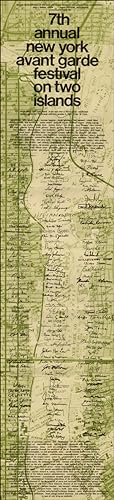
7th Annual New York Avant Garde Festival on Two Islands
Published by Annual Avant Garde Festival of New York [Charlotte Moorman] New York, NY, 1969
Seller: Specific Object / David Platzker, New York, NY, U.S.A.
Seller rating 5 out of 5 stars
[1] pp.; 74 x 18.5 cm.; accordion; duotone; edition size unknown; unsigned and unnumbered; offset-printed Promotional poster for the 7th Annual New York Avant Garde Festival presented by Charlotte Moorman held September 28 - October 4, 1969. Performers included Charlotte Moorman, Jon Aldefer, Billy Apple, Ay-o, Norman Bauman, David Behrman, Lois Bernard, Robert Breer, Darlene Butsch, Luis Camnitzer, Jackie Cassen, Jaropolk Cigash, Michael Cooper, Philip Corner, Arthur Corwin, Ian Crofts, Douglas Davis, Lindsay Decker, Ken Dewey, Juan Downey, Sean Emmett, Jeni Engel, Charles Frazier, Frank Gillette, Jimmy Giuffre, Michael Gurian, Al Hansen, Gary Harris, Don Heckman, Piero Heliczer, Bici Hendricks, Geoffrey Hendricks, Jon Hendricks, Dick Hogle, Richard Hyatt, Yukihisa Isobe, Ken jacobs, Poppy Johnson, Ray Johnson, Joe Jones, Kenneth Knowlton, Gilles Larrain, Fred Lieberman, Ernst Lurker, Jackson Mac Low, Max V. Mathews, Preston McClanahan, Jim McWilliams, Peter Neumann, Henry Niese, Andrew Noren, Ralph Ortiz, Nam June Paik, Benjamin Patterson, Lil Picard, John Pierce, Dick Preston, Ely Raman, Jim Raridon, Earl Reiback, Jean Claude Risset, Sal Romano, Paul Ryan, Ira Schneider, Michael Snow, Rudi Stern, Tal Streeter, Sandra Sutton, Aldo Tambellini, Jean Toche, Jerry Tublin, John van Alstine, John Van Saun, Frank Lincoln Viner, Gerald Vis, Laurence Warshaw, Todd Watts, Joyce Wieland, Kenneth Werner, Pat Willard, David Wise, Ted Wolf, Jud Yalkut, and Gary Zeller performing works by Les Levine, Allan Kaprow, Philip Corner, Stan Brakhage, Jean Toche and many others. Very Good. Hand addressed mailed copy with mailing marks and wear including two 7 mm. tears to bottom edge along closure on either side of 1.6 cm. stain from removed tape. 1 cm. glue staining on verso from closure. Otherwise clean and unmarked.


