Order Total (1 Item Items):
Shipping Destination:

Einstein Albert Nathan Rosen (4 results)
Skip to main search results
Search filters
Product Type
- All Product Types
- Books (4)
- Magazines & Periodicals (No further results match this refinement)
- Comics (No further results match this refinement)
- Sheet Music (No further results match this refinement)
- Art, Prints & Posters (No further results match this refinement)
- Photographs (No further results match this refinement)
- Maps (No further results match this refinement)
- Manuscripts & Paper Collectibles (No further results match this refinement)
Condition Learn more
- New (1)
- As New, Fine or Near Fine (No further results match this refinement)
- Very Good or Good (3)
- Fair or Poor (No further results match this refinement)
- As Described (No further results match this refinement)
Binding
Collectible Attributes
- First Edition (1)
- Signed (No further results match this refinement)
- Dust Jacket (No further results match this refinement)
- Seller-Supplied Images (3)
- Not Print on Demand (4)
Language (3)
Free Shipping
- Free Shipping to U.S.A. (No further results match this refinement)
Seller Location
Seller Rating
-

La meccanica quantistica è completa? Il paradosso dell'entanglement (QBit)
Seller: libreriauniversitaria.it, Occhiobello, RO, Italy
Seller rating 4 out of 5 stars

Condition: NEW.
-
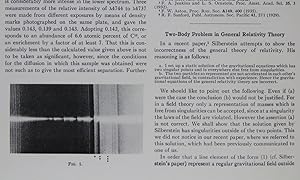
"Two-Body Problem in General Relativity Theory". pp. 404-405. In: The Physical Review. 2nd series, vol. 49. - With: Rabi, Isidor: "On the Process of Space Quantization", pp. 324-328.
Language: English
Published by Lancester, American Physical Society, 1936
Half cloth binding. Condition: Gut. 26 x 20 cm (10,5 x 8 inches). Present is the complete volume 49 with X, 971 pp. *Released stamp on title back side, else in good condition. Sprache: Englisch Gewicht in Gramm: 2000.
-
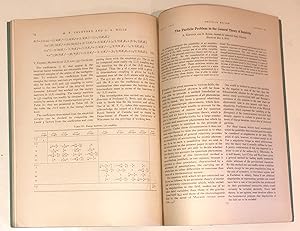
The Particle Problem in the General Theory of Relativity, pp. 73-77 in: The Physical Review, Second Series, vol. 48, no. 1, July 1, 1935. WORMHOLES
Published by Lancaster, PA & New Yor, NY: American Institute of Physics, 1935
Seller: Landmarks of Science Books, Richmond, United Kingdom
Seller rating 4 out of 5 stars
First Edition
Soft cover. Condition: Very Good. 1st Edition. First edition, journal issue, of this famous paper introducing the concept of the 'Einstein-Rosen bridge', now known as a 'wormhole'. "In the last decades of his life, Albert Einstein tried endlessly to unify electromagnetism with his own theory of gravity, general relativity. These efforts are mostly now regarded as quixotic, but a short proposal written in 1935 with a colleague has survived in unlikely fashion as the source of science-fiction ideas for speeding across the universe by means of 'wormholes' through spacetime. From the modern perspective, the paper also illustrates how general relativity posed mathematical and conceptual difficulties that foxed even its creator. Einstein and Nathan Rosen, both at the Institute for Advanced Study in Princeton, wanted to rid physics of singularities - points where mathematical quantities become infinite or otherwise ill-defined such as the concept of a particle that has all its mass concentrated into an infinitely small geometrical point. In general relativity, a point mass curves spacetime around it in a way that was calculated by Karl Schwarzschild in 1916. The Schwarzschild solution has mathematical singularities both at zero and at the so-called Schwarzschild radius. Reinterpretation of the Schwarzschild solution avoids these singularities, Einstein and Rosen argued in their 1935 Phys. Rev. paper. They imagined a path tracing radially inward. Instead of trying to cross the imaginary spherical shell at the singular radius and proceeding down to the center, Einstein and Rosen showed how to match the path onto another track that emerges outward again but into a separate section of spacetime. Imagine funnel shapes pulled out of two adjacent rubber sheets and connected at their necks, providing a continuous, tube-shaped path from one surface to the other. This construction makes a smooth connection or bridge between two distinct pieces of spacetime. Viewed from afar, either part of this solution represents the gravitational effect of a mass because spacetime is strongly curved, but no physical body is present . They hoped their construction would offer a starting point for a unified theory of gravity and electromagnetism based purely on fields, avoiding point particles and the singularities that came with them. Not until 1939 was the modern idea of a black hole broached [Oppenheimer, Phys. Rev. 56, p. 455], and only later were the subtleties of the Schwarzschild solution fully understood. The singular radius that Einstein and Rosen worked hard to avoid became the black hole's event horizon. Although it is a one-way surface light can pass across it going inward, but cannot come out all physical quantities remain well defined at the event horizon. No true singularities arise there. Further theoretical work showed that the Einstein-Rosen 'wormhole' is not, contrary to outward appearances, a stable structure. For an observer trying to pass through, the wormhole opens up and closes too quickly for even a photon to get through. Later work suggested that exotic forms of energy threaded through a wormhole might keep it open but it remains unclear whether such arrangements are physically feasible" (Lindley, "The Birth of Wormholes", Phys. Rev. Focus, 15:11). Wormholes have recently become of greater interest because of the 'ER = EPR' conjecture, proposed by Leonard Susskind and Juan Maldacena in 2013. Six weeks before the present paper, Einstein, Boris Podolsky and Rosen published the famous 'EPR' paper which introduced the idea of 'quantum entanglement'. ER = EPR states that two entangled particles are connected by a wormhole. It is thought by some to be a basis for unifying general relativity and quantum mechanics into a theory of everything. Large 8vo, pp. 111, [1, blank]. Original printed wrappers (faint ink stamp on front wrapper of P.E.O. Memorial Library, Iowa Wesleyan College (now defunct), corners slightly bumped).
-
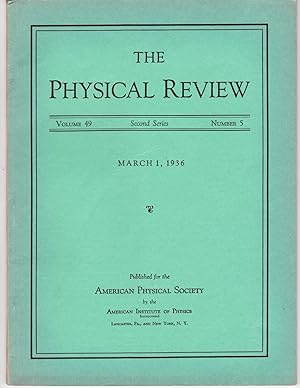
Two-body problem in general relativity theory in The Physical Review
Published by American Physical Society 1 March 1936, Lancaster, PA, 1936
Seller: Rodger Friedman Rare Book Studio, ABAA, Tuxedo, NY, U.S.A.
Seller rating 4 out of 5 stars
Condition: Very Good. Second series, volume 49, number 5. ppl 341-422. Original green wraps. Slight nick at bottom edge of lower wrap, else better than very good. Includes the retort by Einstein and Rosen (originators of speculation on the existence of "worm-holes" in spacetime) to objections made to the general theory of relativity. According to Galina Weinstein: "Between 1935 and 1936, Einstein was occupied with the Schwarzschild solution and the singularity within it while working in Princeton on the unified field theory and with his assistant Nathan Rosen, on the theory of the Einstein-Rosen bridges. He was also occupied with quantum theory. He believed that quantum theory was an incomplete representation of real things. Together with Rosen and Boris Podolsky he invented the EPR paradox. I demonstrate that the two-body problem in general relativity was a heuristic guide in Einstein's and collaborators' 1935 work on the Einstein-Rosen bridge and EPR paradox."Also articles by notable physicists on radioactivity, electron mobility, quantum-mechanical measurement, and so on.