Order Total (1 Item Items):
Shipping Destination:

Dionysius Dooley (3 results)
Skip to main search results
Search filters
Product Type
- All Product Types
- Books (3)
- Magazines & Periodicals (No further results match this refinement)
- Comics (No further results match this refinement)
- Sheet Music (No further results match this refinement)
- Art, Prints & Posters (No further results match this refinement)
- Photographs (No further results match this refinement)
- Maps (No further results match this refinement)
- Manuscripts & Paper Collectibles (No further results match this refinement)
Condition Learn more
- New (No further results match this refinement)
- As New, Fine or Near Fine (No further results match this refinement)
- Very Good or Good (No further results match this refinement)
- Fair or Poor (No further results match this refinement)
- As Described (3)
Binding
- All Bindings
- Hardcover (No further results match this refinement)
- Softcover (No further results match this refinement)
Collectible Attributes
- First Edition (No further results match this refinement)
- Signed (1)
- Dust Jacket (No further results match this refinement)
- Seller-Supplied Images (3)
- Not Print on Demand (3)
Language (1)
Price
- Any Price
- Under £ 20 (No further results match this refinement)
- £ 20 to £ 35 (No further results match this refinement)
- Over £ 35
Free Shipping
- Free Shipping to U.S.A. (No further results match this refinement)
Seller Location
Seller Rating
-
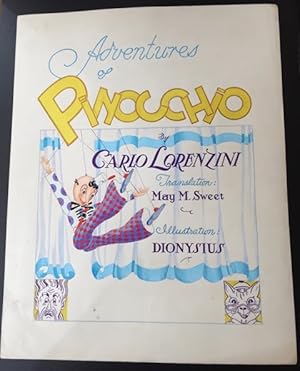
ORIGINAL WATERCOLOR STORYBOARDS CREATED BY DOOLEY DIONYSIUS, A SAINT LOUIS, MISSOURI ARTIST WHO WORKED FOR THE WALT DISNEY STUDIOS, AND THE PUBLIC WORKS OF ART PROJECT (PART OF THE CIVIL WORKS ADMINISTRATION, A PRECURSOR TO THE WPA) IN THE 1930's
Publication Date: 1930
Seller: Bartleby's Books, ABAA, Chevy Chase, MD, U.S.A.
Association Member: ABAA ESA ILAB IOBA
Seller rating 5 out of 5 stars

A group of 57 meticulously hand-drawn and richly colored illustrations by Dooley Dionysius: 24 panels created to illustrate "Pinocchio," each approx. 14 1/2 x 11 1/2 in., on stiff buff card stock or art paper (including a mock-up of the title page, 16 panels split between a color illustration and a penciled sample line or two of text, 1 page of black & white design illustrations for chapter ends, and 6 full page color illustrations); and 33 panels for an original tale entitled "The Story of the Taj Mahal," on stiff buff card stock or art paper, in varying sizes from 9 x 12 in. up to 16 1/2 x 23 in. (including a full color title page, a pen & ink and black watercolor title page, 24 pen & ink and black watercolor illustrations, and 7 full color illustrations, 5 of which are matted [some old staining to mats]). Traces of mounting on versos of most of the images. Dionysius was known for his almost microscopic brush strokes, fanciful designs, and jewel-like painting, often compared by critics to Persian miniatures. His work was exhibited in many St. Louis galleries in the 1930's (including the St. Louis Art Center where two of the "Pinocchio" drawings were displayed), as well as at shows in Los Angeles, including the Los Angeles County Museum of Art, the California Water Color Society, and Marguerite Zimbalist's Twenty Dollar Gallery. Born in Kirkwood, Missouri, H.J. "Dooley" Dionysius attended the Washington University School of Fine Arts in the mid-1920's. He spent 10 years in Hollywood working alternately as a jewelry designer, an apprentice to Willy Pogany designing murals for William Randolph Hearst, and in the art department at the Walt Disney studios. In 1932, the Healy Galleries in St. Louis mounted a one-man show of his works. A story by Guy Forshey in the St. Louis Post-Dispatch on March 13, 1932 describes Dionysius' work: "His subject matter is of a nature that lends itself admirably to his peculiar style of treatment. He paints pure fancy. His scenes are almost invariably placed on lost continents or in lands which have existed only in the imagination of men. Unlike most water color painters, he does not blend color into color, but builds color on color producing an opaque effect." He often worked in miniature, and critical reviews of his watercolors remark on their exotic nature: "The tiny still life arrangements of flowers remind one of medallions in enamel or semi-precious stones. In all of these the draughtsmanship is meticulous and the compositions are so perfectly in balance that you do not think of such an element as deliberate composition in connection with them. You feel the rhythm of the dancing figures, the swing of the boats and the swell of the waves." His work for the PWAP/CWA during the 1930's included creation of a mural of Mother Goose for the Benton School Kindergarten in St. Louis. Dionysius' ambition was to write and illustrate childrens books. According to brief biographies in "Artists in California, 1786-1940," by Edan Hughes and in "Who's Who in American Art 1936-41," he was the author/illustrator of two books, "Black Opal," and a version of "Mother Goose Rhymes." The Census records of 1940, record him in New York City as a lodger, his profession listed as "illustrator," most likely looking to find a market for his other book designs. We have found no record that either his "Pinocchio" or his "Story of the Taj Mahal" was ever published.
-
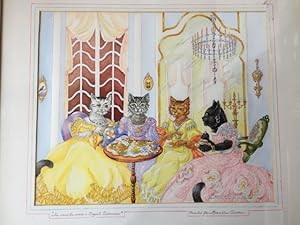
"HE SAID HE WAS A ROYAL SIAMESE." (caption title) ORIGINAL WATERCOLOR DRAWING, SIGNED BY THE ARTIST
Publication Date: 1972
Seller: Bartleby's Books, ABAA, Chevy Chase, MD, U.S.A.
Association Member: ABAA ESA ILAB IOBA
Seller rating 5 out of 5 stars
Signed
Original watercolor, approx. 11 1/2 x 14 in., matted, glazed and framed. The illustration shows four cats, dressed in elegant ball gowns (their tails peaking out just beyond the hems of their dresses) seated around a tea table in a drawing room. The tea table is full of cups and cookies, the cats wear fine jewelry. A chandelier hangs overhead, floor to ceiling windows are covered in fine drapery, pictures of a cat and a bird are mounted on the walls. The drawing is signed and dated by Dionysius, along with the pencil caption title, and a pencil note on the mounting board: "Painted for Marcella Curtin." A humorous, colorfully rendered illustration with much fine detail. Dooley Dionysius was a Saint Louis, Missouri artist who worked for the Walt Disney Studios, and the Public Works of Art Project (part of the Civil Works Administration, a precursor to the WPA) in the 1930's. Born in Kirkwood, Missouri, H.J. "Dooley" Dionysius attended the Washington University School of Fine Arts in the mid-1920's. He spent 10 years in Hollywood working alternately as a jewelry designer, an apprentice to Willy Pogany designing murals for William Randolph Hearst, and in the art department at the Walt Disney studios. In 1932, the Healy Galleries in St. Louis mounted a one-man show of his works. A story by Guy Forshey in the St. Louis Post-Dispatch on March 13, 1932 describes Dionysius' work: "His subject matter is of a nature that lends itself admirably to his peculiar style of treatment. He paints pure fancy. His scenes are almost invariably placed on lost continents or in lands which have existed only in the imagination of men. Unlike most water color painters, he does not blend color into color, but builds color on color producing an opaque effect." He often worked in miniature, and critical reviews of his watercolors remark on their exotic nature: "The tiny still life arrangements of flowers remind one of medallions in enamel or semi-precious stones. In all of these the draughtsmanship is meticulous and the compositions are so perfectly in balance that you do not think of such an element as deliberate composition in connection with them. You feel the rhythm of the dancing figures, the swing of the boats and the swell of the waves." He returned to Saint Louis where he continued to pursue his artistic career, exhibiting in local museums and clubs. His work for the PWAP/CWA during the 1930's included creation of a mural of Mother Goose for the Benton School Kindergarten in St. Louis.
-
FIVE ORIGINAL WATERCOLOR ILLUSTRATED MINIATURE BOXES, ALL SIGNED BY THE ARTIST
Publication Date: 1930
Seller: Bartleby's Books, ABAA, Chevy Chase, MD, U.S.A.
Association Member: ABAA ESA ILAB IOBA
Seller rating 5 out of 5 stars
Five small decorative boxes (three wooden or metal matchboxes, two metal keepsakes), embellished with miniature, jewel-like hand-painted watercolor scenes. Two bear printed labels, most likely also designed by Dionysius, advertising his miniatures, and naming the scenes depicted ("Old South" shows young ladies in hoop skirts; "Atlantis" depicts a young couple in archaic dress). Clasp lacking on one of the metal keepsake boxes, but all images bright, with intense colors and finely wrought scenes. The group, Dooley Dionysius was a Saint Louis, Missouri artist who worked for the Walt Disney Studios, and the Public Works of Art Project (part of the Civil Works Administration, a precursor to the WPA) in the 1930's. Born in Kirkwood, Missouri, H.J. "Dooley" Dionysius attended the Washington University School of Fine Arts in the mid-1920's. He spent 10 years in Hollywood working alternately as a jewelry designer, an apprentice to Willy Pogany designing murals for William Randolph Hearst, and in the art department at the Walt Disney studios. In 1932, the Healy Galleries in St. Louis mounted a one-man show of his works. A story by Guy Forshey in the St. Louis Post-Dispatch on March 13, 1932 describes Dionysius' work: "His subject matter is of a nature that lends itself admirably to his peculiar style of treatment. He paints pure fancy. His scenes are almost invariably placed on lost continents or in lands which have existed only in the imagination of men. Unlike most water color painters, he does not blend color into color, but builds color on color producing an opaque effect." He often worked in miniature, and critical reviews of his watercolors remark on their exotic nature: "The tiny still life arrangements of flowers remind one of medallions in enamel or semi-precious stones. In all of these the draughtsmanship is meticulous and the compositions are so perfectly in balance that you do not think of such an element as deliberate composition in connection with them. You feel the rhythm of the dancing figures, the swing of the boats and the swell of the waves." He returned to Saint Louis where he continued to pursue his artistic career, exhibiting in local museums and clubs. His work for the PWAP/CWA during the 1930's included creation of a mural of Mother Goose for the Benton School Kindergarten in St. Louis.