

Order Total (1 Item Items):
Shipping Destination:

David Ferry Carlo Jacoboni (52 results)
Skip to main search results
Search filters
Product Type
- All Product Types
- Books (52)
- Magazines & Periodicals (No further results match this refinement)
- Comics (No further results match this refinement)
- Sheet Music (No further results match this refinement)
- Art, Prints & Posters (No further results match this refinement)
- Photographs (No further results match this refinement)
- Maps (No further results match this refinement)
- Manuscripts & Paper Collectibles (No further results match this refinement)
Condition Learn more
- New (42)
- As New, Fine or Near Fine (5)
- Very Good or Good (4)
- Fair or Poor (No further results match this refinement)
- As Described (1)
Binding
Collectible Attributes
- First Edition (No further results match this refinement)
- Signed (No further results match this refinement)
- Dust Jacket (No further results match this refinement)
- Seller-Supplied Images (23)
- Not Print on Demand (28)
Language (1)
Free Shipping
Seller Location
Seller Rating
-

Hardcover. Condition: Very Good. No Jacket. Former library book; May have limited writing in cover pages. Pages are unmarked. ~ ThriftBooks: Read More, Spend Less.
-
Quantum Transport in Ultrasmall Devices
Language: English
Published by Kluwer Academic/Plenum Publishers, 1995
ISBN 10: 0306449994 ISBN 13: 9780306449994
Hardcover. Condition: Comme neuf. Edition 1995. Ammareal reverse jusqu'à 15% du prix net de cet article à des organisations caritatives. ENGLISH DESCRIPTION Book Condition: Used, As new. Edition 1995. Ammareal gives back up to 15% of this item's net price to charity organizations.
-

Condition: Good. This is an ex-library book and may have the usual library/used-book markings inside.This book has hardback covers. In good all round condition. Please note the Image in this listing is a stock photo and may not match the covers of the actual item,700grams, ISBN:0306438534.
-
Hardcover. Condition: Good. No Jacket. Condition : Good. Ex-university library with associated markings. Hard cover, no jacket. 292pp. No highlighting or annotations to text. Photo on request.
-
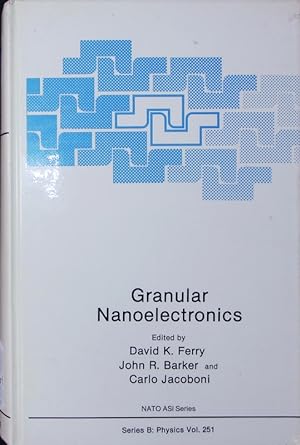
Granular nanoelectronics. Proceedings based on a NATO Advanced Study Institute on Physics of Granular Nanoelectronics, held July 23-August 3, 1990, in Il Ciocco, Italy.
Language: English
Published by New York, N.Y., Plenum Press, 1991
ISBN 10: 030643881X ISBN 13: 9780306438813
Hardcover. 590 S. Ehem. Bibliotheksexemplar mit Bib.-Signatur und Stempel in GUTEM Zustand. Kaum Gebrauchsspuren. 030643881X Sprache: Englisch Gewicht in Gramm: 550.
-

Granular nanoelectronics
Seller: Richard Booth's Bookshop, Hereford, United Kingdom
Seller rating 4 out of 5 stars

HardBack. Condition: Good. No Jacket. xii, 590pp. ill. Good clean copy.NATO ASI Series B: Physics Vol. 251.The technological means now exists for approaching the fundamentallimiting scales of solid state electronics in which a single carrier can, in principle, represent a single bit in an information flow. In this light, the prospect of chemically, or biologically, engineered molccularscale structures which might support information processing functions has enticed workers for many years. The one common factor in all suggested molecular switches, ranging from the experimentally feasible protontunneling structure, to natural systems such as the microtubule, is that each proposed structure deals with individual information carrying entities. Whereas this future molecular electronics faces enormous technical challenges, the same Iimit is already appearing in existing semiconducting quantum wires and small tunneling structures, both superconducting and normal meta devices, in which the motion of a single eh arge through the tunneling barrier can produce a sufficient voltage change to cutoff further tunneling current. We may compare the above situation with todays Si microelectronics, where each bit is encoded as a very arge number, not necessarily fixed, of electrons within acharge pulse. The associated reservoirs and sinks of charge carriers may be profitably tapped and manipulated to proviele macrocurrents which can be readily amplified or curtailed. On the other band, modern semiconductor ULSI has progressed by adopting a linear scaling principle to the downsizing of individual semiconductor devices.
-
Condition: Sehr gut. Zustand: Sehr gut | Seiten: 608 | Sprache: Englisch | Produktart: Bücher | The technological means now exists for approaching the fundamentallimiting scales of solid state electronics in which a single carrier can, in principle, represent a single bit in an information flow. In this light, the prospect of chemically, or biologically, engineered molccular-scale structures which might support information processing functions has enticed workers for many years. The one common factor in all suggested molecular switches, ranging from the experimentally feasible proton-tunneling structure, to natural systems such as the micro-tubule, is that each proposed structure deals with individual information carrying entities. Whereas this future molecular electronics faces enormous technical challenges, the same Iimit is already appearing in existing semiconducting quantum wires and small tunneling structures, both superconducting and normal meta! devices, in which the motion of a single eh arge through the tunneling barrier can produce a sufficient voltage change to cut-off further tunneling current. We may compare the above situation with today's Si microelectronics, where each bit is encoded as a very !arge number, not necessarily fixed, of electrons within acharge pulse. The associated reservoirs and sinks of charge carriers may be profitably tapped and manipulated to proviele macro-currents which can be readily amplified or curtailed. On the other band, modern semiconductor ULSI has progressed by adopting a linear scaling principle to the down-sizing of individual semiconductor devices.
-
Quantum Transport in Semiconductors (Physics of Solids and Liquids)
Seller: Ria Christie Collections, Uxbridge, United Kingdom
Seller rating 5 out of 5 stars

£ 136.79
£ 11.98 shipping
Ships from United Kingdom to U.S.A.Quantity: Over 20 available
Add to basketCondition: New. In.
-

Granular Nanoelectronics (NATO Science Series B:)
Seller: Ria Christie Collections, Uxbridge, United Kingdom
Seller rating 5 out of 5 stars
£ 187.59
£ 11.98 shipping
Ships from United Kingdom to U.S.A.Quantity: Over 20 available
Add to basketCondition: New. In.
-
Quantum Transport in Ultrasmall Devices: Proceedings of a NATO Advanced Study Institute on Quantum Transport in Ultrasmall Devices, held July 17-30, ... Ciocco, Italy (NATO Science Series B:, 342)
Seller: Ria Christie Collections, Uxbridge, United Kingdom
Seller rating 5 out of 5 stars
£ 187.59
£ 11.98 shipping
Ships from United Kingdom to U.S.A.Quantity: Over 20 available
Add to basketCondition: New. In.
-

Quantum Transport in Ultrasmall Devices: Proceedings of a NATO Advanced Study Institute on Quantum Transport in Ultrasmall Devices, held July 17-30, 1994, in II Ciocco, Italy (NATO Science Series B:)
Seller: Ria Christie Collections, Uxbridge, United Kingdom
Seller rating 5 out of 5 stars
£ 187.59
£ 11.98 shipping
Ships from United Kingdom to U.S.A.Quantity: Over 20 available
Add to basketCondition: New. In.
-
Granular Nanoelectronics (NATO Science Series B:, 251)
Seller: Ria Christie Collections, Uxbridge, United Kingdom
Seller rating 5 out of 5 stars
£ 187.59
£ 11.98 shipping
Ships from United Kingdom to U.S.A.Quantity: Over 20 available
Add to basketCondition: New. In.
-

Taschenbuch. Condition: Neu. Druck auf Anfrage Neuware - Printed after ordering - The majority of the chapters in this volume represent a series of lectures. that were given at a workshop on quantum transport in ultrasmall electron devices, held at San Miniato, Italy, in March 1987. These have, of course, been extended and updated during the period that has elapsed since the workshop was held, and have been supplemented with additional chapters devoted to the tunneling process in semiconductor quantum-well structures. The aim of this work is to review and present the current understanding in nonequilibrium quantum transport appropriate to semiconductors. Gen erally, the field of interest can be categorized as that appropriate to inhomogeneous transport in strong applied fields. These fields are most likely to be strongly varying in both space and time. Most of the literature on quantum transport in semiconductors (or in metallic systems, for that matter) is restricted to the equilibrium approach, in which spectral densities are maintained as semiclassical energy conserving delta functions, or perhaps incorporating some form of collision broadening through a Lorentzian shape, and the distribution functions are kept in the equilibrium Fermi-Dirac form. The most familiar field of nonequilibrium transport, at least for the semiconductor world, is that of hot carriers in semiconductors.
-
Condition: New. pp. 608.
-
Condition: New. pp. 556 Index.
-
Condition: New. pp. 556 Index.
-
Condition: New. pp. 608.
-
Condition: New. pp. 556 52:B&W 6.14 x 9.21in or 234 x 156mm (Royal 8vo) Case Laminate on White w/Gloss Lam.
-

Gebunden. Condition: New. Proceedings of a NATO ASI held in Il Ciocco, Italy, July 17-30, 1994 The operation of semiconductor devices depends upon the use of electrical potential barriers (such as gate depletion) in controlling the carrier densities (electrons and holes) an.
-
Condition: New. pp. 556.
-

Taschenbuch. Condition: Neu. Druck auf Anfrage Neuware - Printed after ordering - The technological means now exists for approaching the fundamentallimiting scales of solid state electronics in which a single carrier can, in principle, represent a single bit in an information flow. In this light, the prospect of chemically, or biologically, engineered molccular-scale structures which might support information processing functions has enticed workers for many years. The one common factor in all suggested molecular switches, ranging from the experimentally feasible proton-tunneling structure, to natural systems such as the micro-tubule, is that each proposed structure deals with individual information carrying entities. Whereas this future molecular electronics faces enormous technical challenges, the same Iimit is already appearing in existing semiconducting quantum wires and small tunneling structures, both superconducting and normal meta! devices, in which the motion of a single eh arge through the tunneling barrier can produce a sufficient voltage change to cut-off further tunneling current. We may compare the above situation with today's Si microelectronics, where each bit is encoded as a very !arge number, not necessarily fixed, of electrons within acharge pulse. The associated reservoirs and sinks of charge carriers may be profitably tapped and manipulated to proviele macro-currents which can be readily amplified or curtailed. On the other band, modern semiconductor ULSI has progressed by adopting a linear scaling principle to the down-sizing of individual semiconductor devices.
-

Taschenbuch. Condition: Neu. Druck auf Anfrage Neuware - Printed after ordering - The operation of semiconductor devices depends upon the use of electrical potential barriers (such as gate depletion) in controlling the carrier densities (electrons and holes) and their transport. Although a successful device design is quite complicated and involves many aspects, the device engineering is mostly to devise a 'best' device design by defIning optimal device structures and manipulating impurity profIles to obtain optimal control of the carrier flow through the device. This becomes increasingly diffIcult as the device scale becomes smaller and smaller. Since the introduction of integrated circuits, the number of individual transistors on a single chip has doubled approximately every three years. As the number of devices has grown, the critical dimension of the smallest feature, such as a gate length (which is related to the transport length defIning the channel), has consequently declined. The reduction of this design rule proceeds approximately by a factor of 1. 4 each generation, which means we will be using 0. 1-0. 15 ). lm rules for the 4 Gb chips a decade from now. If we continue this extrapolation, current technology will require 30 nm design rules, and a cell 3 2 size 10 nm , for a 1Tb memory chip by the year 2020. New problems keep hindering the high-performance requirement. Well-known, but older, problems include hot carrier effects, short-channel effects, etc. A potential problem, which illustrates the need for quantum transport, is caused by impurity fluctuations.
-

Buch. Condition: Neu. Druck auf Anfrage Neuware - Printed after ordering - The technological means now exists for approaching the fundamentallimiting scales of solid state electronics in which a single carrier can, in principle, represent a single bit in an information flow. In this light, the prospect of chemically, or biologically, engineered molccular-scale structures which might support information processing functions has enticed workers for many years. The one common factor in all suggested molecular switches, ranging from the experimentally feasible proton-tunneling structure, to natural systems such as the micro-tubule, is that each proposed structure deals with individual information carrying entities. Whereas this future molecular electronics faces enormous technical challenges, the same Iimit is already appearing in existing semiconducting quantum wires and small tunneling structures, both superconducting and normal meta! devices, in which the motion of a single eh arge through the tunneling barrier can produce a sufficient voltage change to cut-off further tunneling current. We may compare the above situation with today's Si microelectronics, where each bit is encoded as a very !arge number, not necessarily fixed, of electrons within acharge pulse. The associated reservoirs and sinks of charge carriers may be profitably tapped and manipulated to proviele macro-currents which can be readily amplified or curtailed. On the other band, modern semiconductor ULSI has progressed by adopting a linear scaling principle to the down-sizing of individual semiconductor devices.
-
Paperback. Condition: Brand New. reprint edition. 602 pages. 9.25x6.10x1.37 inches. In Stock.
-
-
Hardcover. Condition: Like New. LIKE NEW. SHIPS FROM MULTIPLE LOCATIONS. book.
-

Quantum Transport in Ultrasmall Devices : Proceedings of a NATO Advanced Study Institute on Quantum Transport in Ultrasmall Devices, Held July 17-30, 1994, in II Ciocco, Italy
Language: English
Published by Springer Us Jul 1995, 1995
ISBN 10: 0306449994 ISBN 13: 9780306449994
Buch. Condition: Neu. Neuware - The operation of semiconductor devices depends upon the use of electrical potential barriers (such as gate depletion) in controlling the carrier densities (electrons and holes) and their transport. Although a successful device design is quite complicated and involves many aspects, the device engineering is mostly to devise a 'best' device design by defIning optimal device structures and manipulating impurity profIles to obtain optimal control of the carrier flow through the device. This becomes increasingly diffIcult as the device scale becomes smaller and smaller. Since the introduction of integrated circuits, the number of individual transistors on a single chip has doubled approximately every three years. As the number of devices has grown, the critical dimension of the smallest feature, such as a gate length (which is related to the transport length defIning the channel), has consequently declined. The reduction of this design rule proceeds approximately by a factor of 1. 4 each generation, which means we will be using 0. 1-0. 15 ). lm rules for the 4 Gb chips a decade from now. If we continue this extrapolation, current technology will require 30 nm design rules, and a cell 3 2 size 10 nm , for a 1Tb memory chip by the year 2020. New problems keep hindering the high-performance requirement. Well-known, but older, problems include hot carrier effects, short-channel effects, etc. A potential problem, which illustrates the need for quantum transport, is caused by impurity fluctuations.
-
Hardcover. Condition: Like New. Like New. book.
-
Condition: new. Questo è un articolo print on demand.
-
Condition: new. Questo è un articolo print on demand.

