

Order Total (1 Item Items):
Shipping Destination:

Conte Prof Joseph (1 results)
Skip to main search results
Search filters
Product Type
- All Product Types
- Books (No further results match this refinement)
- Magazines & Periodicals (1)
- Comics (No further results match this refinement)
- Sheet Music (No further results match this refinement)
- Art, Prints & Posters (No further results match this refinement)
- Photographs (No further results match this refinement)
- Maps (No further results match this refinement)
- Manuscripts & Paper Collectibles (No further results match this refinement)
Condition Learn more
- New (No further results match this refinement)
- As New, Fine or Near Fine (No further results match this refinement)
- Very Good or Good (1)
- Fair or Poor (No further results match this refinement)
- As Described (No further results match this refinement)
Binding
- All Bindings
- Hardcover (No further results match this refinement)
- Softcover (1)
Collectible Attributes
- First Edition (No further results match this refinement)
- Signed (No further results match this refinement)
- Dust Jacket (No further results match this refinement)
- Seller-Supplied Images (1)
- Not Print on Demand (1)
Language (1)
Price
- Any Price
- Under £ 20
- £ 20 to £ 40 (No further results match this refinement)
- Over £ 40 (No further results match this refinement)
Free Shipping
- Free Shipping to U.S.A. (No further results match this refinement)
Seller Location
Seller Rating
-
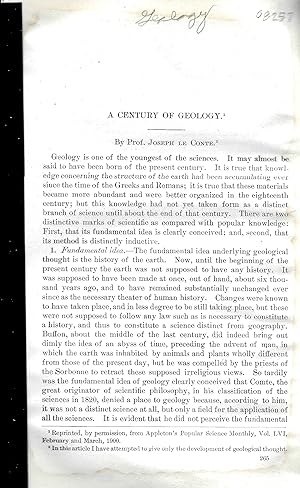
Soft cover. Condition: Good. pp265-287. Removed from ANNUAL REPORT OF THE BOARD OF REGENTS OF THE SMITHSONIAN INSTITUTION FOR THE YEAR ENDING JUNE 30, 1900. Faint dampstaining around the margins of several pages, not affecting text, else G. In plastic report covers. From the introduction: "Geology is one of the youngest of the sciences. It may almost be said to have been born of the present century. It is true that knowledge concerning the structure of the earth had been accumulating ever since the time of the Greeks and Romans; it is true that these materials became more abundant and were better organized in the eighteenth century; but this knowledge had not yet taken form as a distinct branch of science until about the end of that century. There are two distinctive marks of scientific as compared with popular knowledge: First, that its fundamental idea is clearly conceived; and, second, that its method is distinctly inductive.".
