Order Total (1 Item Items):
Shipping Destination:

Besler Basil (29 results)
Skip to main search results
Search filters
Product Type
- All Product Types
- Books (4)
- Magazines & Periodicals (No further results match this refinement)
- Comics (No further results match this refinement)
- Sheet Music (No further results match this refinement)
- Art, Prints & Posters (10)
- Photographs (No further results match this refinement)
- Maps (15)
- Manuscripts & Paper Collectibles (No further results match this refinement)
Condition Learn more
- New (1)
- As New, Fine or Near Fine (2)
- Very Good or Good (10)
- Fair or Poor (No further results match this refinement)
- As Described (16)
Binding
Collectible Attributes
- First Edition (No further results match this refinement)
- Signed (No further results match this refinement)
- Dust Jacket (No further results match this refinement)
- Seller-Supplied Images (26)
- Not Print on Demand (29)
Language (3)
Free Shipping
- Free Shipping to U.S.A. (No further results match this refinement)
Seller Location
Seller Rating
-

27 août 1979, fascicule contenant 14 planches hors texte en couleurs - très bon état.
-

Couverture rigide. Condition: Très bon. AVEC COFFRET ET JAQUETTE.
-

Der Garten von Eichstätt. Das Pflanzenbuch von Basilius Besler. Mit einer Einführung von Klaus Walter Littger und botanischen Erläuterungen von Werner Dressendörfer
Seller: Versandantiquariat BUCHvk, Gunzenhausen, Germany
Seller rating 5 out of 5 stars

Hardcover. Condition: Wie neu. 463 S., mit 367 farbigen Tafelseiten, 35 x5 x 29 cm, gebunden mit Schutzumschlag, nahezu neuwertig. VERSANDKOSTEN WEICHEN ab - 5 kg- DHL-Paket). . Basil Besler (* 13. Februar 1561 in Nürnberg; 13. März 1629 ebenda), war ein deutscher Apotheker, Botaniker und Verleger. Sein offizielles botanisches Autorenkürzel lautet Besler". 1597 beauftragte ihn der Bischof von Eichstätt, Johann Konrad von Gemmingen, mit der Anlage eines botanischen Gartens auf dem Gelände der Willibaldsburg. Auf einem Gelände mit einer Größe von etwa einem Hektar legte er auf acht Terrassen den Garten an. Er bediente sich dabei der Unterstützung der Botaniker Joachim Camerarius, Ludwig Jungermann sowie Carolus Clusius, der bereits den Residenzgarten in Wien angelegt hatte. Der Garten in Eichstätt wurde bald in weiten Kreisen berühmt. Buch.
-

Herbier de Basil Besler
Published by Larousse, 1979
Seller: Maison Vallon Librairie, L'isle sur la sorgue, France
Seller rating 5 out of 5 stars
Condition: Good. Bon état. in4. 1979. broché. non paginé pages. Good.
-

Paliurus
Published by Eichstatt, 1613
Seller: Clive A. Burden Ltd., Chalfont St. Giles, BUCKS, United Kingdom
Seller rating 5 out of 5 stars
Map
No binding. c. 18.5 x 15.5 inches, modern gouache colour, copper plate engraving. Plate 353. Basilius Besler's 'Hortus Eystettensis' is generally considered to be one of the most important and most beautiful florilegia ever published. It was commissioned by the Prince-Bishop Johann Conrad von Gemmingen in 1606, whose castle overlooked Eichstatt, a town to the south of Nuremberg. The garden was begun by Joachim Camerarius the younger (1534-98) in 1596 and was completed by Basilius Besler, a pharmacist from Nuremberg who also owned a fine garden and a collection of scientific curiosities. Within a few years the gardens of Eichstatt had become one of the most renowned in Europe.Instructed by Gemmingen in 1606, Besler enlisted the aid of two collaborators in the compilation of a vast and ambitious catalogue or florilegium - his younger brother Hieronymus (1566-1632) and Ludwig Jungermann (1572-1653), nephew of Camerarius, who taught natural history at the University of Altdorf. Hieronymus helped Besler to write the Latin text, while Jungermann perhaps assisted in the preparation of the botanical descriptions. Several of the original drawings for the plates survive today in the library of the University of Erlangen, and were apparently executed by Besler himself. The dedication to the book states that he was the author of many of them. The task of engraving the hundreds of magnificent plates took many years. Barker (1995); Hunt (1958) 430 (1713 edition); Nissen BBI (1966) 158; Oak Spring Flora (1997) pp. 52-7; Pritzel (1950) 745; Stafleu & Cowan (1976-88) 497.
-

Conyzamedia
Published by Eichstatt, 1613
Seller: Clive A. Burden Ltd., Chalfont St. Giles, BUCKS, United Kingdom
Seller rating 5 out of 5 stars
Map
No binding. c. 18.5 x 15.5 inches, modern gouache colour, copper plate engraving. Plate 215. Basilius Besler's 'Hortus Eystettensis' is generally considered to be one of the most important and most beautiful florilegia ever published. It was commissioned by the Prince-Bishop Johann Conrad von Gemmingen in 1606, whose castle overlooked Eichstatt, a town to the south of Nuremberg. The garden was begun by Joachim Camerarius the younger (1534-98) in 1596 and was completed by Basilius Besler, a pharmacist from Nuremberg who also owned a fine garden and a collection of scientific curiosities. Within a few years the gardens of Eichstatt had become one of the most renowned in Europe.Instructed by Gemmingen in 1606, Besler enlisted the aid of two collaborators in the compilation of a vast and ambitious catalogue or florilegium - his younger brother Hieronymus (1566-1632) and Ludwig Jungermann (1572-1653), nephew of Camerarius, who taught natural history at the University of Altdorf. Hieronymus helped Besler to write the Latin text, while Jungermann perhaps assisted in the preparation of the botanical descriptions. Several of the original drawings for the plates survive today in the library of the University of Erlangen, and were apparently executed by Besler himself. The dedication to the book states that he was the author of many of them. The task of engraving the hundreds of magnificent plates took many years. Barker (1995); Hunt (1958) 430 (1713 edition); Nissen BBI (1966) 158; Oak Spring Flora (1997) pp. 52-7; Pritzel (1950) 745; Stafleu & Cowan (1976-88) 497.
-

Ornithogalum minus
Published by Eichstatt, 1613
Seller: Clive A. Burden Ltd., Chalfont St. Giles, BUCKS, United Kingdom
Seller rating 5 out of 5 stars
Map
No binding. c. 18.5 x 15.5 inches, modern gouache colour, copper plate engraving. Plate 38. Hyacinthe. Basilius Besler's 'Hortus Eystettensis' is generally considered to be one of the most important and most beautiful florilegia ever published. It was commissioned by the Prince-Bishop Johann Conrad von Gemmingen in 1606, whose castle overlooked Eichstatt, a town to the south of Nuremberg. The garden was begun by Joachim Camerarius the younger (1534-98) in 1596 and was completed by Basilius Besler, a pharmacist from Nuremberg who also owned a fine garden and a collection of scientific curiosities. Within a few years the gardens of Eichstatt had become one of the most renowned in Europe. Instructed by Gemmingen in 1606, Besler enlisted the aid of two collaborators in the compilation of a vast and ambitious catalogue or florilegium - his younger brother Hieronymus (1566-1632) and Ludwig Jungermann (1572-1653), nephew of Camerarius, who taught natural history at the University of Altdorf. Hieronymus helped Besler to write the Latin text, while Jungermann perhaps assisted in the preparation of the botanical descriptions. Several of the original drawings for the plates survive today in the library of the University of Erlangen, and were apparently executed by Besler himself. The dedication to the book states that he was the author of many of them. The task of engraving the hundreds of magnificent plates took many years. Barker (1995); Hunt (1958) 430 (1713 edition); Nissen BBI (1966) 158; Oak Spring Flora (1997) pp. 52-7; Pritzel (1950) 745; Stafleu & Cowan (1976-88) 497.
-

Nymphia lutea
Published by Eichstatt, 1613
Seller: Clive A. Burden Ltd., Chalfont St. Giles, BUCKS, United Kingdom
Seller rating 5 out of 5 stars
Map
No binding. c. 18.5 x 15.5 inches, modern gouache colour, copper plate engraving. Plate 111. Basilius Besler's 'Hortus Eystettensis' is generally considered to be one of the most important and most beautiful florilegia ever published. It was commissioned by the Prince-Bishop Johann Conrad von Gemmingen in 1606, whose castle overlooked Eichstatt, a town to the south of Nuremberg. The garden was begun by Joachim Camerarius the younger (1534-98) in 1596 and was completed by Basilius Besler, a pharmacist from Nuremberg who also owned a fine garden and a collection of scientific curiosities. Within a few years the gardens of Eichstatt had become one of the most renowned in Europe.Instructed by Gemmingen in 1606, Besler enlisted the aid of two collaborators in the compilation of a vast and ambitious catalogue or florilegium - his younger brother Hieronymus (1566-1632) and Ludwig Jungermann (1572-1653), nephew of Camerarius, who taught natural history at the University of Altdorf. Hieronymus helped Besler to write the Latin text, while Jungermann perhaps assisted in the preparation of the botanical descriptions. Several of the original drawings for the plates survive today in the library of the University of Erlangen, and were apparently executed by Besler himself. The dedication to the book states that he was the author of many of them. The task of engraving the hundreds of magnificent plates took many years. Barker (1995); Hunt (1958) 430 (1713 edition); Nissen BBI (1966) 158; Oak Spring Flora (1997) pp. 52-7; Pritzel (1950) 745; Stafleu & Cowan (1976-88) 497.
-

Papas Peruanorum (Potato)
Published by Eichstatt, 1613
Seller: Clive A. Burden Ltd., Chalfont St. Giles, BUCKS, United Kingdom
Seller rating 5 out of 5 stars
Map
No binding. Condition: New. c. 18.5 x 15.5 inches, modern colour, copper plate engraving. A repaired wormholes in the lower left margin, not affecting the image. Plate 345. Potato. Basilius BeslerÂ's Â'Hortus EystettensisÂ' is generally considered to be one of the most important and most beautiful florilegia ever published. It was commissioned by the Prince-Bishop Johann Conrad von Gemmingen in 1606, whose castle overlooked Eichstatt, a town to the south of Nuremberg. The garden was begun by Joachim Camerarius the younger (1534-98) in 1596 and was completed by Basilius Besler, a pharmacist from Nuremberg who also owned a fine garden and a collection of scientific curiosities. Within a few years the gardens of Eichstatt had become one of the most renowned in Europe.
-

Caryophyllus Syluestris Flore.
Published by Eichstatt, 1613
Seller: Clive A. Burden Ltd., Chalfont St. Giles, BUCKS, United Kingdom
Seller rating 5 out of 5 stars
Map
No binding. c. 18.5 x 15.5 inches, modern colour, copper plate engraving. Plate 317. Carnations. Basilius BeslerÂ's Â'Hortus EystettensisÂ' is generally considered to be one of the most important and most beautiful florilegia ever published. It was commissioned by the Prince-Bishop Johann Conrad von Gemmingen in 1606, whose castle overlooked Eichstatt, a town to the south of Nuremberg. The garden was begun by Joachim Camerarius the younger (1534-98) in 1596 and was completed by Basilius Besler, a pharmacist from Nuremberg who also owned a fine garden and a collection of scientific curiosities. Within a few years the gardens of Eichstatt had become one of the most renowned in Europe.
-

Caryophyllus Indicus Plenus.
Published by Eichstatt, 1613
Seller: Clive A. Burden Ltd., Chalfont St. Giles, BUCKS, United Kingdom
Seller rating 5 out of 5 stars
Map
No binding. c. 18.5 x 15.5 inches, modern colour, copper plate engraving. Plate 307. Marigold. Basilius BeslerÂ's Â'Hortus EystettensisÂ' is generally considered to be one of the most important and most beautiful florilegia ever published. It was commissioned by the Prince-Bishop Johann Conrad von Gemmingen in 1606, whose castle overlooked Eichstatt, a town to the south of Nuremberg. The garden was begun by Joachim Camerarius the younger (1534-98) in 1596 and was completed by Basilius Besler, a pharmacist from Nuremberg who also owned a fine garden and a collection of scientific curiosities. Within a few years the gardens of Eichstatt had become one of the most renowned in Europe.
-

Cyanus Aruensis Flore Coeruleo
Published by Eichstatt, 1613
Seller: Clive A. Burden Ltd., Chalfont St. Giles, BUCKS, United Kingdom
Seller rating 5 out of 5 stars
Map
No binding. c. 18.5 x 15.5 inches, modern colour, copper plate engraving. Plate 115. Basilius BeslerÂ's Â'Hortus EystettensisÂ' is generally considered to be one of the most important and most beautiful florilegia ever published. It was commissioned by the Prince-Bishop Johann Conrad von Gemmingen in 1606, whose castle overlooked Eichstatt, a town to the south of Nuremberg. The garden was begun by Joachim Camerarius the younger (1534-98) in 1596 and was completed by Basilius Besler, a pharmacist from Nuremberg who also owned a fine garden and a collection of scientific curiosities. Within a few years the gardens of Eichstatt had become one of the most renowned in Europe.
-

Consolida Regalis .Violaceo
Published by Eichstatt, 1613
Seller: Clive A. Burden Ltd., Chalfont St. Giles, BUCKS, United Kingdom
Seller rating 5 out of 5 stars
Map
No binding. c. 18.5 x 15.5 inches, modern colour, copper plate engraving. Plate 175. Larkspur. Basilius BeslerÂ's Â'Hortus EystettensisÂ' is generally considered to be one of the most important and most beautiful florilegia ever published. It was commissioned by the Prince-Bishop Johann Conrad von Gemmingen in 1606, whose castle overlooked Eichstatt, a town to the south of Nuremberg. The garden was begun by Joachim Camerarius the younger (1534-98) in 1596 and was completed by Basilius Besler, a pharmacist from Nuremberg who also owned a fine garden and a collection of scientific curiosities. Within a few years the gardens of Eichstatt had become one of the most renowned in Europe.
-

Geranium Sanguinarium
Published by Eichstatt, 1613
Seller: Clive A. Burden Ltd., Chalfont St. Giles, BUCKS, United Kingdom
Seller rating 5 out of 5 stars
Map
No binding. c. 18.5 x 15.5 inches, modern colour, copper plate engraving. Plate 30. Geranium Basilius BeslerÂ's Â'Hortus EystettensisÂ' is generally considered to be one of the most important and most beautiful florilegia ever published. It was commissioned by the Prince-Bishop Johann Conrad von Gemmingen in 1606, whose castle overlooked Eichstatt, a town to the south of Nuremberg. The garden was begun by Joachim Camerarius the younger (1534-98) in 1596 and was completed by Basilius Besler, a pharmacist from Nuremberg who also owned a fine garden and a collection of scientific curiosities. Within a few years the gardens of Eichstatt had become one of the most renowned in Europe.
-

Clematis Coerulea Pannonica
Published by Eichstatt, 1613
Seller: Clive A. Burden Ltd., Chalfont St. Giles, BUCKS, United Kingdom
Seller rating 5 out of 5 stars
Map
No binding. c. 18.5 x 15.5 inches, modern colour, copper plate engraving. Plate 300. Clematis. Basilius BeslerÂ's Â'Hortus EystettensisÂ' is generally considered to be one of the most important and most beautiful florilegia ever published. It was commissioned by the Prince-Bishop Johann Conrad von Gemmingen in 1606, whose castle overlooked Eichstatt, a town to the south of Nuremberg. The garden was begun by Joachim Camerarius the younger (1534-98) in 1596 and was completed by Basilius Besler, a pharmacist from Nuremberg who also owned a fine garden and a collection of scientific curiosities. Within a few years the gardens of Eichstatt had become one of the most renowned in Europe.
-

Ornithogalum Hispanicum.
Published by Eichstatt, 1613
Seller: Clive A. Burden Ltd., Chalfont St. Giles, BUCKS, United Kingdom
Seller rating 5 out of 5 stars
Map
No binding. c. 18.5 x 15.5 inches, modern colour, copper plate engraving. Plate 131. Basilius BeslerÂ's Â'Hortus EystettensisÂ' is generally considered to be one of the most important and most beautiful florilegia ever published. It was commissioned by the Prince-Bishop Johann Conrad von Gemmingen in 1606, whose castle overlooked Eichstatt, a town to the south of Nuremberg. The garden was begun by Joachim Camerarius the younger (1534-98) in 1596 and was completed by Basilius Besler, a pharmacist from Nuremberg who also owned a fine garden and a collection of scientific curiosities. Within a few years the gardens of Eichstatt had become one of the most renowned in Europe.
-

Leucoium Bulbosum Autumnale.
Published by Eichstatt, 1613
Seller: Clive A. Burden Ltd., Chalfont St. Giles, BUCKS, United Kingdom
Seller rating 5 out of 5 stars
Map
No binding. c. 18.5 x 15.5 inches, modern colour, copper plate engraving. Two minor repairs to lower margin, not affecting the image. Plate 350. Crocus. Basilius BeslerÂ's Â'Hortus EystettensisÂ' is generally considered to be one of the most important and most beautiful florilegia ever published. It was commissioned by the Prince-Bishop Johann Conrad von Gemmingen in 1606, whose castle overlooked Eichstatt, a town to the south of Nuremberg. The garden was begun by Joachim Camerarius the younger (1534-98) in 1596 and was completed by Basilius Besler, a pharmacist from Nuremberg who also owned a fine garden and a collection of scientific curiosities. Within a few years the gardens of Eichstatt had become one of the most renowned in Europe.
-

Nicotiana Maior Angustifolia
Published by Eichstatt, 1613
Seller: Clive A. Burden Ltd., Chalfont St. Giles, BUCKS, United Kingdom
Seller rating 5 out of 5 stars
Map
No binding. c. 18.5 x 15.5 inches, modern colour, copper plate engraving. Some repaired wormholes in the lower left margin, not affecting the image. Plate 341. Tobacco. Basilius BeslerÂ's Â'Hortus EystettensisÂ' is generally considered to be one of the most important and most beautiful florilegia ever published. It was commissioned by the Prince-Bishop Johann Conrad von Gemmingen in 1606, whose castle overlooked Eichstatt, a town to the south of Nuremberg. The garden was begun by Joachim Camerarius the younger (1534-98) in 1596 and was completed by Basilius Besler, a pharmacist from Nuremberg who also owned a fine garden and a collection of scientific curiosities. Within a few years the gardens of Eichstatt had become one of the most renowned in Europe.
-

Hyacinthus Anglicus
Published by Eichstatt, 1613
Seller: Clive A. Burden Ltd., Chalfont St. Giles, BUCKS, United Kingdom
Seller rating 5 out of 5 stars
Map
No binding. c. 18.5 x 15.5 inches, modern colour, copper plate engraving. Plate 40. Hyacinthe. Basilius BeslerÂ's Â'Hortus EystettensisÂ' is generally considered to be one of the most important and most beautiful florilegia ever published. It was commissioned by the Prince-Bishop Johann Conrad von Gemmingen in 1606, whose castle overlooked Eichstatt, a town to the south of Nuremberg. The garden was begun by Joachim Camerarius the younger (1534-98) in 1596 and was completed by Basilius Besler, a pharmacist from Nuremberg who also owned a fine garden and a collection of scientific curiosities. Within a few years the gardens of Eichstatt had become one of the most renowned in Europe.
-
Hand-coloured Tulips.
Published by Nuremberg, 1713
Seller: Shapero Rare Books, London, United Kingdom
Association Member: ABA ILAB PBFA
Seller rating 5 out of 5 stars
Art / Print / Poster
1 copper engraved plate with hand-colouring, framed and glazed, 63.5 x 55.5 cm. (25 x 21 7/8 in) inclusive. A magnificent plate from 'Hortus Eystettensis', one of the earliest and most famous works in the field. The Hortus Eystettensis is a pictorial record of the flowers grown in the greatest German garden of its time, that of Prince Bishop of Eichstatt, Johann Conrad von Gemmingen. The garden was begun by Joachim Camerarius in 1596 and, after his death in 1598, completed by Basil Besler, a pharmacist from Nuremberg. A visitor, Philipp Hainhofer, in 1611 marvelled at the eight gardens, each containing 'flowers from a different country; they varied in the beds and flowers, especially in the beautiful roses, lilies, tulips. The Hortus records this variety and beauty. The book is exceptional in every sense; in its variety and range of flowers, in its size, in its fine quality of engraving. It is also one of the earliest records of flowers from a specific, documented garden. Besler was asked to complete the work by Gemmingen in 1606; the huge nature of the task was clear to Besler and he enlisted the help of his younger brother Hieronymus and Ludwig Jungermann, a nephew of Camerarius. Printing the Hortus may have begun as early as 1607. Drawings were made in situ and from specimens sent by the Bishop to Nuremberg; the Bishop reported to Hainhofer that he had boxes of fresh flowers sent every week to Besler at Nuremberg for sketching. A team of at least 10 engravers were employed to translate the drawings to copperplates. The gardens, along with most of the town of Eichstatt, were destroyed by the invading Swedish troops under Herzog Bernhard von Weimar in 1633-4, although they were partially restored by later bishops. Many of the original drawings survive in the University Library, Erlangen.
-
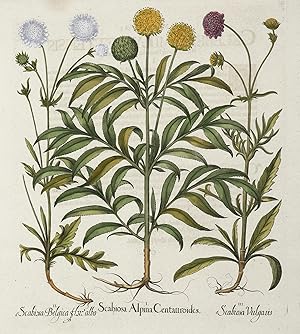
1. Scabiosa Alpina Centauroides.
Publication Date: 1713
Seller: Antique Print & Map Room, Ultimo, NSW, Australia
Association Member: ANZAAB ILAB
Seller rating 5 out of 5 stars
Art / Print / Poster
No Binding. Condition: Very Good. Spectacular engraving of the Yellow cephalaria from Basil Besler's Hortus Eystettensis, the greatest florilegium ever made and which recorded all the plants in their actual size that were in the botanical garden developed by the Prince Bishop of Eichstatt in Bavaria. Binomial name: Cephalaria alpina From Basil Besler's Hortus Eystettensis, the greatest florilegium ever made. Paper Size: 445mm x 510mm (17.5" x 20"). Condition: In good condition. Technique: Hand coloured copper engraving.
-
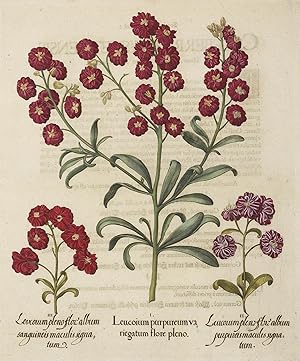
Leucoium Purpureumva, riegatum flore pleno.
Publication Date: 1713
Seller: Antique Print & Map Room, Ultimo, NSW, Australia
Association Member: ANZAAB ILAB
Seller rating 5 out of 5 stars
Art / Print / Poster
No Binding. Condition: Very Good. Spectacular engraving from Basil Beslers Hortus Eystettensis, the greatest florilegium ever made which recorded all the plants in their actual size which were in the botanical garden developed by the Prince Bishop of Eichstatt in Bavaria. Image Size: 410mm x 500mm (16.1" x 19.6"). Paper Size: 445mm x 510mm (17.5" x 20"). Condition: In good condition. Technique: Hand coloured copper engraving.
-
1. Hyacinthus Botryodies Major
Publication Date: 1713
Seller: Antique Print & Map Room, Ultimo, NSW, Australia
Association Member: ANZAAB ILAB
Seller rating 5 out of 5 stars
Art / Print / Poster
No Binding. Condition: Very Good. Spectacular engraving of hyacinths from Basil Besler's Hortus Eystettensis, the greatest florilegium ever made which recorded all the plants in their actual size which were in the botanical garden developed by the Prince Bishop of Eichstatt in Bavaria. Image Size: 410mm x 500mm (16.1" x 19.6"). Paper Size: 445mm x 510mm (17.5 x 20"). Condition: In good condition. Technique: Hand coloured copper engraving.
-
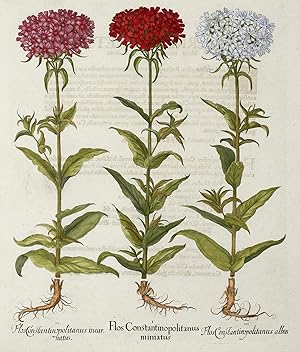
1. Flos Constantinopolitanus miniatus
Publication Date: 1713
Seller: Antique Print & Map Room, Ultimo, NSW, Australia
Association Member: ANZAAB ILAB
Seller rating 5 out of 5 stars
Art / Print / Poster
No Binding. Condition: Very Good. Spectacular engraving of the Maltese cross, also known as the Jerusalem cross from Basil Besler's Hortus Eystettensis, the greatest florilegium ever made and which recorded all the plants in their actual size that were in the botanical garden developed by the Prince Bishop of Eichstatt in Bavaria. Paper Size: 445mm x 510mm (17.5" x 20"). Condition: In good condition. Technique: Hand coloured copper engraving.
-
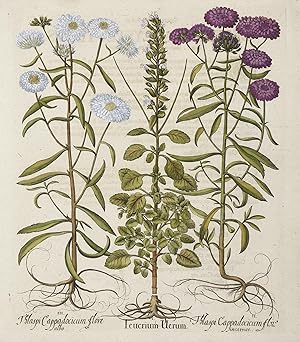
1. Teucrium Verum
Publication Date: 1713
Seller: Antique Print & Map Room, Ultimo, NSW, Australia
Association Member: ANZAAB ILAB
Seller rating 5 out of 5 stars
Art / Print / Poster
No Binding. Condition: Very Good. Spectacular engraving of Teucrium Verum from Basil Besler's Hortus Eystettensis, the greatest florilegium ever made and which recorded all the plants in their actual size that were in the botanical garden developed by the Prince Bishop of Eichstatt in Bavaria. Paper Size: 445mm x 510mm (17.5" x 20"). Condition: In good condition. Technique: Hand coloured copper engraving.
-
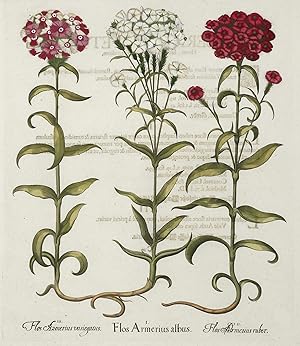
1. Flos Armerius albus
Publication Date: 1713
Seller: Antique Print & Map Room, Ultimo, NSW, Australia
Association Member: ANZAAB ILAB
Seller rating 5 out of 5 stars
Art / Print / Poster
No Binding. Condition: Very Good. Spectacular engraving of Dianthus barbatus, Sweet William from Basil Besler's Hortus Eystettensis, the greatest florilegium ever made and which recorded all the plants in their actual size that were in the botanical garden developed by the Prince Bishop of Eichstatt in Bavaria. Paper Size: 445mm x 510mm (17.5" x 20"). Condition: In good condition. Technique: Hand coloured copper engraving.
-
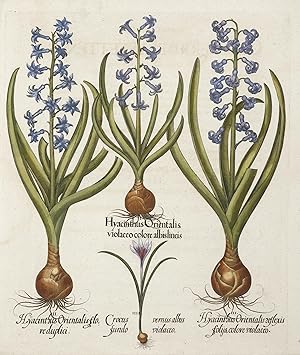
1. Hyacinthus Orientalis.
Publication Date: 1713
Seller: Antique Print & Map Room, Ultimo, NSW, Australia
Association Member: ANZAAB ILAB
Seller rating 5 out of 5 stars
Art / Print / Poster
No Binding. Condition: Very Good. Spectacular engraving of hyacinths from Basil Besler's Hortus Eystettensis, the greatest florilegium ever made and which recorded all the plants in their actual size that were in the botanical garden developed by the Prince Bishop of Eichstatt in Bavaria. Paper Size: 445mm x 510mm (17.5" x 20"). Condition: In good condition. Technique: Hand coloured copper engraving.
-
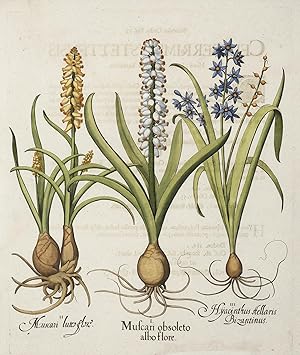
1. Muscari obsoleto alboflore
Publication Date: 1713
Seller: Antique Print & Map Room, Ultimo, NSW, Australia
Association Member: ANZAAB ILAB
Seller rating 5 out of 5 stars
Art / Print / Poster
No Binding. Condition: Very Good. Spectacular engraving of Hyacinths from Basil Besler's Hortus Eystettensis, the greatest florilegium ever made and which recorded all the plants in their actual size that were in the botanical garden developed by the Prince Bishop of Eichstatt in Bavaria. Paper Size: 445mm x 510mm (17.5" x 20"). Condition: In good condition. Technique: Hand coloured copper engraving.
-
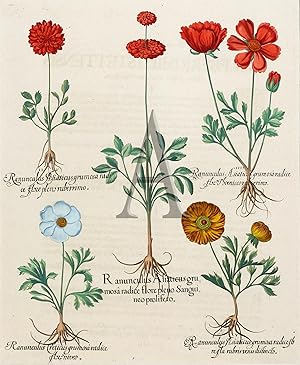
I. Ranunculus Asiaticus gru mosa radice flore pleno Sangui neo prolifero.
Publication Date: 1713
Seller: Antique Print & Map Room, Ultimo, NSW, Australia
Association Member: ANZAAB ILAB
Seller rating 5 out of 5 stars
Art / Print / Poster
No Binding. Condition: Very Good. Spectacular engraving of Buttercups from Basil Besler's Hortus Eystettensis, the greatest florilegium ever made which recorded all the plants in their actual size which were in the botanical garden developed by the Prince Bishop of Eichstatt in Bavaria. Image Size: 400mm x 480mm (15.7" x 18.9"). Paper Size: 440mm x 540mm ( 17.3" x 21.2"). Condition: In good condition. Technique: Hand coloured copper engraving.