

Order Total (1 Item Items):
Shipping Destination:

Bauman Murray (11 results)
Skip to main search results
Search filters
Product Type
- All Product Types
- Books (11)
- Magazines & Periodicals (No further results match this refinement)
- Comics (No further results match this refinement)
- Sheet Music (No further results match this refinement)
- Art, Prints & Posters (No further results match this refinement)
- Photographs (No further results match this refinement)
- Maps (No further results match this refinement)
- Manuscripts & Paper Collectibles (No further results match this refinement)
Condition Learn more
- New (8)
- As New, Fine or Near Fine (No further results match this refinement)
- Very Good or Good (3)
- Fair or Poor (No further results match this refinement)
- As Described (No further results match this refinement)
Binding
Collectible Attributes
- First Edition (No further results match this refinement)
- Signed (No further results match this refinement)
- Dust Jacket (1)
- Seller-Supplied Images (3)
- Not Print on Demand (11)
Language (1)
Free Shipping
Seller Location
Seller Rating
-

MARGINS
Language: English
Published by Independently published, 2019
ISBN 10: 1082751375 ISBN 13: 9781082751370
Condition: New.
-
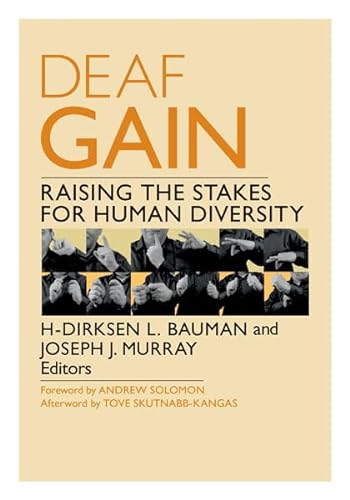
Deaf Gain: Raising the Stakes for Human Diversity
Language: English
Published by Univ Of Minnesota Press, 2014
ISBN 10: 0816691223 ISBN 13: 9780816691227
Paperback. Condition: Good. Connecting readers with great books since 1972! Used textbooks may not include companion materials such as access codes, etc. May have some wear or writing/highlighting. We ship orders daily and Customer Service is our top priority!
-
Deaf Gain: Raising the Stakes for Human Diversity
Language: English
Published by University of Minnesota Press, 2014
ISBN 10: 0816691223 ISBN 13: 9780816691227
Seller: Lake Country Books and More, Excelsior, MN, U.S.A.
Seller rating 5 out of 5 stars

Paperback. Condition: Very Good. Dust Jacket Condition: None as issued. Very clean, solid paperback copy with unmarked text. Cover has light surface and edge wear. Binding is tight and square; no creases to spine. We are unable to ship oversize books and multi-volume sets internationally.
-
Deaf Gain Format: Paperback
Language: English
Published by University of Chicago press, 2014
ISBN 10: 0816691223 ISBN 13: 9780816691227
Condition: New. Brand New.
-

Deaf Gain
Language: English
Published by University of Minnesota Press, US, 2014
ISBN 10: 0816691223 ISBN 13: 9780816691227
Seller: Rarewaves.com USA, London, LONDO, United Kingdom
Seller rating 5 out of 5 stars
Paperback. Condition: New. Deaf people are usually regarded by the hearing world as having a lack, as missing a sense. Yet a definition of deaf people based on hearing loss obscures a wealth of ways in which societies have benefited from the significant contributions of deaf people. In this bold intervention into ongoing debates about disability and what it means to be human, experts from a variety of disciplines-neuroscience, linguistics, bioethics, history, cultural studies, education, public policy, art, and architecture-advance the concept of Deaf Gain and challenge assumptions about what is normal. Through their in-depth articulation of Deaf Gain, the editors and authors of this pathbreaking volume approach deafness as a distinct way of being in the world, one which opens up perceptions, perspectives, and insights that are less common to the majority of hearing persons. For example, deaf individuals tend to have unique capabilities in spatial and facial recognition, peripheral processing, and the detection of images. And users of sign language, which neuroscientists have shown to be biologically equivalent to speech, contribute toward a robust range of creative expression and understanding. By framing deafness in terms of its intellectual, creative, and cultural benefits, Deaf Gain recognizes physical and cognitive difference as a vital aspect of human diversity. Contributors: David Armstrong; Benjamin Bahan, Gallaudet U; Hansel Bauman, Gallaudet U; John D. Bonvillian, U of Virginia; Alison Bryan; Teresa Blankmeyer Burke, Gallaudet U; Cindee Calton; Debra Cole; Matthew Dye, U of Illinois at Urbana-Champaign; Steve Emery; Ofelia GarcÍa, CUNY; Peter C. Hauser, Rochester Institute of Technology; Geo Kartheiser; Caroline Kobek Pezzarossi; Christopher Krentz, U of Virginia; Annelies Kusters; Irene W. Leigh, Gallaudet U; Elizabeth M. Lockwood, U of Arizona; Summer Loeffler; Mara LÚcia Massuti, Instituto Federal de Santa Catarina, Brazil; Donna A. Morere, Gallaudet U; Kati Morton; Ronice MÜller de Quadros, U Federal de Santa Catarina, Brazil; Donna Jo Napoli, Swarthmore College; Jennifer Nelson, Gallaudet U; Laura-Ann Petitto, Gallaudet U; Suvi PylvÄnen, Kymenlaakso U of Applied Sciences; Antti Raike, Aalto U; PÄivi RainÒ, U of Applied Sciences Humak; Katherine D. Rogers; Clara Sherley-Appel; Kristin Snoddon, U of Alberta; Karin Strobel, U Federal de Santa Catarina, Brazil; Hilary Sutherland; Rachel Sutton-Spence, U of Bristol, England; James Tabery, U of Utah; Jennifer Grinder Witteborg; Mark Zaurov.
-
Deaf Gain: Raising the Stakes for Human Diversity
Language: English
Published by University of Minnesota Press, 2014
ISBN 10: 0816691223 ISBN 13: 9780816691227
Seller: Kennys Bookshop and Art Galleries Ltd., Galway, GY, Ireland
Seller rating 5 out of 5 stars
Condition: New. Editor(s): Bauman, H-Dirksen L.; Murray, Joseph J. Num Pages: 568 pages, 60 black & white illustrations, 2 tables. BIC Classification: JFFG; JHMC; JNSC1. Category: (G) General (US: Trade); (P) Professional & Vocational; (UP) Postgraduate, Research & Scholarly. Dimension: 255 x 179 x 30. Weight in Grams: 1010. . 2014. Paperback. . . . .
-
Deaf Gain Raising the Stakes for Human Diversity
Language: English
Published by Univ of Minnesota Pr, 2014
ISBN 10: 0816691223 ISBN 13: 9780816691227
Paperback. Condition: Brand New. 568 pages. 10.00x7.00x2.00 inches. In Stock.
-
Deaf Gain: Raising the Stakes for Human Diversity
Language: English
Published by University of Minnesota Press, 2014
ISBN 10: 0816691223 ISBN 13: 9780816691227
Condition: New. Editor(s): Bauman, H-Dirksen L.; Murray, Joseph J. Num Pages: 568 pages, 60 black & white illustrations, 2 tables. BIC Classification: JFFG; JHMC; JNSC1. Category: (G) General (US: Trade); (P) Professional & Vocational; (UP) Postgraduate, Research & Scholarly. Dimension: 255 x 179 x 30. Weight in Grams: 1010. . 2014. Paperback. . . . . Books ship from the US and Ireland.
-
Deaf Gain: Raising the Stakes for Human Diversity
Language: English
Published by University of Minnesota Press, 2014
ISBN 10: 0816691223 ISBN 13: 9780816691227
Condition: new.
-

Deaf Gain: Raising the Stakes for Human Diversity
Language: English
Published by Univ Of Minnesota Press, 2014
ISBN 10: 0816691215 ISBN 13: 9780816691210
Seller: Midtown Scholar Bookstore, Harrisburg, PA, U.S.A.
Seller rating 5 out of 5 stars
Hardcover. Condition: Good. Good - Bumped and creased book with tears to the extremities, but not affecting the text block, may have remainder mark or previous owner's name - GOOD Oversized.
-

Deaf Gain
Language: English
Published by University of Minnesota Press, US, 2014
ISBN 10: 0816691223 ISBN 13: 9780816691227
Paperback. Condition: New. Deaf people are usually regarded by the hearing world as having a lack, as missing a sense. Yet a definition of deaf people based on hearing loss obscures a wealth of ways in which societies have benefited from the significant contributions of deaf people. In this bold intervention into ongoing debates about disability and what it means to be human, experts from a variety of disciplines-neuroscience, linguistics, bioethics, history, cultural studies, education, public policy, art, and architecture-advance the concept of Deaf Gain and challenge assumptions about what is normal. Through their in-depth articulation of Deaf Gain, the editors and authors of this pathbreaking volume approach deafness as a distinct way of being in the world, one which opens up perceptions, perspectives, and insights that are less common to the majority of hearing persons. For example, deaf individuals tend to have unique capabilities in spatial and facial recognition, peripheral processing, and the detection of images. And users of sign language, which neuroscientists have shown to be biologically equivalent to speech, contribute toward a robust range of creative expression and understanding. By framing deafness in terms of its intellectual, creative, and cultural benefits, Deaf Gain recognizes physical and cognitive difference as a vital aspect of human diversity. Contributors: David Armstrong; Benjamin Bahan, Gallaudet U; Hansel Bauman, Gallaudet U; John D. Bonvillian, U of Virginia; Alison Bryan; Teresa Blankmeyer Burke, Gallaudet U; Cindee Calton; Debra Cole; Matthew Dye, U of Illinois at Urbana-Champaign; Steve Emery; Ofelia GarcÍa, CUNY; Peter C. Hauser, Rochester Institute of Technology; Geo Kartheiser; Caroline Kobek Pezzarossi; Christopher Krentz, U of Virginia; Annelies Kusters; Irene W. Leigh, Gallaudet U; Elizabeth M. Lockwood, U of Arizona; Summer Loeffler; Mara LÚcia Massuti, Instituto Federal de Santa Catarina, Brazil; Donna A. Morere, Gallaudet U; Kati Morton; Ronice MÜller de Quadros, U Federal de Santa Catarina, Brazil; Donna Jo Napoli, Swarthmore College; Jennifer Nelson, Gallaudet U; Laura-Ann Petitto, Gallaudet U; Suvi PylvÄnen, Kymenlaakso U of Applied Sciences; Antti Raike, Aalto U; PÄivi RainÒ, U of Applied Sciences Humak; Katherine D. Rogers; Clara Sherley-Appel; Kristin Snoddon, U of Alberta; Karin Strobel, U Federal de Santa Catarina, Brazil; Hilary Sutherland; Rachel Sutton-Spence, U of Bristol, England; James Tabery, U of Utah; Jennifer Grinder Witteborg; Mark Zaurov.

