

Order Total (1 Item Items):
Shipping Destination:

Barreteau Olivier (56 results)
Skip to main search results
Search filters
Product Type
- All Product Types
- Books (56)
- Magazines & Periodicals (No further results match this refinement)
- Comics (No further results match this refinement)
- Sheet Music (No further results match this refinement)
- Art, Prints & Posters (No further results match this refinement)
- Photographs (No further results match this refinement)
- Maps (No further results match this refinement)
- Manuscripts & Paper Collectibles (No further results match this refinement)
Condition Learn more
- New (46)
- As New, Fine or Near Fine (8)
- Very Good or Good (1)
- Fair or Poor (No further results match this refinement)
- As Described (1)
Binding
Collectible Attributes
- First Edition (No further results match this refinement)
- Signed (No further results match this refinement)
- Dust Jacket (No further results match this refinement)
- Seller-Supplied Images (26)
- Not Print on Demand (34)
Language (2)
Free Shipping
Seller Location
Seller Rating
-

Condition: Neuf.
-
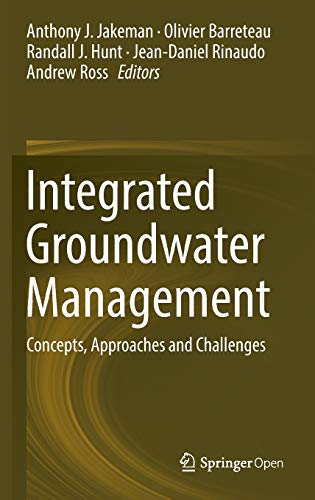
Condition: Brand New. New. US edition. Expediting shipping for all USA and Europe orders excluding PO Box. Excellent Customer Service.
-

Condition: As New. Unread book in perfect condition.
-

hardcover. Condition: Good. Connecting readers with great books since 1972! Used textbooks may not include companion materials such as access codes, etc. May have some wear or writing/highlighting. We ship orders daily and Customer Service is our top priority!
-
Hardcover. Condition: As New. AS NEW hardcover, no marks in text, very clean exterior, appears unread. Book.
-
Integrated Groundwater Management: Concepts, Approaches and Challenges
Seller: Ria Christie Collections, Uxbridge, United Kingdom
Seller rating 5 out of 5 stars

£ 50.43
£ 11.98 shipping
Ships from United Kingdom to U.S.A.Quantity: Over 20 available
Add to basketCondition: New. In.
-

Integrated Groundwater Management: Concepts, Approaches and Challenges
Seller: Ria Christie Collections, Uxbridge, United Kingdom
Seller rating 5 out of 5 stars
£ 50.43
£ 11.98 shipping
Ships from United Kingdom to U.S.A.Quantity: Over 20 available
Add to basketCondition: New. In.
-
Paperback. Condition: New.
-

-

Integrated Groundwater Management : Concepts, Approaches and Challenges
Seller: GreatBookPricesUK, Woodford Green, United Kingdom
Seller rating 5 out of 5 stars
Condition: New.
-

-

Integrated Groundwater Management : Concepts, Approaches and Challenges
Seller: GreatBookPricesUK, Woodford Green, United Kingdom
Seller rating 5 out of 5 stars
Condition: As New. Unread book in perfect condition.
-
Condition: New. pp. 450.
-
Broché. Condition: D'occasion - État correct. Quae, 2020. Une belle pliure angulaire au 1er plat, livre en très bon état sinon. Envoi rapide et soigné.
-
Hardcover. Condition: Brand New. 762 pages. 9.25x6.25x1.75 inches. In Stock.
-
Condition: Brand New. New. US edition. Expediting shipping for all USA and Europe orders excluding PO Box. Excellent Customer Service.
-

-

Integrated Groundwater Management | Concepts, Approaches and Challenges
Language: English
Published by Springer International Publishing, 2018
ISBN 10: 3319795023 ISBN 13: 9783319795027
Taschenbuch. Condition: Neu. Integrated Groundwater Management | Concepts, Approaches and Challenges | Anthony J Jakeman (u. a.) | Taschenbuch | xiii | Englisch | 2018 | Springer International Publishing | EAN 9783319795027 | Verantwortliche Person für die EU: Springer Verlag GmbH, Tiergartenstr. 17, 69121 Heidelberg, juergen[dot]hartmann[at]springer[dot]com | Anbieter: preigu.
-

Integrated Groundwater Management : Concepts, Approaches and Challenges
Language: English
Published by Springer International Publishing, Springer International Publishing, 2018
ISBN 10: 3319795023 ISBN 13: 9783319795027
Taschenbuch. Condition: Neu. Druck auf Anfrage Neuware - Printed after ordering - The aim of this book is to document for the first time the dimensions and requirements of effective integrated groundwater management (IGM). Groundwater management is a formidable challenge, one that remains one of humanity's foremost priorities. It has become a largely non-renewable resource that is overexploited in many parts of the world. In the 21st century, the issue moves from how to simply obtain the water we need to how we manage it sustainably for future generations, future economies, and future ecosystems. The focus then becomes one of understanding the drivers and current state of the groundwater resource, and restoring equilibrium to at-risk aquifers. Many interrelated dimensions, however, come to bear when trying to manage groundwater effectively. An integrated approach to groundwater necessarily involves many factors beyond the aquifer itself, such as surface water, water use, water quality, and ecohydrology. Moreover, the science by itself canonly define the fundamental bounds of what is possible; effective IGM must also engage the wider community of stakeholders to develop and support policy and other socioeconomic tools needed to realize effective IGM. In order to demonstrate IGM, this book covers theory and principles, embracing: 1) an overview of the dimensions and requirements of groundwater management from an international perspective; 2) the scale of groundwater issues internationally and its links with other sectors, principally energy and climate change; 3) groundwater governance with regard to principles, instruments and institutions available for IGM; 4) biophysical constraints and the capacity and role of hydroecological and hydrogeological science including water quality concerns; and 5) necessary tools including models, data infrastructures, decision support systems and the management of uncertainty. Examples of effective, and failed, IGM are given. Throughout, the importance of the socioeconomic context that connects all effective IGM is emphasized. Taken as a whole, this work relates the many facets of effective IGM, from the catchment to global perspective.
-

Integrated Groundwater Management : Concepts, Approaches and Challenges
Language: English
Published by Springer International Publishing, Springer International Publishing, 2016
ISBN 10: 3319235753 ISBN 13: 9783319235752
Buch. Condition: Neu. Druck auf Anfrage Neuware - Printed after ordering - The aim of this book is to document for the first time the dimensions and requirements of effective integrated groundwater management (IGM). Groundwater management is a formidable challenge, one that remains one of humanity's foremost priorities. It has become a largely non-renewable resource that is overexploited in many parts of the world. In the 21st century, the issue moves from how to simply obtain the water we need to how we manage it sustainably for future generations, future economies, and future ecosystems. The focus then becomes one of understanding the drivers and current state of the groundwater resource, and restoring equilibrium to at-risk aquifers. Many interrelated dimensions, however, come to bear when trying to manage groundwater effectively. An integrated approach to groundwater necessarily involves many factors beyond the aquifer itself, such as surface water, water use, water quality, and ecohydrology. Moreover, the science by itself canonly define the fundamental bounds of what is possible; effective IGM must also engage the wider community of stakeholders to develop and support policy and other socioeconomic tools needed to realize effective IGM. In order to demonstrate IGM, this book covers theory and principles, embracing: 1) an overview of the dimensions and requirements of groundwater management from an international perspective; 2) the scale of groundwater issues internationally and its links with other sectors, principally energy and climate change; 3) groundwater governance with regard to principles, instruments and institutions available for IGM; 4) biophysical constraints and the capacity and role of hydroecological and hydrogeological science including water quality concerns; and 5) necessary tools including models, data infrastructures, decision support systems and the management of uncertainty. Examples of effective, and failed, IGM are given. Throughout, the importance of the socioeconomic context that connects all effective IGM is emphasized. Taken as a whole, this work relates the many facets of effective IGM, from the catchment to global perspective.
-
Empirical Agent-Based Modelling - Challenges and Solutions: Volume 1, The Characterisation and Parameterisation of Empirical Agent-Based Models
Seller: Ria Christie Collections, Uxbridge, United Kingdom
Seller rating 5 out of 5 stars
£ 96.15
£ 11.98 shipping
Ships from United Kingdom to U.S.A.Quantity: Over 20 available
Add to basketCondition: New. In.
-

Empirical Agent-Based Modelling - Challenges and Solutions: Volume 1, The Characterisation and Parameterisation of Empirical Agent-Based Models
Seller: Ria Christie Collections, Uxbridge, United Kingdom
Seller rating 5 out of 5 stars
£ 96.15
£ 11.98 shipping
Ships from United Kingdom to U.S.A.Quantity: Over 20 available
Add to basketCondition: New. In.
-

Empirical Agent-based Modelling : Challenges and Solutions - the Characterisation and Parameterisation of Empirical Agent-based Models
Seller: GreatBookPricesUK, Woodford Green, United Kingdom
Seller rating 5 out of 5 stars
Condition: New.
-
Paperback. Condition: Brand New. reprint edition. 262 pages. 9.25x6.10x0.62 inches. In Stock.
-
Hardcover. Condition: Brand New. 2014 edition. 225 pages. 9.25x6.25x0.75 inches. In Stock.
-
Taschenbuch. Condition: Neu. Empirical Agent-Based Modelling - Challenges and Solutions | Volume 1, The Characterisation and Parameterisation of Empirical Agent-Based Models | Alexander Smajgl (u. a.) | Taschenbuch | xiii | Englisch | 2016 | Springer | EAN 9781493952526 | Verantwortliche Person für die EU: Springer Verlag GmbH, Tiergartenstr. 17, 69121 Heidelberg, juergen[dot]hartmann[at]springer[dot]com | Anbieter: preigu.
-

Taschenbuch. Condition: Neu. Druck auf Anfrage Neuware - Printed after ordering - This instructional book showcases techniques to parameterise human agents in empirical agent-based models (ABM). In doing so, it provides a timely overview of key ABM methodologies and the most innovative approaches through a variety of empirical applications. It features cutting-edge research from leading academics and practitioners, and will provide a guide for characterising and parameterising human agents in empirical ABM. In order to facilitate learning, this text shares the valuable experiences of other modellers in particular modelling situations. Very little has been published in the area of empirical ABM, and this contributed volume will appeal to graduate-level students and researchers studying simulation modeling in economics, sociology, ecology, and trans-disciplinary studies, such as topics related to sustainability. In a similar vein to the instruction found in a cookbook, this text provides the empirical modeller with a set of 'recipes' ready to be implemented.Agent-based modeling (ABM) is a powerful, simulation-modeling technique that has seen a dramatic increase in real-world applications in recent years. In ABM, a system is modeled as a collection of autonomous decision-making entities called 'agents.' Each agent individually assesses its situation and makes decisions on the basis of a set of rules. Agents may execute various behaviors appropriate for the system they represent-for example, producing, consuming, or selling. ABM is increasingly used for simulating real-world systems, such as natural resource use, transportation, public health, and conflict. Decision makers increasingly demand support that covers a multitude of indicators that can be effectively addressed using ABM. This is especially the case in situations where human behavior is identified as a critical element. As a result, ABM will only continue its rapid growth.This is the first volume in a series of books that aims tocontribute to a cultural change in the community of empirical agent-based modelling. This series will bring together representational experiences and solutions in empirical agent-based modelling. Creating a platform to exchange such experiences allows comparison of solutions and facilitates learning in the empirical agent-based modelling community. Ultimately, the community requires such exchange and learning to test approaches and, thereby, to develop a robust set of techniques within the domain of empirical agent-based modelling. Based on robust and defendable methods, agent-based modelling will become a critical tool for research agencies, decision making and decision supporting agencies, and funding agencies. This series will contribute to more robust and defendable empirical agent-based modelling.
-

Buch. Condition: Neu. Druck auf Anfrage Neuware - Printed after ordering - This instructional book showcases techniques to parameterise human agents in empirical agent-based models (ABM). In doing so, it provides a timely overview of key ABM methodologies and the most innovative approaches through a variety of empirical applications. It features cutting-edge research from leading academics and practitioners, and will provide a guide for characterising and parameterising human agents in empirical ABM. In order to facilitate learning, this text shares the valuable experiences of other modellers in particular modelling situations. Very little has been published in the area of empirical ABM, and this contributed volume will appeal to graduate-level students and researchers studying simulation modeling in economics, sociology, ecology, and trans-disciplinary studies, such as topics related to sustainability. In a similar vein to the instruction found in a cookbook, this text provides the empirical modeller with a set of 'recipes' ready to be implemented.Agent-based modeling (ABM) is a powerful, simulation-modeling technique that has seen a dramatic increase in real-world applications in recent years. In ABM, a system is modeled as a collection of autonomous decision-making entities called 'agents.' Each agent individually assesses its situation and makes decisions on the basis of a set of rules. Agents may execute various behaviors appropriate for the system they represent-for example, producing, consuming, or selling. ABM is increasingly used for simulating real-world systems, such as natural resource use, transportation, public health, and conflict. Decision makers increasingly demand support that covers a multitude of indicators that can be effectively addressed using ABM. This is especially the case in situations where human behavior is identified as a critical element. As a result, ABM will only continue its rapid growth.This is the first volume in a series of books that aims tocontribute to a cultural change in the community of empirical agent-based modelling. This series will bring together representational experiences and solutions in empirical agent-based modelling. Creating a platform to exchange such experiences allows comparison of solutions and facilitates learning in the empirical agent-based modelling community. Ultimately, the community requires such exchange and learning to test approaches and, thereby, to develop a robust set of techniques within the domain of empirical agent-based modelling. Based on robust and defendable methods, agent-based modelling will become a critical tool for research agencies, decision making and decision supporting agencies, and funding agencies. This series will contribute to more robust and defendable empirical agent-based modelling.
-
-
Condition: Sehr gut. Zustand: Sehr gut | Seiten: 264 | Sprache: Englisch | Produktart: Bücher | This instructional book showcases techniques to parameterise human agents in empirical agent-based models (ABM). In doing so, it provides a timely overview of key ABM methodologies and the most innovative approaches through a variety of empirical applications. It features cutting-edge research from leading academics and practitioners, and will provide a guide for characterising and parameterising human agents in empirical ABM. In order to facilitate learning, this text shares the valuable experiences of other modellers in particular modelling situations. Very little has been published in the area of empirical ABM, and this contributed volume will appeal to graduate-level students and researchers studying simulation modeling in economics, sociology, ecology, and trans-disciplinary studies, such as topics related to sustainability. In a similar vein to the instruction found in a cookbook, this text provides the empirical modeller with a set of 'recipes' ready to be implemented. Agent-based modeling (ABM) is a powerful, simulation-modeling technique that has seen a dramatic increase in real-world applications in recent years. In ABM, a system is modeled as a collection of autonomous decision-making entities called ¿agents.¿ Each agent individually assesses its situation and makes decisions on the basis of a set of rules. Agents may execute various behaviors appropriate for the system they represent¿for example, producing, consuming, or selling. ABM is increasingly used for simulating real-world systems, such as natural resource use, transportation, public health, and conflict. Decision makers increasingly demand support that covers a multitude of indicators that can be effectively addressed using ABM. This is especially the case in situations where human behavior is identified as a critical element. As a result, ABM will only continue its rapid growth. This is the first volume in a series of books that aims tocontribute to a cultural change in the community of empirical agent-based modelling. This series will bring together representational experiences and solutions in empirical agent-based modelling. Creating a platform to exchange such experiences allows comparison of solutions and facilitates learning in the empirical agent-based modelling community. Ultimately, the community requires such exchange and learning to test approaches and, thereby, to develop a robust set of techniques within the domain of empirical agent-based modelling. Based on robust and defendable methods, agent-based modelling will become a critical tool for research agencies, decision making and decision supporting agencies, and funding agencies. This series will contribute to more robust and defendable empirical agent-based modelling.


