

Order Total (1 Item Items):
Shipping Destination:

Barkla Charles (6 results)
Skip to main search results
Search filters
Product Type
- All Product Types
- Books (6)
- Magazines & Periodicals (No further results match this refinement)
- Comics (No further results match this refinement)
- Sheet Music (No further results match this refinement)
- Art, Prints & Posters (No further results match this refinement)
- Photographs (No further results match this refinement)
- Maps (No further results match this refinement)
- Manuscripts & Paper Collectibles (No further results match this refinement)
Condition Learn more
- New (No further results match this refinement)
- As New, Fine or Near Fine (No further results match this refinement)
- Very Good or Good (4)
- Fair or Poor (No further results match this refinement)
- As Described (2)
Binding
- All Bindings
- Hardcover (No further results match this refinement)
- Softcover (4)
Collectible Attributes
- First Edition (3)
- Signed (No further results match this refinement)
- Dust Jacket (No further results match this refinement)
- Seller-Supplied Images (2)
- Not Print on Demand (6)
Language (2)
Free Shipping
- Free Shipping to U.S.A. (No further results match this refinement)
Seller Location
Seller Rating
-

"The Velocity of Electric Waves Along Wires" in the Philosophical Magazine.
Publication Date: 1901
Seller: JF Ptak Science Books, Hendersonville, NC, U.S.A.
Seller rating 5 out of 5 stars

Soft cover. Condition: Good. Also in this issue: James H. Jeans "The Striated Electrical Discharge, Part II" in the London, Edinburgh and Dublin Philosophical Magazine and Journal of Science. Published May 1901, series 6, vol 1 no. 5 pp 521-676 with 6 folding plates, with the Barkla on pp 552-567 and the (24-year-old) Jeans being on pp 521-529. GOOD condition, the monthly issue being extracted from a larger bound volume.
-
Charles Glover Barkla and Janette G. Dunlop. "Note on the Scattering of X-rays and Atomic Structure," AND WITH Charles Glover Barkla, "Note on Experiments to detect Refraction of X-rays" both in the Philosophical Magazine.
Published by London, Taylor and Francis, 1916
Seller: JF Ptak Science Books, Hendersonville, NC, U.S.A.
Seller rating 5 out of 5 stars
Soft cover. Condition: Good. Barkla (Two Papers). Charles Glover Barkla and Janette G. Dunlop. "Note on the Scattering of X-rays and Atomic Structure," (the two papers) in: Philosophical Magazine and Journal of Science. 6th Series. Vol. 31, pp 222-232 in the issue for March of 177-256. Offered with: Charles Glover Barkla, "Note on Experiments to detect Refraction of X-rays" (257)-275 in the issue for April of pp 257-416. Both are disbound from a larger bound volume. Good condition. The Nobel Prize in Physics 1917 was awarded to Charles Glover Barkla "for his discovery of the characteristic Rontgen radiation of the elements". [++] Janette Gilchrist Dunlop (1891 1971) was a Scottish physicist who studied X-ray scattering. She later became a teacher and lived most of her life in Edinburgh. After graduating from George Watson's Ladies College, she studied physics at the University of Edinburgh graduating with honors in Mathematics and Natural Philosophy and with a bachelor's degree and a master's degree in 1914. Funded by a Carnegie Research Fellowship, she conducted research at the University of Edinburgh under the direction of physicist Charles Glover Barkla. She studied the scattering of X-rays by various substances and in 1916, she co-authored a published paper with Barkla, who won the Nobel Prize in Physics in 1917. The first sentence of that joint paper shows that Dunlop, "one of the writers," was an important contributor to the experimental work.
-
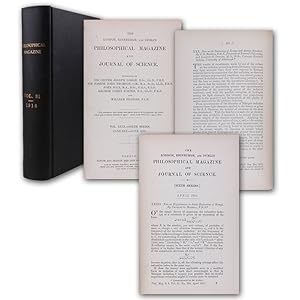
Note on the Scattering of X-rays and Atomic Structure. SS. 222-232. - Und: Charles Glover Barkla. Note on Experiments to detect Refraction of X-rays. SS. (257)-275. Mit 7 Abbildungen. In: Philosophical Magazine and Journal of Science. 6th Series. Vol. 31.
Language: English
Published by London Taylor & Francis, 1916
Seller: Antiquariat Gerhard Gruber, Heilbronn, Germany
Seller rating 5 out of 5 stars
First Edition
(21,5 x 14 cm). VII, 576 S. Mit zahlreichen Abbildungen und Tafeln. Etwas späterer Leinwandband. Zwei bedeutende erste Ausgaben zur Röntgenspektroskopie. - Barkla (1877-1944), Professor für Physik in London und Edinburgh, erhielt 1917 für die Entdeckung der charakteristischen Röntgenstrahlung der Elemente den Nobelpreis für Physik. - Stempel auf Vorsatz und Titel, sonst sauber und gut erhalten. - DSB 1, 456.
-
J.J. Thomson, "Positive Rays" AND Frederick Soddy, "Attempts to Detect the Production of Helium from the Primary Radio-Elements" AND Charles Barkla and Charles Sadler, "Homogenous Secondary Rontgen Radiations" in a single issue of the "Philosophical Magazine".
Publication Date: 1908
Seller: JF Ptak Science Books, Hendersonville, NC, U.S.A.
Seller rating 5 out of 5 stars
Soft cover. Condition: Good. J.J. Thomson, "Positive Rays" AND Frederick Soddy, "Attempts to Detect the Production of Helium from the Primary Radio-Elements" AND Charles Barkla and Charles Sadler, "Homogenous Secondary Rontgen Radiations" in a single issue of the "Philosophical Magazine". J.J. Thomson, "Positive Rays" on pp 657-691 (Thomson Nobel Prize 1906 "in recognition of the great merits of his theoretical and experimental investigations on the conduction of electricity by gases"). AND Frederick Soddy, "Attempts to Detect the Production of Helium from the Primary Radio-Elements" pp 513-530, (Soddy Nobel Prize 1921 "for his contributions to our knowledge of the chemistry of radioactive substances, and his investigations into the origin and nature of isotopes"). AND Charles Barkla and Charles Sadler, "Homogenous Secondary Rontgen Radiations" pp 550-584, (Barkla, Nobel Prize 1917 "for his discovery of the characteristic Röntgen radiation of the elements"). All in the Philosophical Magazine, 6th series, vol 16, no 94, October 1908. Offered in the full issue of pp 497-704 (plus two plates). The issue is extracted from a larger bound volume but complete in itself. GOOD condition.
-
Les Prix Nobel en 1914-1918.
Published by Stockholm: Imprimerie Royale, P. A. Norstedt & Soner 1920., 1920
Seller: Scientia Books, ABAA ILAB, Arlington, MA, U.S.A.
Association Member: ABAA ILAB SNEAB
Seller rating 4 out of 5 stars

First Edition
Soft cover. Condition: Very Good. 1st Edition. 137 pp, 1 leaf, 9 pp [von Laue], 14 pp [Richards], 9 pp [Barkla], 12 pp [Willstätter], 14 pp [Bárány]; plates. Original wrappers. Wrappers are slightly foxed and soiled. Unopened. Very Good. First Edition. Although the title includes the year 1918, the last year represented in this volume is 1917. Contains the five Nobel Lectures by Max von Laue, Theodore Richards, Charles Barkla, Richard Willstätter, and Robert Bárány. Max von Laue was awarded the Nobel Prize for Physics in 1914 "for his discovery of the diffraction of X-rays by crystals". Theodore William Richards was awarded the Nobel Prize for Chemistry in 1914 "in recognition of his accurate determinations of the atomic weight of a large number of chemical elements". Charles Glover Barkla was awarded the Nobel Prize for Physics in 1917 "for his discovery of the characteristic Röntgen radiation of the elements". Richard Martin Willstätter was awarded the Nobel Prize for Chemistry in 1915 "for his researches on plant pigments, especially chlorophyll". Robert Bárány was awarded the Nobel Prize for Physiology or Medicine in 1914 "for his work on the physiology and pathology of the vestibular apparatus". The Nobel lectures by von Laue, Willstätter, and Bárány are in German. The Nobel lectures by Richards and Barkla are in English. Sir William Henry Bragg and William Lawrence Bragg were awarded the Nobel Prize for Physics in 1915 "for their services in the analysis of crystal structure by means of X-rays". Romain Rolland was awarded the Nobel Prize for Literature in 1915 "as a tribute to the lofty idealism of his literary production and to the sympathy and love of truth with which he has described different types of human beings". Carl Gustaf Verner von Heidenstam was awarded the Nobel Prize for Literature in 1916 "in recognition of his significance as the leading representative of a new era in our literature". Karl Adolph Gjellerup shared the Nobel Prize for Literature in 1917 "for his varied and rich poetry, which is inspired by lofty ideals". Henrik Pontoppidan shared the Nobel Prize for Literature in 1917 "for his authentic descriptions of present-day life in Denmark".
-
![Seller image for The Construction and Use of Oscillation Valves for Rectifying High-Frequency Electric Currents (Fleming) AND Secondary Rontgen Radiation (Barkla) in The Physical Society of London, Proceedings, XX, Part II, July 1906, pp. 177-185; 200-218 [FIRST EDITION. ORIGINAL WRAPPERS] for sale by Atticus Rare Books](https://pictures.abebooks.com/inventory/md/md31109592298.jpg)
The Construction and Use of Oscillation Valves for Rectifying High-Frequency Electric Currents (Fleming) AND Secondary Rontgen Radiation (Barkla) in The Physical Society of London, Proceedings, XX, Part II, July 1906, pp. 177-185; 200-218 [FIRST EDITION. ORIGINAL WRAPPERS]
Published by Taylor and Francis, London, 1906
First Edition
1st Edition. ORIGINAL WRAPPERS. FIRST APPEARANCE IN PRINT OF TWO IMPORTANT PAPERS, FLEMING ON HIS VALVE & BARKLA'S 1st IN-DEPTH PAPER SHOWING THAT X-RAYS SCATTERED BY VARIOUS ELEMENTS PRODUCED BEAMS OF CHARACTERISTIC PENETRATION. Both papers were first read before The Physical Society of London on 23 March 1906; each was then printed in the July 1906 edition The Physical Society of London, Proceedings - the issue offered here. In 1904, J. A. Fleming rectified wireless signals using a diode based on the Edison effect, the unilateral flow of current between two electrodes in a vacuum tube; this was the first known use of the Edison effect. Fleming called his invention an "oscillation valve" because it acted in similarly to a valve in a pump that allows gas or water to move in only one direction. Fleming had "discovered that thermionic emission could be used to create what is now called a thermionic or vacuum tube, a device that controls the flow of electric current. He patented the vacuum tube as a rectifier to replace the coherer for use in receiving wireless transmissions" (Wenner Collection). In reading his work at the Physical Society, Fleming "outline[d] the design and use of devices for rectifying high-frequency oscillatory signals such â??as are employed in the rectifying circuits of wireless telegraph apparatus'" (Davis, Science, 8). "Oscillations in the primary circuit, produced by an induction coil and two Leyden jars, generate Hertz waves which are detected some distance away by the secondary circuit. The valve rectifies this signal, as confirmed by the steady deflection of a mirror galvanometer. Fleming used this arrangement to investigate the effects of changing various features; he also experimented with different filaments in the valve (ibid). Fleming's discovery "was later developed by others for a host of applications from sound amplification to electronic switching in digital computers" (ibid). BARKLA: The English physicist began investigating Roentgen's newly discovered X-rays while at Edinburgh. "Barkla noticed that X-rays were scattered by gases and that the degree of scattering was proportional to the density and molecular weight of such gases. From these, he deduced that the more massive the atom, the greater the number of charged particles in the nucleus and the degree of scattering. "This was the first time that a connection was made between the number of protons, the atomic weight and the position of an element in Mendeleev's periodic table. This was definitely a move toward the development of the concept of the atomic number and the recognition of its importance in the ordering of the chemical elements in the periodic table" (Martini, The Story, 690). By 1905, Barkla could clearly distinguish "between the properties of secondary radiation from heavy elements and those of the scattered radiation by lighter elements" (Authier, Early Days, 5.7). Here Barkla does "his most intuitive thinking, [showing] that X-rays scattered by various elements produced beams of characteristic penetration. This was indicated by the degree of beam absorption by an aluminum sheet of standard thickness. At that time, there was no way to measure the wavelength of X-rays; therefore, Barkla had to make his assessment by the absorption on the aluminum sheet" (Martini, 690). Barkla was awarded the 1917 Nobel Prize; his discovery was later used by Henry Moseley to show that elements can be uniquely represented by their â??atomic number,' the charge of the nucleus.s radiation by lighter elements" (Authier, Early Days, 5.7). CONDITION: Complete. Minor sunning around the edges and chipping to the paper on the spine. The interior is clean and bright.


