

Order Total (1 Item Items):
Shipping Destination:

Arthur Slotkin (18 results)
Skip to main search results
Search filters
Product Type
- All Product Types
- Books (18)
- Magazines & Periodicals (No further results match this refinement)
- Comics (No further results match this refinement)
- Sheet Music (No further results match this refinement)
- Art, Prints & Posters (No further results match this refinement)
- Photographs (No further results match this refinement)
- Maps (No further results match this refinement)
- Manuscripts & Paper Collectibles (No further results match this refinement)
Condition Learn more
- New (15)
- As New, Fine or Near Fine (2)
- Very Good or Good (No further results match this refinement)
- Fair or Poor (1)
- As Described (No further results match this refinement)
Binding
- All Bindings
- Hardcover (No further results match this refinement)
- Softcover (18)
Collectible Attributes
- First Edition (No further results match this refinement)
- Signed (No further results match this refinement)
- Dust Jacket (No further results match this refinement)
- Seller-Supplied Images (10)
- Not Print on Demand (13)
Language (1)
Free Shipping
- Free Shipping to U.S.A. (No further results match this refinement)
Seller Location
Seller Rating
-

Condition: acceptable. Small edge tear on front cover. Smudges spots on outside page edges.
-

Condition: As New. Unread book in perfect condition.
-

-

Paperback. Condition: new. New Copy. Customer Service Guaranteed.
-
Condition: New. pp. 336.
-
Condition: New. pp. 336 20 Illus. (9 Col.).
-
Doing the Impossible: George E. Mueller & the Management of NASA's Human Spaceflight Program (Springer Praxis Books in Space Exploration)
Book 224 of 408: Springer Praxis BooksSeller: Ria Christie Collections, Uxbridge, United Kingdom
Seller rating 5 out of 5 stars

£ 45.35
£ 11.98 shipping
Ships from United Kingdom to U.S.A.Quantity: Over 20 available
Add to basketCondition: New. In.
-
-

Doing the Impossible : George E. Mueller and the Management of NASA's Human Spaceflight Program
Book 224 of 408: Springer Praxis BooksSeller: GreatBookPricesUK, Woodford Green, United Kingdom
Seller rating 5 out of 5 stars
Condition: New.
-

Doing the Impossible : George E. Mueller and the Management of NASA's Human Spaceflight Program
Book 224 of 408: Springer Praxis BooksSeller: GreatBookPricesUK, Woodford Green, United Kingdom
Seller rating 5 out of 5 stars
Condition: As New. Unread book in perfect condition.
-
Paperback. Condition: Brand New. 2012 edition. 280 pages. 9.50x6.75x0.75 inches. In Stock.
-
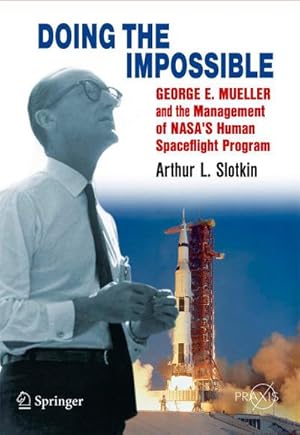
Taschenbuch. Condition: Neu. Druck auf Anfrage Neuware - Printed after ordering - Apollo was known for its engineering triumphs, but its success also came from a disciplined management style. This excellent account of one of the most important personalities in early American human spaceflight history describes for the first time how George E. Mueller, the system manager of the human spaceflight program of the 1960s, applied the SPO methodology and other special considerations such as 'all-up'testing, resulting in the success of the Apollo Program. Wernher von Braun and others did not readily accept such testing or Mueller's approach to system management, but later acknowledged that without them NASA would not have landed astronauts on the Moon by 1969. While Apollo remained Mueller's priority, from his earliest days at the agency, he promoted a robust post-Apollo Program which resulted in Skylab, the Space Shuttle and the International Space Station. As a result of these efforts, Mueller earned the sobriquet: 'the father of the space shuttle.' Following his success at NASA, Mueller returned to industry. Although he did not play a leading role in human spaceflight again, in 2011 the National Air and Space Museum awarded him their lifetime achievement trophy for his contributions. Following the contributions of George E. Mueller, in this unique book Arthur L. Slotkin answers such questions as: exactly how did the methods developed for use in the Air Force ballistic missile programs get modified and used in the Apollo Program How did George E. Mueller, with the help of others, manage the Apollo Program How did NASA centers, coming from federal agencies with cultures of their own, adapt to the new structured approach imposed from Washington George E. Mueller is the ideal central character for this book. He was instrumental in the creation of Apollo extension systems leading to Apollo, the Shuttle, and today's ISS and thus was a pivotal figure in early American human spaceflight history.
-
Taschenbuch. Condition: Neu. Doing the Impossible | George E. Mueller and the Management of NASA's Human Spaceflight Program | Arthur L. Slotkin | Taschenbuch | Springer Praxis Books | xxv | Englisch | 2012 | Humana | EAN 9781461437000 | Verantwortliche Person für die EU: Springer Verlag GmbH, Tiergartenstr. 17, 69121 Heidelberg, juergen[dot]hartmann[at]springer[dot]com | Anbieter: preigu.
-
Condition: new. Questo è un articolo print on demand.
-
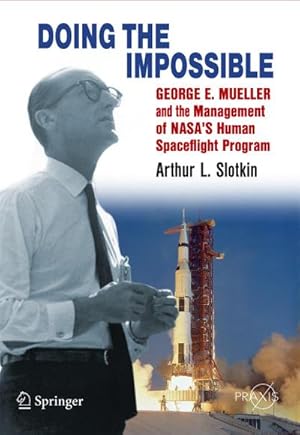
Doing the Impossible
Book 224 of 408: Springer Praxis BooksLanguage: English
Published by Springer, Humana Jul 2012, 2012
ISBN 10: 1461437008 ISBN 13: 9781461437000
Seller: BuchWeltWeit Ludwig Meier e.K., Bergisch Gladbach, Germany
Seller rating 5 out of 5 stars
Taschenbuch. Condition: Neu. This item is printed on demand - it takes 3-4 days longer - Neuware -Apollo was known for its engineering triumphs, but its success also came from a disciplined management style. This excellent account of one of the most important personalities in early American human spaceflight history describes for the first time how George E. Mueller, the system manager of the human spaceflight program of the 1960s, applied the SPO methodology and other special considerations such as 'all-up'testing, resulting in the success of the Apollo Program. Wernher von Braun and others did not readily accept such testing or Mueller's approach to system management, but later acknowledged that without them NASA would not have landed astronauts on the Moon by 1969. While Apollo remained Mueller's priority, from his earliest days at the agency, he promoted a robust post-Apollo Program which resulted in Skylab, the Space Shuttle and the International Space Station. As a result of these efforts, Mueller earned the sobriquet: 'the father of the space shuttle.' Following his success at NASA, Mueller returned to industry. Although he did not play a leading role in human spaceflight again, in 2011 the National Air and Space Museum awarded him their lifetime achievement trophy for his contributions. Following the contributions of George E. Mueller, in this unique book Arthur L. Slotkin answers such questions as: exactly how did the methods developed for use in the Air Force ballistic missile programs get modified and used in the Apollo Program How did George E. Mueller, with the help of others, manage the Apollo Program How did NASA centers, coming from federal agencies with cultures of their own, adapt to the new structured approach imposed from Washington George E. Mueller is the ideal central character for this book. He was instrumental in the creation of Apollo extension systems leading to Apollo, the Shuttle, and today's ISS and thus was a pivotal figure in early American human spaceflight history. 336 pp. Englisch.
-
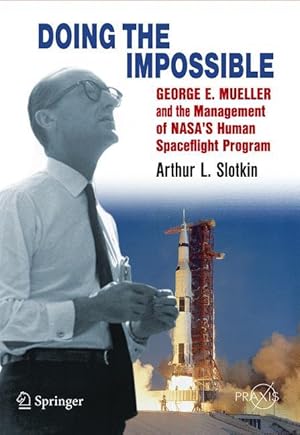
Kartoniert / Broschiert. Condition: New. Dieser Artikel ist ein Print on Demand Artikel und wird nach Ihrer Bestellung fuer Sie gedruckt. Presents a fascinating insight into the management of NASA s Apollo Program Explains how a single indivdual, George E. Mueller, introduced new approaches to NASA Gives historical perspectives of the Apollo program and details of systems mana.
-
Condition: New. PRINT ON DEMAND pp. 336.
-

Doing the Impossible
Book 224 of 408: Springer Praxis BooksLanguage: English
Published by Springer, Humana Jul 2012, 2012
ISBN 10: 1461437008 ISBN 13: 9781461437000
Seller: buchversandmimpf2000, Emtmannsberg, BAYE, Germany
Seller rating 5 out of 5 stars
Taschenbuch. Condition: Neu. This item is printed on demand - Print on Demand Titel. Neuware -Apollo was known for its engineering triumphs, but its success also came from a disciplined management style. This excellent account of one of the most important personalities in early American human spaceflight history describes for the first time how George E. Mueller, the system manager of the human spaceflight program of the 1960s, applied the SPO methodology and other special considerations such as ¿all-up¿testing, resulting in the success of the Apollo Program. Wernher von Braun and others did not readily accept such testing or Mueller¿s approach to system management, but later acknowledged that without them NASA would not have landed astronauts on the Moon by 1969. While Apollo remained Mueller¿s priority, from his earliest days at the agency, he promoted a robust post-Apollo Program which resulted in Skylab, the Space Shuttle and the International Space Station. As a result of these efforts, Mueller earned the sobriquet: ¿the father of the space shuttle.¿ Following his success at NASA, Mueller returned to industry. Although he did not play a leading role in human spaceflight again, in 2011 the National Air and Space Museum awarded him their lifetime achievement trophy for his contributions.Following the contributions of George E. Mueller, in this unique book Arthur L. Slotkin answers such questions as: exactly how did the methods developed for use in the Air Force ballistic missile programs get modified and used in the Apollo Program How did George E. Mueller, with the help of others, manage the Apollo Program How did NASA centers, coming from federal agencies with cultures of their own, adapt to the new structured approach imposed from Washington George E. Mueller is the ideal central character for this book. He was instrumental in the creation of Apollo extension systems leading to Apollo, the Shuttle, and today¿s ISS and thus was a pivotal figure in early American human spaceflight history.Springer-Verlag KG, Sachsenplatz 4-6, 1201 Wien 336 pp. Englisch.


