

Order Total (1 Item Items):
Shipping Destination:

Alexander Sidorov (78 results)
Skip to main search results
Search filters
Product Type
- All Product Types
- Books (78)
- Magazines & Periodicals (No further results match this refinement)
- Comics (No further results match this refinement)
- Sheet Music (No further results match this refinement)
- Art, Prints & Posters (No further results match this refinement)
- Photographs (No further results match this refinement)
- Maps (No further results match this refinement)
- Manuscripts & Paper Collectibles (No further results match this refinement)
Condition Learn more
- New (60)
- As New, Fine or Near Fine (8)
- Very Good or Good (9)
- Fair or Poor (No further results match this refinement)
- As Described (1)
Binding
Collectible Attributes
- First Edition (No further results match this refinement)
- Signed (No further results match this refinement)
- Dust Jacket (No further results match this refinement)
- Seller-Supplied Images (46)
- Not Print on Demand (62)
Language (3)
Free Shipping
Seller Location
Seller Rating
-

Condition: As New. Unread book in perfect condition.
-

-
hardcover. Condition: New.
-
hardcover. Condition: New.
-
Hardcover. Condition: Brand New. 400 pages. 8.75x5.25x1.00 inches. In Stock.
-
Russian Criminal Tattoo Encyclopaedia
Book 1 of 5: Russian Criminal Tattoo EncyclopaediaSeller: GreatBookPricesUK, Woodford Green, United Kingdom
Seller rating 5 out of 5 stars

Condition: New.
-
Russian Criminal Tattoo Encyclopaedia
Book 1 of 5: Russian Criminal Tattoo EncyclopaediaSeller: GreatBookPricesUK, Woodford Green, United Kingdom
Seller rating 5 out of 5 stars
Condition: As New. Unread book in perfect condition.
-

Metallogenesis and Tectonics of the Russian Far East, Alaska, and the Canadian Cordillera Professional Paper 1697
Published by USGS, 2005
ISBN 10: 0607984074 ISBN 13: 9780607984071
Condition: new. "The Proterozoic and Phanerozoic metallogenic and tectonic evolution of the Russian Far East, Alaska, and the Canadian Cordillera is recorded in the cratons, craton margins, and orogenic collages of the Circum-North Pacific mountain belts that separate the North Pacific from the eastern North Asian and western North American Cratons. The collages consist of tectonostratigraphic terranes and contained metallogenic belts, which are composed of fragments of igneous arcs, accretionary-wedge and subduction-zone complexes, passive continental margins, and cratons. The terranes are overlapped by continental-margin-arc and sedimentary-basin assemblages and contained metallogenic belts. The metallogenic and geologic history of terranes, overlap assemblages, cratons, and craton margins has been complicated by postaccretion dismemberment and translation during strike-slip faulting that occurred subparallel to continental margins. Seven processes overlapping in time were responsible for most of metallogenic and geologic complexities of the region (1) In the Early and Middle Proterozoic, marine sedimentary basins developed on major cratons and were the loci for ironstone (Superior Fe) deposits and sediment-hosted Cu deposits that occur along both the North Asia Craton and North American Craton Margin. (2) In the Late Proterozoic, Late Devonian, and Early Carboniferous, major periods of rifting occurred along the ancestral margins of present-day Northeast Asia and northwestern North America. The rifting resulted in fragmentation of each continent, and formation of cratonal and passive continental-margin terranes that eventually migrated and accreted to other sites along the evolving margins of the original or adjacent continents. The rifting also resulted in formation of various massive-sulfide metallogenic belts. (3) From about the late Paleozoic through the mid-Cretaceous, a succession of island arcs and contained igneous-arc-related metallogenic belts and tectonically paired subduction zones formed near continental margins. (4) From about mainly the mid-Cretaceous through the present, a succession of continental-margin igneous arcs (some extending offshore into island arcs) and contained metallogenic belts, and tectonically paired subduction zones formed along the continental margins. (5) From about the Jurassic to the present, oblique convergence and rotations caused orogen-parallel sinistral, and then dextral displacements within the plate margins of the Northeast Asian and North American Cratons. The oblique convergences and rotations resulted in the fragmentation, displacement, and duplication of formerly more continuous arcs, subduction zones, passive continental margins, and contained metallogenic belts. These fragments were subsequently accreted along the margins of the expanding continental margins. (6) From the Early Jurassic through Tertiary, movement of the upper continental plates toward subduction zones resulted in strong plate coupling and accretion of the former island arcs, subduction zones, and contained metallogenic belts to continental margins. In this region, the multiple arc accretions were accompanied and followed by crustal thickening, anatexis, metamorphism, formation of collision-related metallogenic belts, and uplift; this resulted in the substantial growth of the North Asian and North American continents. (7) In the middle and late Cenozoic, oblique to orthogonal convergence of the Pacific Plate with present-day Alaska and Northeast Asia resulted in formation of the present ring of volcanoes and contained metallogenic belts around the Circum-North Pacific. Oblique convergence between the Pacific Plate and Alaska also resulted in major dextral-slip faulting in interior and southern Alaska and along the western part of the Aleutian- Wrangell arc. Associated with dextral-slip faulting was crustal extrusion of terranes from western Alaska into the Bering Sea. " DV2. softcover, wrapped in shrink wrap, tight, crisp,
-

Metallogenesis and Tectonics of the Russian Far East, Alaska, and the Canadian Cordillera Professional Paper 1697
Published by USGS, 2005
ISBN 10: 0607984074 ISBN 13: 9780607984071
Condition: new. "The Proterozoic and Phanerozoic metallogenic and tectonic evolution of the Russian Far East, Alaska, and the Canadian Cordillera is recorded in the cratons, craton margins, and orogenic collages of the Circum-North Pacific mountain belts that separate the North Pacific from the eastern North Asian and western North American Cratons. The collages consist of tectonostratigraphic terranes and contained metallogenic belts, which are composed of fragments of igneous arcs, accretionary-wedge and subduction-zone complexes, passive continental margins, and cratons. The terranes are overlapped by continental-margin-arc and sedimentary-basin assemblages and contained metallogenic belts. The metallogenic and geologic history of terranes, overlap assemblages, cratons, and craton margins has been complicated by postaccretion dismemberment and translation during strike-slip faulting that occurred subparallel to continental margins. Seven processes overlapping in time were responsible for most of metallogenic and geologic complexities of the region (1) In the Early and Middle Proterozoic, marine sedimentary basins developed on major cratons and were the loci for ironstone (Superior Fe) deposits and sediment-hosted Cu deposits that occur along both the North Asia Craton and North American Craton Margin. (2) In the Late Proterozoic, Late Devonian, and Early Carboniferous, major periods of rifting occurred along the ancestral margins of present-day Northeast Asia and northwestern North America. The rifting resulted in fragmentation of each continent, and formation of cratonal and passive continental-margin terranes that eventually migrated and accreted to other sites along the evolving margins of the original or adjacent continents. The rifting also resulted in formation of various massive-sulfide metallogenic belts. (3) From about the late Paleozoic through the mid-Cretaceous, a succession of island arcs and contained igneous-arc-related metallogenic belts and tectonically paired subduction zones formed near continental margins. (4) From about mainly the mid-Cretaceous through the present, a succession of continental-margin igneous arcs (some extending offshore into island arcs) and contained metallogenic belts, and tectonically paired subduction zones formed along the continental margins. (5) From about the Jurassic to the present, oblique convergence and rotations caused orogen-parallel sinistral, and then dextral displacements within the plate margins of the Northeast Asian and North American Cratons. The oblique convergences and rotations resulted in the fragmentation, displacement, and duplication of formerly more continuous arcs, subduction zones, passive continental margins, and contained metallogenic belts. These fragments were subsequently accreted along the margins of the expanding continental margins. (6) From the Early Jurassic through Tertiary, movement of the upper continental plates toward subduction zones resulted in strong plate coupling and accretion of the former island arcs, subduction zones, and contained metallogenic belts to continental margins. In this region, the multiple arc accretions were accompanied and followed by crustal thickening, anatexis, metamorphism, formation of collision-related metallogenic belts, and uplift; this resulted in the substantial growth of the North Asian and North American continents. (7) In the middle and late Cenozoic, oblique to orthogonal convergence of the Pacific Plate with present-day Alaska and Northeast Asia resulted in formation of the present ring of volcanoes and contained metallogenic belts around the Circum-North Pacific. Oblique convergence between the Pacific Plate and Alaska also resulted in major dextral-slip faulting in interior and southern Alaska and along the western part of the Aleutian- Wrangell arc. Associated with dextral-slip faulting was crustal extrusion of terranes from western Alaska into the Bering Sea. " DV1. softcover, wrapped in shrink wrap, tight, crisp,
-

Metallogenesis and Tectonics of the Russian Far East, Alaska, and the Canadian Cordillera Professional Paper 1697
Published by USGS, 2005
ISBN 10: 0607984074 ISBN 13: 9780607984071
Condition: new. "The Proterozoic and Phanerozoic metallogenic and tectonic evolution of the Russian Far East, Alaska, and the Canadian Cordillera is recorded in the cratons, craton margins, and orogenic collages of the Circum-North Pacific mountain belts that separate the North Pacific from the eastern North Asian and western North American Cratons. The collages consist of tectonostratigraphic terranes and contained metallogenic belts, which are composed of fragments of igneous arcs, accretionary-wedge and subduction-zone complexes, passive continental margins, and cratons. The terranes are overlapped by continental-margin-arc and sedimentary-basin assemblages and contained metallogenic belts. The metallogenic and geologic history of terranes, overlap assemblages, cratons, and craton margins has been complicated by postaccretion dismemberment and translation during strike-slip faulting that occurred subparallel to continental margins. Seven processes overlapping in time were responsible for most of metallogenic and geologic complexities of the region (1) In the Early and Middle Proterozoic, marine sedimentary basins developed on major cratons and were the loci for ironstone (Superior Fe) deposits and sediment-hosted Cu deposits that occur along both the North Asia Craton and North American Craton Margin. (2) In the Late Proterozoic, Late Devonian, and Early Carboniferous, major periods of rifting occurred along the ancestral margins of present-day Northeast Asia and northwestern North America. The rifting resulted in fragmentation of each continent, and formation of cratonal and passive continental-margin terranes that eventually migrated and accreted to other sites along the evolving margins of the original or adjacent continents. The rifting also resulted in formation of various massive-sulfide metallogenic belts. (3) From about the late Paleozoic through the mid-Cretaceous, a succession of island arcs and contained igneous-arc-related metallogenic belts and tectonically paired subduction zones formed near continental margins. (4) From about mainly the mid-Cretaceous through the present, a succession of continental-margin igneous arcs (some extending offshore into island arcs) and contained metallogenic belts, and tectonically paired subduction zones formed along the continental margins. (5) From about the Jurassic to the present, oblique convergence and rotations caused orogen-parallel sinistral, and then dextral displacements within the plate margins of the Northeast Asian and North American Cratons. The oblique convergences and rotations resulted in the fragmentation, displacement, and duplication of formerly more continuous arcs, subduction zones, passive continental margins, and contained metallogenic belts. These fragments were subsequently accreted along the margins of the expanding continental margins. (6) From the Early Jurassic through Tertiary, movement of the upper continental plates toward subduction zones resulted in strong plate coupling and accretion of the former island arcs, subduction zones, and contained metallogenic belts to continental margins. In this region, the multiple arc accretions were accompanied and followed by crustal thickening, anatexis, metamorphism, formation of collision-related metallogenic belts, and uplift; this resulted in the substantial growth of the North Asian and North American continents. (7) In the middle and late Cenozoic, oblique to orthogonal convergence of the Pacific Plate with present-day Alaska and Northeast Asia resulted in formation of the present ring of volcanoes and contained metallogenic belts around the Circum-North Pacific. Oblique convergence between the Pacific Plate and Alaska also resulted in major dextral-slip faulting in interior and southern Alaska and along the western part of the Aleutian- Wrangell arc. Associated with dextral-slip faulting was crustal extrusion of terranes from western Alaska into the Bering Sea." DV4. softcover, wrapped in shrink wrap, tight, crisp, 4.
-

Metallogenesis and Tectonics of the Russian Far East, Alaska, and the Canadian Cordillera Professional Paper 1697
Published by USGS, 2005
ISBN 10: 0607984074 ISBN 13: 9780607984071
Condition: new. The Proterozoic and Phanerozoic metallogenic and tectonic evolution of the Russian Far East, Alaska, and the Canadian Cordillera is recorded in the cratons, craton margins, and orogenic collages of the Circum-North Pacific mountain belts that separate the North Pacific from the eastern North Asian and western North American Cratons. The collages consist of tectonostratigraphic terranes and contained metallogenic belts, which are composed of fragments of igneous arcs, accretionary-wedge and subduction-zone complexes, passive continental margins, and cratons. The terranes are overlapped by continental-margin-arc and sedimentary-basin assemblages and contained metallogenic belts. The metallogenic and geologic history of terranes, overlap assemblages, cratons, and craton margins has been complicated by postaccretion dismemberment and translation during strike-slip faulting that occurred subparallel to continental margins. Seven processes overlapping in time were responsible for most of metallogenic and geologic complexities of the region (1) In the Early and Middle Proterozoic, marine sedimentary basins developed on major cratons and were the loci for ironstone (Superior Fe) deposits and sediment-hosted Cu deposits that occur along both the North Asia Craton and North American Craton Margin. (2) In the Late Proterozoic, Late Devonian, and Early Carboniferous, major periods of rifting occurred along the ancestral margins of present-day Northeast Asia and northwestern North America. The rifting resulted in fragmentation of each continent, and formation of cratonal and passive continental-margin terranes that eventually migrated and accreted to other sites along the evolving margins of the original or adjacent continents. The rifting also resulted in formation of various massive-sulfide metallogenic belts. (3) From about the late Paleozoic through the mid-Cretaceous, a succession of island arcs and contained igneous-arc-related metallogenic belts and tectonically paired subduction zones formed near continental margins. (4) From about mainly the mid-Cretaceous through the present, a succession of continental-margin igneous arcs (some extending offshore into island arcs) and contained metallogenic belts, and tectonically paired subduction zones formed along the continental margins. (5) From about the Jurassic to the present, oblique convergence and rotations caused orogen-parallel sinistral, and then dextral displacements within the plate margins of the Northeast Asian and North American Cratons. The oblique convergences and rotations resulted in the fragmentation, displacement, and duplication of formerly more continuous arcs, subduction zones, passive continental margins, and contained metallogenic belts. These fragments were subsequently accreted along the margins of the expanding continental margins. (6) From the Early Jurassic through Tertiary, movement of the upper continental plates toward subduction zones resulted in strong plate coupling and accretion of the former island arcs, subduction zones, and contained metallogenic belts to continental margins. In this region, the multiple arc accretions were accompanied and followed by crustal thickening, anatexis, metamorphism, formation of collision-related metallogenic belts, and uplift; this resulted in the substantial growth of the North Asian and North American continents. (7) In the middle and late Cenozoic, oblique to orthogonal convergence of the Pacific Plate with present-day Alaska and Northeast Asia resulted in formation of the present ring of volcanoes and contained metallogenic belts around the Circum-North Pacific. Oblique convergence between the Pacific Plate and Alaska also resulted in major dextral-slip faulting in interior and southern Alaska and along the western part of the Aleutian- Wrangell arc. Associated with dextral-slip faulting was crustal extrusion of terranes from western Alaska into the Bering Sea. DX1. softcover, wrapped in shrink wrap, tight, crisp, 429.
-
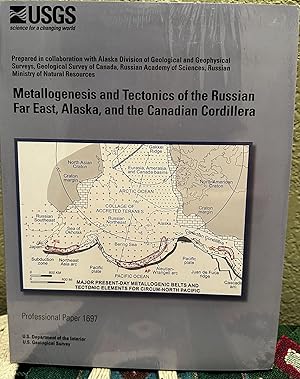
Metallogenesis and Tectonics of the Russian Far East, Alaska, and the Canadian Cordillera Professional Paper 1697
Published by USGS, 2005
ISBN 10: 0607984074 ISBN 13: 9780607984071
Condition: new. The Proterozoic and Phanerozoic metallogenic and tectonic evolution of the Russian Far East, Alaska, and the Canadian Cordillera is recorded in the cratons, craton margins, and orogenic collages of the Circum-North Pacific mountain belts that separate the North Pacific from the eastern North Asian and western North American Cratons. The collages consist of tectonostratigraphic terranes and contained metallogenic belts, which are composed of fragments of igneous arcs, accretionary-wedge and subduction-zone complexes, passive continental margins, and cratons. The terranes are overlapped by continental-margin-arc and sedimentary-basin assemblages and contained metallogenic belts. The metallogenic and geologic history of terranes, overlap assemblages, cratons, and craton margins has been complicated by postaccretion dismemberment and translation during strike-slip faulting that occurred subparallel to continental margins. Seven processes overlapping in time were responsible for most of metallogenic and geologic complexities of the region (1) In the Early and Middle Proterozoic, marine sedimentary basins developed on major cratons and were the loci for ironstone (Superior Fe) deposits and sediment-hosted Cu deposits that occur along both the North Asia Craton and North American Craton Margin. (2) In the Late Proterozoic, Late Devonian, and Early Carboniferous, major periods of rifting occurred along the ancestral margins of present-day Northeast Asia and northwestern North America. The rifting resulted in fragmentation of each continent, and formation of cratonal and passive continental-margin terranes that eventually migrated and accreted to other sites along the evolving margins of the original or adjacent continents. The rifting also resulted in formation of various massive-sulfide metallogenic belts. (3) From about the late Paleozoic through the mid-Cretaceous, a succession of island arcs and contained igneous-arc-related metallogenic belts and tectonically paired subduction zones formed near continental margins. (4) From about mainly the mid-Cretaceous through the present, a succession of continental-margin igneous arcs (some extending offshore into island arcs) and contained metallogenic belts, and tectonically paired subduction zones formed along the continental margins. (5) From about the Jurassic to the present, oblique convergence and rotations caused orogen-parallel sinistral, and then dextral displacements within the plate margins of the Northeast Asian and North American Cratons. The oblique convergences and rotations resulted in the fragmentation, displacement, and duplication of formerly more continuous arcs, subduction zones, passive continental margins, and contained metallogenic belts. These fragments were subsequently accreted along the margins of the expanding continental margins. (6) From the Early Jurassic through Tertiary, movement of the upper continental plates toward subduction zones resulted in strong plate coupling and accretion of the former island arcs, subduction zones, and contained metallogenic belts to continental margins. In this region, the multiple arc accretions were accompanied and followed by crustal thickening, anatexis, metamorphism, formation of collision-related metallogenic belts, and uplift; this resulted in the substantial growth of the North Asian and North American continents. (7) In the middle and late Cenozoic, oblique to orthogonal convergence of the Pacific Plate with present-day Alaska and Northeast Asia resulted in formation of the present ring of volcanoes and contained metallogenic belts around the Circum-North Pacific. Oblique convergence between the Pacific Plate and Alaska also resulted in major dextral-slip faulting in interior and southern Alaska and along the western part of the Aleutian- Wrangell arc. Associated with dextral-slip faulting was crustal extrusion of terranes from western Alaska into the Bering Sea. softcover, wrapped in shrink wrap, tight, crisp, 429 page.
-
Hardcover. Condition: Brand New. 400 pages. 8.75x5.25x1.00 inches. In Stock.
-
Hardcover. Condition: Brand New. 400 pages. 8.75x5.25x1.00 inches. In Stock.
-

Russian Criminal Tattoo Encyclopedia Volume III
Book 1 of 5: Russian Criminal Tattoo EncyclopaediaLanguage: English
Published by Thames & Hudson Okt 2008, 2008
ISBN 10: 0955006198 ISBN 13: 9780955006197
Seller: BuchWeltWeit Ludwig Meier e.K., Bergisch Gladbach, Germany
Seller rating 5 out of 5 stars
Buch. Condition: Neu. Neuware -'This is not solely an addendum to the previous volumes, but stands well on its own. The book's physical and emotional core lies in the Baldaev drawings, which are ethnographic, artistic, and surprisingly moving. His unflinching documentation reveals a world of systematic brutality and violence, where prisoners flaunted their savagery on their skin and punished their adversaries, poseurs, and the weak by etching humiliations into them.' - Alarm This is the final volume of drawings and photographs from Danzig Baldaev and Sergei Vasiliev, which completes the Russian Criminal Tattoo Encyclopaedia trilogy. Danzig Baldaev documented over three thousand tattoos during a lifetime working as a prison guard. His recording of this esoteric world was reported to the KGB who unexpectedly supported him, realising the importance of being able to establish facts about convicts by reading the images on their bodies. The motifs depicted represent the uncensored lives of the criminal classes, ranging from violence and pornography to politics and alcohol. The illustrated criminals of Russia tell the tale of their closed society. With an introduction by historian Alexander Sidorov, exploring the origin of Russian criminal tattoos and their meaning today. 399 pp. Englisch.
-

Russian Criminal Tattoo Encyclopedia Volume III
Book 1 of 5: Russian Criminal Tattoo EncyclopaediaLanguage: English
Published by Thames & Hudson Okt 2008, 2008
ISBN 10: 0955006198 ISBN 13: 9780955006197
Seller: Rheinberg-Buch Andreas Meier eK, Bergisch Gladbach, Germany
Seller rating 5 out of 5 stars
Buch. Condition: Neu. Neuware -'This is not solely an addendum to the previous volumes, but stands well on its own. The book's physical and emotional core lies in the Baldaev drawings, which are ethnographic, artistic, and surprisingly moving. His unflinching documentation reveals a world of systematic brutality and violence, where prisoners flaunted their savagery on their skin and punished their adversaries, poseurs, and the weak by etching humiliations into them.' - Alarm This is the final volume of drawings and photographs from Danzig Baldaev and Sergei Vasiliev, which completes the Russian Criminal Tattoo Encyclopaedia trilogy. Danzig Baldaev documented over three thousand tattoos during a lifetime working as a prison guard. His recording of this esoteric world was reported to the KGB who unexpectedly supported him, realising the importance of being able to establish facts about convicts by reading the images on their bodies. The motifs depicted represent the uncensored lives of the criminal classes, ranging from violence and pornography to politics and alcohol. The illustrated criminals of Russia tell the tale of their closed society. With an introduction by historian Alexander Sidorov, exploring the origin of Russian criminal tattoos and their meaning today. 399 pp. Englisch.
-

Russian Criminal Tattoo Encyclopedia Volume III
Book 1 of 5: Russian Criminal Tattoo EncyclopaediaLanguage: English
Published by Thames & Hudson Okt 2008, 2008
ISBN 10: 0955006198 ISBN 13: 9780955006197
Buch. Condition: Neu. Neuware -'This is not solely an addendum to the previous volumes, but stands well on its own. The book's physical and emotional core lies in the Baldaev drawings, which are ethnographic, artistic, and surprisingly moving. His unflinching documentation reveals a world of systematic brutality and violence, where prisoners flaunted their savagery on their skin and punished their adversaries, poseurs, and the weak by etching humiliations into them.' - Alarm This is the final volume of drawings and photographs from Danzig Baldaev and Sergei Vasiliev, which completes the Russian Criminal Tattoo Encyclopaedia trilogy. Danzig Baldaev documented over three thousand tattoos during a lifetime working as a prison guard. His recording of this esoteric world was reported to the KGB who unexpectedly supported him, realising the importance of being able to establish facts about convicts by reading the images on their bodies. The motifs depicted represent the uncensored lives of the criminal classes, ranging from violence and pornography to politics and alcohol. The illustrated criminals of Russia tell the tale of their closed society. With an introduction by historian Alexander Sidorov, exploring the origin of Russian criminal tattoos and their meaning today.
-

The physics of space Part I: Gravitational model. Its analysis on the example of cosmological expansion
Language: English
Published by LAP LAMBERT Academic Publishing, 2017
ISBN 10: 6202052120 ISBN 13: 9786202052122
Paperback. Condition: Brand New. 60 pages. 8.66x5.91x0.14 inches. In Stock.
-

Condition: New. Documenting over 3,000 tattoo drawings, this title describes the motifs that represent the uncensored lives of Russian criminal classes, ranging from violence and pornography to politics and alcohol.This final volume of previously unpublished drawings a.
-

The physics of space Part I
Language: English
Published by LAP LAMBERT Academic Publishing, 2017
ISBN 10: 6202052120 ISBN 13: 9786202052122
Condition: New.
-

Russian Criminal Tattoo Encyclopedia Volume III
Book 1 of 5: Russian Criminal Tattoo EncyclopaediaLanguage: English
Published by Thames & Hudson Okt 2008, 2008
ISBN 10: 0955006198 ISBN 13: 9780955006197
Seller: buchversandmimpf2000, Emtmannsberg, BAYE, Germany
Seller rating 5 out of 5 stars
Buch. Condition: Neu. Neuware -'This is not solely an addendum to the previous volumes, but stands well on its own. The book's physical and emotional core lies in the Baldaev drawings, which are ethnographic, artistic, and surprisingly moving. His unflinching documentation reveals a world of systematic brutality and violence, where prisoners flaunted their savagery on their skin and punished their adversaries, poseurs, and the weak by etching humiliations into them.' - Alarm This is the final volume of drawings and photographs from Danzig Baldaev and Sergei Vasiliev, which completes the Russian Criminal Tattoo Encyclopaedia trilogy. Danzig Baldaev documented over three thousand tattoos during a lifetime working as a prison guard. His recording of this esoteric world was reported to the KGB who unexpectedly supported him, realising the importance of being able to establish facts about convicts by reading the images on their bodies. The motifs depicted represent the uncensored lives of the criminal classes, ranging from violence and pornography to politics and alcohol. The illustrated criminals of Russia tell the tale of their closed society. With an introduction by historian Alexander Sidorov, exploring the origin of Russian criminal tattoos and their meaning today.Libri GmbH, Europaallee 1, 36244 Bad Hersfeld 399 pp. Englisch.
-

-

The physics of space Part I | Gravitational model. Its analysis on the example of cosmological expansion
Language: English
Published by LAP LAMBERT Academic Publishing, 2017
ISBN 10: 6202052120 ISBN 13: 9786202052122
Taschenbuch. Condition: Neu. The physics of space Part I | Gravitational model. Its analysis on the example of cosmological expansion | Alexander Sidorov | Taschenbuch | Englisch | 2017 | LAP LAMBERT Academic Publishing | EAN 9786202052122 | Verantwortliche Person für die EU: preigu GmbH & Co. KG, Lengericher Landstr. 19, 49078 Osnabrück, mail[at]preigu[dot]de | Anbieter: preigu.
-

Advances in Computational Intelligence: 20th Mexican International Conference on Artificial Intelligence, MICAI 2021, Mexico City, Mexico, October ... I (Lecture Notes in Artificial Intelligence)
Seller: Ria Christie Collections, Uxbridge, United Kingdom
Seller rating 5 out of 5 stars
£ 76.40
£ 11.98 shipping
Ships from United Kingdom to U.S.A.Quantity: Over 20 available
Add to basketCondition: New. In.
-

Approximation And Regularisation Methods For Operator-functional Equations
Language: English
Published by World Scientific Publishing Co Pte Ltd, SG, 2025
ISBN 10: 9819801680 ISBN 13: 9789819801688
Hardback. Condition: New. This book presents an overview of the most recent research and findings in the field of approximation and regularisation methods for operator-functional equations, and explores their applications in electrical and power engineering. It presents the state of the art in building operator theory, regularised numerical methods, and the verification of mathematical models for dynamical models based on integral and differential equations. Special attention is paid to Volterra models, a powerful tool for modelling hereditary dynamics.This book begins by exploring the solvability of singular integral equations and moves on to study approximation methods for linear operator equations and nonlinear integral equations. Following this, it examines loaded equations and bifurcation analysis, before concluding with an investigation of the applications of the contents of the book in electrical engineering and automation. Each chapter provides an overview and analysis of the relevant problem statements, outlines current methods within the field, and identifies future directions for research.With an interdisciplinary approach, this book is essential reading for anyone interested in operator-functional equations. Graduate students and professors in the fields of applied mathematics, physics, materials science, and numerical analysis will find this work insightful and valuable, as will industry professionals in related fields.
-
-
Approximation And Regularisation Methods For Operator-functional Equations (Series on Advances in Mathematics for Applied Sciences)
Seller: Ria Christie Collections, Uxbridge, United Kingdom
Seller rating 5 out of 5 stars
£ 86.65
£ 11.98 shipping
Ships from United Kingdom to U.S.A.Quantity: Over 20 available
Add to basketCondition: New. In.
-

Condition: As New. Unread book in perfect condition.
-
Advances In Computational Intelligence :
Seller: Kennys Bookshop and Art Galleries Ltd., Galway, GY, Ireland
Seller rating 5 out of 5 stars
Condition: New.
-
Condition: New. 1st ed. 2021 edition NO-PA16APR2015-KAP.

