
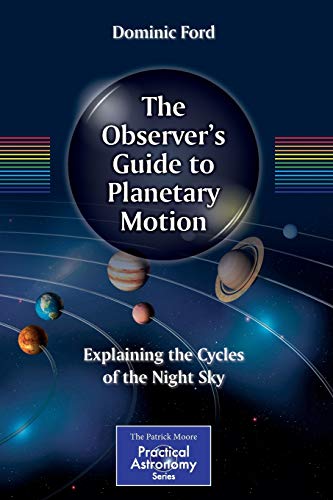
The Observer's Guide to Planetary Motion : Explaining the Cycles of the Night Sky
Ford, Dominic
ISBN 10: 1493906283 ISBN 13: 9781493906284
Published by Springer New York, 2014
Used
Soft cover
From
Better World Books, Mishawaka, IN, U.S.A.
Seller rating 5 out of 5 stars

AbeBooks Seller since 3 August 2006
This specific item is no longer available.
About this Item
Description:
Former library copy. Pages intact with minimal writing/highlighting. The binding may be loose and creased. Dust jackets/supplements are not included. Includes library markings. Stock photo provided. Product includes identifying sticker. Better World Books: Buy Books. Do Good. Seller Inventory # 54409288-6
Synopsis:
To the naked eye, the most evident defining feature of the planets is their motion across the night sky. It was this motion that allowed ancient civilizations to single them out as different from fixed stars. “The Observer’s Guide to Planetary Motion” takes each planet and its moons (if it has them) in turn and describes how the geometry of the Solar System gives rise to its observed motions.
Although the motions of the planets may be described as simple elliptical orbits around the Sun, we have to observe them from a particular vantage point: the Earth, which spins daily on its axis and circles around the Sun each year. The motions of the planets as observed relative to this spinning observatory take on more complicated patterns. Periodically, objects become prominent in the night sky for a few weeks or months, while at other times they pass too close to the Sun to be observed. “The Observer’s Guide to Planetary Motion” provides accurate tables of the best time for observing each planet, together with other notable events in their orbits, helping amateur astronomers plan when and what to observe. Uniquely each of the chapters includes extensive explanatory text, relating the events listed to the physical geometry of the Solar System.
Along the way, many questions are answered: Why does Mars take over two years between apparitions (the times when it is visible from Earth) in the night sky, while Uranus and Neptune take almost exactly a year? Why do planets appear higher in the night sky when they’re visible in the winter months? Why do Saturn’s rings appear to open and close every 15 years? This book places seemingly disparate astronomical events into an understandable three-dimensional structure, enabling an appreciation that, for example, very good apparitions of Mars come around roughly every 15 years and that those in 2018 and 2035 will be nearly as good as that seen in 2003.
Events are listed for the time period2010-2030 and in the case of rarer events (such as eclipses and apparitions of Mars) even longer time periods are covered. A short closing chapter describes the seasonal appearance of deep sky objects, which follow an annual cycle as a result of Earth’s orbital motion around the Sun.
About the Author: Dr. Dominic Ford is an experienced observer of the night sky and a regular contributor to the ‘Journal of the British Astronomical Association.’ He obtained his MSc in Physics from the University of Cambridge (UK) in 2003 and a doctorate in Astrophysics (also from Cambridge) in 2008. He is a member of the Council of the British Astronomical Association, a Fellow of the Royal Astronomical Society and a Trustee of the British Astronomical Association (as of August 2011). Dominic has written 58 meeting reports for ‘The Journal of the British Astronomical Association’ over the past ten years and is a regular monthly contributor to ‘the Naked Astronomy’ podcast. Currently he is employed as a post-doctoral Research Associate working on the Square Kilometre Array in the Astrophysics Group, Department of Physics, University of Cambridge.
"About this title" may belong to another edition of this title.
Bibliographic Details
Title: The Observer's Guide to Planetary Motion : ...
Publisher: Springer New York
Publication Date: 2014
Binding: Soft cover
Condition: Good
Edition: 2014th Edition.
Top Search Results from the AbeBooks Marketplace

Stock Image
The Observer's Guide to Planetary Motion : Explaining the Cycles of the Night Sky
Seller: Better World Books Ltd, Dunfermline, United Kingdom
Seller rating 5 out of 5 stars
Condition: Very Good. 2014th Edition. Former library copy. Pages intact with possible writing/highlighting. Binding strong with minor wear. Dust jackets/supplements may not be included. Includes library markings. Stock photo provided. Product includes identifying sticker. Better World Books: Buy Books. Do Good. Seller Inventory # 18271949-75
Buy Used
£ 21.74
£ 5 shipping
Ships from United Kingdom to U.S.A.
Ships from United Kingdom to U.S.A.
Quantity: 1 available
Stock Image
The Observer's Guide to Planetary Motion
Seller: Chiron Media, Wallingford, United Kingdom
Seller rating 5 out of 5 stars
PF. Condition: New. Seller Inventory # 6666-IUK-9781493906284
Buy New
£ 32.09
£ 15.49 shipping
Ships from United Kingdom to U.S.A.
Ships from United Kingdom to U.S.A.
Quantity: 10 available
Stock Image
Ford:The Observer's Guide to Planetary (eng)
Print on DemandSeller: Brook Bookstore On Demand, Napoli, NA, Italy
Seller rating 4 out of 5 stars

Condition: new. Questo è un articolo print on demand. Seller Inventory # 7a4b53870511fcfd4f8e25b67ebc0e1f
Buy New
£ 32.73
£ 26.03 shipping
Ships from Italy to U.S.A.
Ships from Italy to U.S.A.
Quantity: Over 20 available
Seller Image
The Observer s Guide to Planetary Motion
Published by
Springer New York, 2014
ISBN 10: 1493906283
ISBN 13: 9781493906284
New
Kartoniert / Broschiert
Seller: moluna, Greven, Germany
Seller rating 4 out of 5 stars
Kartoniert / Broschiert. Condition: New. Dieser Artikel ist ein Print on Demand Artikel und wird nach Ihrer Bestellung fuer Sie gedruckt. The first almanac that not only tabulates positions but also explains the orbital mechanics that dictate how the planets and stars move as observed from Earth Equips readers with an authoritative point of reference for complete lists of celestial . Seller Inventory # 4213858
Buy New
£ 33.05
£ 42.51 shipping
Ships from Germany to U.S.A.
Ships from Germany to U.S.A.
Quantity: Over 20 available
Seller Image
Observer's Guide to Planetary Motion : Explaining the Cycles of the Night Sky
Seller: GreatBookPricesUK, Woodford Green, United Kingdom
Seller rating 5 out of 5 stars
Condition: New. Seller Inventory # 21320636-n
Buy New
£ 34.29
£ 15 shipping
Ships from United Kingdom to U.S.A.
Ships from United Kingdom to U.S.A.
Quantity: Over 20 available
Stock Image
The Observer's Guide to Planetary Motion: Explaining the Cycles of the Night Sky (The Patrick Moore Practical Astronomy Series)
Seller: Ria Christie Collections, Uxbridge, United Kingdom
Seller rating 5 out of 5 stars
Condition: New. In. Seller Inventory # ria9781493906284_new
Buy New
£ 34.30
£ 11.98 shipping
Ships from United Kingdom to U.S.A.
Ships from United Kingdom to U.S.A.
Quantity: Over 20 available
Seller Image
The Observer's Guide to Planetary Motion
Published by
Springer New York Mai 2014, 2014
ISBN 10: 1493906283
ISBN 13: 9781493906284
New
Taschenbuch
Seller: BuchWeltWeit Ludwig Meier e.K., Bergisch Gladbach, Germany
Seller rating 5 out of 5 stars
Taschenbuch. Condition: Neu. This item is printed on demand - it takes 3-4 days longer - Neuware -To the naked eye, the most evident defining feature of the planets is their motion across the night sky. It was this motion that allowed ancient civilizations to single them out as different from fixed stars. 'The Observer's Guide to Planetary Motion' takes each planet and its moons (if it has them) in turn and describes how the geometry of the Solar System gives rise to its observed motions.Although the motions of the planets may be described as simple elliptical orbits around the Sun, we have to observe them from a particular vantage point: the Earth, which spins daily on its axis and circles around the Sun each year. The motions of the planets as observed relative to this spinning observatory take on more complicated patterns. Periodically, objects become prominent in the night sky for a few weeks or months, while at other times they pass too close to the Sun to be observed. 'The Observer's Guide to Planetary Motion' provides accurate tables of the best time for observing each planet, together with other notable events in their orbits, helping amateur astronomers plan when and what to observe. Uniquely each of the chapters includes extensive explanatory text, relating the events listed to the physical geometry of the Solar System.Along the way, many questions are answered: Why does Mars take over two years between apparitions (the times when it is visible from Earth) in the night sky, while Uranus and Neptune take almost exactly a year Why do planets appear higher in the night sky when they're visible in the winter months Why do Saturn's rings appear to open and close every 15 years This book places seemingly disparate astronomical events into an understandable three-dimensional structure, enabling an appreciation that, for example, very good apparitions of Mars come around roughly every 15 years and that those in 2018 and 2035 will be nearly as good as that seen in 2003.Events are listed for the time period2010-2030 and in the case of rarer events (such as eclipses and apparitions of Mars) even longer time periods are covered. A short closing chapter describes the seasonal appearance of deep sky objects, which follow an annual cycle as a result of Earth's orbital motion around the Sun. 256 pp. Englisch. Seller Inventory # 9781493906284
Seller Image
The Observer's Guide to Planetary Motion
Published by
Springer US, Springer New York Mai 2014, 2014
ISBN 10: 1493906283
ISBN 13: 9781493906284
New
Taschenbuch
Seller: buchversandmimpf2000, Emtmannsberg, BAYE, Germany
Seller rating 5 out of 5 stars
Taschenbuch. Condition: Neu. Neuware -To the naked eye, the most evident defining feature of the planets is their motion across the night sky. It was this motion that allowed ancient civilizations to single them out as different from fixed stars. ¿The Observer¿s Guide to Planetary Motion¿ takes each planet and its moons (if it has them) in turn and describes how the geometry of the Solar System gives rise to its observed motions.Although the motions of the planets may be described as simple elliptical orbits around the Sun, we have to observe them from a particular vantage point: the Earth, which spins daily on its axis and circles around the Sun each year. The motions of the planets as observed relative to this spinning observatory take on more complicated patterns. Periodically, objects become prominent in the night sky for a few weeks or months, while at other times they pass too close to the Sun to be observed. ¿The Observer¿s Guide to Planetary Motion¿ provides accurate tables of the best time for observing each planet, together with other notable events in their orbits, helping amateur astronomers plan when and what to observe. Uniquely each of the chapters includes extensive explanatory text, relating the events listed to the physical geometry of the Solar System.Along the way, many questions are answered: Why does Mars take over two years between apparitions (the times when it is visible from Earth) in the night sky, while Uranus and Neptune take almost exactly a year Why do planets appear higher in the night sky when they¿re visible in the winter months Why do Saturn¿s rings appear to open and close every 15 years This book places seemingly disparate astronomical events into an understandable three-dimensional structure, enabling an appreciation that, for example, very good apparitions of Mars come around roughly every 15 years and that those in 2018 and 2035 will be nearly as good as that seen in 2003.Events are listed for the time period2010-2030 and in the case of rarer events (such as eclipses and apparitions of Mars) even longer time periods are covered. A short closing chapter describes the seasonal appearance of deep sky objects, which follow an annual cycle as a result of Earth¿s orbital motion around the Sun.Springer Verlag GmbH, Tiergartenstr. 17, 69121 Heidelberg 256 pp. Englisch. Seller Inventory # 9781493906284
Seller Image
Observer's Guide to Planetary Motion : Explaining the Cycles of the Night Sky
Seller: GreatBookPrices, Columbia, MD, U.S.A.
Seller rating 5 out of 5 stars
Condition: As New. Unread book in perfect condition. Seller Inventory # 21320636
Seller Image
The Observer's Guide to Planetary Motion : Explaining the Cycles of the Night Sky
Published by
Springer US, Springer New York, 2014
ISBN 10: 1493906283
ISBN 13: 9781493906284
New
Taschenbuch
Seller: AHA-BUCH GmbH, Einbeck, Germany
Seller rating 5 out of 5 stars
Taschenbuch. Condition: Neu. Druck auf Anfrage Neuware - Printed after ordering - To the naked eye, the most evident defining feature of the planets is their motion across the night sky. It was this motion that allowed ancient civilizations to single them out as different from fixed stars. 'The Observer's Guide to Planetary Motion' takes each planet and its moons (if it has them) in turn and describes how the geometry of the Solar System gives rise to its observed motions.Although the motions of the planets may be described as simple elliptical orbits around the Sun, we have to observe them from a particular vantage point: the Earth, which spins daily on its axis and circles around the Sun each year. The motions of the planets as observed relative to this spinning observatory take on more complicated patterns. Periodically, objects become prominent in the night sky for a few weeks or months, while at other times they pass too close to the Sun to be observed. 'The Observer's Guide to Planetary Motion' provides accurate tables of the best time for observing each planet, together with other notable events in their orbits, helping amateur astronomers plan when and what to observe. Uniquely each of the chapters includes extensive explanatory text, relating the events listed to the physical geometry of the Solar System.Along the way, many questions are answered: Why does Mars take over two years between apparitions (the times when it is visible from Earth) in the night sky, while Uranus and Neptune take almost exactly a year Why do planets appear higher in the night sky when they're visible in the winter months Why do Saturn's rings appear to open and close every 15 years This book places seemingly disparate astronomical events into an understandable three-dimensional structure, enabling an appreciation that, for example, very good apparitions of Mars come around roughly every 15 years and that those in 2018 and 2035 will be nearly as good as that seen in 2003.Events are listed for the time period2010-2030 and in the case of rarer events (such as eclipses and apparitions of Mars) even longer time periods are covered. A short closing chapter describes the seasonal appearance of deep sky objects, which follow an annual cycle as a result of Earth's orbital motion around the Sun. Seller Inventory # 9781493906284