Hesiod's Theogony as Source of the Iconological Program of Giorgione's "Tempesta": The Poet, Amalthea, the Infant Zeus and the Muses - Hardcover
Synopsis
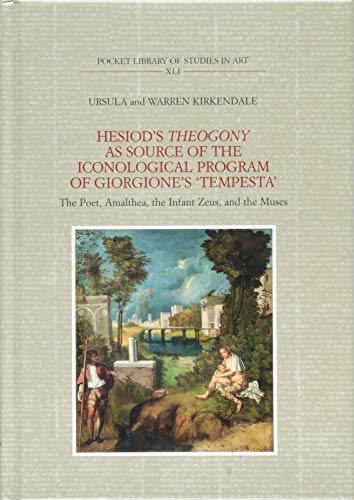
This book explains how Giorgione’s famous picture shows the shepherd Hesiod undergoing his famous vision in which the Muses told him of his poetic mission; on the right the infant Zeus held by his nurse Amalthea one year after being rescued from being devoured by his father Cronus; and the altar of two columns erected by Zeus to commemorate his victory over Cronus, corresponding to his own altar with two columns in his birthplace Lyktos. The lightening is, of course, the attribute of Zeus. The muses are not seen, since Hesiod says they are ‘invisible’, but he often mentions their nine houses, shown in the painting.
"synopsis" may belong to another edition of this title.
About the Author
Ursula Kirkendale received her PhD in historical musicology in Bonn and taught at four important American universities, until, in 1971, after only one semester at Columbia University, a speech impairment (ictus) terminated her teaching, but not her research, highly acclaimed internationally, on Caldara, Handel and Bach.
"About this title" may belong to another edition of this title.
Search results for Hesiod's Theogony as Source of the Iconological...

Stock Image
Hesiod's Theogony as source of the iconological program of Giorgione's 'Tempesta'N
Published by
Casa Editrice Leo S. Olschki, 2015
ISBN 10: 8822264088
ISBN 13: 9788822264084
New
Hardcover
Seller: ISD LLC, Bristol, CT, U.S.A.
Seller rating 5 out of 5 stars

hardcover. Condition: New. Seller Inventory # 1552621
Seller Image
Hesiod's Theogony as source of the iconological program of Giorgione's "Tempesta"
Published by
Casa Editrice Leo S.Olschki, IT, 2018
ISBN 10: 8822264088
ISBN 13: 9788822264084
New
Hardcover
Seller: Rarewaves.com USA, London, LONDO, United Kingdom
Seller rating 5 out of 5 stars
Hardback. Condition: New. Seller Inventory # LU-9788822264084
Stock Image
Hesiod's Theogony as source of the iconological - The Poet, Amalthea, The Infant Zeus and The Muses
Seller: PBShop.store UK, Fairford, GLOS, United Kingdom
Seller rating 5 out of 5 stars
HRD. Condition: New. New Book. Shipped from UK. Established seller since 2000. Seller Inventory # WY-9788822264084
Stock Image
Hesiods Theogony as source of the iconological program of Giorgiones Tempesta (Hardcover)
Published by
Casa Editrice Leo S.Olschki, Firenze, 2018
ISBN 10: 8822264088
ISBN 13: 9788822264084
New
Hardcover
Seller: Grand Eagle Retail, Bensenville, IL, U.S.A.
Seller rating 5 out of 5 stars
Hardcover. Condition: new. Hardcover. This book explains how Giorgione's famous picture shows the shepherd Hesiod undergoing his famous vision in which the Muses told him of his poetic mission; on the right the infant Zeus held by his nurse Amalthea one year after being rescued from being devoured by his father Cronus; and the altar of two columns erected by Zeus to commemorate his victory over Cronus, corresponding to his own altar with two columns in his birthplace Lyktos. The lightening is, of course, the attribute of Zeus. The muses are not seen, since Hesiod says they are 'invisible', but he often mentions their nine houses, shown in the painting. This book explains how Giorgiones famous picture shows the shepherd Hesiodundergoing his famous vision in which the Muses told him of his poetic mission; and the altar of two columns erected byZeus to commemorate his victory over Cronus, corresponding to his own altar withtwo columns in his birthplace Lyktos. Shipping may be from multiple locations in the US or from the UK, depending on stock availability. Seller Inventory # 9788822264084
Stock Image
La 'Tempesta' Di Giorgione E Il Suo Programma Iconologico Derivato Dalla Teogoni di Esiodo: Il Poeta, Amalthea, Zeus Bambino e le Muse
Published by
Leo S. Olschki, Firenze, 2015
ISBN 10: 8822264088
ISBN 13: 9788822264084
Used
Hardcover
Seller: Mullen Books, ABAA, Marietta, PA, U.S.A.
Seller rating 4 out of 5 stars

Hardcover. Condition: VG+. A glossy casebound book with the title in black down a beige-green spine. Pages: (4), 1-100, (15). Contains 7 color plates. Text in English. Seller Inventory # 203233
Stock Image
Hesiod?s Theogony as source of the iconological program of Giorgione?s ?Tempesta?: The Poet, Amalthea, The Infant Zeus and The Muses
Seller: Majestic Books, Hounslow, United Kingdom
Seller rating 4 out of 5 stars
Condition: New. Seller Inventory # 381364167
Stock Image
Hesiod's Theogony As Source of the Iconological Program of Giorgione's Tempesta: The Poet, Amalthea, the Infant Zeus and the Muses
Seller: Revaluation Books, Exeter, United Kingdom
Seller rating 5 out of 5 stars
Hardcover. Condition: Brand New. 106 pages. 8.26x6.00x0.63 inches. In Stock. Seller Inventory # __8822264088
Stock Image
Hesiod?s Theogony as source of the iconological program of Giorgione?s ?Tempesta?: The Poet, Amalthea, The Infant Zeus and The Muses
Seller: Books Puddle, New York, NY, U.S.A.
Seller rating 4 out of 5 stars
Condition: New. Seller Inventory # 26382507032
Seller Image
Hesiod's Theogony as source of the iconological program of Giorgione's 'Tempesta'. The Poet, Amalthea, The Infant Zeus and The Muses.
Seller: FIRENZELIBRI SRL, Reggello, FI, Italy
Seller rating 5 out of 5 stars
Condition: NUOVO. Firenze, Olschki Ed. cm 15 x 21, iv-102 pp. con 7 ill. f.t. di cui 6 a colori. Rilegato (Hardcover)., legatura ed. Pocket Library of Studies in Art,41. Testo in Inglese. Giorgione's Tempesta has been the most discussed enigma in the history of art, with over fifty different interpretations, based largely on ancient literary sources which were compared, unconvincingly, with very few elements of the painting. Hesiod's Theogony, well known in Venice when the painting was made, explains all of them, for the artist translated the poet's words literally into visual images, showing the shepherd Hesiod during the vision in which the muses consign to him a poetic mission; the infant Zeus held by his nurse Almathea one year after being rescued from being devoured by his father Cronus; and the altar of two columns erected by Zeus to commemorate his victory over Cronus, corresponding to his own altar with two columns in his birthplace Lyktos. The lightening is, of course, the attribute of Zeus. The muses are not seen, since Hesiod says they are 'invisible', but he often mentions their nine houses, shown in the painting. Seller Inventory # 291495
Stock Image
Hesiod's Theogony as source of the iconological program of Giorgione's "Tempesta": The Poet, Amalthea, The Infant Zeus and The Muses
Seller: libreriauniversitaria.it, Occhiobello, RO, Italy
Seller rating 4 out of 5 stars
Condition: NEW. Seller Inventory # 9788822264084