
Items related to You Don't Have to Be Buddhist to Know Nothing:...
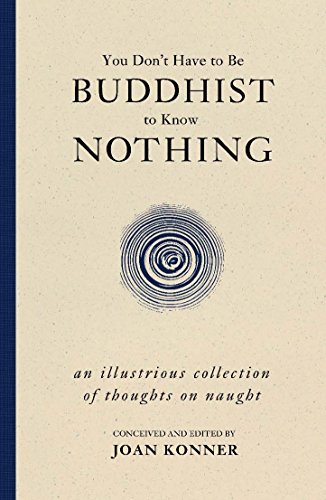
You Don't Have to Be Buddhist to Know Nothing: An Illustrious Collection of Thoughts on Naught - Hardcover
Synopsis
I love talking about nothing It is the only thing I know anything about. Oscar Wilde Whether a subject of dread or fascination, Nothing has intrigued writers, philosophers, and scientists since ancient times. You Dont Have to Be Buddhist to Know Nothing brings together the thoughts and musings of well-known writers and philosophers, artists and musicians, poets and playwrights, geniuses and jokers on, well, nothing. Organised into short topical chapters ranging from Knowing Nothing to the Joy of Unknowing and Nothing is Sacred, this is a volume full of insight, wisdom, humour, and wonder.
"synopsis" may belong to another edition of this title.
About the Author
Joan Konner conceived and edited The Atheist's Bible, which became a national bestseller in 2007. She is Dean Emerita and Professor Emerita of the Columbia Graduate School of Journalism, as well as the former publisher and currently an honorary co-chair of the Columbia Journalism Review. This is her second book.
Excerpt. © Reprinted by permission. All rights reserved.
You Don't Have to Be BUDDHIST to Know NOTHING
Prometheus Books
Copyright © 2009 Joan KonnerAll right reserved.
ISBN: 978-1-59102-757-7
Contents
PREFACE...................................................11INTRODUCTION..............................................13BOOK I: BEFORE............................................230. The Origin.............................................25BOOK II: HERE GOES NOTHING................................311. In the Beginning.......................................332. The Light at the End of the Tunnel.....................353. Directions.............................................374. The Geography of Nowhere...............................41BOOK III: IN RESIDENCE....................................451. Foyer..................................................472. Living Room............................................493. Dinner Party...........................................514. East Room..............................................565. West Wing..............................................586. A Room of One's Own....................................627. The Children's Hour....................................658. In the Garden..........................................689. Reflecting Pool........................................70BOOK IV: PUBLIC LIBRARY...................................751. Dictionary of Nothing..................................772. Reading Room...........................................833. Writer's Room..........................................854. In the Stacks..........................................904.1 Samuel Beckett........................................904.2 Italo Calvino.........................................924.3 E. M. Cioran..........................................934.4 Edmond Jabs..........................................954.5 Thomas Merton.........................................974.6 Rumi..................................................984.7 William Shakespeare...................................1005. Poet's Corner..........................................1026. No Exit................................................1067. The Classics...........................................113BOOK V: CONCERT HALL......................................1171. Overture...............................................1192. Silence of the Spheres.................................1203. Symphonies of Silence..................................1224. Moments of Silence.....................................1255. The Audience...........................................129BOOK VI: SCHOOL...........................................1311. Knowing Nothing........................................1332. The Joy of Unknowing...................................1363. Mathematics............................................1394. The Arts...............................................1445. Science Sutra..........................................1476. Creative Thinking......................................1527. Paradoxical Logic......................................1568. Master Class...........................................1629. Recess.................................................16510. Final Exam............................................168BOOK VII: MUSEUM..........................................1711. Permanent Collection...................................1732. The Moderns............................................1753. Warhol Retrospective...................................1774. Gallery of Blind Spots.................................1795. In Studio..............................................1836. Nothing Is Beautiful...................................186BOOK VIII: THEATER DISTRICT...............................1891. Comedy Tonight.........................................1912. Mostly Mystery.........................................1943. In the Wings...........................................1964. Theater of the Absurd..................................199BOOK IX: HOUSE OF WORSHIP.................................2031. Nothing Is Sacred......................................2052. Seminary...............................................2123. House of Doubt.........................................2154. Practicing Nothing.....................................217BOOK X: DOWNTOWN..........................................2211. City Hall..............................................2232. The Office.............................................2273. Inn on Main Street.....................................2314. Restaurant.............................................2335. Corner Bar.............................................2346. Wall Street............................................237BOOK XI: CITY LIMITS......................................2391. This Way Out...........................................2412. Tunnel at the End of the Light.........................2453. Cemetery...............................................2504. Last Words.............................................2555. After Lite.............................................256EPILOGUE..................................................259ACKNOWLEDGMENTS...........................................261BIBLIOGRAPHY..............................................263INDEX.....................................................303CREDITS AND PERMISSIONS...................................325ABOUT THE AUTHOR..........................................333
Introduction
I was in Aspen, Colorado, on my first on-location shoot as executive producer for the new season of Bill Moyers' Journal, fall 1978 on PBS. It was late August, and the green and hay-colored meadows were glorious in the Rockies' radiant light. Moyers was shooting an interview with one of his favorite subjects, the late philosopher Mortimer Adler. This program was to be a conversation on Adler's latest book, Aristotle for Everybody. Adler's thesis was that Aristotle, by means of reason and logic, had paved The Way to answer life's most persistent questions about the nature of Truth, Beauty, Goodness, and Happiness. Logic and reason were Aristotle's religion-and Adler's, but with an exception, as revealed in the interview. Adler had taken a leap of faith some years earlier, converting from being Jewish, the religion into which he was born, to becoming a Catholic.Leap of faith? That mysterious leap keeps leaping up, in both belief and science. An inexplicable change from this to that! An instantaneous shift from here to there! What is a quantum, anyway? And what is the in-between, the blind spot over which the leap occurs?
Between rolls of film, in a scenic clich, Adler sat down next to me, on a stone beside a babbling brook. I chatted with him and posed a question that was on my mind:
"How do you reconcile Aristotelian logic with Eastern philosophy and religion, which are based on paradoxical logic?" I asked.
As background and a brief digression, I had in mind the documentary I had produced and written a few years earlier for NBC News called The Search for Something Else. It was a report on the spread of Eastern philosophy and religion to the United States through music: the Beatles, the Beach Boys, and others; and changes of hearts and minds through the practices of Buddhism, Yoga, Transcendental Meditation, and Zen, led by gurus from India, Tibet, Japan, and a few American early adopters. A shift in Western consciousness was taking place, especially among young people.
"That's easy," Adler answered. "They are wrong! Just try flying from New York to Tokyo based on paradoxical logic."
"Oh," I responded. And then, with respectful hesitation, I added, "I didn't know you could take a plane to the Truth."
The concept of Nothing, in Western thought, is a paradox. We simply cannot accept, no less conceive of, the paradoxical concept that "Nothing exists," given that we learn to think and reason in the Western tradition, which is based on Aristotelian logic. The Age of Reason, the Enlightenment, and the scientific method have trained us to think otherwise-rationally, that is. In the material world, which we inhabit, the very words "Nothing exists" are a contradiction in terms, an oxymoron. We are not conditioned to perceive a contradiction-in-terms as possible, as real, as able to be. Our way of seeing does not admit that something is and is not at the same time. We live in an either/or construct.
Take the notion that we are living and dying at this very moment. We just don't think that way. Either we are healthy and alive; or we are ill and dying, although we know that each day of life brings us closer to our inevitable death. A both/and construct, which some call holistic, is not in our cultural curriculum, except that more and more, Eastern thought and spiritual traditions, which are rooted in paradoxical logic, are being assimilated into Western culture.
In fact, Nothing can and does co-exist with Everything, because everything in the natural world, we are learning, has its equal and opposite force-matter and antimatter; electrons and protons, and so forth. We accept "equal and opposite" because we trust science. We also trust, from science, that Nature abhors a vacuum. If a vacuum occurs, nature rushes in to fill it. But where and what would Nature rush in to fill if there wasn't a vacuum? Without Emptiness there would be no opportunity for something new, or something else, to occur. Where would Something happen? Stars disappearing. Novas appearing. Leaves falling. New leaves growing. One generation dying, another being born. Nothing is the still center of the wheel of life. Nothing is the core of creation. In the dark evanescence between equal and opposite, the Universe ignites.
In a very simple way, You Don't Have to Be Buddhist to Know Nothing demonstrates, if nothing else, that Nothing, capital N, exists, simultaneously with Everything, capital E. I capitalize Nothing and Everything because, here, they are abstractions, universals, ideals, as if from an existent archetypal sphere or the Platonic world of Ideas, waves that break into particles on the shore of being. Small "n" nothing, and small "e" everything are the actual nothing and everything, the particulars, the particles of our daily existence. We, prisoners of rational thought-like Adler and many other logically positive philosophers-cannot, or will not, believe that nonbeing coexists with being. Nothing would make Everything spooky, kooky, and irrational, or worse, mystical and New Age.
That is, until you take a leap! A quantum leap? A leap of faith? Is faith rational? Is lack of faith reasonable?
I propose readers consider that there is a vacuum everywhere, all the time, right where we are, here and now, which Nature is rushing to fill with Everything-not just anything, but Everything, everything possible according to the observed laws of nature. If there wasn't Nothing, Everything would be static, paralyzed. There could be no motion between bodies, no music minus silence, no rhythm without pause, no meaning without space between words and sentences, no emptiness out of which new thoughts, new works, might arise. Nature is dynamic. Life is dynamic. We know, or believe we know, that the only constant is change, according to not only science but the wisdom of experience. Without Nothing, Change itself could not be constant.
The human brain had a difficult time conceptualizing Nothing, but once conceived in Hindu thought, Nothing became a necessity. The dictionary says Nothing is a point of reckoning. We find Nothing in science. We find it in Art. We find it in the philosophies of Hegel, Heidegger, Sartre, and Levinas. We find it in the plays of Samuel Beckett. We find it in the poems of Emily Dickinson, Robert Frost, and Rainer Maria Rilke. We couldn't calculate, compose, or create without Nothing. There are books, ancient, old, and new, on the history and evolution of Nothing. Though the idea itches, tickles, and teases the brain, the rational mind imposes a No Entry sign, ordering intellect to Keep Out! Off limits! The mind-or should we say, the Western mindset-will not work that way. The eyes will not see that way. Thus, we balance on the tipping point of denial, and miss the point of it All.
In English, there is only one word for Love, although there are many kinds of love that give shape and meaning to life-from romance and friendship to the love of pets and God. Curiously, there are many words for Nothing, from abyss to zip, among them bupkis, emptiness, nada, naught, nirvana, the void, vacuum, zip, zero, and zilch. According to the dictionary, the definition of Nothing/nothing is that which does not exist; utter insignificance, having no value, no magnitude, unimportant, inert. But then, additional meanings: a mark from which the beginning is measured! How invaluable is that? How invaluable is the long list of dictionary definitions following: in chemistry, physics, and mathematics; music, art, and more? Oddly, not in religion! Religion admits no nothing, no uncertainty, no unknown or unknowable. God appears to fill the Void. The Creator, and creation, out of Nothing, Ex Nihilo.
Nothing explains a lot. I would say Nothing explains Everything. If you picture a graph, it coheres around an Origin, the O,O point. The Origin is the still center where opposites intersect. It is the point of connection, the point of interconnection, the point through which something must pass to fuse with its opposite. It is the zero base of becoming. The Origin is the point where the horizontal and vertical intersect, a hole to create new wholes: Plus and Minus; Positive and Negative; Space and Time; Good and Evil; Grief and Joy; West and East; Mind and Body; Beauty and the Beast. The Origin is where One becomes the Other, a point of fusion, of transformation, the nonexistent existence. The missing point, the blind spot, in our perception is the Origin, the leap between before and after, the non-dimensional dimension, the instantaneous Nothing that is everywhere, all the time, coming into and going out of existence in no time, where the arrow ceases to progress over half the remaining space and pierces the target, where Nothing makes room for Everything. Nothing produces Being.
This collection of quotes brings together, in one portable volume, the thoughts of many well-known, and not so well-known, writers and philosophers, artists and musicians, poets and playwrights, geniuses and jokers, who have explored, feared, confronted, experienced, and played with the presence of Nothing in their lives. They knew Nothing intuitively, subjectively, imaginatively, irrationally, and conceptually, and they possessed the wit and words to express it.
You Don't Have to Be Buddhist to Know Nothing is organized within chapter headings that make the abstract and non-material nature of Nothing more accessible, more user-friendly. Adopting the concrete metaphor of a place, a locus, the book guides the reader through the universe of Nothing, to a land called Nowhere, uncharted until now. Following directions to Nowhere, we discover its geography, its landscape, its climate, and a village with inhabitants of various faiths and feelings; habits and practices; professions and traditions. We meet the occupants in the familiar settings of residence, library, concert hall, school, museum, house of worship, theater, corner bar, cemetery, and more. The verbal snapshots create a coherent work of insight, humor, and wonder, as awesome and mysterious as the material universe itself.
On this journey, we learn that there are those who have despaired about Nothing (Book IV: Chapter 6), and others who have laughed about it (Book VIII: Chapters 1 and 4). We find others who have played hide-and-seek with Nothing (Book III: Chapter 7) and some whose minds are burdened by it, weightless though Nothing may be (Book XI: Chapter 2). Still others encounter Nothing and find bliss (Book VI: Chapter 2). Many see Nothing as death itself (Book XI: Chapter 3), approaching it with dread and denial. Nothing, like death, repels the mind and body. It is the unknown before we were born and the unknowable after we die. But Nothing is also potential (Book I: Chapter 0). Nothing may be primal Power. The Force! The instability that is the opportunity to become! (Book II: Chapter 2.) It is the origin of stories, the dark spark igniting the Word: Genesis, Creation, Heaven, Hell, God, and the Apocalypse (Book IV). Each quote is testimony to the perennial search for the nature of truth, existence, and the ground of being.
You Don't Have to Be Buddhist to Know Nothing fills a need, a vacuum, if you will, in the library of the mind that demonstrates that even if we can't see, feel, or touch it, or even imagine it, Nothing is here, all the time. It haunts us like a ghost. It stalks us like a shadow. We find Nothing in the work of some of our greatest Western thinkers, writers, and artists-William Shakespeare, Friedrich Nietzsche, John Cage, Franz Kafka, Albert Camus, Thomas Merton, and more. All have dared to pass the Stop sign, feeling the force of Nothing, like gravity and levity all at once. This book is a witness to Nothing, even if we cannot apprehend it with the rational mind. Nothing may appear to be imaginary, extraneous, illogical, absurd. Nevertheless, Nothing exists like an open secret.
Listen to Nothing's presence-its manifestation in words and feeling. Once we know Nothing, we know we don't know or didn't know or can't know or will know or will never know. Nothing is where knowing stops. And starts! What Nothing should not be is the Dead End of thinking. Nothing is the other half of Being, of the paradox we call reality. Irrational? Naturally. Perhaps these writers will demonstrate what the mind denies, the Nothing that must be, an immaculate conception, an Absolute, maybe the only absolute, the only certainty, the only constant, that we can never, ever, know.
Why, one might ask, is Nothing important? Because it is an essential part of our existence. The now of Nothing is the opportunity to create and to choose. Nothing holds the power to change your life. As the dictionary says: "Nothing is a point of reckoning." What you make of your Nothing is what you make of your life.
(Continues...)
Excerpted from You Don't Have to Be BUDDHIST to Know NOTHING Copyright © 2009 by Joan Konner. Excerpted by permission.
All rights reserved. No part of this excerpt may be reproduced or reprinted without permission in writing from the publisher.
Excerpts are provided by Dial-A-Book Inc. solely for the personal use of visitors to this web site.
"About this title" may belong to another edition of this title.
Search results for You Don't Have to Be Buddhist to Know Nothing:...

Stock Image
You Don't Have to Be Buddhist to Know Nothing: An Illustrious Collection of Thoughts on Naught
Seller: World of Books (was SecondSale), Montgomery, IL, U.S.A.
Seller rating 5 out of 5 stars

Hardback. Condition: Very Good. Brings together the thoughts of well-known writers and philosophers, artists and musicians, poets and playwrights, geniuses and jokers, demonstrating that some of the finest minds explored, feared, confronted, experienced, and played with the real or imagined presence of 'nothing' in their lives. Seller Inventory # 00103225217
Stock Image
You Don't Have to Be Buddhist to Know Nothing: An Illustrious Collection of Thoughts on Naught
Seller: BooksRun, Philadelphia, PA, U.S.A.
Seller rating 5 out of 5 stars
Hardcover. Condition: Very Good. It's a well-cared-for item that has seen limited use. The item may show minor signs of wear. All the text is legible, with all pages included. It may have slight markings and/or highlighting. Seller Inventory # 1591027578-11-1
Stock Image
You Don't Have to Be Buddhist to Know Nothing: An Illustrious Collection of Thoughts on Naught
Seller: ThriftBooks-Atlanta, AUSTELL, GA, U.S.A.
Seller rating 5 out of 5 stars
Hardcover. Condition: Very Good. No Jacket. May have limited writing in cover pages. Pages are unmarked. ~ ThriftBooks: Read More, Spend Less. Seller Inventory # G1591027578I4N00
Stock Image
You Don't Have to Be Buddhist to Know Nothing: An Illustrious Collection of Thoughts on Naught
Seller: ThriftBooks-Phoenix, Phoenix, AZ, U.S.A.
Seller rating 5 out of 5 stars
Hardcover. Condition: Very Good. No Jacket. May have limited writing in cover pages. Pages are unmarked. ~ ThriftBooks: Read More, Spend Less. Seller Inventory # G1591027578I4N00
Stock Image
You Don't Have to Be Buddhist to Know Nothing: An Illustrious Collection of Thoughts on Naught
Seller: Open Books, Chicago, IL, U.S.A.
Seller rating 5 out of 5 stars
hardcover. Condition: Very Good. Open Books is a nonprofit social venture that provides literacy experiences for thousands of readers each year through inspiring programs and creative capitalization of books. Seller Inventory # mon0000842965
Stock Image
You Don't Have to Be Buddhist to Know Nothing: An Illustrious Collection of Thoughts on Naught
Seller: World of Books Inc, Montgomery, IL, U.S.A.
Seller rating 4 out of 5 stars

Hardback. Condition: Very Good. Brings together the thoughts of well-known writers and philosophers, artists and musicians, poets and playwrights, geniuses and jokers, demonstrating that some of the finest minds explored, feared, confronted, experienced, and played with the real or imagined presence of 'nothing' in their lives. Seller Inventory # CIN1591027578VG
Stock Image
You Don't Have to Be Buddhist to Know Nothing: An Illustrious Collection of Thoughts on Naught
Seller: St Vincent de Paul of Lane County, Eugene, OR, U.S.A.
Seller rating 5 out of 5 stars
Condition: Very Good. hardcover 100% of proceeds go to charity! May have signs of use, wear and minor cosmetic defects. Seller Inventory # 2BB-07-3427
Stock Image
You Don't Have to Be Buddhist to Know Nothing: An Illustrious Collection of Thoughts on Naught
Seller: HPB-Ruby, Dallas, TX, U.S.A.
Seller rating 5 out of 5 stars
hardcover. Condition: Very Good. Connecting readers with great books since 1972! Used books may not include companion materials, and may have some shelf wear or limited writing. We ship orders daily and Customer Service is our top priority! Seller Inventory # S_475903858
Stock Image
You Don't Have to Be Buddhist to Know Nothing : An Illustrious Collection of Thoughts on Naught
Published by
The Globe Pequot Publishing Group, Inc., 2009
ISBN 10: 1591027578
ISBN 13: 9781591027577
Used
Hardcover
Seller: Better World Books, Mishawaka, IN, U.S.A.
Seller rating 5 out of 5 stars
Condition: Very Good. Pages intact with possible writing/highlighting. Binding strong with minor wear. Dust jackets/supplements may not be included. Stock photo provided. Product includes identifying sticker. Better World Books: Buy Books. Do Good. Seller Inventory # 4639504-6
Stock Image
You Don't Have to Be Buddhist to Know Nothing: An Illustrious Collection of Thoughts on Naught
Seller: WorldofBooks, Goring-By-Sea, WS, United Kingdom
Seller rating 5 out of 5 stars
Hardback. Condition: Very Good. The book has been read, but is in excellent condition. Pages are intact and not marred by notes or highlighting. The spine remains undamaged. Seller Inventory # GOR009328919
Buy Used
£ 3.52
£ 5.60 shipping
Ships from United Kingdom to U.S.A.
Ships from United Kingdom to U.S.A.
Quantity: 1 available