
Items related to Laws: Plato (Contemporary Issues (Prometheus))
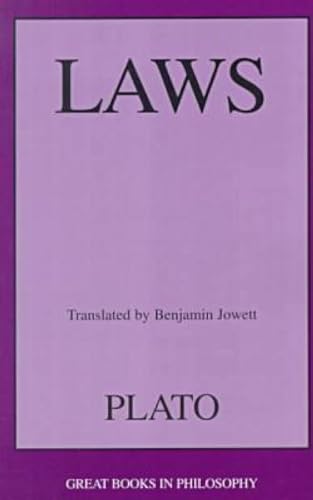
Synopsis
Plato's fascinating dialogue about legislation and governance in an ideal state supposedly takes place among three travellers passing the time during a long journey by foot through the countryside of Crete. The participants in the conversation are an Athenian visitor, the dominant speaker; a citizen of Knossos, who along with nine other citizens has been commissioned by the state of Crete to found and administer government in a new colony; and a Spartan. After preliminary discussions about the education of youth; the means of instilling citizens with the cardinal virtues of justice, temperance, wisdom, and courage; and the necessity of basing laws on these virtues, the focus of the conversation turns to an elaboration of the particular laws that should be enacted in the new Cretan colony. Much of the remainder of the work consists of monologues by the Athenian, who is clearly Plato's spokesman, in which the details of setting up the government and of laws governing every aspect of life are painstakingly laid out. Plato covers a great deal of philosophical ground in this dialogue ranging from mundane, everyday affairs (marriage laws, sexual habits, crime and punishment, trade, slavery, and many other topics) to deep questions about the existence of the gods, the nature of the soul, and the problem of evil. In the final analysis he envisions a political state described as a mean between monarchy and democracy ruled by a council of the most virtuous elders who are the guardians of the law. This classic work by one of the towering thinkers of Western civilization is indispensable for students of both political science and philosophy, and anyone interested in the perennial human quest to establish a just society.
"synopsis" may belong to another edition of this title.
About the Author
PLATO was born about 427 B.C.E. into the distinguished Athenian family of Ariston and Perictione. Although interested in politics as a young man, he became disenchanted with the cruel and immoral behavior of Athenian rulers. Some small ray of hope emerged when Athens deposed its dictators and established a democracy; however, when the citizens put the philosopher Socrates on trial and later executed him for impiety, Plato left Athens to travel abroad.
In 387 B.C.E., Plato finally returned to Athens and created the Academy, an intellectual center for philosophy and science that offered scholarly training in such fields as astronomy, biological sciences, mathematics, and political science. From this influen-tial institution emerged Aristotle, Plato's most famous student. Plato dedicated himself to the Academy until his death in about 347 B.C.E. During his lifetime Plato wrote a number of supremely important dialogues, which presented and critically analyzed significant philosophical ideas in metaphysics, epistemology, ethics, and social and political philosophy--all of which con-tinue to engage posterity. His better-known dialogues include: The Apology, Cratylus, Crito, Euthyphro, Gorgias, The Laws, Meno, Parmenides, Phaedo, Phaedrus, Protagoras, The Repub-lic, The Sophist, The Symposium, Theaetetus, and Timaeus."About this title" may belong to another edition of this title.
Search results for Laws: Plato (Contemporary Issues (Prometheus))

Stock Image
Laws: Plato (Great Books in Philosophy)
Seller: Indiana Book Company, Marion, IN, U.S.A.
Seller rating 5 out of 5 stars

Condition: Good. Ships same or next business day with delivery confirmation. Good condition. May or may not contain highlighting. Expedited shipping available. Seller Inventory # 1000007425417-954
Stock Image
Laws: Plato (Great Books in Philosophy)
Seller: Indiana Book Company, Marion, IN, U.S.A.
Seller rating 5 out of 5 stars
Condition: Acceptable. Book has minor liquid or water damage on pages. Ships same or next business day with delivery confirmation. Acceptable condition. Contains highlighting. Expedited shipping available. Seller Inventory # 1000007514286-1270
Stock Image
Laws: Plato
Seller: Magers and Quinn Booksellers, Minneapolis, MN, U.S.A.
Seller rating 5 out of 5 stars
paperback. Condition: Acceptable. May have underlining, highlighting, margin notes, remainder marks, inscriptions, book plates, tears, significant wear, and/or a missing dust jacket, box, or discs. Damaged item. Seller Inventory # 1561795
Seller Image
Laws : Plato
Seller: GreatBookPrices, Columbia, MD, U.S.A.
Seller rating 5 out of 5 stars
Condition: New. Seller Inventory # 538473-n
Seller Image
Laws: Plato (Paperback or Softback)
Published by
Prometheus Books 5/1/2000, 2000
ISBN 10: 1573927996
ISBN 13: 9781573927994
New
Paperback or Softback
Seller: BargainBookStores, Grand Rapids, MI, U.S.A.
Seller rating 5 out of 5 stars
Paperback or Softback. Condition: New. Laws: Plato. Book. Seller Inventory # BBS-9781573927994
Seller Image
Laws : Plato
Seller: GreatBookPrices, Columbia, MD, U.S.A.
Seller rating 5 out of 5 stars
Condition: As New. Unread book in perfect condition. Seller Inventory # 538473
Stock Image
Laws: Plato (Great Books in Philosophy)
Seller: California Books, Miami, FL, U.S.A.
Seller rating 5 out of 5 stars
Condition: New. Seller Inventory # I-9781573927994
Stock Image
Laws
Published by
Globe Pequot Publishing Group Inc, 2000
ISBN 10: 1573927996
ISBN 13: 9781573927994
New
PAP
Seller: PBShop.store US, Wood Dale, IL, U.S.A.
Seller rating 5 out of 5 stars
PAP. Condition: New. New Book. Shipped from UK. Established seller since 2000. Seller Inventory # CX-9781573927994
Seller Image
Laws
Seller: Rarewaves.com USA, London, LONDO, United Kingdom
Seller rating 5 out of 5 stars
Paperback. Condition: New. Plato's fascinating dialogue about legislation and governance in an ideal state supposedly takes place among three travellers passing the time during a long journey by foot through the countryside of Crete. The participants in the conversation are an Athenian visitor, the dominant speaker; a citizen of Knossos, who along with nine other citizens has been commissioned by the state of Crete to found and administer government in a new colony; and a Spartan.After preliminary discussions about the education of youth; the means of instilling citizens with the cardinal virtues of justice, temperance, wisdom, and courage; and the necessity of basing laws on these virtues, the focus of the conversation turns to an elaboration of the particular laws that should be enacted in the new Cretan colony. Much of the remainder of the work consists of monologues by the Athenian, who is clearly Plato's spokesman, in which the details of setting up the government and of laws governing every aspect of life are painstakingly laid out. Plato covers a great deal of philosophical ground in this dialogue ranging from mundane, everyday affairs (marriage laws, sexual habits, crime and punishment, trade, slavery, and many other topics) to deep questions about the existence of the gods, the nature of the soul, and the problem of evil.In the final analysis he envisions a political state described as a mean between monarchy and democracy ruled by a council of the most virtuous elders who are the guardians of the law. This classic work by one of the towering thinkers of Western civilization is indispensable for students of both political science and philosophy, and anyone interested in the perennial human quest to establish a just society. Seller Inventory # LU-9781573927994
Buy New
£ 16.02
Free Shipping
Ships from United Kingdom to U.S.A.
Ships from United Kingdom to U.S.A.
Quantity: Over 20 available
Stock Image
Laws
Published by
Globe Pequot Publishing Group Inc, 2000
ISBN 10: 1573927996
ISBN 13: 9781573927994
New
PAP
Seller: PBShop.store UK, Fairford, GLOS, United Kingdom
Seller rating 5 out of 5 stars
PAP. Condition: New. New Book. Shipped from UK. Established seller since 2000. Seller Inventory # CX-9781573927994
Buy New
£ 12.85
£ 4.16 shipping
Ships from United Kingdom to U.S.A.
Ships from United Kingdom to U.S.A.
Quantity: 15 available