
Items related to Evaluating Economic Research in a Contested Discipline:...
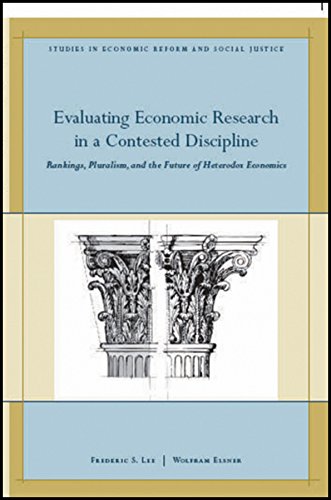
Evaluating Economic Research in a Contested Discipline: Ranking, Pluralism, and the Future of Heterodox Economics (Studies in Economic Reform and Social Justice (Paperback)) - Softcover
Synopsis
This book challenges the view that using SSCI journal citations (especially its impact factor score) and peer review/evaluation are the best ways (in that they are the most objective ways) to evaluate economic research.
- First extensive ranking of heterodox economics journals
- First ranking of mainstream and heterodox journals
- Ranking of mainstream and heterodox graduate programs in the US
- Impact of national research assessment exercises on heterodox economics in Italy and Australia
- Use of social network analysis to examine the diffusion of heterodox economicsCritique of the use of citation metrics and heterodox economics; Social Science Citation Index with respect to economics is deliberately biased in favour of mainstream journals
"synopsis" may belong to another edition of this title.
About the Author
Frederic S. Lee is a Professor of Economics at the University of Missouri-Kansas City. He has published extensively on heterodox microeconomics, on the history of heterodox economics. He was the editor of the Heterodox Economics Newsletter and the executive director of ICAPE. He is currently the editor of the American Journal of Economics and Sociology. He has published in numerous heterodox journals including the Journal of Post Keynesian Economics, Review of Radical Political Economics, Review of Social Economy, and the Journal of Economic Issues.
From the Back Cover
This book challenges the view that using SSCI journal citations (especially its impact factor score) and peer review/evaluation are the best ways (in that they are the most objective ways) to evaluate economic research. In a contested discipline such as economics those methods are used by mainstream economists to attack and dismiss heterodox economics. In the book, discriminatory use of these methods vis-a-vis heterodox economics is investigated (with case studies in Australia, Italy, and the United States) and discussed. In addition, it is also shown how such methods can be used to promote heterodox economics and heterodox research (without at the same time denigrating mainstream economics and its research). Finally, the book concludes with the unexpected position that a contested economics discipline is a good thing for it makes for better economists who are more capable of contributing in an open and intelligent manner to economic-social policy issues.
From the Inside Flap
This book challenges the view that using SSCI journal citations (especially its impact factor score) and peer review/evaluation are the best ways (in that they are the most objective ways) to evaluate economic research. In a contested discipline such as economics those methods are used by mainstream economists to attack and dismiss heterodox economics. In the book, discriminatory use of these methods vis-a-vis heterodox economics is investigated (with case studies in Australia, Italy, and the United States) and discussed. In addition, it is also shown how such methods can be used to promote heterodox economics and heterodox research (without at the same time denigrating mainstream economics and its research). Finally, the book concludes with the unexpected position that a contested economics discipline is a good thing for it makes for better economists who are more capable of contributing in an open and intelligent manner to economic-social policy issues.
"About this title" may belong to another edition of this title.
Search results for Evaluating Economic Research in a Contested Discipline:...

Seller Image
Evaluating Economic Research in a Contested Discipline : Ranking, Pluralism, and the Future of Heterodox Economics
Seller: GreatBookPrices, Columbia, MD, U.S.A.
Seller rating 5 out of 5 stars

Condition: As New. Unread book in perfect condition. Seller Inventory # 11627903
Stock Image
Evaluating Economic Research in a Contested Discipline: Ranking, Pluralism, and the Future of Heterodox Economics
Published by
John Wiley and Sons Ltd, 2011
ISBN 10: 144433946X
ISBN 13: 9781444339468
New
Softcover
First Edition
Seller: Kennys Bookshop and Art Galleries Ltd., Galway, GY, Ireland
Seller rating 5 out of 5 stars
Condition: New. This book challenges the view that using SSCI journal citations (especially its impact factor score) and peer review/evaluation are the best ways (in that they are the most objective ways) to evaluate economic research. Num Pages: 200 pages, illustrations. BIC Classification: KC. Category: (P) Professional & Vocational. Dimension: 229 x 157 x 11. Weight in Grams: 400. . 2011. 1st Edition. Paperback. . . . . Seller Inventory # V9781444339468
Seller Image
Evaluating Economic Research in a Contested Discipline : Ranking, Pluralism, and the Future of Heterodox Economics
Seller: GreatBookPrices, Columbia, MD, U.S.A.
Seller rating 5 out of 5 stars
Condition: New. Seller Inventory # 11627903-n
Stock Image
Evaluating Economic Research in a Contested Discipline: Ranking, Pluralism, and the Future of Heterodox Economics (Studies in Economic Reform and Social Justice (Paperback))
Seller: INDOO, Avenel, NJ, U.S.A.
Seller rating 5 out of 5 stars
Condition: New. Seller Inventory # 9781444339468
Seller Image
Evaluating Economic Research in a Contested Discipline : Ranking, Pluralism, and the Future of Heterodox Economics
Seller: GreatBookPricesUK, Woodford Green, United Kingdom
Seller rating 5 out of 5 stars
Condition: New. Seller Inventory # 11627903-n
Buy New
£ 46.25
£ 15 shipping
Ships from United Kingdom to U.S.A.
Ships from United Kingdom to U.S.A.
Quantity: 1 available
Seller Image
Evaluating Economic Research in a Contested Discipline : Ranking, Pluralism, and the Future of Heterodox Economics
Seller: GreatBookPricesUK, Woodford Green, United Kingdom
Seller rating 5 out of 5 stars
Condition: As New. Unread book in perfect condition. Seller Inventory # 11627903
Buy Used
£ 46.81
£ 15 shipping
Ships from United Kingdom to U.S.A.
Ships from United Kingdom to U.S.A.
Quantity: 1 available
Stock Image
Evaluating Economic Research in a Contested Discipline: Ranking, Pluralism, and the Future of Heterodox Economics
Seller: Kennys Bookstore, Olney, MD, U.S.A.
Seller rating 5 out of 5 stars
Condition: New. This book challenges the view that using SSCI journal citations (especially its impact factor score) and peer review/evaluation are the best ways (in that they are the most objective ways) to evaluate economic research. Num Pages: 200 pages, illustrations. BIC Classification: KC. Category: (P) Professional & Vocational. Dimension: 229 x 157 x 11. Weight in Grams: 400. . 2011. 1st Edition. Paperback. . . . . Books ship from the US and Ireland. Seller Inventory # V9781444339468
Stock Image
Evaluating Economic Research in a Contested Discipline
Seller: Books Puddle, Woodside, NY, U.S.A.
Seller rating 4 out of 5 stars

Condition: New. pp. 200. Seller Inventory # 263484673
Stock Image
Evaluating Economic Research in a Contested Discipline
Seller: Majestic Books, Hounslow, United Kingdom
Seller rating 4 out of 5 stars
Condition: New. pp. 200. Seller Inventory # 4363230
Buy New
£ 57.52
£ 6.50 shipping
Ships from United Kingdom to U.S.A.
Ships from United Kingdom to U.S.A.
Quantity: 1 available
Stock Image
Evaluating Economic Research in a Contested Discipline: Ranking, Pluralism, and the Future of Heterodox Economics (Studies in Economic Reform and Social Justice (Paperback))
Seller: Ubiquity Trade, Miami, FL, U.S.A.
Seller rating 5 out of 5 stars
Condition: New. Brand new! Please provide a physical shipping address. Seller Inventory # 9781444339468