
Synopsis
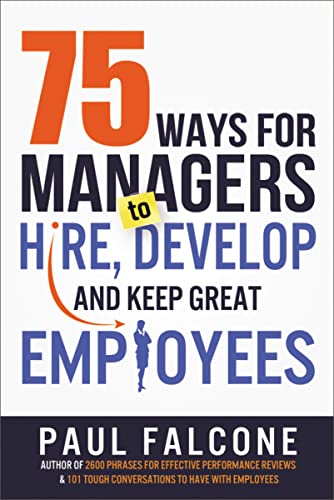
Products and services will change with demand, but one thing that will always be required for a company’s success is having the right people working hard for you.
As a manager, are you cultivating this vital resource? Is there more you could be doing? In this accessible and practical playbook, HR expert and author Paul Falcone helps take the guesswork out of this crucial element for success.
In 75 Ways for Managers to Hire, Develop, and Keep Great Employees, Falcone shows managers how to:
- Identify the best and brightest talent
- Hire for organizational compatibility
- Address uncomfortable workplace situations
- Create an environment that motivates
- Retain restless top performers
- Delegate in a way that develops your staff
Every HR executive has a laundry list of things they wish managers knew--best practices that would enable the entire organization to operate more effectively. Falcone’s book 75 Ways for Managers to Hire, Develop, and Keep Great Employees has encapsulated all of this for you in a single indispensable resource!
"synopsis" may belong to another edition of this title.
About the Author
Paul Falcone is principal of Paul Falcone Workplace Leadership Consulting, LLC, specializing in management and leadership training, executive coaching, international keynote speaking, and facilitating corporate offsite retreats. He is the former CHRO of Nickelodeon Animation Studios and has held senior-level HR positions with Paramount Pictures, Time Warner, and City of Hope. He has extensive experience in entertainment, healthcare/biotech, and financial services, including in international, nonprofit, and union environments.
Paul is the author of seventeen books, many of which have been ranked as #1 Amazon bestsellers in the categories of human resources management, business and organizational learning, labor and employment law, business mentoring and coaching, business conflict resolution and mediation, communication in management, and business decision-making and problem-solving. His books have been translated into Chinese, Hindi, Russian, Korean, Vietnamese, Indonesian, and Turkish and have sold in excess of 750,000 copies worldwide.
Paul is a certified executive coach through the Marshall Goldsmith Stakeholder Centered Coaching program, a long-term columnist for SHRM.org and HR Magazine, an adjunct faculty member in UCLA Extension’s School of Business and Management, and a member of the board of directors of the American Management Association. He is an accomplished keynote presenter, in-house trainer, and webinar facilitator in the areas of hiring, talent and performance management, leadership development, workplace ethics, and effective leadership communication.
From the Back Cover
Insider strategies from a top-ranked HR executive.
Ready to move your organization forward? You'll need skilled, motivated, and loyal people to get results. That means eliminating haphazard tactics and policies that quietly demoralize--and building a best-in-class field manual for developing great people. Paul Falcone, a nationally acclaimed human resources leader, delivers key strategies that managers and executives need to know. Filled with scripts and real-life scenarios, this book demonstrates how to implement a people-focused program that helps you: - Identify the best and the brightest talent - Gather crucial information during the interviewing and selection process - Hire for organizational compatibility - Communicate openly and honestly to build trust - Address uncomfortable situations and bad attitudes - Create a positive environment that engages employees - Retain restless top performers - Reengage your team after a layoff or during times of adversity - Conduct performance reviews skillfully - Take corrective action when needed, while avoiding "punishment" - Steer clear of litigation landmines - Give people opportunities to grow and be recognized - Practice the kind of enlightened leadership that rallies a team to greatness-- and much more. Paul Falcone has worked as an HR executive at Paramount Pictures, Nickelodeon, and Time Warner. Author of the best-selling 2600 Phrases for Effective Performance Reviews and others, four of his books made SHRM's prestigious "Great 8" annual bestsellers list. A top-rated presenter and speaker, he lives in San Diego.Excerpt. © Reprinted by permission. All rights reserved.
75 Ways for Managers to Hire, Develop, and Keep Great Employees
By Paul FalconeAMACOM
Copyright © 2016 Paul Falcone
All rights reserved.
ISBN: 978-0-8144-3669-1All rights reserved.
Contents
Acknowledgments, xv,
Permissions, xvii,
Introduction, 1,
CHAPTER 1: Effective Hiring and Selection, 6,
CHAPTER 2: Effective Leadership and Outstanding Communication, 59,
CHAPTER 3: The Importance of the Written Record, 108,
CHAPTER 4: Avoiding Litigation Land Mines, 165,
CHAPTER 5: Inspiring Employee Engagement, 205,
CHAPTER 6: Putting It All Together, 254,
Index, 305,
About the Author, 315,
Free Sample from 2600 Phrases for Effective Performance Review by Paul Falcone, 317,
Copyright, 338,
CHAPTER 1
Effective Hiring and Selection
ONE OF THE MOST IMPORTANT and significant responsibilities and opportunities that comes along with leadership lies in hiring the right people for the jobs in your company. Think about it: whether you're an executive vice president or a first-time supervisor, your individual performance is a direct reflection of your team's productivity. Hire the right people who are self-motivated, have a high level of self-awareness, and who hold themselves accountable for bottom-line results, and your career sails happily along while building and growing the careers of those following in your footsteps. Conversely, hire the wrong people, and you'll end up spending considerable time counseling and disciplining workers who struggle just to meet minimum expectations. Often, you will be forced to do the work yourself — at the expense of your family time, your social life, and your sleep.
Self-motivated new hires find new ways of handling the work flow, assume broader responsibilities beyond their basic job description, and do their best work every day — with little need for your intervention. And you recognize these workers when you see them; they typically stand out from their peers in terms of their willingness to assume additional responsibilities, take creative approaches to their work based on their natural, healthy sense of curiosity, and they appreciate the opportunity you've given them and they behave with gratitude. If you can find these kinds of hires for every job opening, you'll be well ahead of your peers and develop a reputation as a team builder and people developer.
Unfortunately, many leaders in corporate America have become jaded over the course of their careers. They reason that finding exceptional hires is more a matter of chance than planned strategy, and they're so busy doing their day-to-day work that they often don't pay enough attention to the open positions they're responsible for filling. Then again, that becomes a self-fulfilling prophecy of downward spiraling because if you don't take the time to fill the open positions on your team, then you and the rest of your group become overburdened making up for the talent shortage and often plunge into a tailspin that will soon lead to burnout.
So let's make a decision at the beginning of this book to change all that. I'll commit to you that there's a way to partner with your in-house or external recruiter in such a way that making outstanding hires can become the consistent norm — rather than the occasional exception — in terms of the fresh talent that you bring aboard. On the flip side, you'll need to commit to making effective interviewing and hiring your top priority from this point forward in your career. My part of the bargain as the author of this book is actually easier than you think; a few tweaks to your interview questioning techniques and reference checking activities will go a long way in helping you land motivated and engaged new hires who are looking to make their mark in your organization as top-notch performers. Your part of the bargain is a bit more complex; focusing on effective hiring remains challenging when you've got so many other responsibilities that demand your immediate attention.
Our goal, then, in this chapter, is to change your perspective on the hiring and selection process. To achieve this, you'll need to make a leap of faith with me on two critical fronts: First, with the chapter tools in hand that you're about to access, you must believe that you can catapult your candidate evaluation skills to new heights and become a magnet for top-notch talent. Second, no matter what exigencies lie before you at any given time, you have to commit to filling openings on your team as your top-most priority under all circumstances. To do anything less isn't fair to you or the other members of your team. In short, you're only as good as the people you hire. Let's venture together now and determine what new approaches and tools for recruitment and hiring are available to you as you address this critical leadership responsibility head on.
(1) Establishing Your Brand: Social Network Outreach, Recruitment Brochures, and Adding New Life to Your Recruitment Advertising Campaigns
Up to the early 1990s, the business world ran ads in newspapers to attract candidates. Recruitment ads were short and almost cryptic because newspapers charged by the word. In large-city newspapers, you could easily end up paying $800 to $1,000 for an ad that barely stretched the length of your thumb, so needless to say, there was very little fluff about the company or its culture and vision, and the entire message was dedicated to the job's critical requirements. Around the year 2000, Monster and other online job boards were established, providing much more room for the hiring organization to be creative and express its true spirit. Job applicants uploaded their résumés online, and both internal recruiters and headhunters had volumes of résumés to choose from at the click of a button.
Flash forward to today's job market, and LinkedIn and other social media sites have clearly overtaken the larger online job boards in capturing talent. Researchers will tell you that employers and recruiters today are looking to the "Big 5" social media locations to source top talent:
Websites Where Employers Are Searching for New Talent
Website or Type of Site Percent of Employers Using the Website
LinkedIn 94
Facebook 65
Twitter 55
Blogs 20
You Tube 15
Source: Jobvite Social Recruitment Survey, 2013.
In similar fashion, job candidates are defining their resumes by searchable key words, creating a comprehensive social media presence, and identifying which social media platforms are optimal for their target audience.
Where does this massive change in such a short time leave you? You guessed it: investing in and beefing up your online presence to compete and attract the best and brightest talent that your industry and local job market have to offer. It's nothing less than critical that your company — large or small, public or private, international or domestic, union or nonunion — invest heavily in creating and developing your online brand across multiple platforms such as the Big 5 listed above. Ask yourself:
What are you doing to create visibility and credibility to attract highly qualified applicants?
Would someone looking at the career page on your website, your company's LinkedIn or Facebook pages, or your You Tube presence be over- or under-whelmed by your message? Likewise, when was the last time you made a significant change to your online presence?
Are you engaging in best practices in terms of maintaining your online persona, and are you aware of the ROI (return on investment) of social media in terms of your recruitment brand?
If you are unsure of the answer to any of these questions, you're probably missing out on one of the most fascinating and creative times in recruitment history! Enlist the services of an external consultant for a short-term project to spruce up your online profile and tell your organization's story. Understand that applicants will access your company's website on Google first and foremost, but LinkedIn, Facebook, Glassdoor, and similar sites will also be accessed. The Internet has made so much possible in terms of company intelligence gathering that it would be very shortsighted of an organization to fail to establish a compelling presence on the Internet that describes its company's vision, values, and achievements. Be sure you make your Internet presence especially friendly to mobile devices, where so much initial access and research take place.
Next, create a recruitment/marketing brochure that can be downloaded from your website's career page or otherwise emailed to candidates once they're selected for interview. (Your applicant tracking system should be able to automatically email a brochure once an individual's resume is moved to the interviewing bin.) Your marketing and communications department or a recent new hire who just graduated from college and has solid writing or graphic arts skills can create a recruitment brochure. Sections of a typical recruitment brochure might include:
A brief company history (year founded, founder's mission and vision, annual revenue, number of employees, stock market ticker symbol, locations, corporate governance structure, customers served, market niche, and the like).
The hiring process, including the fact that your organization conducts background checks and drug screens as well as reference checks before someone can begin working. You can also use this as an opportunity to clarify in writing that you generally expect new hires to provide you with copies of recent performance evaluations to demonstrate their strengths and areas for self-development.
Starting salaries and performance reviews: Clarify that merit increases occur either on employee anniversary dates or on specific dates for the whole company (e.g., the second payroll period in January) and that first-year merit increases are typically prorated based on the number of months served up to that point. Likewise, address whether new-hire evaluations include salary increases or are used strictly to provide initial feedback after 60 or 90 days.
Benefits: Take this opportunity to sell the value of your company's benefits programs! Benefits and paid-time-off privileges are typically worth 30 to 40 percent of a full-time employee's base salary at many organizations, so be sure to highlight the value of your programs that will attract new talent. Defined-benefit pension plans are rare these days, but if your company offers one, be sure to explain how it works and how employees will benefit. Do the same for tuition reimbursement, wellness programs, generous paid-time-off (PTO) policies, and the like.
Miscellaneous information that employees normally might not learn about unless they ask: parking options and costs, mandatory versus voluntary union membership, employee services (e.g., gymnasium, on-site childcare, movie discounts, and ride-share public transportation subsidies). Casual dress days on Friday can serve as a positive inducement for strong candidates choosing among multiple offers.
Likewise, consider creating and posting a video in your company website's career page or on You Tube that introduces prospective candidates to your current employees. Companies are even creating online avatars so that prospective employees can walk through the online hiring experience and learn first hand what it's like to work for you. The various ways and means of developing your online presence and your website career page go beyond the scope of this book because Internet technology changes so quickly, but the point is simple: The recruitment process has become highly automated and digitized, and your investment in developing a best-in-class online experience will pay considerable dividends.
Similarly, consider drafting a freestanding document titled "What to Expect When You First Come to Work for Us" if you're hiring large volumes of entry-level employees who may not have prior industry experience. Such expectations flyers can serve as a one-sheet handout for applicants who want a clearer understanding of the job they're applying for, and, better yet, they can be used as a tool during the interviewing process to discuss the challenges of the position. A typical expectations flyer might include:
• The particular challenges of customer service in your organization
• Work schedule demands, including weekend work, shift structure, and last-minute overtime
• The physical demands of the job, especially if they include anything out of the ordinary (like standing for eight hours or spending excessive amounts of time in a warehouse freezer)
• An emphasis on internal audits and compliance
• Excessive travel demands, on-call requirements, and the like
The point is not to let these workplace requirements surprise the new hires in their first few weeks on the job. Such transparency will not only be appreciated but will likely cut down on employee turnover in the first ninety days.
Finally, when adding new life to your recruitment advertising campaigns, remember two basic rules: First, candidates are generally more attracted to the organization than to the job, so sell your company aggressively. Outline what makes your organization stand out from the competition, what you value, what achievements you're proudest of, and where your vision and priorities lie. Second, don't underestimate the value of career websites that invite worker feedback regarding working conditions, pay, benefits, and opportunities for growth. Glassdoor (www.Glassdoor.com), CareerLeak (www.CareerLeak.com), PayScale (www.Payscale.com), and other websites invite employee feedback. And while there's no way to validate salary information that's volunteered, for example, the overall tone of the feedback that workers share online is exceptionally important for your branding. Therefore, whenever someone is promoted internally or receives some form of an award or formal recognition, consider encouraging them to log onto a site like Glassdoor to share their experiences. Building that shadow presence may take some time but could pay off handsomely over the long run.
(2) Becoming an Employer of Choice: An Investment Worth Considering
"Employer of choice" has become a bit of a buzzword in many organizational lexicons. What exactly does that mean? It means that you value competitive pay, promotion from within, ongoing learning, corporate social responsibility, and work-life balance. But the formal "employer of choice" programs that I'm recommending here come from a source outside your company; magazines like Forbes, Fortune, and Inc. have made a big business of identifying companies that stand out among their competitors in some way, and it may be worth your investment to dedicate resources to becoming a member of these elite listings.
Why? Simply put, the high brand name recognition that your company garners in being identified on these honor roles can serve as a significant swing factor in helping to convince prospective new hires to join your organization rather than go elsewhere. In addition, think of the tremendous value you get from being identified as a leader within your industry. Unions typically won't bother attempting to organize a company that's ranked and recognized at the top of its pier group. It's too much of an uphill battle, and it's much easier for unions to pursue lower-hanging fruit where they know that workers may be disgruntled and frustrated.
Let's look at an example: If you're part of a large multinational company, then the Fortune Data Store (www.FortuneDatsStore.com) alone offers these prestigious lists that your organization can belong to:
Fortune 500
Fortune 1000
Fortune Global 500
100 Best Companies to Work For
But what if you're not that large? The good news is that the proliferation of these types of company recognition programs is staggering, and it might be easier than you think to pursue a ranking that helps you stand out among your competition. For example, review the following listings and see if any of them strike you as a designation you might want to pursue:
• America's Fastest-Growing Companies
Fortune: "Fastest-Growing Companies in the Fortune 1000 by Revenue"
http://money.cnn.com/gallery/news/companies/2013/05/ 06/500-fastest-growing-revenue.fortune/index.html
Fortune's Fastest-Growing Companies
http://money.cnn.com/magazines/fortune/fastest-growing/ 2012/full_list/index.html
Inc.: "Inc. 5000 — America's Fastest-Growing Companies"
http://www.inc.com/inc5000
Fortune's 100 Fastest-Growing Companies
http://money.cnn.com/magazines/fortune/fastest-growing/ index.html?iid=bc_sp_toprr
• Global and Internationally Based Organizations
Fortune: "Global 500"
http://money.cnn.com/magazines/fortune/global500/2012/ snapshots/6388.html?iid=bc_sp_toprr
Forbes: "The International 500"
http://www.forbes.com/2003/07/07/internationaland.html
Bloomberg Businessweek: "Top 100 Global Brands Scoreboard"
http://www.businessweek.com/interactive_reports/top_brands.html
Bloomberg Businessweek: "The Global 1000"
http://www.businessweek.com/stories/2004-07-25/the-global -1000
(Continues...)
Excerpted from 75 Ways for Managers to Hire, Develop, and Keep Great Employees by Paul Falcone. Copyright © 2016 Paul Falcone. Excerpted by permission of AMACOM.
All rights reserved. No part of this excerpt may be reproduced or reprinted without permission in writing from the publisher.
Excerpts are provided by Dial-A-Book Inc. solely for the personal use of visitors to this web site.
"About this title" may belong to another edition of this title.
Search results for 75 Ways for Managers to Hire, Develop, and Keep Great...

Stock Image
75 Ways for Managers to Hire, Develop, and Keep Great Employees
Seller: Gulf Coast Books, Cypress, TX, U.S.A.
Seller rating 5 out of 5 stars

paperback. Condition: Good. Seller Inventory # 0814436692-3-36395576
Stock Image
75 Ways for Managers to Hire, Develop, and Keep Great Employees
Seller: World of Books (was SecondSale), Montgomery, IL, U.S.A.
Seller rating 5 out of 5 stars
Condition: Very Good. Item in very good condition! Textbooks may not include supplemental items i.e. CDs, access codes etc. Seller Inventory # 00098125866
Seller Image
75 Ways for Managers to Hire, Develop, and Keep Great Employees
Seller: Zoom Books East, Glendale Heights, IL, U.S.A.
Seller rating 5 out of 5 stars
Condition: good. Book is in good condition and may include underlining highlighting and minimal wear. The book can also include "From the library of" labels. May not contain miscellaneous items toys, dvds, etc. . We offer 100% money back guarantee and 24 7 customer service. Seller Inventory # ZEV.0814436692.G
Seller Image
75 Ways for Managers to Hire, Develop, and Keep Great Employees
Seller: Zoom Books Company, Lynden, WA, U.S.A.
Seller rating 5 out of 5 stars
Condition: very_good. Book is in very good condition and may include minimal underlining highlighting. The book can also include "From the library of" labels. May not contain miscellaneous items toys, dvds, etc. . We offer 100% money back guarantee and 24 7 customer service. Seller Inventory # ZBV.0814436692.VG
Seller Image
75 Ways for Managers to Hire, Develop, and Keep Great Employees
Seller: Goodwill, Brooklyn Park, MN, U.S.A.
Seller rating 4 out of 5 stars

Condition: acceptable. This is a retired library book with typical wear markings. May or may not have library stickers attached which will not be removed. Cover Case has some rubbing and edgewear. Access codes, CD's, slipcovers and other accessories may not be included. Seller Inventory # 2Y6JCK0084X0_ns
Stock Image
75 Ways for Managers to Hire, Develop, and Keep Great Employees
Seller: Better World Books, Mishawaka, IN, U.S.A.
Seller rating 5 out of 5 stars
Condition: Very Good. Former library copy. Pages intact with possible writing/highlighting. Binding strong with minor wear. Dust jackets/supplements may not be included. Includes library markings. Stock photo provided. Product includes identifying sticker. Better World Books: Buy Books. Do Good. Seller Inventory # 18385249-6
Stock Image
75 Ways for Managers to Hire, Develop, and Keep Great Employees
Seller: Better World Books, Mishawaka, IN, U.S.A.
Seller rating 5 out of 5 stars
Condition: Good. Former library copy. Pages intact with minimal writing/highlighting. The binding may be loose and creased. Dust jackets/supplements are not included. Includes library markings. Stock photo provided. Product includes identifying sticker. Better World Books: Buy Books. Do Good. Seller Inventory # 39143952-6
Stock Image
75 Ways for Managers to Hire, Develop, and Keep Great Employees
Seller: Better World Books: West, Reno, NV, U.S.A.
Seller rating 5 out of 5 stars
Condition: Very Good. Former library copy. Pages intact with possible writing/highlighting. Binding strong with minor wear. Dust jackets/supplements may not be included. Includes library markings. Stock photo provided. Product includes identifying sticker. Better World Books: Buy Books. Do Good. Seller Inventory # 18385249-6
Stock Image
75 Ways for Managers to Hire, Develop, and Keep Great Employees
Seller: HPB Inc., Dallas, TX, U.S.A.
Seller rating 5 out of 5 stars
paperback. Condition: Very Good. Connecting readers with great books since 1972! Used books may not include companion materials, and may have some shelf wear or limited writing. We ship orders daily and Customer Service is our top priority! Seller Inventory # S_460353945
Stock Image
75 Ways for Managers to Hire, Develop, and Keep Great Employees
Seller: ThriftBooks-Reno, Reno, NV, U.S.A.
Seller rating 5 out of 5 stars
Paperback. Condition: Very Good. No Jacket. May have limited writing in cover pages. Pages are unmarked. ~ ThriftBooks: Read More, Spend Less. Seller Inventory # G0814436692I4N00