
Items related to The Facility Management Handbook
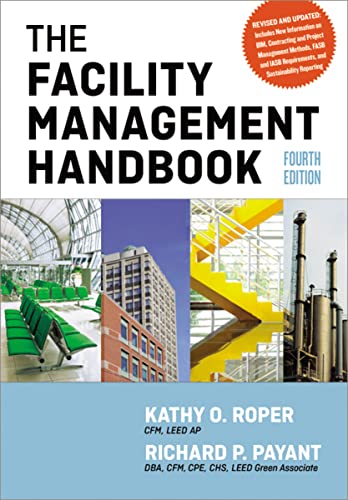
Synopsis
Facility management is a multidisciplinary function requiring a deep knowledge of the entire business and physical planning cycle, including the buildings, infrastructure, and people. Technology systems, disaster recovery planning, zoning compliance, furnishings, recycling programs, grounds maintenance--it all falls under the facility management umbrella. The sheer scope of duties requires a far-reaching reference for staying abreast of the latest innovations and best practices.
The Facility Management Handbook is that one essential book. Insightful overviews, case studies, and practical guidelines pave the way for successful planning, budgeting, real estate transactions, construction, emergency preparedness, security, operations, maintenance, and more. This thoroughly revised fourth edition examines cutting-edge technologies and includes new information on Building Information Modeling (BIM), contracting and project management methods, FASB and IASB requirements, distributed working, and sustainability reporting.
Balancing an in-depth look at the fundamentals with a view toward what the future holds, the book is essential reading for every facility management professional.
"synopsis" may belong to another edition of this title.
About the Author
KATHY O. ROPER, CFM, LEED AP, is Associate Professor of Integrated Facility Management at Georgia Institute of Technology. RICHARD P. PAYANT, DBA, CFM, CPE, CHS, LEED GREEN ASSOCIATE, is Director of Facilities Management, Georgetown University.
From the Back Cover
Technical mastery of operations and maintenance is just the beginning. Today, you've got to be a skilled communicator, a budgeting wiz, an effective manager, and a sustainability expert. You need to be as conversant in how to upgrade the electrical systems as how to prepare a 10-year recapitalization plan.
It is a complex, multifaceted, and sometimes overwhelming role. That's why thousands of managers have relied on The Facility Management Handbook to help them master their evolving and expanding responsibilities. This award-winning resource captures the key developments in the field, and imparts the skills and knowledge needed to thrive as both technical professional and business leader.
Covering new technologies, trends, challenges, and strategies, the book uncovers the "big twelve" actions needed to manage facilities and departments successfully, followed by practical guidelines for providing essential services, including:
* Organizing the Department: Develop the optimal mix of staff, consultants, and contractors for your department and facility.
* Planning, Programming, and Budgeting: Plan proactively, weighing strategic goals and anticipated costs and expenditures.
* Sustainability: Spearhead a sustainability program that supports organizational priorities, achieves savings, and enhances prestige.
* The Design-Build Cycle: Manage a project through its entire life cycle, whether you're developing a new site or altering an existing space.
* Facility Emergency Preparedness and Business Continuity: Reduce vulnerability to hazards and disasters, and ensure that core business functions remain viable.
* Operations and Maintenance: Improve the effectiveness and cost efficiency of the day-to-day maintenance of your facility.
* Facility Management Practice: Embrace best practices in outsourcing, benchmarking, procurement, communications, leadership, and more.
Throughout, you'll find updated information on using building commissioning, employing energy management and conservation practices, managing diverse workforces, maximizing technology, dealing with aging buildings and infrastructure, ensuring financial accountability, meeting sustainability requirements, and inspiring people to action.
The Facility Management Handbook balances in-depth guidelines on the fundamentals with a sweeping overview of new developments. It's the go-to reference for busy facility management professionals in search of authoritative, real-life answers.
Kathy O. Roper, CFM, LEED AP, IFMA Fellow, is associate professor in the Georgia Tech School of Building Construction and serves as director of the Master of Science program's Integrated Facility Management track. She is cofounder and coeditor of the International Journal of Facility Management, as well as coauthor of the third edition of The Facility Management Handbook. An International Facility Management Association Certified Facility Manager, she was awarded an IFMA Fellow, the association's highest recognition of service and lifetime achievement.
Richard P. Payant, DBA, CFM, CPE, CHS, LEED GREEN ASSOCIATE served as director of Facilities Management at Georgetown University for 22 years. He is the coauthor of the previous edition of The Facility Management Handbook, as well as coauthor of The Facility Manager's Emergency Preparedness Handbook.
From the Inside Flap
Technical mastery of operations and maintenance is just the beginning. Today, you've got to be a skilled communicator, a budgeting wiz, an effective manager, and a sustainability expert. You need to be as conversant in how to upgrade the electrical systems as how to prepare a 10-year recapitalization plan.
It is a complex, multifaceted, and sometimes overwhelming role. That's why thousands of managers have relied on The Facility Management Handbook to help them master their evolving and expanding responsibilities. This award-winning resource captures the key developments in the field, and imparts the skills and knowledge needed to thrive as both technical professional and business leader.
Covering new technologies, trends, challenges, and strategies, the book uncovers the "big twelve" actions needed to manage facilities and departments successfully, followed by practical guidelines for providing essential services, including:
* Organizing the Department: Develop the optimal mix of staff, consultants, and contractors for your department and facility.
* Planning, Programming, and Budgeting: Plan proactively, weighing strategic goals and anticipated costs and expenditures.
* Sustainability: Spearhead a sustainability program that supports organizational priorities, achieves savings, and enhances prestige.
* The Design-Build Cycle: Manage a project through its entire life cycle, whether you're developing a new site or altering an existing space.
* Facility Emergency Preparedness and Business Continuity: Reduce vulnerability to hazards and disasters, and ensure that core business functions remain viable.
* Operations and Maintenance: Improve the effectiveness and cost efficiency of the day-to-day maintenance of your facility.
* Facility Management Practice: Embrace best practices in outsourcing, benchmarking, procurement, communications, leadership, and more.
Throughout, you'll find updated information on using building commissioning, employing energy management and conservation practices, managing diverse workforces, maximizing technology, dealing with aging buildings and infrastructure, ensuring financial accountability, meeting sustainability requirements, and inspiring people to action.
The Facility Management Handbook balances in-depth guidelines on the fundamentals with a sweeping overview of new developments. It's the go-to reference for busy facility management professionals in search of authoritative, real-life answers.
Kathy O. Roper, CFM, LEED AP, IFMA Fellow, is associate professor in the Georgia Tech School of Building Construction and serves as director of the Master of Science program's Integrated Facility Management track. She is cofounder and coeditor of the International Journal of Facility Management, as well as coauthor of the third edition of The Facility Management Handbook. An International Facility Management Association Certified Facility Manager, she was awarded an IFMA Fellow, the association's highest recognition of service and lifetime achievement.
Richard P. Payant, DBA, CFM, CPE, CHS, LEED GREEN ASSOCIATE served as director of Facilities Management at Georgetown University for 22 years. He is the coauthor of the previous edition of The Facility Management Handbook, as well as coauthor of The Facility Manager's Emergency Preparedness Handbook.
Excerpt. © Reprinted by permission. All rights reserved.
Preface to the Fourth Edition
This fourth edition of The Facility Management Handbook has evolved into the best compendium of facility management information and practices for facility managers. The purpose of the book is to centralize information for all facility managers, both in the private and public sectors, and serve as a quick reference for issues every facility manager faces.
The original purpose of each handbook edition remains the same, but with each revision, the book expands to cover new technologies, trends, challenges, and management strategies within facility management.
Facility managers make things happen. They do it by planning, organizing, budgeting, and controlling. To be successful in this profession facility managers have to be good leaders and managers. Up-to-date information in facility management is a necessity, not a luxury. Management requires skills that have to be studied and cultivated. The cultivation may require a change in thinking, and this is where facility managers have to be open-minded and armed with current best practices, procedures, technology, and information.
One exciting new change is the expanding recognition of the value that well-managed facilities bring to the occupants and users of these spaces. Throughout the book, updates have been provided to reflect this new thinking and the facility manager's new roles in supporting organizations' new ways of working. Technological advances continue more and more rapidly, causing shifts from manual to electronic to automated work in many areas. This impacts not only the technology, but also the facility service provision skills, as well as changes in how users interact with their facilities. Many new developments in this area are found throughout this fourth edition.
As changes and adaptations are made in the areas of building materials, construction technology, energy management, and conservation, there is a need for change as it applies to the awareness of security, emergency preparedness, and overall management practices. The more diverse labor force today, the increased use and expansion of technology, and the aging of buildings and infrastructure require well-trained and skilled facility professionals. Managers guide, evaluate, measure, demand accountability, and have to be business-oriented. At the opposite extreme, leaders influence and inspire people to action. There is a time to manage and a time to lead. This book offers suggestions for facility managers on how to accomplish each.
This fourth edition brings together and capitalizes on over one hundred years of experience of several facility management professionals. This edition updates and expands information throughout the book by utilizing experience, knowledge, proven techniques, and best practices to guide you through daily facility management challenges and emergency situations. This new information focuses on building commissioning, building information modeling (BIM), contracting and project management and methods, Financial Accounting Standards Board (FASB) and International Accounting Standards Board (IASB) requirements, new knowledge-age ways of working and office design, and sustainability requirements. At the end of each chapter there are review questions. These questions are intended for instructional purposes, to promote discussion, and reinforce facility management concepts. At several places in the book we comment that facility management is big business and should be integrated into graduate school business courses. This is especially true today with the emphasis on business processes and the expectation that facility managers must contribute to the organization's bottom line by reducing costs, improving productivity, and in some cases generate revenue. Finally, we retained the "pulse points" at the beginning of each chapter because they continue to serve as a quick overview of the chapter. As in previous editions, we use FM as the abbreviation for facility management. The word organization is used to represent company, corporation, or agency.
We want to recognize two individuals who were the impetus behind beginning and then continuing to expand The Facility Management Handbook. Michael Lee and Dave Cotts coauthored the first edition of the book. These two individuals understood the need and sought to collect and assemble information into one source. Over the next twenty years Dave Cotts continued to refine the information in the second edition and invited us to participate in the third edition. We consider Dave the dean of facility management. We also want to recognize Bob Nirkind, our AMACOM senior acquisitions editor. Bob convinced us to write this fourth edition to provide the updates needed to keep facility managers abreast of current issues.
It is our hope that this book will enhance your professional skills and stimulate your thinking about facility management. We hope it provides you with ideas on how to "sell" your program to organization leaders and that it helps to advance your career in this ever-evolving field.
"About this title" may belong to another edition of this title.
Search results for The Facility Management Handbook

Stock Image
The Facility Management Handbook
Seller: HPB-Red, Dallas, TX, U.S.A.
Seller rating 5 out of 5 stars

Hardcover. Condition: Acceptable. Connecting readers with great books since 1972. Used textbooks may not include companion materials such as access codes, etc. May have condition issues including wear and notes/highlighting. We ship orders daily and Customer Service is our top priority! Seller Inventory # S_436747142
Stock Image
The Facility Management Handbook
Published by
AMACOM (edition Fourth), 2014
ISBN 10: 0814432158
ISBN 13: 9780814432150
Used
Hardcover
Seller: BooksRun, Philadelphia, PA, U.S.A.
Seller rating 5 out of 5 stars
Hardcover. Condition: Very Good. Fourth. It's a well-cared-for item that has seen limited use. The item may show minor signs of wear. All the text is legible, with all pages included. It may have slight markings and/or highlighting. Seller Inventory # 0814432158-8-1
Seller Image
The Facility Management Handbook
Seller: Greenworld Books, Arlington, TX, U.S.A.
Seller rating 5 out of 5 stars
Condition: very_good. Fast Free Shipping â" Very Good condition book with a firm cover and clean pages. Shows normal use and some light wear or limited notes markings. A solid, nice copy to enjoy. Seller Inventory # GWV.0814432158.VG
Stock Image
The Facility Management Handbook
Seller: Evergreen Goodwill, Seattle, WA, U.S.A.
Seller rating 5 out of 5 stars
hardcover. Condition: Acceptable. Pages include notes, underlining, or highlighting. Seller Inventory # mon0000774058
Stock Image
The Facility Management Handbook
Seller: Anybook.com, Lincoln, United Kingdom
Seller rating 5 out of 5 stars
Condition: Good. This is an ex-library book and may have the usual library/used-book markings inside.This book has hardback covers. In good all round condition. No dust jacket. Please note the Image in this listing is a stock photo and may not match the covers of the actual item,1400grams, ISBN:9780814432150. Seller Inventory # 9642515
Buy Used
£ 57.47
£ 13.60 shipping
Ships from United Kingdom to U.S.A.
Ships from United Kingdom to U.S.A.
Quantity: 1 available
Stock Image
The Facility Management Handbook
Seller: YESIBOOKSTORE, MIAMI, FL, U.S.A.
Seller rating 3 out of 5 stars

hardcover. Condition: As New. Seller Inventory # 0814432158-VB
Stock Image
The Facility Management Handbook
Seller: GoldBooks, Denver, CO, U.S.A.
Seller rating 5 out of 5 stars
Hardcover. Condition: new. New Copy. Customer Service Guaranteed. Seller Inventory # 67A35_48_0814432158
Stock Image
The Facility Management Handbook
Seller: Mispah books, Redhill, SURRE, United Kingdom
Seller rating 4 out of 5 stars

Hardcover. Condition: Good. Good .Ships From Multiple Locations. book. Seller Inventory # ERICA80308144321586
Buy Used
£ 135
£ 25 shipping
Ships from United Kingdom to U.S.A.
Ships from United Kingdom to U.S.A.
Quantity: 1 available