
Items related to Logical Tools for Modelling Legal Argument: A Study...
Logical Tools for Modelling Legal Argument: A Study of Defeasible Reasoning in Law: 32 (Law and Philosophy Library, 32) - Hardcover
Synopsis
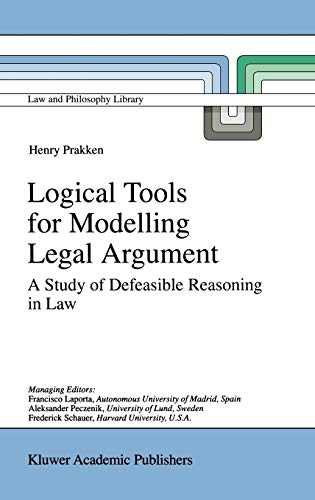
This book is a revised and extended version of my PhD Thesis 'Logical Tools for Modelling Legal Argument', which I defended on 14 January 1993 at the Free University Amsterdam. The first five chapters of the thesis have remained almost completely unchanged but the other chapters have undergone considerable revision and expansion. Most importantly, I have replaced the formal argument-based system of the old Chapters 6, 7 and 8 with a revised and extended system, whieh I have developed during the last three years in collaboration with Giovanni Sartor. Apart from some technical improvements, the main additions to the old system are the enriehment of its language with a nonprovability operator, and the ability to formalise reasoning about preference criteria. Moreover, the new system has a very intuitive dialectieal form, as opposed to the rather unintuitive fixed-point appearance of the old system. Another important revision is the split of the old Chapter 9 into two new chapters. The oldSection 9. 1 on related research has been updated and expanded into a whole chapter, while the rest of the old chapter is now in revised form in Chapter 10. This chapter also contains two new contributions, a detailed discussion of Gordon's Pleadings Game, and a general description of a multi-Iayered overall view on the structure of argu mentation, comprising a logieal, dialectical, procedural and strategie layer. Finally, in the revised conclusion I have paid more attention to the relevance of my investigations for legal philosophy and argumentation theory.
"synopsis" may belong to another edition of this title.
Review
`The main contribution of Prakken's work is its organization and expression of non-technical ideas. Prakken successfully makes the best possible case for logic as a tool for modeling legal reasoning. He has written the best, most technically detailed, and fairest survey of the formal work on argument and defeasible reasoning.'
Ronald P. Loui, Artificial Intelligence and Law, 3 (1995)
`... Prakken has written the best current text with which the interested logician can quickly study the main surviving applicable ideas of non-monotonic reasoning and can glimpse the themes that are shaping current research in defeasible reasoning.'
The Journal of Symbolic Logic, 64:4 (1999)
Synopsis
This book, the expanded and completely revised text of the author's 1993 dissertation, studies the logical aspects of legal reasoning, in order to provide philosophical foundations for legal applications of artificial intelligence. It respects that legal reasoning often takes place in a disputational setting, and observes that the law leaves ample room for disagreement, which means that lawyers reason under the possibility of exceptions and with contradictory legal sources, and cannot do without non-deductive reasoning forms, such as analogical reasoning. The study shows that, contrary to what is often said, these features do not escape a logical analysis if recent developments in logic and artificial intelligence on non-monotonic reasoning and defeasible argumentation are used, and if logic is regarded as a tool in, rather than as a model of, legal argument. This book should be relevant for scholars in legal philosophy, artificial intelligence, logic and argumentation theory, and can also serve as a textbook for graduate courses in Artifical Intelligence and Law, non-monotonic reasoning and legal argumentation.
"About this title" may belong to another edition of this title.
Search results for Logical Tools for Modelling Legal Argument: A Study...

Stock Image
Logical Tools for Modelling Legal Argument: A Study of Defeasible Reasoning in Law (Law and Philosophy Library, 32)
Seller: Ria Christie Collections, Uxbridge, United Kingdom
Seller rating 5 out of 5 stars

Condition: New. In. Seller Inventory # ria9780792347767_new
Buy New
£ 189.04
£ 11.98 shipping
Ships from United Kingdom to U.S.A.
Ships from United Kingdom to U.S.A.
Quantity: Over 20 available
Seller Image
Logical Tools for Modelling Legal Argument
Print on DemandSeller: moluna, Greven, Germany
Seller rating 5 out of 5 stars
Gebunden. Condition: New. Dieser Artikel ist ein Print on Demand Artikel und wird nach Ihrer Bestellung fuer Sie gedruckt. This book is a revised and extended version of my PhD Thesis Logical Tools for Modelling Legal Argument , which I defended on 14 January 1993 at the Free University Amsterdam. The first five chapters of the thesis have remained almost completely unchanged . Seller Inventory # 5968248
Buy New
£ 159.24
£ 42.06 shipping
Ships from Germany to U.S.A.
Ships from Germany to U.S.A.
Quantity: Over 20 available
Seller Image
Logical Tools for Modelling Legal Argument
Published by
Springer Netherlands Okt 1997, 1997
ISBN 10: 0792347765
ISBN 13: 9780792347767
New
Hardcover
Seller: BuchWeltWeit Ludwig Meier e.K., Bergisch Gladbach, Germany
Seller rating 5 out of 5 stars
Buch. Condition: Neu. This item is printed on demand - it takes 3-4 days longer - Neuware -This book is a revised and extended version of my PhD Thesis 'Logical Tools for Modelling Legal Argument', which I defended on 14 January 1993 at the Free University Amsterdam. The first five chapters of the thesis have remained almost completely unchanged but the other chapters have undergone considerable revision and expansion. Most importantly, I have replaced the formal argument-based system of the old Chapters 6, 7 and 8 with a revised and extended system, whieh I have developed during the last three years in collaboration with Giovanni Sartor. Apart from some technical improvements, the main additions to the old system are the enriehment of its language with a nonprovability operator, and the ability to formalise reasoning about preference criteria. Moreover, the new system has a very intuitive dialectieal form, as opposed to the rather unintuitive fixed-point appearance of the old system. Another important revision is the split of the old Chapter 9 into two new chapters. The old Section 9. 1 on related research has been updated and expanded into a whole chapter, while the rest of the old chapter is now in revised form in Chapter 10. This chapter also contains two new contributions, a detailed discussion of Gordon's Pleadings Game, and a general description of a multi-Iayered overall view on the structure of argu mentation, comprising a logieal, dialectical, procedural and strategie layer. Finally, in the revised conclusion I have paid more attention to the relevance of my investigations for legal philosophy and argumentation theory. 332 pp. Englisch. Seller Inventory # 9780792347767
Seller Image
Logical Tools for Modelling Legal Argument | A Study of Defeasible Reasoning in Law
Print on DemandSeller: preigu, Osnabrück, Germany
Seller rating 5 out of 5 stars
Buch. Condition: Neu. Logical Tools for Modelling Legal Argument | A Study of Defeasible Reasoning in Law | H. Prakken | Buch | Law and Philosophy Library | xiii | Englisch | 1997 | Springer | EAN 9780792347767 | Verantwortliche Person für die EU: Springer Verlag GmbH, Tiergartenstr. 17, 69121 Heidelberg, juergen[dot]hartmann[at]springer[dot]com | Anbieter: preigu Print on Demand. Seller Inventory # 102156585
Seller Image
Logical Tools for Modelling Legal Argument : A Study of Defeasible Reasoning in Law
Seller: AHA-BUCH GmbH, Einbeck, Germany
Seller rating 5 out of 5 stars
Buch. Condition: Neu. Druck auf Anfrage Neuware - Printed after ordering - This book is a revised and extended version of my PhD Thesis 'Logical Tools for Modelling Legal Argument', which I defended on 14 January 1993 at the Free University Amsterdam. The first five chapters of the thesis have remained almost completely unchanged but the other chapters have undergone considerable revision and expansion. Most importantly, I have replaced the formal argument-based system of the old Chapters 6, 7 and 8 with a revised and extended system, whieh I have developed during the last three years in collaboration with Giovanni Sartor. Apart from some technical improvements, the main additions to the old system are the enriehment of its language with a nonprovability operator, and the ability to formalise reasoning about preference criteria. Moreover, the new system has a very intuitive dialectieal form, as opposed to the rather unintuitive fixed-point appearance of the old system. Another important revision is the split of the old Chapter 9 into two new chapters. The oldSection 9. 1 on related research has been updated and expanded into a whole chapter, while the rest of the old chapter is now in revised form in Chapter 10. This chapter also contains two new contributions, a detailed discussion of Gordon's Pleadings Game, and a general description of a multi-Iayered overall view on the structure of argu mentation, comprising a logieal, dialectical, procedural and strategie layer. Finally, in the revised conclusion I have paid more attention to the relevance of my investigations for legal philosophy and argumentation theory. Seller Inventory # 9780792347767
Stock Image
Logical Tools for Modelling Legal Argument
Published by
Kluwer Academic Publishers, 1997
ISBN 10: 0792347765
ISBN 13: 9780792347767
New
Hardcover
Seller: Kennys Bookshop and Art Galleries Ltd., Galway, GY, Ireland
Seller rating 5 out of 5 stars
Condition: New. This book, the expanded and completely revised text of the author's 1993 dissertation, studies the logical aspects of legal reasoning, in order to provide philosophical foundations for legal applications of artificial intelligence. Series: Law and Philosophy Library. Num Pages: 314 pages, biography. BIC Classification: LAB. Category: (P) Professional & Vocational; (UP) Postgraduate, Research & Scholarly; (UU) Undergraduate. Dimension: 166 x 241 x 25. Weight in Grams: 658. . 1997. Rev ed. Hardback. . . . . Seller Inventory # V9780792347767
Seller Image
Logical Tools for Modelling Legal Argument
Published by
Kluwer Academic Publishers, US, 1997
ISBN 10: 0792347765
ISBN 13: 9780792347767
New
Hardcover
Seller: Rarewaves.com USA, London, LONDO, United Kingdom
Seller rating 5 out of 5 stars
Hardback. Condition: New. This book is a revised and extended version of my PhD Thesis 'Logical Tools for Modelling Legal Argument', which I defended on 14 January 1993 at the Free University Amsterdam. The first five chapters of the thesis have remained almost completely unchanged but the other chapters have undergone considerable revision and expansion. Most importantly, I have replaced the formal argument-based system of the old Chapters 6, 7 and 8 with a revised and extended system, whieh I have developed during the last three years in collaboration with Giovanni Sartor. Apart from some technical improvements, the main additions to the old system are the enriehment of its language with a nonprovability operator, and the ability to formalise reasoning about preference criteria. Moreover, the new system has a very intuitive dialectieal form, as opposed to the rather unintuitive fixed-point appearance of the old system. Another important revision is the split of the old Chapter 9 into two new chapters. The oldSection 9. 1 on related research has been updated and expanded into a whole chapter, while the rest of the old chapter is now in revised form in Chapter 10. This chapter also contains two new contributions, a detailed discussion of Gordon's Pleadings Game, and a general description of a multi-Iayered overall view on the structure of argu mentation, comprising a logieal, dialectical, procedural and strategie layer. Finally, in the revised conclusion I have paid more attention to the relevance of my investigations for legal philosophy and argumentation theory. Seller Inventory # LU-9780792347767
Buy New
£ 236.34
Free Shipping
Ships from United Kingdom to U.S.A.
Ships from United Kingdom to U.S.A.
Quantity: Over 20 available
Stock Image
Logical Tools for Modelling Legal Argument
Seller: Books Puddle, New York, NY, U.S.A.
Seller rating 4 out of 5 stars

Condition: New. pp. 332. Seller Inventory # 26463352
Seller Image
Logical Tools for Modelling Legal Argument
Published by
Springer, Springer Okt 1997, 1997
ISBN 10: 0792347765
ISBN 13: 9780792347767
New
Hardcover
Seller: buchversandmimpf2000, Emtmannsberg, BAYE, Germany
Seller rating 5 out of 5 stars
Buch. Condition: Neu. This item is printed on demand - Print on Demand Titel. Neuware -This book is a revised and extended version of my PhD Thesis 'Logical Tools for Modelling Legal Argument', which I defended on 14 January 1993 at the Free University Amsterdam. The first five chapters of the thesis have remained almost completely unchanged but the other chapters have undergone considerable revision and expansion. Most importantly, I have replaced the formal argument-based system of the old Chapters 6, 7 and 8 with a revised and extended system, whieh I have developed during the last three years in collaboration with Giovanni Sartor. Apart from some technical improvements, the main additions to the old system are the enriehment of its language with a nonprovability operator, and the ability to formalise reasoning about preference criteria. Moreover, the new system has a very intuitive dialectieal form, as opposed to the rather unintuitive fixed-point appearance of the old system. Another important revision is the split of the old Chapter 9 into two new chapters. The oldSection 9. 1 on related research has been updated and expanded into a whole chapter, while the rest of the old chapter is now in revised form in Chapter 10. This chapter also contains two new contributions, a detailed discussion of Gordon's Pleadings Game, and a general description of a multi-Iayered overall view on the structure of argu mentation, comprising a logieal, dialectical, procedural and strategie layer. Finally, in the revised conclusion I have paid more attention to the relevance of my investigations for legal philosophy and argumentation theory.Springer-Verlag KG, Sachsenplatz 4-6, 1201 Wien 332 pp. Englisch. Seller Inventory # 9780792347767
Stock Image
Logical Tools for Modelling Legal Argument
Print on DemandSeller: Majestic Books, Hounslow, United Kingdom
Seller rating 4 out of 5 stars
Condition: New. Print on Demand pp. 332 52:B&W 6.14 x 9.21in or 234 x 156mm (Royal 8vo) Case Laminate on White w/Gloss Lam. Seller Inventory # 7384615
Buy New
£ 245.83
£ 6.50 shipping
Ships from United Kingdom to U.S.A.
Ships from United Kingdom to U.S.A.
Quantity: 4 available