
Items related to Management of Biological Nitrogen Fixation for the...
Management of Biological Nitrogen Fixation for the Development of More Productive and Sustainable Agricultural Systems: Extended versions of papers ... (Developments in Plant and Soil Sciences, 65) - Hardcover
Synopsis
Table 1. Global allocation of arable land between different com modities Globally, cereal cropping dominates cultivated land Commodities' Proportion of land area use (around 50% of total area, Table I). The remain (%) ing arable land is used for production of oilseed, fibre, or food and cash crops. In addition, vast areas are Cereals maintained under temporary or permanent pasture for Wheat 16 forage production (2-3 fold greater than the total area Rice 10 under cultivation and permanent crop; Table 1, Fig. Maize 9 O. All cultivated crops, except for legumes (pulses All other cereals 13 and legume oilseeds) require the soil to provide rel Total 48 atively large amounts of nitrogen (N). It is necessary for the three most important cereals, wheat (Triticum Legumes aestivum), rice (Oryza sativa) and maize (Zea mays), Legume pulses 5 1 to take up 20 to 40 kg soil N ha- over a period of 3 Legume oilseeds 6 to 5 months to satisfy the N requirements of the seed and supporting vegetative structure for each tonne of Total II grain produced (e. g. Fig. 2; Myers, 1988). Produc tive pastures on the other hand may assimilate> 100 Other crops kg N ha -\ each annum, of which 50 to 90% will be Other oilseeds 6 consumed by livestock in intensively grazed systems Beverages I Tobacco 7 (Ledgardy, 1991; Thomas, 1995).
"synopsis" may belong to another edition of this title.
Review
`The book is highly recommended for advanced students of agriculture as well as for agroculturalists, agrochemists, plant breeders and also also who are interested in various aspects of conservation and improving the natural resources with special reference to problems that are close to sustainable agriculture.'
Acta Physiologiae Plantarum, 18:3 (1996)
Synopsis
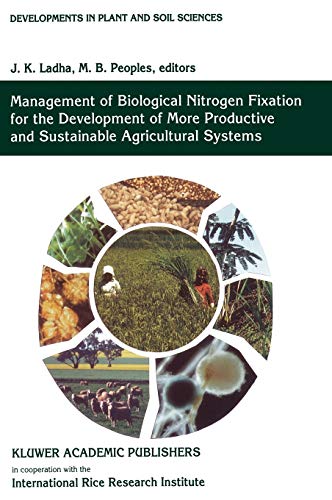
The subsistence agriculture of the pre-chemical era efficiently sustained the nitrogen status of soils by maintaining a balance between N loss and N gain from biological nitrogen fixation (BNF): the microbial conversion of atmospheric N to a form usable by plants. This was possible with less intensive cropping, adaptation of rational crop rotations and intercropping schemes, and the use of legumes as green manure. Modern agriculture concentrates on maximum output, however, overlooking input efficiency; It is not sustainable. Intensive monocropping, with no or inadequate crop rotations or green manuring, together with the excessive use of chemical N fertilizers, results in an imbalance between N gain and N loss. The losses are often larger than the gains, and soil N status declines. The challenge is to sustain soil N fertility in many different tropical and temperate farming systems operating at high productivity levels.This requires judicious integration of BNF components, maintaining a good balance between N losses and gains.
In this book, papers on BNF in crop forage and tree legumes are augmented with discussions of integrated farming systems involving BNF, soil and N management, and recycling of legume residues. BNF by non-legumes are discussed, and attempts to transform cereals into nodulating plants are critically reviewed. Advances in the development of novel methodologies to understand symbiotic relations and to assess N2 fixation in the field are described, and means are presented to enhance BNF through plant and soil management or breeding and selection. Problems encountered in exploiting BNF under field conditions are examined, as are promising approaches to improving BNF exploitation."About this title" may belong to another edition of this title.
Search results for Management of Biological Nitrogen Fixation for the...

Stock Image
Management of Biological Nitrogen Fixation for the Development of More Productive and Sustainable Agricultural Systems: Extended Versions of Papers presented. at the 15th Congress of Soil Science, Acapulco, Mexico, 1994 (Developments in Plant and Soil
Seller: Zubal-Books, Since 1961, Cleveland, OH, U.S.A.
Seller rating 5 out of 5 stars

Condition: Very Good. 287 pp., Hardcover, bookplate to front pastedown, handstamp to title page, else very good. - If you are reading this, this item is actually (physically) in our stock and ready for shipment once ordered. We are not bookjackers. Buyer is responsible for any additional duties, taxes, or fees required by recipient's country. Seller Inventory # ZB685068
Stock Image
Management of Biological Nitrogen Fixation for the Development of More Productive and Sustainable Agricultural Systems: Extended versions of papers ... (Developments in Plant and Soil Sciences, 65)
Seller: California Books, Miami, FL, U.S.A.
Seller rating 5 out of 5 stars
Condition: New. Seller Inventory # I-9780792334132
Seller Image
Management of Biological Nitrogen Fixation for the Development of More Productive and Sustainable Agricultural Systems
Seller: moluna, Greven, Germany
Seller rating 5 out of 5 stars
Gebunden. Condition: New. Seller Inventory # 5967389
Buy New
£ 119.76
£ 41.83 shipping
Ships from Germany to U.S.A.
Ships from Germany to U.S.A.
Quantity: Over 20 available
Stock Image
Management of Biological Nitrogen Fixation for the Development of More Productive and Sustainable Agricultural Systems: Extended versions of papers ... (Developments in Plant and Soil Sciences, 65)
Seller: Ria Christie Collections, Uxbridge, United Kingdom
Seller rating 5 out of 5 stars
Condition: New. In English. Seller Inventory # ria9780792334132_new
Buy New
£ 151.83
£ 11.29 shipping
Ships from United Kingdom to U.S.A.
Ships from United Kingdom to U.S.A.
Quantity: Over 20 available
Seller Image
Management of Biological Nitrogen Fixation for the Development of More Productive and Sustainable Agricultural Systems : Extended versions of papers presented at the Symposium on Biological Nitrogen Fixation for Sustainable Agriculture at the 15th Congress of Soil Science, Acapulco, Mexico, 1994
Seller: AHA-BUCH GmbH, Einbeck, Germany
Seller rating 5 out of 5 stars
Buch. Condition: Neu. Druck auf Anfrage Neuware - Printed after ordering - Table 1. Global allocation of arable land between different com modities Globally, cereal cropping dominates cultivated land Commodities' Proportion of land area use (around 50% of total area, Table I). The remain (%) ing arable land is used for production of oilseed, fibre, or food and cash crops. In addition, vast areas are Cereals maintained under temporary or permanent pasture for Wheat 16 forage production (2-3 fold greater than the total area Rice 10 under cultivation and permanent crop; Table 1, Fig. Maize 9 O. All cultivated crops, except for legumes (pulses All other cereals 13 and legume oilseeds) require the soil to provide rel Total 48 atively large amounts of nitrogen (N). It is necessary for the three most important cereals, wheat (Triticum Legumes aestivum), rice (Oryza sativa) and maize (Zea mays), Legume pulses 5 1 to take up 20 to 40 kg soil N ha- over a period of 3 Legume oilseeds 6 to 5 months to satisfy the N requirements of the seed and supporting vegetative structure for each tonne of Total II grain produced (e. g. Fig. 2; Myers, 1988). Produc tive pastures on the other hand may assimilate 100 Other crops kg N ha - each annum, of which 50 to 90% will be Other oilseeds 6 consumed by livestock in intensively grazed systems Beverages I Tobacco 7 (Ledgardy, 1991; Thomas, 1995). Seller Inventory # 9780792334132
Seller Image
Management of Biological Nitrogen Fixation for the Development of More Productive and Sustainable Agricultural Systems | Extended versions of papers presented at the Symposium on Biological Nitrogen Fixation for Sustainable Agriculture at the 15th Congress of Soil Science, Acapulco, Mexico, 1994
Print on DemandSeller: preigu, Osnabrück, Germany
Seller rating 5 out of 5 stars
Buch. Condition: Neu. Management of Biological Nitrogen Fixation for the Development of More Productive and Sustainable Agricultural Systems | Extended versions of papers presented at the Symposium on Biological Nitrogen Fixation for Sustainable Agriculture at the 15th Congress of Soil Science, Acapulco, Mexico, 1994 | M. B. Peoples (u. a.) | Buch | Einband - fest (Hardcover) | Englisch | 1995 | Springer Netherland | EAN 9780792334132 | Verantwortliche Person für die EU: Springer Netherlands, Haberstr. 7, 69126 Heidelberg, buchhandel-buch[at]springer[dot]com | Anbieter: preigu Print on Demand. Seller Inventory # 101954963
Seller Image
Management of Biological Nitrogen Fixation for the Development of More Productive and Sustainable Agricultural Systems
Published by
Springer Netherlands, Springer Netherlands Sep 1995, 1995
ISBN 10: 0792334132
ISBN 13: 9780792334132
New
Hardcover
Seller: buchversandmimpf2000, Emtmannsberg, BAYE, Germany
Seller rating 5 out of 5 stars
Buch. Condition: Neu. This item is printed on demand - Print on Demand Titel. Neuware -Table 1. Global allocation of arable land between different com modities Globally, cereal cropping dominates cultivated land Commodities' Proportion of land area use (around 50% of total area, Table I). The remain (%) ing arable land is used for production of oilseed, fibre, or food and cash crops. In addition, vast areas are Cereals maintained under temporary or permanent pasture for Wheat 16 forage production (2-3 fold greater than the total area Rice 10 under cultivation and permanent crop; Table 1, Fig. Maize 9 O. All cultivated crops, except for legumes (pulses All other cereals 13 and legume oilseeds) require the soil to provide rel Total 48 atively large amounts of nitrogen (N). It is necessary for the three most important cereals, wheat (Triticum Legumes aestivum), rice (Oryza sativa) and maize (Zea mays), Legume pulses 5 1 to take up 20 to 40 kg soil N ha- over a period of 3 Legume oilseeds 6 to 5 months to satisfy the N requirements of the seed and supporting vegetative structure for each tonne of Total II grain produced (e. g. Fig. 2; Myers, 1988). Produc tive pastures on the other hand may assimilate> 100 Other crops kg N ha - each annum, of which 50 to 90% will be Other oilseeds 6 consumed by livestock in intensively grazed systems Beverages I Tobacco 7 (Ledgardy, 1991; Thomas, 1995).Springer Verlag GmbH, Tiergartenstr. 17, 69121 Heidelberg 304 pp. Englisch. Seller Inventory # 9780792334132
Seller Image
Management of Biological Nitrogen Fixation for the Development of More Productive and Sustainable Agricultural Systems
Published by
Springer Netherlands Sep 1995, 1995
ISBN 10: 0792334132
ISBN 13: 9780792334132
New
Hardcover
Seller: BuchWeltWeit Ludwig Meier e.K., Bergisch Gladbach, Germany
Seller rating 5 out of 5 stars
Buch. Condition: Neu. This item is printed on demand - it takes 3-4 days longer - Neuware -Table 1. Global allocation of arable land between different com modities Globally, cereal cropping dominates cultivated land Commodities' Proportion of land area use (around 50% of total area, Table I). The remain (%) ing arable land is used for production of oilseed, fibre, or food and cash crops. In addition, vast areas are Cereals maintained under temporary or permanent pasture for Wheat 16 forage production (2-3 fold greater than the total area Rice 10 under cultivation and permanent crop; Table 1, Fig. Maize 9 O. All cultivated crops, except for legumes (pulses All other cereals 13 and legume oilseeds) require the soil to provide rel Total 48 atively large amounts of nitrogen (N). It is necessary for the three most important cereals, wheat (Triticum Legumes aestivum), rice (Oryza sativa) and maize (Zea mays), Legume pulses 5 1 to take up 20 to 40 kg soil N ha- over a period of 3 Legume oilseeds 6 to 5 months to satisfy the N requirements of the seed and supporting vegetative structure for each tonne of Total II grain produced (e. g. Fig. 2; Myers, 1988). Produc tive pastures on the other hand may assimilate 100 Other crops kg N ha - each annum, of which 50 to 90% will be Other oilseeds 6 consumed by livestock in intensively grazed systems Beverages I Tobacco 7 (Ledgardy, 1991; Thomas, 1995). 304 pp. Englisch. Seller Inventory # 9780792334132
Stock Image
Management of Biological Nitrogen Fixation for the Development of More Productive and Sustainable Agricultural Systems
Seller: Books Puddle, Woodside, NY, U.S.A.
Seller rating 4 out of 5 stars

Condition: New. pp. 300. Seller Inventory # 26548296
Stock Image
Management of Biological Nitrogen Fixation for the Development of More Productive and Sustainable Agricultural Systems
Print on DemandSeller: Majestic Books, Hounslow, United Kingdom
Seller rating 4 out of 5 stars
Condition: New. Print on Demand pp. 300 68:B&W 7 x 10 in or 254 x 178 mm Case Laminate on White w/Gloss Lam. Seller Inventory # 8380951
Buy New
£ 219.89
£ 6.50 shipping
Ships from United Kingdom to U.S.A.
Ships from United Kingdom to U.S.A.
Quantity: 4 available