
Items related to The Last Samurai
Synopsis
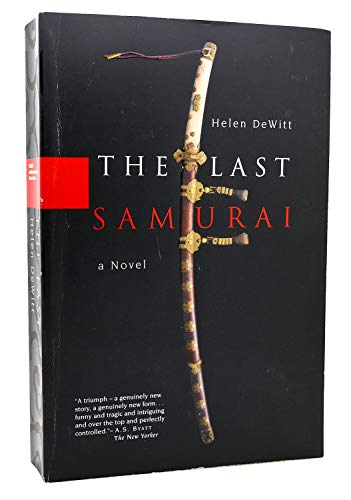
A child prodigy with a talent for languages and an insatiable thirst for knowledge, Ludo shares with his single mother, Sibylla, an obsession with Kurosawa's Seven Samurai, absorbing its lessons in Samurai virtue, and embarks on a quest to find his father, approaching seven men to test their worthiness. Reprint. 35,000 first printing.
"synopsis" may belong to another edition of this title.
Review
Helen DeWitt's extraordinary debut novel The Last Samurai centres on the relationship between Sibylla, a single mother of precocious and rigorous intelligence, and her son Ludo, who, through his mother's singular attitude to education, develops into a prodigy of learning. He reads Homer in the original Greek at the age of four before moving onto Hebrew, Japanese, Old Norse and Inuit; studying advanced mathematical techniques (Fourier analysis and Laplace transformations), and, as the title hints, endlessly watching and analysing Akira Kurosawa's cinematic masterpiece The Seven Samurai. But the one question that eludes an answer is that of the name of his father: Sibylla believes the Japanese film obliquely provides the male role models that Ludo's genetic father cannot supply, and refuses to be drawn on the question of paternal identity. The child thinks differently, however, and eventually sets out on a search for his lost father, a search which leads him beyond the certainties of acquired knowledge into the complex and messy world of adults.
The book draws on themes topical and perennial--the hothousing of children, the familiar literary trope of the quest for the (absent) father--and as such, the book divides itself into two halves: the first describes the education of Ludo, the second follows Ludo in his search for his father and father figures. The first stresses a sacred, Apollonian pursuit of logic, precise (if wayward) erudition and the erratic and endlessly fascinating architecture of languages, while the second moves this knowledge into the preterite world of emotion, human ambitions and their attendant frustrations and failures.
This is a book about the pleasure of ideas, of the rich varieties of human thought, the possibilities that life offers us and, ultimately, about the balance between the structures we make of the world and the irredeemable chaos that the world proffers in return. Stylistically, the novel mirrors this ambivalence: DeWitt's remarkable prose follows the shifts and breaks of human consciousness and memory, and captures the intrusions of unspoken thought that punctuate conversation, while providing tantalising disquisitions on, for example, Japanese grammar or the physics of aerodynamics. The Last Samurai is a remarkable, profound and often very funny book. "Arigato DeWitt-sensei"--and after reading this, you'll want to look it up too. --Burhan Tufail
Review
"A triumph – a genuinely new story, a genuinely new form" (A. S. Byatt New Yorker)
"An exhilaratingly literate and playful first novel by a fresh, electrifying talent. DeWitt goes to the top of the class...her adventurousness spins out on an epic scale" (New York Times)
"A brilliant debut novel...keeps things moving at an exhilarating clip... DeWitt is formidably intelligent but engagingly witty" (Washington Post)
"The Last Samurai is an original work of brilliance about, in part, the limits of brilliance. And in literature as in life, DeWitt understands that what we like most of all is a good yarn" (Time)
"Destined to become a classic" (Garth Risk Hallberg)
"A brilliant and sad book... The funniest book I’ve read in years." (Spectator)
"Helen DeWitt is a real find – I loved this book" (Independent on Sunday)
"It is exciting for the future of the novel that a writer can do all the basic things readers need – from Peter Pan to the Odyssey, from Bleak House to The Crying of Lot 49 – and do something new with the form of the tale itself" (New Yorker)
"A delightful and original novel – expansive and intelligent writing" (Daily Telegraph)
"DeWitt pushes against the limitations of the novel as a form; reading her, one wants to push against the limitations of one’s own brain" (Paris Review)
"About this title" may belong to another edition of this title.
Search results for The Last Samurai

Stock Image
The Last Samurai
Seller: HPB-Diamond, Dallas, TX, U.S.A.
Seller rating 5 out of 5 stars

Paperback. Condition: Very Good. Connecting readers with great books since 1972! Used books may not include companion materials, and may have some shelf wear or limited writing. We ship orders daily and Customer Service is our top priority! Seller Inventory # S_487321763
Stock Image
The Last Samurai
Seller: World of Books (was SecondSale), Montgomery, IL, U.S.A.
Seller rating 5 out of 5 stars
Paperback. Condition: Very Good. When Corran, Rigan, and their friends became outlaw monster hunters and fled beyond the walls of Ravenwood City, they thought they had defeated the source of the abominations that killed so many of their friends and loved ones. But the more successful they become at destroying the creatures, the more they realize that greater evil is at work. The city state of Ravenwood is wealthy, powerful, and corrupt. Ambitious and ruthless leaders use betrayal and assassination to gain their ends. Blood magic conjures monsters to further the goals of the ruling class, and stolen power is paid for by the deaths of commoners. But now the magic extracts too high a toll, merchant princes scheme against each other, smugglers and pirates threaten the trade that holds the kingdom together, and old alliances shatter. Darkhurst's wastrel king seems ill-suited to stop the collapse of the merchant league and the kingdom itself. When fanatic priests begin a reign of terror to summon ravenous beings and cause the unmaking of the world, Corran, Rigan, and their friends face an impossible task. They must bind the monstrous First Being, stop the priests from bringing about their blood-soaked reckoning, and put a king on the throne that will end the cull forever. The price of failure is the destruction of Darkhurst and the world itself. Seller Inventory # CIN0786887001VG
Stock Image
The Last Samurai
Seller: Evergreen Goodwill, Seattle, WA, U.S.A.
Seller rating 5 out of 5 stars
paperback. Condition: Good. Seller Inventory # mon0000134782
Seller Image
The Last Samurai
Seller: -OnTimeBooks-, Phoenix, AZ, U.S.A.
Seller rating 5 out of 5 stars
Condition: good. A copy that has been read, remains in good condition. All pages are intact, and the cover is intact. The spine and cover show signs of wear. Pages can include notes and highlighting and show signs of wear, and the copy can include "From the library of" labels or previous owner inscriptions. 100% GUARANTEE! Shipped with delivery confirmation, if you're not satisfied with purchase please return item! Ships via media mail. Seller Inventory # OTV.0786887001.G
Stock Image
The Last Samurai
Seller: World of Books Inc, Montgomery, IL, U.S.A.
Seller rating 4 out of 5 stars

Paperback. Condition: Very Good. When Corran, Rigan, and their friends became outlaw monster hunters and fled beyond the walls of Ravenwood City, they thought they had defeated the source of the abominations that killed so many of their friends and loved ones. But the more successful they become at destroying the creatures, the more they realize that greater evil is at work. The city state of Ravenwood is wealthy, powerful, and corrupt. Ambitious and ruthless leaders use betrayal and assassination to gain their ends. Blood magic conjures monsters to further the goals of the ruling class, and stolen power is paid for by the deaths of commoners. But now the magic extracts too high a toll, merchant princes scheme against each other, smugglers and pirates threaten the trade that holds the kingdom together, and old alliances shatter. Darkhurst's wastrel king seems ill-suited to stop the collapse of the merchant league and the kingdom itself. When fanatic priests begin a reign of terror to summon ravenous beings and cause the unmaking of the world, Corran, Rigan, and their friends face an impossible task. They must bind the monstrous First Being, stop the priests from bringing about their blood-soaked reckoning, and put a king on the throne that will end the cull forever. The price of failure is the destruction of Darkhurst and the world itself. Seller Inventory # CIN0786887001VG
Stock Image
The Last Samurai
Seller: GoldBooks, Denver, CO, U.S.A.
Seller rating 5 out of 5 stars
Paperback. Condition: new. New Copy. Customer Service Guaranteed. Seller Inventory # 81I75_99_0786887001
Stock Image
The Last Samurai
Seller: Revaluation Books, Exeter, United Kingdom
Seller rating 5 out of 5 stars
Paperback. Condition: Brand New. reprint edition. 530 pages. 9.25x6.25x1.00 inches. In Stock. Seller Inventory # 0786887001
Buy New
£ 60.10
£ 12.50 shipping
Ships from United Kingdom to U.S.A.
Ships from United Kingdom to U.S.A.
Quantity: 1 available