
Items related to Virtual War
Synopsis
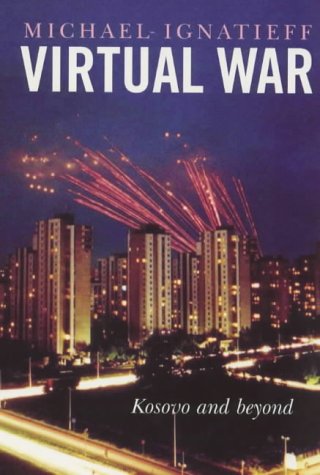
This is a brilliant and indispensable history of the present in which Michael Ignatieff reports on the extraordinary way the war in Kosovo was fought - the dawn of a new type of warfare. In real wars, whole nations are mobilised, soldiers fight and die, victories are won. In virtual war, hostilities may not even be declared, the only combatants may be strike pilots and computer programmers, the watching nation is mobilised only as a television audience and instead of victory there is only an uncertain endgame. Kosovo was a virtual war; fought by pilots at 15, 000 feet, commanded by generals whose only view of the battle was through their pilots' bombing sites, and reported by opposing media with competing versions of collateral damage stories; a war in which Americans and NATO forces did the fighting but only Kosovars and Serbs did the dying.
"synopsis" may belong to another edition of this title.
Review
Kosovo was, Michael Ignatieff asserts, "the first post-modern war". A lateral step from the Gulf War, and further than just decades away from the total wars of the 20th century, it was essentially fought on the Allied side by a few thousand airmen with not one combat casualty, yet was watched by billions of spectators. War without death, he argues, is surely "virtual" war, and this gladiatorial vision, of foreign policy stripped of its physical and emotive restraints, forms the basis of his third book in an unintentional trilogy. The first two books--Blood and Belonging and The Warrior's Honor--explored themes of ethnic nationalism and the impossibly fine line between negligence and interference for outside, ie, generally Western, "democratised" nations or individuals. Virtual War uses Ignatieff's personal experiences in and around Kosovo to bring the two together in a meditation on the Balkans and, by way of it, the future of modern warfare (though "war" is an "unspun", obsolete word in our sensitive age). In 1995, French philosopher Jean Baudrillard published The Gulf War Has Not Taken Place; Ignatieff does not go that far, but in some ways Virtual War is a virtual book. The first half comprises a series of essays concerning key players in Kosovo, and is among the best collected journalism on the subject yet written. Ignatieff is a remarkable journalist; whether profiling American envoy Richard Holbrooke, prosecutor for the War Crimes Tribunal Louise Arbour, old friend and now "virtual" enemy Aleksa Djilas, exchanging letters with British peer Robert Skidelsky (by e-mail, naturally), or reporting from a Kosovan deportee camp in Macedonia, his writing never fails to match a fiercely wrought intellect to rhetorical eloquence. The latter chapters, in which he expounds his theories of virtual warfare leading to virtual victories, are tightly argued if not groundbreaking, though his portrait of post-Cold War globalisation, of a world shrink-wrapped by telecommunications and homogenised moral universalism, justifies the conceit. In a Playstation world, this is a persuasive, provocative book by a very real thinker. --David Vincent
Review
"Ignatieff has produced a work that is both intellectually unflinching and genuinely open-minded. Ostensibly a consideration on the moral and political implications of the West's military intervention in Kosovo, the book is in fact the best exploration of both the operational and moral dilemmas of humanitarian war that has yet been written . . . A considerable achievement." --David Rieff, Los Angeles Times Book Review
"Arresting . . . Helps combat many of the cliched images we have of the Balkans, and explain how the world's most powerful military alliance had its credibility put to the test in a long-neglected corner of Europe." --Michael Dobbs, The Washington Post Book World
"A talented and versatile writer, Ignatieff takes up the central moral issues raised by the intervention . . . The shadows across his path give his book poignancy and engagement." --Fouad Ajami, The New York Times Book Review
"Virtual wars lead to a 'less stable world, '' he concludes, because the victors do not stay, do not 'bring order.' Animated with emotion: informed, documented, and essential." --Kirkus Reviews
"Vividly reported and thoughtful . . . Something like the Yugoslav tangle may confront us again, and Ignatieff's book will help our thinking if and when the time comes again to unleash the dogs of virtual war." --Bruce Nelan, Time magazine
"Especially vivid and accessible . . . Ignatieff combine[s] fine reportage and sophisticated reflection." --Timothy Garton Ash, The New York Review of Books
"Citizens or their representatives will periodically clamor for the military to intervene. When they do, the military will go. It is useful, therefore, to read Ignatieff to better understand the conditions of these kinds of missions. From that understanding, we may reach insights that may allow us to find solutions, or at least to stop the killing." --Col. Gregory Fontenot, Army
"Ignatieff is one of the most thoughtful commentators. He combines superior reporting with provocative and troubling insights on the world we've inherited." --The New York Review of Booksr
"To the illumination of dark deeds on the killing fields, Ignatieff brings a poetic sensibility and a lyrical style. His insights succeed brilliantly." --David Fromkin, Foreign Affairs
"It is not easy to categorize Michael Ignatieff. He writes something very like moral philosophy. . . . A talent for historical exposition marks everything he writes. Cultural commentator is near the mark, but perhaps public moralist would be the proper description." --Alan Ryan, The New York Times Book Review
"About this title" may belong to another edition of this title.
Search results for Virtual War

Stock Image
Virtual War
Published by
Chatto Bodley Head & Cape, 2000
ISBN 10: 0701169435
ISBN 13: 9780701169435
Used
Softcover
Seller: Wonder Book, Frederick, MD, U.S.A.
Seller rating 5 out of 5 stars

Condition: Good. Good condition. A copy that has been read but remains intact. May contain markings such as bookplates, stamps, limited notes and highlighting, or a few light stains. Seller Inventory # V09N-00339
Stock Image
Virtual War
Seller: AwesomeBooks, Wallingford, United Kingdom
Seller rating 5 out of 5 stars
Paperback. Condition: Very Good. Virtual War This book is in very good condition and will be shipped within 24 hours of ordering. The cover may have some limited signs of wear but the pages are clean, intact and the spine remains undamaged. This book has clearly been well maintained and looked after thus far. Money back guarantee if you are not satisfied. See all our books here, order more than 1 book and get discounted shipping. Seller Inventory # 7719-9780701169435
Buy Used
£ 3.04
£ 4.12 shipping
Ships from United Kingdom to U.S.A.
Ships from United Kingdom to U.S.A.
Quantity: 2 available
Stock Image
Virtual War
Seller: Bahamut Media, Reading, United Kingdom
Seller rating 4 out of 5 stars

Paperback. Condition: Very Good. This book is in very good condition and will be shipped within 24 hours of ordering. The cover may have some limited signs of wear but the pages are clean, intact and the spine remains undamaged. This book has clearly been well maintained and looked after thus far. Money back guarantee if you are not satisfied. See all our books here, order more than 1 book and get discounted shipping. Seller Inventory # 6545-9780701169435
Buy Used
£ 3.38
£ 6.98 shipping
Ships from United Kingdom to U.S.A.
Ships from United Kingdom to U.S.A.
Quantity: 2 available
Stock Image
Virtual War
Seller: Anybook.com, Lincoln, United Kingdom
Seller rating 5 out of 5 stars
Condition: Good. This is an ex-library book and may have the usual library/used-book markings inside.This book has soft covers. Clean from markings. In good all round condition. Please note the Image in this listing is a stock photo and may not match the covers of the actual item,450grams, ISBN:9780701169435. Seller Inventory # 9863153
Buy Used
£ 2.89
£ 13.04 shipping
Ships from United Kingdom to U.S.A.
Ships from United Kingdom to U.S.A.
Quantity: 1 available
Stock Image
Virtual War
Seller: Anybook.com, Lincoln, United Kingdom
Seller rating 5 out of 5 stars
Condition: Good. This is an ex-library book and may have the usual library/used-book markings inside.This book has soft covers. Clean from markings. In good all round condition. Please note the Image in this listing is a stock photo and may not match the covers of the actual item,450grams, ISBN:9780701169435. Seller Inventory # 9856812
Buy Used
£ 3.17
£ 13.04 shipping
Ships from United Kingdom to U.S.A.
Ships from United Kingdom to U.S.A.
Quantity: 1 available
Stock Image
Virtual War
Seller: HALCYON BOOKS, LONDON, United Kingdom
Seller rating 5 out of 5 stars
Paperback. Condition: Very Good. NEW EU 3 EURO CHARGE FOR IMPORTS IS INCLUDED IN OUR SHIPPING PRICE. ALL ITEMS ARE DISPATCHED FROM THE UK, ALL OVERSEAS ORDERS SENT BY TRACKABLE AIR MAIL. IF YOU ARE LOCATED OUTSIDE THE UK PLEASE ASK US FOR A POSTAGE QUOTE FOR MULTI VOLUME SETS BEFORE ORDERING. Seller Inventory # mon0000722953
Buy Used
£ 5.50
£ 18 shipping
Ships from United Kingdom to U.S.A.
Ships from United Kingdom to U.S.A.
Quantity: 2 available
Stock Image
Virtual War
Seller: Greener Books, London, United Kingdom
Seller rating 4 out of 5 stars
Paperback. Condition: Used; Very Good. **SHIPPED FROM UK** We believe you will be completely satisfied with our quick and reliable service. All orders are dispatched as swiftly as possible! Buy with confidence! Greener Books. Seller Inventory # 5032127
Buy Used
£ 3.67
£ 20 shipping
Ships from United Kingdom to U.S.A.
Ships from United Kingdom to U.S.A.
Quantity: 3 available
Seller Image
Virtual War. Kosvo and beyond
Published by
London, Chatto & Windus, 2000
ISBN 10: 0701169435
ISBN 13: 9780701169435
Used
Softcover
Seller: Barksdale Books, Almere, Netherlands
Seller rating 5 out of 5 stars
Condition: Good. Seller Inventory # 266506
Buy Used
£ 8.63
£ 16.75 shipping
Ships from Netherlands to U.S.A.
Ships from Netherlands to U.S.A.
Quantity: 1 available
Seller Image
Virtual war: Kosovo and beyond
Published by
Chatto & Windus, London, 2000
ISBN 10: 0701169435
ISBN 13: 9780701169435
Used
Softcover
Seller: Mr Pickwick's Fine Old Books, Katoomba, NSW, Australia
Seller rating 5 out of 5 stars
Softcover. Condition: Very Good. Dust Jacket Condition: No Dust Jacket. Early Edition. Size: Octavo (standard book size). 249 pages. Text body is clean, and free from previous owner annotation, underlining and highlighting. Binding is tight, covers and spine fully intact. Edges foxed and browned. Quantity Available: 1. Shipped Weight: Under 1 kilogram. Category: Military & Warfare; History. ISBN: 0701169435. ISBN/EAN: 9780701169435. Dewey Code: 949.7103 21. All our pictures shown here are of the actual item, not stock photos. Inventory No: RB14170. For further info on this title, click on the "Contact Seller" button within this listing. We will try to reply within 24 hours. Otherwise you can order right now (inclusive of shipping options) from the "Add to Basket" button to the right. Seller Inventory # RB14170
Seller Image
Virtual War
Published by
Chatto Bodley Head & Cape, 2000
ISBN 10: 0701169435
ISBN 13: 9780701169435
Used
Secondhand, Paperback
Seller: Book Grocer, Tullamarine, VIC, Australia
Seller rating 5 out of 5 stars
Secondhand, Paperback. [Author], [Publisher]. NB: This is a secondhand book in very good condition. See our FAQs for more information. Please note that the jacket image is indicative only. A description of our secondhand books is not always available. Please contact us if you have a question about this title. Author: M Ignatieff Format: Paperback Number of Pages: 256 This is a brilliant and indispensable history of the present in which Michael Ignatieff reports on the extraordinary way the war in Kosovo was fought - the dawn of a new type of warfare. In real wars, whole nations are mobilised, soldiers fight and die, victories are won. In virtual war, hostilities may not even be declared, the only combatants may be strike pilots and computer programmers, the watching nation is mobilised only as a television audience and instead of victory there is only an uncertain endgame. Kosovo was a virtual war; fought by pilots at 15, 000 feet, commanded by generals whose only view of the battle was through their pilots' bombing sites, and reported by opposing media with competing versions of collateral damage stories; a war in which Americans and NATO forces did the fighting but only Kosovars and Serbs did the dying. Secondhand, Paperback. Seller Inventory # 9780701169435-SECONDHAND