
Items related to The Consolation of Philosophy
Synopsis
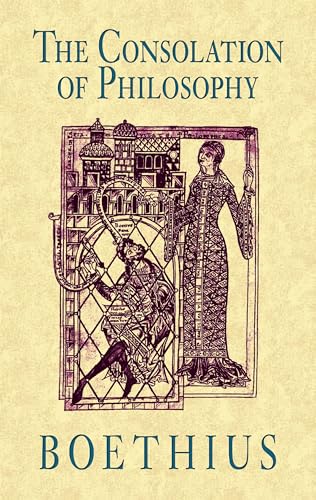
Landmark of Western thought written by a 6th-century Roman statesman and philosopher awaiting execution. Comprising a dialogue in alternating prose and verse between Boethius and his spiritual guardian, the book concerns happiness: how to achieve and maintain it amid life's inevitable pain. A cornerstone of medieval humanism.
"synopsis" may belong to another edition of this title.
About the Author
An aristocratic scholar and philosopher and one of the most influential members of the court of the Ostrogoth ruler Theodoric, Boethius (born c. 480 AD) was arrested for alleged treason (which he denied). During his confinement in northern Italy, he wrote his masterpiece, "The Consolation of Philosophy," a work in which he considers universal issues. Executed in about 526 AD.
Synopsis
This work is cited in Books for College Libraries, 3d ed. One of the most popular books in Western Europe from the time it appeared in Latin in 524 until the end of the Renaissance, its subject is achieving happiness amidst suffering. Boethius wrote his work of poetry, prose, and personification while imprisoned for treasonable offenses for which h
"About this title" may belong to another edition of this title.
Search results for The Consolation of Philosophy

Stock Image
The Consolation of Philosophy
Published by
Dover Publications (edition ), 2002
ISBN 10: 0486421635
ISBN 13: 9780486421636
Used
Paperback
Seller: BooksRun, Philadelphia, PA, U.S.A.
Seller rating 5 out of 5 stars

Paperback. Condition: Fair. The item might be beaten up but readable. May contain markings or highlighting, as well as stains, bent corners, or any other major defect, but the text is not obscured in any way. Seller Inventory # 0486421635-7-1
Stock Image
The Consolation of Philosophy
Seller: Wonder Book, Frederick, MD, U.S.A.
Seller rating 5 out of 5 stars
Condition: Good. Good condition. A copy that has been read but remains intact. May contain markings such as bookplates, stamps, limited notes and highlighting, or a few light stains. Seller Inventory # K04L-01037
Stock Image
The Consolation of Philosophy
Seller: Half Price Books Inc., Dallas, TX, U.S.A.
Seller rating 5 out of 5 stars
Paperback. Condition: Very Good. Connecting readers with great books since 1972! Used books may not include companion materials, and may have some shelf wear or limited writing. We ship orders daily and Customer Service is our top priority! Seller Inventory # S_484873218
Seller Image
The Consolation of Philosophy
Published by
Dover Publications, Inc., Mineola, New York, 2015
ISBN 10: 0486421635
ISBN 13: 9780486421636
Used
UNKNOWN
Seller: Aspen Book Co., Denver, CO, U.S.A.
Seller rating 5 out of 5 stars
UNKNOWN. Condition: Good. Unabridged reprint of 2002 edition. This 2015 Dover Publications softcover edition of "The Consolation of Philosophy" is an ex-library copy, indicated by a yellow sticker on the spine. The cover is intact but shows some signs of wear, typical for library books. There is no dust jacket, and the binding is tight with all pages securely attached. The interior pages are clean, free from markings or inscriptions, offering a clear and readable text. no dust jacket present, cover shows some wear. Seller Inventory # A12-B1-ALT-0312
Seller Image
Consolation of Philosophy
Seller: GreatBookPrices, Columbia, MD, U.S.A.
Seller rating 5 out of 5 stars
Condition: good. May show signs of wear, highlighting, writing, and previous use. This item may be a former library book with typical markings. No guarantee on products that contain supplements Your satisfaction is 100% guaranteed. Twenty-five year bookseller with shipments to over fifty million happy customers. Seller Inventory # 689273-5
Stock Image
The Consolation of Philosophy
Seller: Books From California, Simi Valley, CA, U.S.A.
Seller rating 4 out of 5 stars

paperback. Condition: Good. A used copy with minor wear and annotation. Seller Inventory # mon0003400231
Stock Image
The Consolation of Philosophy
Seller: A Team Books, Conway, AR, U.S.A.
Seller rating 5 out of 5 stars
paperback. Condition: Good. Used books may not include access codes or one time use codes. Proven Seller with Excellent Customer Service. Choose expedited shipping and get it FAST. Seller Inventory # sun0000042434
Stock Image
The Consolation of Philosophy
Published by
Dover Publications Inc., 2003
ISBN 10: 0486421635
ISBN 13: 9780486421636
Used
Paperback
Seller: World of Books (was SecondSale), Montgomery, IL, U.S.A.
Seller rating 5 out of 5 stars
Paperback. Condition: Very Good. One of the most influential books in the history of Western thought, The Consolation of Philosophy was written in a prison cell by a condemned man. Anicius Manlius Severinus Boethius (c. 480-524) was a Roman scholar, theologian, philosopher, and statesman. Imprisoned by the Ostrogothic king Theodoric, probably on trumped-up subversion charges, he was thrown into a remote prison where he was eventually executed.While awaiting his fate, he wrote this dialogue in alternating prose and poetry between himself and his spiritual guardian. Its subject is human happiness and the possibility of achieving it in the midst of the suffering and disappointment that characterize human existence. As Richard H. Green notes in the introduction, For the reader of the Christian Middle Ages, The Consolation of Philosophy celebrated the life of the mind, or reason, and the possibility of its ultimate victory over the misfortunes and frustrations which attend fallen man's pursuit of transitory substitutes for the Supreme Good which alone can satisfy human desires.Mr. Green's translation is quite literal in order to remain as faithful as possible to Boethius's original meaning. He has also provided an informative introduction and notes. The result is a superbly accessible edition that still exercises a powerful influence on contemporary thinkers and theologians and represents a source of comfort and solace for the general reader. Seller Inventory # CIN0486421635VG
Stock Image
The Consolation of Philosophy
Published by
Dover Publications Inc., 2003
ISBN 10: 0486421635
ISBN 13: 9780486421636
Used
Paperback
Seller: World of Books (was SecondSale), Montgomery, IL, U.S.A.
Seller rating 5 out of 5 stars
Paperback. Condition: Fair. One of the most influential books in the history of Western thought, The Consolation of Philosophy was written in a prison cell by a condemned man. Anicius Manlius Severinus Boethius (c. 480-524) was a Roman scholar, theologian, philosopher, and statesman. Imprisoned by the Ostrogothic king Theodoric, probably on trumped-up subversion charges, he was thrown into a remote prison where he was eventually executed.While awaiting his fate, he wrote this dialogue in alternating prose and poetry between himself and his spiritual guardian. Its subject is human happiness and the possibility of achieving it in the midst of the suffering and disappointment that characterize human existence. As Richard H. Green notes in the introduction, For the reader of the Christian Middle Ages, The Consolation of Philosophy celebrated the life of the mind, or reason, and the possibility of its ultimate victory over the misfortunes and frustrations which attend fallen man's pursuit of transitory substitutes for the Supreme Good which alone can satisfy human desires.Mr. Green's translation is quite literal in order to remain as faithful as possible to Boethius's original meaning. He has also provided an informative introduction and notes. The result is a superbly accessible edition that still exercises a powerful influence on contemporary thinkers and theologians and represents a source of comfort and solace for the general reader. Seller Inventory # CIN0486421635A
Stock Image
The Consolation of Philosophy
Published by
Dover Publications Inc., 2003
ISBN 10: 0486421635
ISBN 13: 9780486421636
Used
Paperback
Seller: World of Books (was SecondSale), Montgomery, IL, U.S.A.
Seller rating 5 out of 5 stars
Paperback. Condition: Good. One of the most influential books in the history of Western thought, The Consolation of Philosophy was written in a prison cell by a condemned man. Anicius Manlius Severinus Boethius (c. 480-524) was a Roman scholar, theologian, philosopher, and statesman. Imprisoned by the Ostrogothic king Theodoric, probably on trumped-up subversion charges, he was thrown into a remote prison where he was eventually executed.While awaiting his fate, he wrote this dialogue in alternating prose and poetry between himself and his spiritual guardian. Its subject is human happiness and the possibility of achieving it in the midst of the suffering and disappointment that characterize human existence. As Richard H. Green notes in the introduction, For the reader of the Christian Middle Ages, The Consolation of Philosophy celebrated the life of the mind, or reason, and the possibility of its ultimate victory over the misfortunes and frustrations which attend fallen man's pursuit of transitory substitutes for the Supreme Good which alone can satisfy human desires.Mr. Green's translation is quite literal in order to remain as faithful as possible to Boethius's original meaning. He has also provided an informative introduction and notes. The result is a superbly accessible edition that still exercises a powerful influence on contemporary thinkers and theologians and represents a source of comfort and solace for the general reader. Seller Inventory # CIN0486421635G