
Items related to The Age of Innocence (Thrift Editions)
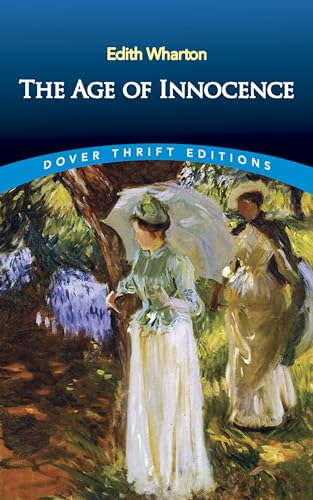
Synopsis
Deeply moving study of the tyrannical and rigid requirements of New York high society in the late 19th century and the effect of those strictures on the lives of three people. Vividly characterized drama of affection thwarted by a man’s sense of honor, family, and societal pressures. A long-time favorite with readers and critics alike.
"synopsis" may belong to another edition of this title.
From the Back Cover
Edith Wharton (1862-1937) wrote carefully structured fiction that probed the psychological and social elements guiding the behavior of her characters. Her portrayals of upper-class New Yorkers were unrivaled. The Age of Innocence, for which Wharton won the Pulitzer Prize in 1920, is one of her most memorable novels.
At the heart of the story are three people whose entangled lives are deeply affected by the tyrannical and rigid requirements of high society: Newland Archer, a restrained young attorney; his lovely fiancée, May Welland; and May's beautiful and unconventional cousin, Countess Ellen Olenska. The romance that blossoms between Newland and Ellen and its consequences illustrate the conflict between living a passionate life and behaving in accordance with family and social expectations. The novel's lucid and penetrating prose style, vivid characterizations, and its rendering of the social history of an era have long made it a favorite with readers and critics alike.
Excerpt. © Reprinted by permission. All rights reserved.
The Age of Innocence
By Edith WhartonDover Publications
Copyright © 1997 Edith WhartonAll right reserved.
ISBN: 0486298035
Book One
Chapter One
On a January evening of the early seventies, Christine Nilsson was singing in Faust at the Academy of Music in New York.
Though there was already talk of the erection, in remote metropolitan distances "above the Forties," of a new Opera House which should compete in costliness and splendour with those of the great European capitals, the world of fashion was still content to reassemble every winter in the shabby red and gold boxes of the sociable old Academy. Conservatives cherished it for being small and inconvenient, and thus keeping out the it new people" whom New York was beginning to dread and yet be drawn to; and the sentimental clung to it for its historic associations, and the musical for its excellent acoustics, always so problematic a quality in halls built for the hearing of music.
It was Madame Nilsson's first appearance that winter, and what the daily press had already learned to describe as "an exceptionally brilliant audience " had gathered to hear her, transported through the slippery snow streets in private broughams, in the spacious family landau, or in the humbler but more convenient "Brown coupe"' To come to the Opera in a Brown coupe was almost as honourable a way of arriving as in one 's own carriage; and departure by the same means had the immense advantage of enabling one (with a playful allusion to democratic principles) to scramble into the first Brown conveyance in the line, instead of waiting till the cold and--gin congested nose of one's own coachman gleamed under the portico of the Academy. It was one of the great livery-lstableman's most masterly intuitions to have discovered that Americans want to get away from amusement even more quickly than they want to get to it.
When Newland Archer opened the door at the back of the club box the curtain had just gone up on the garden scene. There was no reason why the young man should not have come earlier, for he had dined at seven, alone with his mother and sister, and had lingered afterward over a cigar in the Gothic library with glazed black-walnut bookcases and finial-topped chairs which was the only room in the house where Mrs. Archer allowed smoking. But, in the first place, New York was a metropolis, and perfectly aware that in metropolises it was "not the thing" to arrive early at the opera; and what was or was not "the thing" played a part as important in Newland Archer's New York as the inscrutable totem terrors that had ruled the destinies of his forefathers thousands of years ago.
The second reason for his delay was a personal one. He had dawdled over his cigar because he was at heart a dilettante, and thinking over a pleasure tocome often gave him a subtler satisfaction than its realisation. This was especially the case when the pleasure was a delicate one, as his pleasures mostly were; and on this occasion the moment he looked forward to was so rare and exquisite in quality that-well, if he had timed his arrival in accord with the prima donna's stage-manager he could not have entered the Academy at a more significant moment than just as she was singing: "He loves me-he loves me not-he loves me!" and sprinkling the falling daisy petals with notes as clear as dew.
She sang, of course, "Mama!" and not "he loves me," since an unalterable and unquestioned law of the musical world required that the German text of French operas sung by Swedish artists should be translated into Italian for the clearer understanding of English-speaking audiences. This seemed as natural to Newland Archer as all the other conventions on which his life was moulded: such as the duty of using two silver-backed brushes with his monogram in blue enamel to part his hair, and of never appearing in society without a flower (preferably a gardenia) in his buttonhole.
"Mama . . . non mama the prima donna sang, and "Mama!", with a final burst of love triumphant, as she pressed the dishevelled daisy to her lips and lifted her large eyes to the sophisticated countenance of the little brown Faust-Capoul, who was vainly trying, in a tight purple velvet doublet and plumed cap, to look as pure and true as his artless victim.
Newland Archer, leaning against the wall at the back of the club box, turned his eyes from the stage and scanned the opposite side of the house. Directly facing him was the box of old Mrs. Manson Mingott, whose monstrous obesity had long since made it impossible for her to attend the Opera, but who was always represented on fashionable nights by some of the younger members of the family. On this occasion, the front of the box was filled by her daughter-in-law, Mrs. Lovell Mingott, and her niece, Mrs. Welland; and slightly withdrawn behind these brocaded matrons sat a young girl in white with eyes ecstatically fixed on the stagelovers. As Madame Nilsson's "M'ama!" thrilled out above the silent house (the boxes always stopped talking during the Daisy Song) a warm pink mounted to the girl's cheek, mantled her brow to the roots of her fair braids, and suffused the young slope of her breast to the line where it met a modest tulle tucker fastened with a single gardenia. She dropped her eyes to the immense bouquet of lilies of-the-valley on her knee, and Newland Archer saw her white-gloved finger-tips touch the flowers softly. He drew a breath of satisfied vanity and his eyes returned to the stage.
No expense had been spared on the setting, which was acknowledged to be very beautiful even by people who shared his acquaintance with the Opera houses of Paris and Vienna. The foreground, to the footlights, was covered with emerald green cloth.
Continues...Continues...
Excerpted from The Age of Innocenceby Edith Wharton Copyright © 1997 by Edith Wharton. Excerpted by permission.
All rights reserved. No part of this excerpt may be reproduced or reprinted without permission in writing from the publisher.
Excerpts are provided by Dial-A-Book Inc. solely for the personal use of visitors to this web site.
"About this title" may belong to another edition of this title.
Search results for The Age of Innocence (Thrift Editions)

Stock Image
The Age of Innocence
Published by
Dover Publications Inc., 2003
ISBN 10: 0486298035
ISBN 13: 9780486298030
Used
Paperback
Seller: World of Books (was SecondSale), Montgomery, IL, U.S.A.
Seller rating 5 out of 5 stars

Paperback. Condition: Good. &&LDIV&&R&&LDIV&&R&&LI&&RAge of Innocence&&L/I&&R, by &&LB&&REdith Wharton&&L/B&&R, is part of the &&LI&&RBarnes & Noble Classics&&L/I&&R&&LI&&R &&L/I&&Rseries, which offers quality editions at affordable prices to the student and the general reader, including new scholarship, thoughtful design, and pages of carefully crafted extras. Here are some of the remarkable features of &&LI&&RBarnes & Noble Classics&&L/I&&R: &&LDIV&&RNew introductions commissioned from today's top writers and scholars Biographies of the authors Chronologies of contemporary historical, biographical, and cultural events Footnotes and endnotes Selective discussions of imitations, parodies, poems, books, plays, paintings, operas, statuary, and films inspired by the work Comments by other famous authors Study questions to challenge the reader's viewpoints and expectations Bibliographies for further reading Indices & Glossaries, when appropriateAll editions are beautifully designed and are printed to superior specifications; some include illustrations of historical interest. &&LI&&RBarnes & Noble Classics &&L/I&&Rpulls together a constellation of influences--biographical, historical, and literary--to enrich each reader's understanding of these enduring works.&&L/DIV&&R&&L/DIV&&R&&LP style=MARGIN: 0in 0in 0pt&&R &&L/P&&R&&LP style=MARGIN: 0in 0in 0pt&&RWinner of the 1921 Pulitzer Prize, &&LI&&RThe Age of Innocence&&L/I&&R is &&LB&&REdith Wharton&&L/B&&R's masterful portrait of desire and betrayal during the sumptuous Golden Age of Old New York, a time when society people dreaded scandal more than disease.&&LBR&&R&&LBR&&RThis is Newland Archer's world as he prepares to marry the beautiful but conventional May Welland. But when the mysterious Countess Ellen Olenska returns to New York after a disastrous marriage, Archer falls deeply in love with her. Torn between duty and passion, Archer struggles to make a decision that will either courageously define his life--or mercilessly destroy it.&&LBR&&R&&L/P&&R&&LP style=MARGIN: 0in 0in 0pt&&R&&LSTRONG&&RMaureen Howard&&L/B&&R&&L/B&&R is a critic, teacher, and writer of fiction. Her seven novels include &&LI&&RBridgeport Bus&&L/I&&R, &&LI&&RNatural History&&L/I&&R, and &&LI&&RA Lover's Almanac&&L/I&&R. Her memoir, &&LI&&RFacts of Life&&L/I&&R, won the National Book Critics' Circle Award. She has taught at Yale and Columbia University.&&L/P&&R&&L/DIV&&R. Seller Inventory # 00104597096
Stock Image
The Age of Innocence
Published by
Dover Publications Inc., 2003
ISBN 10: 0486298035
ISBN 13: 9780486298030
Used
Paperback
Seller: World of Books (was SecondSale), Montgomery, IL, U.S.A.
Seller rating 5 out of 5 stars
Paperback. Condition: Fair. &&LDIV&&R&&LDIV&&R&&LI&&RAge of Innocence&&L/I&&R, by &&LB&&REdith Wharton&&L/B&&R, is part of the &&LI&&RBarnes & Noble Classics&&L/I&&R&&LI&&R &&L/I&&Rseries, which offers quality editions at affordable prices to the student and the general reader, including new scholarship, thoughtful design, and pages of carefully crafted extras. Here are some of the remarkable features of &&LI&&RBarnes & Noble Classics&&L/I&&R: &&LDIV&&RNew introductions commissioned from today's top writers and scholars Biographies of the authors Chronologies of contemporary historical, biographical, and cultural events Footnotes and endnotes Selective discussions of imitations, parodies, poems, books, plays, paintings, operas, statuary, and films inspired by the work Comments by other famous authors Study questions to challenge the reader's viewpoints and expectations Bibliographies for further reading Indices & Glossaries, when appropriateAll editions are beautifully designed and are printed to superior specifications; some include illustrations of historical interest. &&LI&&RBarnes & Noble Classics &&L/I&&Rpulls together a constellation of influences--biographical, historical, and literary--to enrich each reader's understanding of these enduring works.&&L/DIV&&R&&L/DIV&&R&&LP style=MARGIN: 0in 0in 0pt&&R &&L/P&&R&&LP style=MARGIN: 0in 0in 0pt&&RWinner of the 1921 Pulitzer Prize, &&LI&&RThe Age of Innocence&&L/I&&R is &&LB&&REdith Wharton&&L/B&&R's masterful portrait of desire and betrayal during the sumptuous Golden Age of Old New York, a time when society people dreaded scandal more than disease.&&LBR&&R&&LBR&&RThis is Newland Archer's world as he prepares to marry the beautiful but conventional May Welland. But when the mysterious Countess Ellen Olenska returns to New York after a disastrous marriage, Archer falls deeply in love with her. Torn between duty and passion, Archer struggles to make a decision that will either courageously define his life--or mercilessly destroy it.&&LBR&&R&&L/P&&R&&LP style=MARGIN: 0in 0in 0pt&&R&&LSTRONG&&RMaureen Howard&&L/B&&R&&L/B&&R is a critic, teacher, and writer of fiction. Her seven novels include &&LI&&RBridgeport Bus&&L/I&&R, &&LI&&RNatural History&&L/I&&R, and &&LI&&RA Lover's Almanac&&L/I&&R. Her memoir, &&LI&&RFacts of Life&&L/I&&R, won the National Book Critics' Circle Award. She has taught at Yale and Columbia University.&&L/P&&R&&L/DIV&&R. Seller Inventory # 00082144484
Seller Image
The Age of Innocence (Dover Thrift Editions: Classic Novels)
Seller: 3Brothers Bookstore, Egg harbor township, NJ, U.S.A.
Seller rating 5 out of 5 stars
Condition: very_good. Cover may have light wear, pages in very good condition and binding is sturdy; may have other light shelf wear or creases. May have notes or highlighting. Seller Inventory # EVV.0486298035.VG
Seller Image
The Age of Innocence (Dover Thrift Editions: Classic Novels)
Seller: Books for Life, LAUREL, MD, U.S.A.
Seller rating 5 out of 5 stars
Condition: good. Book is in good condition. Minimal signs of wear. It May have markings or highlights, but kept to only a few pages. May not come with supplemental materials if applicable. Seller Inventory # LFM.83AL
Seller Image
The Age of Innocence (Dover Thrift Editions: Classic Novels)
Seller: Greenworld Books, Arlington, TX, U.S.A.
Seller rating 5 out of 5 stars
Condition: good. Fast Free Shipping â" Good condition. It may show normal signs of use, such as light writing, highlighting, or library markings, but all pages are intact and the book is fully readable. A solid, complete copy that's ready to enjoy. Seller Inventory # GWV.0486298035.G
Seller Image
The Age of Innocence (Dover Thrift Editions: Classic Novels)
Seller: Greenworld Books, Arlington, TX, U.S.A.
Seller rating 5 out of 5 stars
Condition: like_new. Fast Free Shipping â" Excellent condition book with clean cover and pages. Barely handled, with minimal wear. An outstanding copy, close to enjoy! Seller Inventory # GWV.0486298035.LN
Stock Image
The Age of Innocence (Dover Thrift Editions: Classic Novels)
Published by
Dover Publications (edition Revised ed.), 1997
ISBN 10: 0486298035
ISBN 13: 9780486298030
Used
Paperback
Seller: BooksRun, Philadelphia, PA, U.S.A.
Seller rating 5 out of 5 stars
Paperback. Condition: Very Good. Revised ed. It's a well-cared-for item that has seen limited use. The item may show minor signs of wear. All the text is legible, with all pages included. It may have slight markings and/or highlighting. Seller Inventory # 0486298035-11-18
Stock Image
The Age of Innocence (Dover Thrift Editions: Classic Novels)
Seller: PlumCircle, West Mifflin, PA, U.S.A.
Seller rating 5 out of 5 stars
paperback. Condition: Good. Somewhat damaged. May have bumped corner, torn dust cover, folded pages, light dust soil, remainder mark, price sticker, other damage, or be bent. 99% of orders arrive in 4-10 days. Discounted shipping on multiple books. Seller Inventory # mon0001349243
Stock Image
The Age of Innocence (Dover Thrift Editions: Classic Novels)
Seller: HPB-Diamond, Dallas, TX, U.S.A.
Seller rating 5 out of 5 stars
paperback. Condition: Very Good. Connecting readers with great books since 1972! Used books may not include companion materials, and may have some shelf wear or limited writing. We ship orders daily and Customer Service is our top priority! Seller Inventory # S_477477031
Stock Image
The Age of Innocence (Dover Thrift Editions: Classic Novels)
Seller: Half Price Books Inc., Dallas, TX, U.S.A.
Seller rating 5 out of 5 stars
paperback. Condition: Very Good. Connecting readers with great books since 1972! Used books may not include companion materials, and may have some shelf wear or limited writing. We ship orders daily and Customer Service is our top priority! Seller Inventory # S_454466433