
Items related to A Modern Herbal: Vol. 1
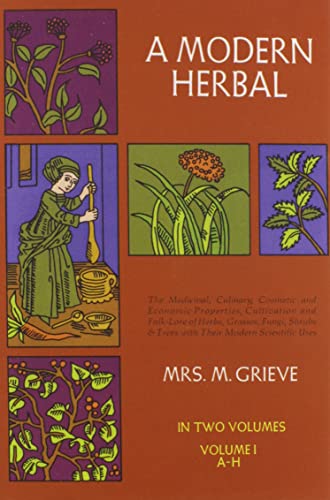
Synopsis
Volume 1 of the fullest, most exact, most useful compilation of herbal material. Gigantic alphabetical encyclopedia, from aconite to zedoary, gives botanical information, medical properties, folklore, economic uses, much else. Indispensable to serious reader. Total in set: 161 illustrations.
"synopsis" may belong to another edition of this title.
From the Back Cover
"There is not one page of this enchanting book which does not contain something to interest the common reader as well as the serious student. Regarded simply as a history of flowers, it adds to the joys of the country."--B. E. Todd, Spectator.
If you want to know how pleurisy root, lungwort, and abscess root got their names, how poison ivy used to treat rheumatism, or how garlic guarded against the Bubonic Plague, consult A Modern Herbal. This 20th-century version of the medieval Herbal is as rich in scientific fact and folklore as its predecessors and is equally encyclopedic in coverage. From aconite to zedoary, not an herb, grass, fungus, shrub or tree is overlooked; and strange and wonderful discoveries about even the most common of plants await the reader.
Traditionally, an herbal combined the folk beliefs and tales about plants, the medicinal properties (and parts used) of the herbs, and their botanical classification. But Mrs. Grieve has extended and enlarged the tradition; her coverage of asafetida, bearberry, broom, chamomile, chickweed, dandelion, dock, elecampane, almond, eyebright, fenugreek, moss, fern, figwort, gentian, Hart's tongue, indigo, acacia, jaborandi, kava kava, lavender, pimpernel, rhubarb, squill, sage, thyme, sarsaparilla, unicorn root, valerian, woundwort, yew, etc.--more than 800 varieties in all--includes in addition methods of cultivation; the chemical constituents, dosages, and preparations of extracts and tinctures, unknown to earlier herbalists; possible economic and cosmetic properties, and detailed illustrations, from root to bud, of 161 plants.
Of the many exceptional plants covered in Herbal, perhaps the most fascinating are the poisonous varieties--hemlock, poison oak, aconite, etc.--whose poisons, in certain cases, serve medical purposes and whose antidotes (if known) are given in detail. And of the many unique features, perhaps the most interesting are the hundreds of recipes and instructions for making ointments, lotions, sauces, wines, and fruit brandies like bilberry and carrot jam, elderberry and mint vinegar, sagina sauce, and cucumber lotion for sunburn; and the hundreds of prescriptions for tonics and liniments for bronchitis, arthritis, dropsy, jaundice, nervous tension, skin disease, and other ailments. 96 plates, 161 illustrations.
From the Inside Flap
There is not one page of this enchanting book which does not contain something to interest the common reader as well as the serious student. Regarded simply as a history of flowers, it adds to the joys of the country.--B. E. Todd, Spectator.
If you want to know how pleurisy root, lungwort, and abscess root got their names, how poison ivy used to treat rheumatism, or how garlic guarded against the Bubonic Plague, consult A Modern Herbal. This 20th-century version of the medieval Herbal is as rich in scientific fact and folklore as its predecessors and is equally encyclopedic in coverage. From aconite to zedoary, not an herb, grass, fungus, shrub or tree is overlooked; and strange and wonderful discoveries about even the most common of plants await the reader.
Traditionally, an herbal combined the folk beliefs and tales about plants, the medicinal properties (and parts used) of the herbs, and their botanical classification. But Mrs. Grieve has extended and enlarged the tradition; her coverage of asafetida, bearberry, broom, chamomile, chickweed, dandelion, dock, elecampane, almond, eyebright, fenugreek, moss, fern, figwort, gentian, Hart's tongue, indigo, acacia, jaborandi, kava kava, lavender, pimpernel, rhubarb, squill, sage, thyme, sarsaparilla, unicorn root, valerian, woundwort, yew, etc.--more than 800 varieties in all--includes in addition methods of cultivation; the chemical constituents, dosages, and preparations of extracts and tinctures, unknown to earlier herbalists; possible economic and cosmetic properties, and detailed illustrations, from root to bud, of 161 plants.
Of the many exceptional plants covered in Herbal, perhaps the most fascinating are the poisonous varieties--hemlock, poison oak, aconite, etc.--whose poisons, in certain cases, serve medical purposes and whose antidotes (if known) are given in detail. And of the many unique features, perhaps the most interesting are the hundreds of recipes and instructions for making ointments, lotions, sauces, wines, and fruit brandies like bilberry and carrot jam, elderberry and mint vinegar, sagina sauce, and cucumber lotion for sunburn; and the hundreds of prescriptions for tonics and liniments for bronchitis, arthritis, dropsy, jaundice, nervous tension, skin disease, and other ailments. 96 plates, 161 illustrations.
"About this title" may belong to another edition of this title.
Search results for A Modern Herbal: Vol. 1

Stock Image
A Modern Herbal (Volume 1, A-H): The Medicinal, Culinary, Cosmetic and Economic Properties, Cultivation and Folk-Lore of Herbs, Grasses, Fungi, Shrubs & Trees with Their Modern Scientific Uses
Seller: Half Price Books Inc., Dallas, TX, U.S.A.
Seller rating 5 out of 5 stars

Paperback. Condition: Very Good. Connecting readers with great books since 1972! Used books may not include companion materials, and may have some shelf wear or limited writing. We ship orders daily and Customer Service is our top priority! Seller Inventory # S_481241964
Seller Image
A Modern Herbal (Volume 1, A-H): The Medicinal, Culinary, Cosmetic and Economic Properties, Cultivation and Folk-Lore of Herbs, Grasses, Fungi, Shrubs & Trees with Their Modern Scientific Uses
Seller: Goodwill Industries, Spokane, WA, U.S.A.
Seller rating 5 out of 5 stars
Condition: good. Condition: Good â" Used book with some visible wear. May include stickers on the cover, wear or absence of the dust jacket, wear to the spine or inside cover, slight corner curling, minor staining, and wear along the fore edge. All orders are shipped via UPS Mail Innovations and may take up to 10 business days from the initial scan to be delivered. Seller Inventory # INWV.0486227987.G
Stock Image
A Modern Herbal (Volume 1, A-H): The Medicinal, Culinary, Cosmetic and Economic Properties, Cultivation and Folk-Lore of Herbs, Grasses, Fungi, Shrubs & Trees with Their Modern Scientific Uses
Seller: Idaho Youth Ranch Books, Boise, ID, U.S.A.
Seller rating 5 out of 5 stars
Condition: Good. A copy that has been read, but remains in clean condition. All pages are intact, and the cover is intact (including dust cover, if applicable). The spine may show signs of wear. Pages can include limited notes and highlighting, and the copy can include "From the library of" labels or limited small stickers. Book may have a remainder mark or be a price cutter. Seller Inventory # B-03-01-04-0848
Seller Image
A Modern Herbal (Volume 1, A-H): The Medicinal, Culinary, Cosmetic and Economic Properties, Cultivation and Folk-Lore of Herbs, Grasses, Fungi, Shrubs & Trees with Their Modern Scientific Uses
Seller: Goodwill Books, Hillsboro, OR, U.S.A.
Seller rating 5 out of 5 stars
Condition: good. Signs of wear and consistent use. Seller Inventory # GICWV.0486227987.G
Stock Image
A Modern Herbal (Volume 1, A-H): The Medicinal, Culinary, Cosmetic and Economic Properties, Cultivation and Folk-Lore of Herbs, Grasses, Fungi, Shrubs & Trees with Their Modern Scientific Uses
Published by
Dover Publications (edition Revised ed.), 1971
ISBN 10: 0486227987
ISBN 13: 9780486227986
Used
Paperback
Seller: BooksRun, Philadelphia, PA, U.S.A.
Seller rating 5 out of 5 stars
Paperback. Condition: Very Good. Revised ed. It's a well-cared-for item that has seen limited use. The item may show minor signs of wear. All the text is legible, with all pages included. It may have slight markings and/or highlighting. Seller Inventory # 0486227987-11-1
Seller Image
A Modern Herbal (Volume 1, A-H): The Medicinal, Culinary, Cosmetic and Economic Properties, Cultivation and Folk-Lore of Herbs, Grasses, Fungi, Shrubs & Trees with Their Modern Scientific Uses
Seller: -OnTimeBooks-, Phoenix, AZ, U.S.A.
Seller rating 5 out of 5 stars
Condition: good. A copy that has been read, remains in good condition. All pages are intact, and the cover is intact. The spine and cover show signs of wear. Pages can include notes and highlighting and show signs of wear, and the copy can include "From the library of" labels or previous owner inscriptions. 100% GUARANTEE! Shipped with delivery confirmation, if you're not satisfied with purchase please return item! Ships via media mail. Seller Inventory # OTV.0486227987.G
Stock Image
A Modern Herbal (Volume 1, A-H): The Medicinal, Culinary, Cosmetic and Economic Properties, Cultivation and Folk-Lore of Herbs, Grasses, Fungi, Shrubs & Trees with Their Modern Scientific Uses
Seller: Deadstock Gear, Fort Oglethorpe, GA, U.S.A.
Seller rating 5 out of 5 stars
paperback. Condition: Very Good. Satisfaction guaranteed. Thank you! Seller Inventory # 10-20-2026-Blake-Shelf 17/D052
Stock Image
A Modern Herbal
Published by
Dover Publications Inc., 1971
ISBN 10: 0486227987
ISBN 13: 9780486227986
Used
Paperback
Seller: World of Books (was SecondSale), Montgomery, IL, U.S.A.
Seller rating 5 out of 5 stars
Paperback. Condition: Good. "There is not one page of this enchanting book which does not contain something to interest the common reader as well as the serious student. Regarded simply as a history of flowers, it adds to the joys of the country." -- B. E. Todd, Spectator. If you want to know how pleurisy root, lungwort, and abscess root got their names, how poison ivy used to treat rheumatism, or how garlic guarded against the Bubonic Plague, consult A Modern Herbal. This 20th-century version of the medieval Herbal is as rich in scientific fact and folklore as its predecessors and is equally encyclopedic in coverage. From aconite to zedoary, not an herb, grass, fungus, shrub or tree is overlooked; and strange and wonderful discoveries about even the most common of plants await the reader. Traditionally, an herbal combined the folk beliefs and tales about plants, the medicinal properties (and parts used) of the herbs, and their botanical classification. But Mrs. Grieve has extended and enlarged the tradition; her coverage of asafetida, bearberry, broom, chamomile, chickweed, dandelion, dock, elecampane, almond, eyebright, fenugreek, moss, fern, figwort, gentian, Hart's tongue, indigo, acacia, jaborandi, kava kava, lavender, pimpernel, rhubarb, squill, sage, thyme, sarsaparilla, unicorn root, valerian, woundwort, yew, etc. -- more than 800 varieties in all -- includes in addition methods of cultivation; the chemical constituents, dosages, and preparations of extracts and tinctures, unknown to earlier herbalists; possible economic and cosmetic properties, and detailed illustrations, from root to bud, of 161 plants. Of the many exceptional plants covered in Herbal, perhaps the most fascinating are the poisonous varieties -- hemlock, poison oak, aconite, etc. -- whose poisons, in certain cases, serve medical purposes and whose antidotes (if known) are given in detail. And of the many unique features, perhaps the most interesting are the hundreds of recipes and instructions for making ointments, lotions, sauces, wines, and fruit brandies like bilberry and carrot jam, elderberry and mint vinegar, sagina sauce, and cucumber lotion for sunburn; and the hundreds of prescriptions for tonics and liniments for bronchitis, arthritis, dropsy, jaundice, nervous tension, skin disease, and other ailments. 96 plates, 161 illustrations. Seller Inventory # 00110256892
Stock Image
A Modern Herbal
Published by
Dover Publications Inc., 1971
ISBN 10: 0486227987
ISBN 13: 9780486227986
Used
Paperback
Seller: World of Books (was SecondSale), Montgomery, IL, U.S.A.
Seller rating 5 out of 5 stars
Paperback. Condition: Very Good. "There is not one page of this enchanting book which does not contain something to interest the common reader as well as the serious student. Regarded simply as a history of flowers, it adds to the joys of the country." -- B. E. Todd, Spectator. If you want to know how pleurisy root, lungwort, and abscess root got their names, how poison ivy used to treat rheumatism, or how garlic guarded against the Bubonic Plague, consult A Modern Herbal. This 20th-century version of the medieval Herbal is as rich in scientific fact and folklore as its predecessors and is equally encyclopedic in coverage. From aconite to zedoary, not an herb, grass, fungus, shrub or tree is overlooked; and strange and wonderful discoveries about even the most common of plants await the reader. Traditionally, an herbal combined the folk beliefs and tales about plants, the medicinal properties (and parts used) of the herbs, and their botanical classification. But Mrs. Grieve has extended and enlarged the tradition; her coverage of asafetida, bearberry, broom, chamomile, chickweed, dandelion, dock, elecampane, almond, eyebright, fenugreek, moss, fern, figwort, gentian, Hart's tongue, indigo, acacia, jaborandi, kava kava, lavender, pimpernel, rhubarb, squill, sage, thyme, sarsaparilla, unicorn root, valerian, woundwort, yew, etc. -- more than 800 varieties in all -- includes in addition methods of cultivation; the chemical constituents, dosages, and preparations of extracts and tinctures, unknown to earlier herbalists; possible economic and cosmetic properties, and detailed illustrations, from root to bud, of 161 plants. Of the many exceptional plants covered in Herbal, perhaps the most fascinating are the poisonous varieties -- hemlock, poison oak, aconite, etc. -- whose poisons, in certain cases, serve medical purposes and whose antidotes (if known) are given in detail. And of the many unique features, perhaps the most interesting are the hundreds of recipes and instructions for making ointments, lotions, sauces, wines, and fruit brandies like bilberry and carrot jam, elderberry and mint vinegar, sagina sauce, and cucumber lotion for sunburn; and the hundreds of prescriptions for tonics and liniments for bronchitis, arthritis, dropsy, jaundice, nervous tension, skin disease, and other ailments. 96 plates, 161 illustrations. Seller Inventory # CIN0486227987VG
Stock Image
A Modern Herbal
Published by
Dover Publications Inc., 1971
ISBN 10: 0486227987
ISBN 13: 9780486227986
Used
Paperback
Seller: World of Books (was SecondSale), Montgomery, IL, U.S.A.
Seller rating 5 out of 5 stars
Paperback. Condition: Fair. "There is not one page of this enchanting book which does not contain something to interest the common reader as well as the serious student. Regarded simply as a history of flowers, it adds to the joys of the country." -- B. E. Todd, Spectator. If you want to know how pleurisy root, lungwort, and abscess root got their names, how poison ivy used to treat rheumatism, or how garlic guarded against the Bubonic Plague, consult A Modern Herbal. This 20th-century version of the medieval Herbal is as rich in scientific fact and folklore as its predecessors and is equally encyclopedic in coverage. From aconite to zedoary, not an herb, grass, fungus, shrub or tree is overlooked; and strange and wonderful discoveries about even the most common of plants await the reader. Traditionally, an herbal combined the folk beliefs and tales about plants, the medicinal properties (and parts used) of the herbs, and their botanical classification. But Mrs. Grieve has extended and enlarged the tradition; her coverage of asafetida, bearberry, broom, chamomile, chickweed, dandelion, dock, elecampane, almond, eyebright, fenugreek, moss, fern, figwort, gentian, Hart's tongue, indigo, acacia, jaborandi, kava kava, lavender, pimpernel, rhubarb, squill, sage, thyme, sarsaparilla, unicorn root, valerian, woundwort, yew, etc. -- more than 800 varieties in all -- includes in addition methods of cultivation; the chemical constituents, dosages, and preparations of extracts and tinctures, unknown to earlier herbalists; possible economic and cosmetic properties, and detailed illustrations, from root to bud, of 161 plants. Of the many exceptional plants covered in Herbal, perhaps the most fascinating are the poisonous varieties -- hemlock, poison oak, aconite, etc. -- whose poisons, in certain cases, serve medical purposes and whose antidotes (if known) are given in detail. And of the many unique features, perhaps the most interesting are the hundreds of recipes and instructions for making ointments, lotions, sauces, wines, and fruit brandies like bilberry and carrot jam, elderberry and mint vinegar, sagina sauce, and cucumber lotion for sunburn; and the hundreds of prescriptions for tonics and liniments for bronchitis, arthritis, dropsy, jaundice, nervous tension, skin disease, and other ailments. 96 plates, 161 illustrations. Seller Inventory # 00110707694