
Items related to The Elements of Drawing
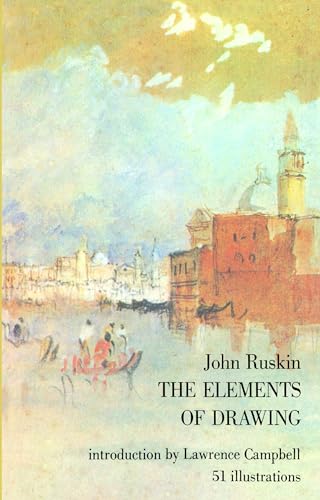
Synopsis
Timeless work by one of the greatest art critics of all time begins with bare fundamentals and offers brilliant philosophical advice from sketching to the laws of color and composition. "The truth behind Ruskin's statements is always clear." ― American Artist. 48 illustrations.
"synopsis" may belong to another edition of this title.
About the Author
John Ruskin was an English polymath – a writer, lecturer, art historian, art critic, draughtsman and philanthropist of the Victorian era. He wrote on subjects as varied as art, architecture, political economy, education, museology, geology, botany, ornithology, literature, history, and myth.
From the Back Cover
Can drawing--sound, honest representation of the world as the eye sees it, not tricks with the pencil or a few "effects"--be learned from a book? One of the most gifted draftsmen, who is also one of the greatest art critics and theorists of all time, answers that question with a decided "Yes." He is John Ruskin, the author of this book, a classic in art education as well as a highly effective text for the student and amateur today.
The work is in three parts, cast in the form of letters to a student, successively covering "First Practice," "Sketching from Nature," and "Colour and Composition." Starting with the bare fundamentals (what kind of drawing pen to buy; shading a square evenly), and using the extremely practical method of exercises which the student performs from the very first, Ruskin instructs, advises, guides, counsels, and anticipates problems with sensitivity. The exercises become more difficult, developing greater and greater skills until Ruskin feels his reader is ready for watercolors and finally composition, which he treats in detail as to the laws of principality, repetition, continuity, curvature, radiation, contrast, interchange, consistency, and harmony. All along the way, Ruskin explains, in plain, clear language, the artistic and craftsmanlike reasons behind his practical advice--underlying which, of course, is Ruskin's brilliant philosophy of honest, naturally observed art which has so much affected our aesthetic.
Three full-page plates and 48 woodcuts and diagrams (the latter from drawings by the author) show the student what the text describes. An appendix devotes many pages to the art works which may be studied with profit.
Unabridged republication of the text from the Library edition of The Works of John Ruskin, 1904.
From the Inside Flap
Can drawing--sound, honest representation of the world as the eye sees it, not tricks with the pencil or a few effects--be learned from a book? One of the most gifted draftsmen, who is also one of the greatest art critics and theorists of all time, answers that question with a decided Yes. He is John Ruskin, the author of this book, a classic in art education as well as a highly effective text for the student and amateur today.
The work is in three parts, cast in the form of letters to a student, successively covering First Practice, Sketching from Nature, and Colour and Composition. Starting with the bare fundamentals (what kind of drawing pen to buy; shading a square evenly), and using the extremely practical method of exercises which the student performs from the very first, Ruskin instructs, advises, guides, counsels, and anticipates problems with sensitivity. The exercises become more difficult, developing greater and greater skills until Ruskin feels his reader is ready for watercolors and finally composition, which he treats in detail as to the laws of principality, repetition, continuity, curvature, radiation, contrast, interchange, consistency, and harmony. All along the way, Ruskin explains, in plain, clear language, the artistic and craftsmanlike reasons behind his practical advice--underlying which, of course, is Ruskin's brilliant philosophy of honest, naturally observed art which has so much affected our aesthetic.
Three full-page plates and 48 woodcuts and diagrams (the latter from drawings by the author) show the student what the text describes. An appendix devotes many pages to the art works which may be studied with profit.
Unabridged republication of the text from the Library edition of The Works of John Ruskin, 1904.
"About this title" may belong to another edition of this title.
Search results for The Elements of Drawing

Stock Image
The Elements of Drawing (Dover Art Instruction)
Seller: HPB-Movies, Dallas, TX, U.S.A.
Seller rating 5 out of 5 stars

paperback. Condition: Very Good. Connecting readers with great books since 1972! Used books may not include companion materials, and may have some shelf wear or limited writing. We ship orders daily and Customer Service is our top priority! Seller Inventory # S_483628175
Stock Image
The Elements of Drawing (Dover Art Instruction)
Published by
Dover Publications (edition Revised), 1971
ISBN 10: 0486227308
ISBN 13: 9780486227306
Used
Paperback
Seller: BooksRun, Philadelphia, PA, U.S.A.
Seller rating 5 out of 5 stars
Paperback. Condition: Very Good. Revised. It's a well-cared-for item that has seen limited use. The item may show minor signs of wear. All the text is legible, with all pages included. It may have slight markings and/or highlighting. Seller Inventory # 0486227308-8-1
Stock Image
The Elements of Drawing (Dover Art Instruction)
Published by
Dover Publications (edition Revised), 1971
ISBN 10: 0486227308
ISBN 13: 9780486227306
Used
Paperback
Seller: BooksRun, Philadelphia, PA, U.S.A.
Seller rating 5 out of 5 stars
Paperback. Condition: Fair. Revised. The item might be beaten up but readable. May contain markings or highlighting, as well as stains, bent corners, or any other major defect, but the text is not obscured in any way. Seller Inventory # 0486227308-7-1
Stock Image
The Elements of Drawing (Dover Art Instruction)
Seller: HPB-Diamond, Dallas, TX, U.S.A.
Seller rating 5 out of 5 stars
Paperback. Condition: Very Good. Connecting readers with great books since 1972! Used books may not include companion materials, and may have some shelf wear or limited writing. We ship orders daily and Customer Service is our top priority! Seller Inventory # S_482769962
Stock Image
The Elements of Drawing (Dover Art Instruction)
Seller: HPB-Ruby, Dallas, TX, U.S.A.
Seller rating 5 out of 5 stars
Paperback. Condition: Very Good. Connecting readers with great books since 1972! Used books may not include companion materials, and may have some shelf wear or limited writing. We ship orders daily and Customer Service is our top priority! Seller Inventory # S_483674831
Stock Image
The Elements of Drawing (Dover Art Instruction)
Seller: HPB Inc., Dallas, TX, U.S.A.
Seller rating 5 out of 5 stars
Paperback. Condition: Very Good. Connecting readers with great books since 1972! Used books may not include companion materials, and may have some shelf wear or limited writing. We ship orders daily and Customer Service is our top priority! Seller Inventory # S_483976861
Seller Image
The Elements of Drawing (Dover Art Instruction)
Seller: Goodwill of Central and Coastal Virginia, Richmond, VA, U.S.A.
Seller rating 4 out of 5 stars

Condition: acceptable. Seller Inventory # CCVV.0486227308.A
Seller Image
Elements of Drawing
Seller: GreatBookPrices, Columbia, MD, U.S.A.
Seller rating 5 out of 5 stars
Condition: New. Seller Inventory # 444240-n
Stock Image
The Elements of Drawing Format: Paperback
Seller: INDOO, Avenel, NJ, U.S.A.
Seller rating 5 out of 5 stars
Condition: New. Brand New. Seller Inventory # 9780486227306
Stock Image
The Elements of Drawing
Seller: AVON HILL BOOKS, Cambridge, MA, U.S.A.
Seller rating 5 out of 5 stars
Softcover. Condition: As New. Republication of 1857 work. ; 8vo 8" - 9" tall; 228 pp; Dover Art Instruction. Seller Inventory # 28049