
Items related to Nikolay Rimsky-Korsakov - Principles of Orchestration...
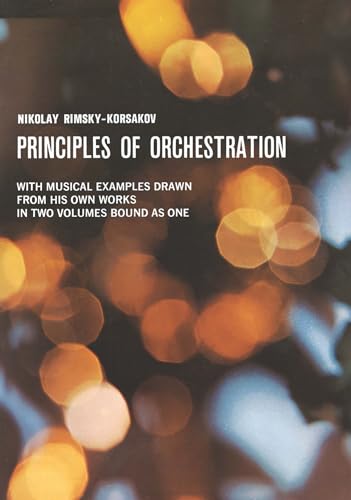
Nikolay Rimsky-Korsakov - Principles of Orchestration | Classical Orchestration Textbook for Music Students and Composers with 330 Musical Examples ... Paperback (Dover Books on Music: Analysis) - Softcover
Synopsis
Principles of Orchestration by Nikolay Rimsky-Korsakov is one of the most celebrated and comprehensive textbooks ever written on the art of orchestration. Ideal for composers, arrangers, and advanced music students, this book explores the structure and color of orchestral sound through clear explanations and hundreds of real musical examples. It serves as both a technical manual and a creative guide for understanding the brilliance and imagination behind great orchestral writing.
This masterwork provides systematic instruction on every section of the orchestra, covering strings, woodwinds, brass, and percussion. The author examines how to achieve tonal balance, effective chord progressions, and expressive orchestral textures. Students learn how to detach melodies from harmonic backgrounds, distribute voices, and use combinations of timbres to create rich musical effects. Rimsky-Korsakov’s insights reveal how technical precision and artistic vision work together to shape orchestral beauty.
Across its extensive chapters, the book discusses the composition of the orchestra, tutti effects, solo and choral accompaniment, and the integration of voices with instruments in opera and symphonic works. Over 330 musical excerpts from the composer’s own masterpieces—such as Sheherazade, Capriccio Espagnol, and The Tsar’s Bride—demonstrate the techniques described, allowing readers to see each principle in action.
How It Helps: Readers develop a deep understanding of tonal resonance, orchestral color, and instrumental balance. It enhances compositional technique, improves orchestration skills, and inspires confidence in creative writing for the symphony orchestra.
A thoughtful gift for any musician. This timeless resource remains essential for anyone studying orchestration or composition, bringing clarity and artistry to every musical creation.
"synopsis" may belong to another edition of this title.
About the Author
Nikolai Rimsky-Korsakov (1844-1908) was a prolific composer of orchestral works and many other forms of music, including chamber works and art songs. He also wrote many operas, excerpts from which are featured in this collection; most notably, "The Flight of the Bumblebee" from The Tale of Tsar Saltan.
From the Back Cover
"To orchestrate is to create, and this cannot be taught," wrote Nikolay Rimsky-Korsakov, the great Russian composer whose genius for brilliant, highly colored orchestration is unsurpassed. But invention, in all art, is closely allied to technique, and technique can be taught. This book, therefore, which differs from most other texts on the subject because of its tremendous wealth of musical examples and its systematic arrangement of material according to each constituent of the orchestra, will undoubtedly be of value to any music student. It is a music classic, perhaps the only book on classical orchestration written by a major composer.
In it, the composer aims to provide the reader with the fundamental principles of modern orchestration from the standpoint of brilliance and imagination, and he devotes considerable space to the study of tonal resonance and orchestral combination. In his course, he demonstrates such things as how to produce a good-sounding chord of certain tone-quality, uniformly distributed; how to detach a melody from its harmonic setting; correct progression of parts; and other similar problems.
The first chapter is a general review of orchestral groups, with an instrument-by-instrument breakdown and material on such technical questions as fingering, range, emission of sound, etc. There follows two chapters on melody and harmony in strings, winds, brasses, and combined groups. Chapter IV, Composition of the Orchestra, covers different ways of orchestrating the same music; effects that can be achieved with full tutti; tutti in winds, tutti pizzicato, soli in the strings, etc.; chords; progressions; and so on. The last two chapters deal with opera and include discussion of solo and choral accompaniment, instruments on stage or in the wings, technical terms, soloists (range, register, vocalization, vowels, etc.), voices in combination, and choral singing.
Immediately following this text are some 330 pages of musical examples drawn from "Sheherazade," the "Antar Symphony," "Capriccio Espagnol," "Sadko," "Ivan the Terrible," "Le Coq d'Or," "Mlada," "The Tsar's Bride," and others of Rimsky-Korsakov's works. These excerpts are all referred to in the text itself, where they illustrate, far better than words, particular points of theory and actual musical practice. They are largely responsible for making this book the very special (and very useful) publication it is.
This single-volume edition also includes a brief preface by the editor and extracts from Rimsky-Korsakov's 1891 draft and final versions of his own preface, as well as an appendixed chart of single tutti chords in the composer's works.
"About this title" may belong to another edition of this title.
Search results for Nikolay Rimsky-Korsakov - Principles of Orchestration...

Stock Image
Principles of Orchestration (Dover Books On Music: Analysis)
Published by
Dover Publications (edition Revised ed.), 1964
ISBN 10: 0486212661
ISBN 13: 9780486212661
Used
Paperback
Seller: BooksRun, Philadelphia, PA, U.S.A.
Seller rating 5 out of 5 stars

Paperback. Condition: Fair. Revised ed. The item might be beaten up but readable. May contain markings or highlighting, as well as stains, bent corners, or any other major defect, but the text is not obscured in any way. Seller Inventory # 0486212661-7-1
Seller Image
Principles of Orchestration (Dover Books On Music: Analysis)
Seller: Goodwill of Colorado, COLORADO SPRINGS, CO, U.S.A.
Seller rating 5 out of 5 stars
Condition: acceptable. All pages and the cover are intact, but shrink wrap, dust covers, or boxed set case may be missing. Pages may include limited notes, highlighting, or minor water damage but the text is readable. Seller Inventory # COLV.0486212661.A
Stock Image
Principles of Orchestration (Dover Books on Music)
Seller: Half Price Books Inc., Dallas, TX, U.S.A.
Seller rating 5 out of 5 stars
Paperback. Condition: Very Good. Connecting readers with great books since 1972! Used books may not include companion materials, and may have some shelf wear or limited writing. We ship orders daily and Customer Service is our top priority! Seller Inventory # S_476334246
Stock Image
Principles Of Orchestration: Paperback
Published by
Dover Publications Inc., 1964
ISBN 10: 0486212661
ISBN 13: 9780486212661
Used
Softcover
Seller: World of Books (was SecondSale), Montgomery, IL, U.S.A.
Seller rating 5 out of 5 stars
Condition: Fair. To orchestrate is to create, and this cannot be taught, wrote Nikolay Rimsky-Korsakov, the great Russian composer whose genius for brilliant, highly colored orchestration is unsurpassed. But invention, in all art, is closely allied to technique, and technique can be taught. This book, therefore, which differs from most other texts on the subject because of its tremendous wealth of musical examples and its systematic arrangement of material according to each constituent of the orchestra, will undoubtedly be of value to any music student. It is a music classic, perhaps the only book on classical orchestration written by a major composer.In it, the composer aims to provide the reader with the fundamental principles of modern orchestration from the standpoint of brilliance and imagination, and he devotes considerable space to the study of tonal resonance and orchestral combination. In his course, he demonstrates such things as how to produce a good-sounding chord of certain tone-quality, uniformly distributed; how to detach a melody from its harmonic setting; correct progression of parts; and other similar problems.The first chapter is a general review of orchestral groups, with an instrument-by-instrument breakdown and material on such technical questions as fingering, range, emission of sound, etc. There follows two chapters on melody and harmony in strings, winds, brasses, and combined groups. Chapter IV, Composition of the Orchestra, covers different ways of orchestrating the same music; effects that can be achieved with full tutti; tutti in winds, tutti pizzicato, soli in the strings, etc.; chords; progressions; and so on. The last two chapters deal with opera and include discussion of solo and choral accompaniment, instruments on stage or in the wings, technical terms, soloists (range, register, vocalization, vowels, etc.), voices in combination, and choral singing. Immediately following this text are some 330 pages of musical examples drawn from Sheherazade, the Antar Symphony, Capriccio Espagnol, Sadko, Ivan the Terrible, Le Coq d'Or, Mlada, The Tsar's Bride, and others of Rimsky-Korsakov's works. These excerpts are all referred to in the text itself, where they illustrate, far better than words, particular points of theory and actual musical practice. They are largely responsible for making this book the very special (and very useful) publication it is.This single-volume edition also includes a brief preface by the editor and extracts from Rimsky-Korsakov's 1891 draft and final versions of his own preface, as well as an appendixed chart of single tutti chords in the composer's works. Seller Inventory # 00107165017
Stock Image
Principles of Orchestration (Dover Books On Music: Analysis)
Seller: World of Books (was SecondSale), Montgomery, IL, U.S.A.
Seller rating 5 out of 5 stars
Condition: Good. Item in good condition. Textbooks may not include supplemental items i.e. CDs, access codes etc. Seller Inventory # 00106161661
Stock Image
Principles Of Orchestration: Paperback
Published by
Dover Publications Inc., 1964
ISBN 10: 0486212661
ISBN 13: 9780486212661
Used
Softcover
Seller: World of Books Inc, Montgomery, IL, U.S.A.
Seller rating 4 out of 5 stars

Condition: Good. To orchestrate is to create, and this cannot be taught, wrote Nikolay Rimsky-Korsakov, the great Russian composer whose genius for brilliant, highly colored orchestration is unsurpassed. But invention, in all art, is closely allied to technique, and technique can be taught. This book, therefore, which differs from most other texts on the subject because of its tremendous wealth of musical examples and its systematic arrangement of material according to each constituent of the orchestra, will undoubtedly be of value to any music student. It is a music classic, perhaps the only book on classical orchestration written by a major composer.In it, the composer aims to provide the reader with the fundamental principles of modern orchestration from the standpoint of brilliance and imagination, and he devotes considerable space to the study of tonal resonance and orchestral combination. In his course, he demonstrates such things as how to produce a good-sounding chord of certain tone-quality, uniformly distributed; how to detach a melody from its harmonic setting; correct progression of parts; and other similar problems.The first chapter is a general review of orchestral groups, with an instrument-by-instrument breakdown and material on such technical questions as fingering, range, emission of sound, etc. There follows two chapters on melody and harmony in strings, winds, brasses, and combined groups. Chapter IV, Composition of the Orchestra, covers different ways of orchestrating the same music; effects that can be achieved with full tutti; tutti in winds, tutti pizzicato, soli in the strings, etc.; chords; progressions; and so on. The last two chapters deal with opera and include discussion of solo and choral accompaniment, instruments on stage or in the wings, technical terms, soloists (range, register, vocalization, vowels, etc.), voices in combination, and choral singing. Immediately following this text are some 330 pages of musical examples drawn from Sheherazade, the Antar Symphony, Capriccio Espagnol, Sadko, Ivan the Terrible, Le Coq d'Or, Mlada, The Tsar's Bride, and others of Rimsky-Korsakov's works. These excerpts are all referred to in the text itself, where they illustrate, far better than words, particular points of theory and actual musical practice. They are largely responsible for making this book the very special (and very useful) publication it is.This single-volume edition also includes a brief preface by the editor and extracts from Rimsky-Korsakov's 1891 draft and final versions of his own preface, as well as an appendixed chart of single tutti chords in the composer's works. Seller Inventory # CIN0486212661G
Stock Image
Principles of Orchestration (Dover Books on Music)
Seller: HPB-Diamond, Dallas, TX, U.S.A.
Seller rating 5 out of 5 stars
Paperback. Condition: Very Good. Connecting readers with great books since 1972! Used books may not include companion materials, and may have some shelf wear or limited writing. We ship orders daily and Customer Service is our top priority! Seller Inventory # S_480999254
Stock Image
Principles of Orchestration (Dover Books on Music)
Seller: HPB-Ruby, Dallas, TX, U.S.A.
Seller rating 5 out of 5 stars
Paperback. Condition: Very Good. Connecting readers with great books since 1972! Used books may not include companion materials, and may have some shelf wear or limited writing. We ship orders daily and Customer Service is our top priority! Seller Inventory # S_483801257
Stock Image
Principles of Orchestration (Dover Books on Music)
Seller: HPB Inc., Dallas, TX, U.S.A.
Seller rating 5 out of 5 stars
Paperback. Condition: Very Good. Connecting readers with great books since 1972! Used books may not include companion materials, and may have some shelf wear or limited writing. We ship orders daily and Customer Service is our top priority! Seller Inventory # S_482618951
Stock Image
Principles of Orchestration (Dover Books On Music: Analysis)
Seller: GoldBooks, Denver, CO, U.S.A.
Seller rating 5 out of 5 stars
Paperback. Condition: new. New Copy. Customer Service Guaranteed. Seller Inventory # 12L4_4_0486212661