
Items related to Student Solutions Guide to Accompany Introduction to...
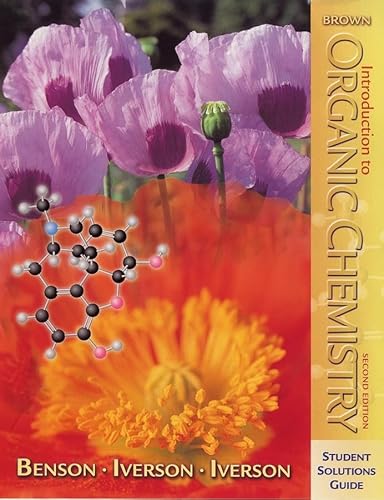
Synopsis
This book enables readers to see the connections in organic chemistry and understand the logic.
- Reaction mechanisms are grouped together to reflect logical relationships.
- Discusses organic chemistry as it is applied to real–world compounds and problems.
- Electrostatic potential plots are added throughout the text to enhance the recognition and importance of molecular polarity.
- Presents problems in a new “Looking–Ahead” section at the end of each chapter that show how concepts constantly build upon each other.
- Converts many of the structural formulas to a line–angle format in order to make structural formulas both easier to recognize and easier to draw.
"synopsis" may belong to another edition of this title.
About the Author
William H. Brown is Professor Emeritus at Beloit College, where he was twice named Teacher of the Year. He is also the author of two other college textbooks; Organic Chemistry 3/e published in 2002, and General, Organic, and Biochemistry 7/e coauthored with Fred Bettelheim and Jerry March, published in 2004. he received h is PhD from Columbia University under the direction of Gilbert Stork and did post–doctoral work at California Institute of Technology and the University of Arizona. Twice he was Director of a Beloit College World Affairs Center seminar at the University of Glasgow, Scotland. In 1999, he retired from Beloit College to devote more time to writing and development of educational materials. Although officially retired, he continues to teach Special Topics in Organic Synthesis on a Yearly basis.
Thomas Poon is Associate professor of Chemistry in the Joint Science Department of Claremont McKenna, Pitzer, and Scripps Colleges, three of the five undergraduate institutions that make up the Claremont Colleges in Claremont, California. He received his B.S. degree from Fairfield University (CT) and his Ph.D. from the University of California, Los Angeles under the direction of Christopher S. Foote. Poon was a Camille and Henry Dreyfus Postdoctoral Fellow under Bradford P. Mundy at Colby College (ME) before joining the faculty at Randolph–Macon College (VA) where he received the Thomas Branch Award for Excellence in Teaching in 1999. He was visiting scholar at Columbia University (NY) in 2002 (and again in 2004) where he worked on projects in both research and education with his friend and mentor, Nicholas J. Turro. His teaching duties include organic chemistry, forensic chemistry, and upper level courses in photochemistry and advanced laboratory techniques. his favorite activity is working alongside undergraduates in the laboratory on research problems involving the investigation of synthetic methodology in zeolites, zeolite photochemistry, and reactions of singlet oxygen.
From the Back Cover
The flower of the passion fruit, Passiflora edulis, showing 3–fold and 5–fold symmetry in its styles and stamen, respectively. Symmetry and the lack of symmetry are important features of organic molecules. For example, a fascinating distinction between the yellow and purple passion fruit was found when studying compounds occurring within the species. 2–Heptanol, for example, is found in both the yellow and purple passion fruit but, whereas the R enantiomer predominates in purple fruit (92%), the S enantiomer predominates in yellow fruit (82%). Just as the passion fruit and its′ flower illustrate important concepts at work in organic chemistry, this text enables students to make the connections between organic chemistry in the classroom and the world around them.
"About this title" may belong to another edition of this title.
Search results for Student Solutions Guide to Accompany Introduction to...

Stock Image
Student Solutions Guide to Accompany Introduction to Organic Chemistry
Published by
Wiley & Sons, Incorporated, John, 1999
ISBN 10: 0470004053
ISBN 13: 9780470004050
Used
Softcover
Seller: Better World Books, Mishawaka, IN, U.S.A.
Seller rating 5 out of 5 stars

Condition: Good. 2nd Edition. Pages intact with minimal writing/highlighting. The binding may be loose and creased. Dust jackets/supplements are not included. Stock photo provided. Product includes identifying sticker. Better World Books: Buy Books. Do Good. Seller Inventory # 573854-6