
Synopsis
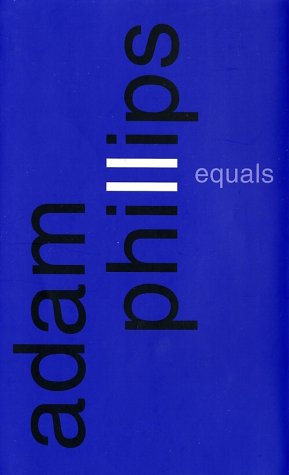
If the best thing we do is look after each other, then the worst thing we do is pretend to look after each other when in fact we are doing something else. Psychoanalysis teaches us the dangers of this paradox--and, in doing so, gives us fair warning about the perils of all social endeavors. In one way, the talking cure can be seen as a kind of listening cure. And learning to listen and be listened to is a skill upon which democracy itself depends.Written in his beloved epigrammatic and aphoristic style, Equals extends Phillips's essayistic probings into the psychological and the political, bringing his trenchant wit to such subjects as the usefulness of inhibitions and the paradox of permissive authority. He explores why citizens in a democracy are so eager to establish levels of hierarchy when the system is based on the assumption that every man is created equal. And he ponders the importance of mockery in group behavior and the psyche's struggle as a metaphor for political conflict.
"synopsis" may belong to another edition of this title.
Review
Adam Phillips's Equals attempts to relocate psychoanalysis as a natural part--and even a necessary part--of an engaged and unregimented life. Phillips is a politically aware writer. He is not a "party man" in any sense. But he has notions about democracy that inform, not just his view of psychoanalytic practice, but also his ideas about human freedom and happiness. Phillips reminds us that people suffer, not because they are in conflict with themselves, but because they have suppressed a conflict by imposing an unconscious authoritarian order over their thoughts and feelings.
The aim of psychoanalysis is to recreate emotional fluency. (One assumes the job of politics is to deal with the fallout.) Like democracy, psychoanalysis should recognise and legitimate conflict which an authoritarian (superegoistic) order would suppress. Drawing parallels between the idea of free association in democracy, and the practice of free association in psychoanalysis, Phillips writes: "hearing all those voices... may itself be a kind of happiness". Phillips's arguments are meticulous, and sometimes fussy. The general reader will find some passages obscure, but there is never the sense that Phillips is being deliberately obscurantist. His compassion--as a writer, as an analyst, and as a literary critic--is admirable. A child psychotherapist by training, his essay "Childhood Again" brings his strongest qualities together--ideological nous, close argument and compassion--in an entirely successful and memorable synthesis. --Simon Ings
Review
"Brilliantly lucid; reading him on top form is like having bubbles of insight exploding inside one's head."
"About this title" may belong to another edition of this title.
Other Popular Editions of the Same Title

Search results for Equals

Stock Image
Equals
Seller: Wonder Book, Frederick, MD, U.S.A.
Seller rating 5 out of 5 stars

Condition: Good. Good condition. Acceptable dust jacket. With remainder mark. A copy that has been read but remains intact. May contain markings such as bookplates, stamps, limited notes and highlighting, or a few light stains. Seller Inventory # V02A-05197
Stock Image
Equals : On Inhibition, Mockery, Hierarchy, and the Pleasures of Democracy
Published by
Basic Books, 2002
ISBN 10: 0465056792
ISBN 13: 9780465056798
Used
Hardcover
First Edition
Seller: Better World Books, Mishawaka, IN, U.S.A.
Seller rating 5 out of 5 stars
Condition: Good. 1st Edition. Pages intact with minimal writing/highlighting. The binding may be loose and creased. Dust jackets/supplements are not included. Stock photo provided. Product includes identifying sticker. Better World Books: Buy Books. Do Good. Seller Inventory # 4981126-6
Stock Image
Equals
Seller: HPB Inc., Dallas, TX, U.S.A.
Seller rating 5 out of 5 stars
hardcover. Condition: Very Good. Connecting readers with great books since 1972! Used books may not include companion materials, and may have some shelf wear or limited writing. We ship orders daily and Customer Service is our top priority! Seller Inventory # S_397859791
Stock Image
Equals
Seller: ThriftBooks-Reno, Reno, NV, U.S.A.
Seller rating 5 out of 5 stars
Hardcover. Condition: Very Good. No Jacket. May have limited writing in cover pages. Pages are unmarked. ~ ThriftBooks: Read More, Spend Less. Seller Inventory # G0465056792I4N00
Stock Image
Equals
Seller: ThriftBooks-Atlanta, AUSTELL, GA, U.S.A.
Seller rating 5 out of 5 stars
Hardcover. Condition: Very Good. No Jacket. May have limited writing in cover pages. Pages are unmarked. ~ ThriftBooks: Read More, Spend Less. Seller Inventory # G0465056792I4N00
Stock Image
Equals
Seller: ThriftBooks-Dallas, Dallas, TX, U.S.A.
Seller rating 5 out of 5 stars
Hardcover. Condition: Very Good. No Jacket. May have limited writing in cover pages. Pages are unmarked. ~ ThriftBooks: Read More, Spend Less. Seller Inventory # G0465056792I4N00
Stock Image
Equals
Published by
Basic Books, 2002
ISBN 10: 0465056792
ISBN 13: 9780465056798
Used
Hardcover
First Edition
Seller: Rick's Books NYC, New York, NY, U.S.A.
Seller rating 4 out of 5 stars

Hardcover. Condition: Very Good. Dust Jacket Included. 1st Edition. Basic Books, 2002 1st Very good -. Seller Inventory # 879232922
Stock Image
Equals
Seller: Lexington Books Inc, Idaho Falls, ID, U.S.A.
Seller rating 5 out of 5 stars
Hardcover. Condition: Very Good. VG in VG dj. Seller Inventory # 116073
Stock Image
Equals
Seller: WorldofBooks, Goring-By-Sea, WS, United Kingdom
Seller rating 5 out of 5 stars
Paperback. Condition: Very Good. The book has been read, but is in excellent condition. Pages are intact and not marred by notes or highlighting. The spine remains undamaged. Seller Inventory # GOR005393082
Buy Used
£ 9.20
£ 5.80 shipping
Ships from United Kingdom to U.S.A.
Ships from United Kingdom to U.S.A.
Quantity: 1 available
Stock Image
Equals
Published by
Basic Books, New York, New York, U.S.A., 2002
ISBN 10: 0465056792
ISBN 13: 9780465056798
Used
Hardcover
Seller: Murphy-Brookfield Books, Iowa City SE, IA, U.S.A.
Seller rating 5 out of 5 stars
Hardback. Condition: Very Good. Dust Jacket Condition: Very Good. Seller Inventory # 326423