
Items related to Born That Way: Genes, Behavior, Personality
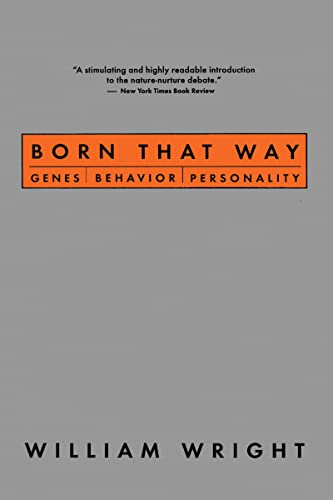
Synopsis
Taking the nature vs. nurture debate to a new level, this fascinating, comprehensive journey into the world of genetic research and molecular biology offers a fresh assessment of the work that has been done in this relatively new field during the last half century-work that has demolished common assumptions and overturned existing theories about what determines our personality and behavior.
"synopsis" may belong to another edition of this title.
About the Author
William Wright grew up in Philadelphia and graduated from Yale University. He is the author of many books and articles. Wright lives in Bucks County, Pennsylvania and Key West, Florida.
Excerpt. © Reprinted by permission. All rights reserved.
Born That Way
By William WrightRoutledge
Copyright © 1999 William WrightAll right reserved.
ISBN: 9780415924948
Chapter One
THE CHEMISTRY OF SELF
ON A MONDAY MORNING Of a typical workweek, a single woman inher early thirties is awakened by k.d. lang coming over her clock radio.She switches to a classical station and is pleased to hear a Haydn symphony;the soothing rationality of classical music is her preference forstarting the day. After a hot shower, she applies her usual discreetmakeup, then selects a beige suit with gold buttons to wear to theoffice. She wore it only four days ago, but she feels good in it andknows it's becoming.
She brews a pot of Yuban French Roast and drinks a cup--milk butno sugar--while skimming the morning paper, which annoys her forhaving nothing about a major film star's arrest on drug charges thathad been mentioned on the eleven o'clock news. An article on theobstructed relief efforts in Zaire upsets her and she resolves to donateanother fifty dollars to Save the Children. On her way to the street, theelevator stops at a lower floor and an unfamiliar man in his fortiesenters and greets her cheerfully. She grunts and feels a complicatedmix of obligatory civility, stranger-fear, violated space, and anger atmale sexual presumption. She yearns for the elevator to reach thelobby.
Once outside her building, she resists splurging on a taxi and waitsfor a bus. Finding a seat next to a teenaged boy with books on his lap,one open to a page of graphs, she feels a rush of satisfaction at her successsince leaving college, where her grades were lackluster. But then apang of regret hits-her about career opportunities missed, misstepstaken. The boy indicates he is getting off. She slides into his seat andlooks out the window to see an old man carrying a suitcase stumble onthe curb and almost fall. An urge to help comes over her.
The empty seat beside the woman is taken by a tall slender man inhis forties. From the corner of her eye she sees that he has curly brownhair, a trim mustache, and glasses--three of her favorite attributes in amale. She reads her newspaper, but glances at his pants leg so close toher skirt and wonders if his leg is hairy. She forces down an erotic surgeby plunging into an editorial on redistricting. Traffic is moving slowly;she fears she'll be late. A Hispanic man who looks drunk boards thebus and fumbles for the fare as the traffic light turns red. She wants toscream.
All of these reactions, concerns, judgments, and decisions mightseem products of conscious thoughts. Or, with more reflection, somemight be traced to the woman's experience, upbringing, or social conditioning.They may, in fact, have sprung from none of these, but mayhave been prompted, wholly or in part, by her genes, those infinitesimalbits of DNA, which thirty years of research tells us influences ourpersonalities, our behavior, and how we respond to the world aroundus. As the woman goes about her day, she draws on her reasoningpower to deal with special situations. Much of the time, however, sheis, like most of us, on semiautomatic pilot, reacting to whatever theenvironment throws at her with ebbs and surges, blips and flashes, ofchemical, gene-rooted responses. As with all humans, her behavior isshaped and guided by signals from the biochemical motherboards thatgenes have created in each of us.
The interaction between genes and environment is, we now know,essential to the developing child--and for psychologists the term "environment"means every influence on an organism that is not genetic.Not only in children, but in adults too, the environment can havepowerful effects. But to a greater degree than ever before realized, thegenetic influences on behavior, barring an extraordinary childhood(malnutrition, social deprivation, prolonged abuse), express themselvespretty much as configured before birth.
Scholars have traditionally divvied up the human into an arrayof discrete vantage points--anatomy, psychology, anthropology, sociology,economics, political science, history. We now see these disciplinesconverging on a component of our physical selves that mountingevidence indicates is the underlying basis of it all: the twenty-threepairs of chromosomes, containing approximately 100,000 genes, thatexist in every human cell. Whatever the term--chromosomes, genes,DNA, the double helix, nucleic acids, ribosomes, alleles--all refer toour biochemical blueprints.
Genetic discoveries have been receiving so much press that non-scientistscan be forgiven for seeing the DNA furor as a fad, a NewThing steamroller, this year's channeling or biorhythms. The worldappears so in the grip of a double-helix dither that less excitable typesshrug it off as a hyped-up media ploy to make the news of the dayappear different from the news of last week. Unfortunately for peoplealready bored with gene palaver, the ramifications of this scientificearthquake will continue unfolding, and making news, well into thenext century. And the possibilities this knowledge opens up are vast.
Many of the most riveting findings have been of a high-prioritymedical nature, the genetic roots of birth defects and diseases that,throughout time, have plagued humanity. Because of the widespreadsuffering caused by these genetic mishaps--British geneticist SteveJones states that one child in thirty is born with a genetic irregularity ofone sort or other--the excitement over genetic therapies is understandable.More recently, the sensational news about cloning a sheepfrom a mature cell has seized the spotlight from even the landmarkmedical breakthroughs.
Important as these advances are, they have overshadowed a concurrent,and in some ways more momentous, revolution--the burgeoningunderstanding of genetic links to personality and behavior. Amass of research that has been building over the past two decades hasforced most psychologists and other social scientists to acknowledgewhat they had long denied: Genes influence not just physical characteristicssuch as hair color and susceptibility to cancer but ourpersonalities, temperaments, behavioral patterns--even personal idiosyncrasies,the quirks and foibles that make each person unique.
Since behavior is the subject of this book, and the term is broadenough to glaze the eyes of nonprofessionals, it might be a good idea toconsider what the word means to scientists. For them, behavior iseverything the organism does and thinks--from crying for its motherto delivering a Nobel acceptance speech. Ambition is behavior; so arelaziness, rebellion, and compassion. Patriotism, sexism, hating yourboss, and loving the Lakers--all are forms of behavior. Virtually anythingthe individual does, any product of the brain, any action, anymood, emotion, mannerism, or tic, is lumped under the umbrella word"behavior."
From the beginning of the brief hundred years that the mechanicsof inheritance have been unfolding, science understood that geneswere the building plans for our bodies and brains, the human machinethat seemed to be able to think and behave in unlimited numbers ofways. Patterns and constraints were imposed on behavior from theexternal world, especially from the culture and its primary agents, parents.Now we see that this picture is not accurate. Many patterns andconstraints are imposed by culture, but many others, the new evidenceshows--along with batteries of impulses, leanings, attitudes, susceptibilities,aptitudes--are born with us.
It is hard enough for nonscientists to conceive or a few microscopicspecks of nucleic acid containing the instructions for growing an arm,an ear, or a kidney. Now research says we must grasp as well that similarspecks can also go far toward determining if we are to be happy ormorose, passive or aggressive, bright or dim, liberal or conservative,religious or atheistic. "Phenotype" is the word scientists use for eachgenetic manifestation. (Genotype refers to an organism's entire complementof genes, the overall blueprint for each species.) A leg is aphenotype; so are arms, ears, and kidneys. Geneticists have come toconsider behavior (or behavioral propensities) just another phenotype.
Among those pursuing this research, some focus on specieswidetraits, seeking out the evolved behavioral template shared by everyone.These are the evolutionary psychologists and sociobiologists who try toidentify the broad traits that have evolved to make up human nature--aggression,competitiveness, sociality, and altruism would be a few.Behavioral geneticists, on the other hand, are more interested in individualdifferences. They are ferreting out the genetic influences, ifany, that make one person fearful, another bold, one optimistic, onepessimistic, one placid, one fretful. They are also seeking the specificgenetic configurations that abundant evidence indicates interact withthe environment to produce such common behavioral problems asdepression, addiction, obesity, and autism.
An unexpected product of this research is the ever-narrower behavioralnooks and crannies that reveal a genetic component. For most ofus it is not difficult to accept at least partial genetic orchestration ofbroad categories of temperament such as shyness, pessimism, andboldness, among others. Narrower traits, however, such as compassion,extravagance, rule-flouting, and risk-taking, can, without toogreat an effort of the imagination, also be nominated for biochemicalunderpinnings. But our minds rebel at the news that genes can inducesuch behavioral minutiae as hand gestures, pet-naming, and nervousgiggles. According to recent research, this appears to be the case.Whether aimed at individual differences or specieswide traits, bothbehavioral genetics and evolutionary biology are in the business ofseeking genetic paths to behavior, and both are bringing about a newperspective on the human complex.
Therapeutic promise is not the only reason the news about genetherapy and cloning has overshadowed the news concerning behavior.The genetic insights about physical defects and dysfunctions are fillinga void of knowledge or deepening existing understanding. This sortof information is welcomed by everyone. Findings about the gene-behaviordynamic, on the other hand, are overturning existing truthsand demolishing assumptions upon which fifty years of psychologicaltheory has been based. Totally different answers are emerging to questionsmany experts were confident had long been answered. It is thisapostate cast to the behavioral findings that has caused turmoil in theacademic community and provoked angry debate. It has also contributedto the early media caution in announcing the discoveries.
THE LARGEST BODY of hard data to establish the genetic roots ofbehavior has come from comparisons of fraternal with identical twinsand comparisons of adopted with biological siblings. For thirty yearsthese investigations have been progressing quietly in scores of kinshipstudies in the United States and abroad and building a mountain ofevidence of the gene-behavior relationship. Of all this research, themost persuasive as well as the most dramatic has been an eighteen-yearexamination at the University of Minnesota of identical twins whowere separated shortly after birth and raised in different homes. Thestudy has examined over seventy sets of separated identical twinsand more than fifty sets of fraternals. The telling results startled notonly the scientific world but the Minnesota researchers themselves.This was not so much for the degree of genetic influence on traits,which has already been established by other studies, but by the highlyspecific nature of some genetic expressions. Some of these storiesare astounding and dramatically extend the possibilities of geneticstring-pulling.
Conclusive as these overall twin findings were for many of the extensivegene-personality links, even harder scientific evidence corroboratingthis data is just now beginning to emerge from molecularbiologists who are tracking the DNA itself to locate explicit chromosomalsegments that lead to particular behaviors. While twin and adoptionstudies measure and compare individuals to establish geneticinfluence, molecular biologists can be seen as approaching humanbehavior "from the other end," seeking out the individual genes thatmight contribute to a particular trait. Such gene pinpointing brings usmuch closer to interventions--enhancing, fixing, blocking. The possibilitiesare endless.
After a disheartening series of near misses--studies that appeared tohave located culprit genes for specific behaviors but that couldnot be replicated--success appeared to have arrived in January 1996.Researchers in two different research groups (one in the U.S., anotherin Israel) isolated a DNA fragment that was consistently longer in subjectswho showed a taste for risk-taking. This appeared to be the firsttime a precise strand of nucleic acid was linked to a particular personalitytrait. The discovery was reported on the front page of the NewYork Times. It looked as if science had at last "seen" the bouquet ofmolecules that causes certain people to shoot rapids and bungeejump. As so often has happened with efforts to pinpoint behavioralgenes, this finding was cast into doubt by a third study in Finland, butfew in the field doubted that such specific pairings of genes and behaviorwere far off.
Confusion has resulted from the two different methods of linkinggenes to behavior when misfires of one were mistakenly seen to negatethe successes of the other. A typical example of the misunderstandingappeared in a 1994 Time magazine cover story, "Genetics, the FutureIs Now." The piece was an authoritative overview of the medical discoveriesand a discussion of the social and ethical issues they evoke.The article stumbled, however, when it touched on behavior. "Studiesclaiming to have found genes for alcoholism," it read, "... have notheld up under scrutiny, but many people still assume such complexbehaviors may be predetermined by heredity." With the word "assume,"Time renders a belief in a genetic component to traits such asalcoholism little more than a hunch. And by the use of the word "predetermined"rather than "predisposed," Time sets up a straw-man theory ofall-powerful genes held by no behavioral geneticist.
Twin and kinship studies have for decades established geneticcomponents to some forms of alcoholism, depression, and many otherbehavioral irregularities. To accurately sum up the state of behavioralgenetics research at that time, they could say that, no, scientists hadnot yet found the specific genes, but, yes, they knew that genes wereinvolved. But that was knowing plenty, enough certainly to justify themillions of research dollars that have been spent in the years sinceseeking out specific genes. The failure to pinpoint gene-behavior tie-upsin no way weakened the hard statistical evidence of inherited predispositionsfrom somewhere in the genome.
In the two years since the Time article appeared, there have beenmajor advances in gene-behavior understanding, and specific genesfor specific behaviors have now been isolated. But the confusionlingers on. Reviewing Philip Kitcher's book The Lives to Come in TheNew Yorker of February 12, 1996, John Seabrook wrote: "What if it turnsout that there really are genes that influence intelligence, along with avariety of behavioral characteristics. . .?"
To write such a sentence in a respected publication in 1996 is akinto someone writing in the New York Times, "What if it turns out thesun really is the center of the solar system. . .?" Although the conclusionof genetic influence over behavior has been, to a degree, inferential,the abundance of data has long since removed the issue fromwhat-if-land.
It is understandable that the DNA scanners have created greaterexcitement than the observational studies of twins and adoptees. Themain reason for this preference is that zooming in on trouble-causinggenes brings science much closer to therapies and remedies. But thoseof us rooting for broad acceptance of the new knowledge about genesand behavior see a public relations advantage as well. Astronomersmight prove mathematically that Pluto is out there circling the sun,but for most people, it is much more convincing to see a photo of theelusive planet, however fuzzy.
When scientists hold a news conference to show on a screen thegene that causes alcoholism--or depression or violence or nail-bitingor child abuse--the impact on the public is sure to be far greater thanthe hardworking psychologist, who may have examined thousandsof twins pairs, holding up charts, saying, "See, my statistics prove agenetic influence." However powerful the numbers, this is still anabstract, circumstantial case; juries always prefer concrete, eyewitnesscases.
In animals a number of genes have been located that govern specificbehaviors. Most recently a gene in female rodents was found thatwhen blocked, turned mothers from busy nurturers into indifferentloll-abouts. The experiment had clearly isolated a good-mother gene.(Don't have kids without it.) In humans, similar tie-ups are imminent.Since late 1994, several genetic mechanisms that cause obesity havebeen revealed, and many more gene-behavior couplings are sure tofollow.
As the spotlight is turning from the kinship studies with theirdry statistics to the sexier molecular biologists with their promise ofbehavioral-gene snapshots, it should be pointed out that the searcheswould not have been undertaken in the first place if it were not for thepsychologists who for the past thirty years, in bold defiance of theirfield's prevailing orthodoxy, have been following their intuitions andsearching out genetic links to behavior using the only tools at their disposal,the statistical comparisons of genetically related individuals.
Just as Gregor Mendel only inferred the existence of genes butnonetheless developed his on-target laws in the 1860s by merelyobserving patterns of inheritance, so the behavioral geneticists havedrawn conclusions from their studies of twins and adoptees with noidea which genes brought about the all-too-evident behavioral effectsand little idea how they functioned. They pushed ahead, making nosecret of their ignorance of the workings in "the black box" that satbetween a gene and a trait. Although much mystery still obscures thechemical path from genes to behavior, molecular biologists havejoined behavioral geneticists to demonstrate beyond any doubt thatthe genes-behavior paths are there.
ON THE FACE of it, all of this may not seem too revolutionary. Everydaychitchat abounds in behavioral geneticist thinking. "She gother extravagance from her mother." Or, "the musical talent comesfrom his father's side." Or, "he's a crook just like his granddaddy."Whether consciously or not, such remarks suggest DNA strings thatlead to spending sprees, piano-playing, and crookedness. While wemay have gut feelings of genetic transmission of personality traits--animalbreeders have known about it for centuries--such thinkinghas been abhorrent to prevailing scientific thought for much of thiscentury. Back-porch philosophers and animal breeders could believewhatever they wished; science knew we humans were creatures of ourrearing environments. Experience and learning determined who weare, nothing else.
This is no minor artifact of intellectual history to be tossed quicklyinto the bin marked "Earlier Mistakes." The behaviorist belief in anall-powerful environment has for many decades dominated enlightenedthinking and been the basis of our society's approaches to child-rearing,education, social dysfunctions--and, of course, psychologicalproblems. All the leading psychotherapists, from Freud to Joyce Brothers,might have disagreed about which environmental influences madeyou wet your bed, bite your nails, expose yourself--but none had anydoubts that it was something in the environment. Always the environment.And this view is still very much with us, if more as a habit ofthought than a conscious idea.
Psychiatrist Peter Neubauer, who did his own study of reared-aparttwins, tells a story of identical brothers that vividly illustrates thedegree to which the environmental assumption dominated our thinking.The brothers, who were in their early thirties, had been separatedat birth and raised in different countries. Both were neat and clean to acompulsive degree. When asked to explain how they had become thisway, each twin traced his idiosyncrasy to his adoptive mother. Oneexplained that his mother had also been obsessively fastidious, constantlycleaning the house, doing laundry, straightening things. Hehad no doubt that his tidiness came from her. The other brother, notknowing his twin's explanation, replied without hesitation that heknew exactly why he was so neat: His mother had been a completeslob as a housekeeper. He was reacting against her.
The men did not need training in the day's psychology to haveabsorbed the behaviorist truth that the key to unusual adult behaviorlay somewhere in childhood experience, in the rearing environment.There was no other possibility. Armed with that assumption, explanationswere easy to come by, even if they contradicted each other.
In the days when such behaviorist certitude prevailed, countlessresearch projects examined how and to what degree the environment,acting alone, determined behavior. Those skewed psychological studies,which remarkably still go on, were based on the premise that onenewborn was pretty much like another; the environment stamped theinfants with distinctive personalities. For behaviorists, unraveling thepuzzle of a particular human was simply a matter of discovering whichenvironmental elements were the most relevant during the formativeyears. No one found genetic influences because no one was lookingfor them. Now that many are looking, they've found them in spades.
The new information about genes is not just a matter of freshdogma replacing old. The discoveries of behavioral genetics have shownthe earlier environment-is-everything model to be half true, but a viewof human functioning so myopic, so lopsided as to invalidate most ofthe findings based on it. It also caused considerable harm. A primeexample would be the psychodynamic "cures" imposed on sufferersof conditions we now know can have genetic roots--calamities likeschizophrenia, autism, obesity, and an array of neurotic symptoms.Harm was also inflicted when parents were blamed for childhoodproblems that stemmed from genetic irregularities. In addition to theinjustice involved, placing blame in the wrong place moved practitionersfurther from remedies. For nailing down the cause of psychologicalproblems, genetic knowledge now provides an additionalsuspect: pesky bits of nucleic acid contained in the genes that the parentsmay have provided but over which they have little or no control.
A PRINCIPAL REASON the extreme behaviorist, antigenes view dominatedpsychology for so many years was its strong political appeal. Theliberal movements that flourished in the first half of the century basedmuch of their theory on the concept of an infinitely malleable human.The world could be made better by making people better. Talk ofgenetic influences suggested unchangeable humans and was seen asjustification for such societal brutalities as racism and slavery. Not onlywas a belief in gene-based behavior seen as an obstacle to improvingthe world, but it was also viewed as an excuse for not trying.
There were valid reasons for fearing a backward thrust to thegenetic perspective. Charles Darwin had barely enunciated his theoryof natural selection before it was brandished by conservatives as proofof the inevitability of social injustice. His monumental insight aboutevolution with its encapsulation, "survival of the fittest" (which referredonly to procreational prowess), was wrenched into the service of reactionarysystems such as Social Darwinism (if you are poor it is becauseyou were born to be poor), eugenics (stop the unfit from propagating),and Nazism (eliminate the unfit already here).
Because of these bogus and preemptive applications of inheritancetheories, the entire subject of genes and human behavior wasstigmatized with ugly ramifications that linger today. In a look at thishistory further on, I hope to demonstrate that behavioral geneticsknowledge, like all knowledge, is neutral and can be used to bolsterany political position, left or right. To reject this fundamental informationbecause of previous right-wing applications makes as much senseas rejecting electricity because of daytime television.
Today, however, the genetic evidence is too powerful for whimsicalselection on political grounds of one behavioral theory over another.The abundant data now on the table is forcing both liberals andconservatives to grapple with the genes-environment-behavior nexus.The cumulative evidence from evolutionary psychologists, sociobiologists,and behavioral geneticists has established a new reality withwhich everyone must deal. Because this revised view of the human isgaining acceptance from people of all ideologies, it is highly unlikelythat one group will succeed in commandeering it, at least not withouta fight from the others.
The shrinking band who still oppose behavioral genetics on politicalgrounds console themselves with fantasies that it is a passing phase.Prominent psychologist Leon Kamin of Northeastern University, whois one of the most bellicose critics, told me in an interview early in myresearch that genes-behavior theories make sporadic appearances onthe intellectual landscape. With weary exasperation he added thatthese outbreaks lofted him and other alert champions of environmentaldeterminism to beat them back like so many brush fires--writingdebunking articles and angry letters to editors. After my five years ofresearch, which I summarize in this book, I feel his remark is akin tosaying the spherical-earth theory is an idea that crops up with irritatingfrequency and must be repeatedly dispatched by scientists of sounderbent.
Political fears are not the only reason for resistance to the genes-behaviorfindings. Because of broadly held misconceptions aboutgenes' power, many people feel that awarding them a degree of controlover our actions means we are no longer masters of ourselves.By admitting that genes influence our behavior, we will be admittingthat we are not in charge, that we are operating on chemicalremote-control.
The obvious power of genes to dictate physical traits like hair colorand foot size has led many nonscientists to assume that if such dictatorialentities also affect behavior, their influence must ipso facto beequally strong in this area. The fear seems to be that if we yield to DNAa degree of sovereignty over our conscious thought, if we permit genesthrough the behavioral door, we will be acquiescing to the same geneticdetermination governing our body parts. An individual's chronicpessimism, overeating, or fear of flying would become as unchangeableas eye color.
Behavioral genes don't work that way. None of the data turned upby behavioral geneticists shows genes to be tyrannical commands, butrather nudges, sometimes strong, but more often weak. None of theresearch has found a single genetic influence on behavior that couldbe called "all-powerful," even though the critics pin this belief onbehavioral geneticists and stigmatize them with the frightening label"genetic determinists."
A lot has been learned in the past year or so about the weaknessof some genetic influence. As for the more powerful genetic triggersto behavior-particularly to negative behaviors like addiction andviolence--we can now foresee interventions to reduce or alter theeffects. It is as though in order to soften the jarring news of how pervasiveand meddlesome genes can be, Mother Nature is providing uswith calming insights into their uneven power and potential adjustability.With good-news-bad-news timing, we are learning of genes'broad influence over our behavior at the same time we are learningthat they are not as powerful as we feared.
Genetic impulses are overruled all the time--when a fat persondiets, for instance. As British geneticist Richard Dawkins puts it, whenhumans use contraception, they are defying their genes, which arebent on reproduction. Nuns and monks take rebellion to the limit andrenounce sex altogether. Although the gene-based sex drive is as powerfulas any genetic command, it can be disobeyed. However difficultor uninteresting, celibacy is still an option.
While genes are not all-powerful with behavior, evidence mountsthey are all-pervasive in that they appear to influence, to howeversmall a degree, our every thought and action. This sweeping claim is not justa verbal trick based on the physiological fact that genes have fashionedthe brain with which we think and act. It is said in the more specificsense that human impulses, reactions, dispositions, desires, aversions--mostfacets of our personalities--are colored directly, if only to a minordegree, by each individual's genetic makeup. In countless studiesaimed at sorting out genetic from environmental effects, not one of thenumerous traits examined failed to show at least some degree of geneticinfluence.
I have my own hunch why the loss-of-sovereignty fear may lingerlonger than the evidence should allow. The people most likely toreject the notion of a behaviorally programmed human brain are thebrightest people among us, the brain-proud, those most disposed tobelieve their every thought flows from pure reason, nothing more.They are also the people who evaluate intellectual trends--writers,academics, and other opinion shapers. It is ironic that those whoprobably see themselves as having the most to lose by admitting thattheir behavior has genetic strings attached are the very ones we look tofor a thumbs-up or thumbs-down on new visions of human makeup.You might not be upset to learn that genes are manipulating ushumans, but Harvard's Stephen Jay Gould hates the idea.
All of these perceived threats--to progressive politics, to scientificorthodoxy, and to self-esteem--have combined to hinder acceptanceof the genes-behavioral revolution and to mute, sometimes to a whisper,the announcements of its remarkable findings. Of course, thevalidity of the new science in no way depends on our enthusiasm for itsimplications, but its acceptance, to a large degree, does. Even thoughthe resistance is weakening, the result is that much of the publicremains unaware of this landmark change in our understanding of thehuman or at best perceives the genes-behavior perspective as just oneof a parade of fads in psychological truth.
Even worse, the old belief that the roots of all human behaviorcould be found in the rearing environment permeates much of ourthinking and hobbles our quest for solutions to a broad range ofproblems--from individual quirks to societywide scourges like addictionand violence. Some argue that it's only natural we look to theenvironment for solving problems because environments can bealtered, genes cannot. While both points are untrue, the logic isskewed as well. To use behavioral geneticist Robert Plomin's analogy,this is like the man who lost his wallet in an alley but looked for it inthe street because the light was better.
The appealing notion that environments are always adjustable isturning out to be just as false as the notion that genes issue orders wecan't refuse. An example of an influential environment that is difficult,if not impossible, to adjust would be the womb conditions that canhave lasting behavioral impact on the child to be. Also, the air webreathe and the water we drink--and here the two uses of the word"environment" converge--have elements that can affect behavior surreptitiously,as shown by recent findings about the devastating effectsof lead pollution on children. Other troublemaking environmentalconditions cannot be repaired because we don't know they're out theremaking trouble.
In spite of much scientific evidence to the contrary, the twofallacies--immutable genes and malleable environments--linger on. Itis, I believe, the shadow of these misconceptions that explains why somany informed people accept in principle a genes-behavior dynamicbut have yet to incorporate the new view into their cognitive databanks.
And behind all the pragmatic fears of genetic influence liesan emotional resistance. Will an understanding of the biochemicalmechanics of behavior make us less interesting? Throughout historyour fascination with ourselves has proved endless. Not only is all ofworld literature and drama evidence of this, we now have scores ofsatellites circling the globe, beaming hundreds of channels into millionsof living rooms. Except for George Page on PBS and a few otheranimal programs, all of it is taken up with the rich variations of humanbehavior. Will an unraveling of behavioral biochemistry, a grasp of theblack box, make us less intriguing? I suspect a deep-seated dread thatreducing such worthy qualities as friendship, loyalty, ambition, andlove to molecular interactions will dispel the mystery, diminish theglory. The resistance to knowledge about behavioral genes may notstem so much from what is implied about politics or self-command butfrom what it might do to our self-absorption. I like to think it will makeus even more interesting, but in a different, more enlightened way. Wemight even net a few new plots in the human saga.
For all the advances in understanding of genes' power over behavior,no geneticist denies that the environment still plays an importantrole. Researchers of twins are quick to point out that with separatedidentical twins, in spite of similarities that so vividly demonstrategenetic effects, their many differences are eloquent testimony to theenvironment's power to mold.
The evidence we are about to examine leads to the conclusion thatwhile the environment can have a major effect on forming personalityand guiding behavior, much of the time it doesn't. But the simpleacknowledgment that, with any human behavior, genes may be involvedis a momentous change in our species' self-view, and a changewith major ramifications for our approach to parenting, education,psychotherapy, and a host of other self-directed human enterprises.
ALTHOUGH SOME ACADEMICS continue to fight for the blank-slateview of the human, the biological-genetic perspective has now establisheditself in universities throughout the country and, more andmore, with the public. Young academic disciplines such as sociobiologyand evolutionary psychology are totally rooted in this gene-basedview. Increasingly, the traditional social sciences are introducinggenes into their grab bags of variables on almost any aspect of humanactivity. Serious writers are doing the same.
Major behavioral genetics research projects involving teams ofscientists are under way at the universities of Minnesota, Texas, Virginia,Colorado, and Louisville, and at Penn State and the MedicalCollege of Virginia. Individual scientists are pursuing smaller studiesat Harvard, California State University, and the University of Pennsylvania,as well as at Northwestern and Boston universities. Researchat many U.S. hospitals on such medical problems as alcoholism andobesity fall under the category of behavioral genetics. Importantresearch is also in progress in Sweden, Denmark, England, Australia,and Canada.
Increasingly there are signs of gene-behavior awareness seepinginto the national consciousness. A New York Times crosswordpuzzle--perhaps as good a bellwether as any other of mainstream acceptance ofcontroversial knowledge--not long ago required a four-letter word thatmeant "personality determinant." The word was "gene." During a televisioninterview, author Russell Baker was asked by Charlie Rose hisopinion about the source of a sense of humor. Without hesitationBaker replied, "It's genetic." Only a few years earlier, few educatedpeople would have held such an opinion, or if they had, would havelet it fall so casually from the tongue in front of a large audience.
Now, however, the genes-behavior link has been accepted to sucha degree, in both academia and with the public, that opponents areshifting their field to a pose of "what else is new?" While I was talkingwith Professor Kamin, he launched into a slash-and-burn diatribeagainst the most prominent behavioral genetics studies. Did he then, Iasked, believe human behavior was without genetic influence? Withno hesitation Kamin replied, "Of course there's a genetic componentto behavior." You would never detect this view by reading Kamin'smany attacks or those of his allies.
Other members of the opposition, the stop-genes group some termthe "radical environmentalists" and I term the "genophobes," slip similaradmissions into their antigene screeds. But these offhand capitulationshave a false resonance, akin to a chorus of fifteenth-centurybishops after learning of Columbus's voyage, saying, "Of course theworld is round. We knew that. Let's get on to something more interesting."To that, one could only say, "Not so fast, gentlemen. For onething, you'll have to change all your maps."
Whether we welcome or resist a genes-behavior link and whetheror not the link is seen to be compatible with this or that political vision,the evidence is now overwhelming that our nature is as much a productof evolution as our physiques, that each of us is born with an arrayof behavioral dispositions--some noble, some ruthless, some specieswide,some individual, some general, some of a birth-mark specificity--andthat the more we know about these internal givens, the moreeffective we will be at dealing with ourselves, with others, and withthe psychological and societal problems that, till now, have provedintractable.
The research that brought us to this new view of the human isfascinating and eye-opening enough to make every one of us see ourselvesdifferently. The nature-nurture war is over, but the way it playedout says volumes about political visions' ability to block scientificadvances. It also says much about how easily hopes for the way wewould like things to be can blind the best intentioned of us to the waythings are. Finally, a retracing of this exciting and epoch-definingtransformation will illustrate that improving the world will happen notby bending our view of the human to fit our solutions but by understandingthe givens we have inherited from our evolutionary past andbasing solutions upon them.
Continues...
Excerpted from Born That Wayby William Wright Copyright © 1999 by William Wright. Excerpted by permission.
All rights reserved. No part of this excerpt may be reproduced or reprinted without permission in writing from the publisher.
Excerpts are provided by Dial-A-Book Inc. solely for the personal use of visitors to this web site.
"About this title" may belong to another edition of this title.
Search results for Born That Way: Genes, Behavior, Personality

Stock Image
Born That Way
Seller: World of Books (was SecondSale), Montgomery, IL, U.S.A.
Seller rating 5 out of 5 stars

Condition: Good. Item in good condition. Textbooks may not include supplemental items i.e. CDs, access codes etc. Seller Inventory # 00099697432
Stock Image
Born That Way
Seller: BooksRun, Philadelphia, PA, U.S.A.
Seller rating 5 out of 5 stars
Paperback. Condition: Very Good. 1. It's a well-cared-for item that has seen limited use. The item may show minor signs of wear. All the text is legible, with all pages included. It may have slight markings and/or highlighting. Seller Inventory # 0415924944-11-1
Stock Image
Born That Way
Seller: HPB-Diamond, Dallas, TX, U.S.A.
Seller rating 5 out of 5 stars
paperback. Condition: Very Good. Connecting readers with great books since 1972! Used books may not include companion materials, and may have some shelf wear or limited writing. We ship orders daily and Customer Service is our top priority! Seller Inventory # S_457689665
Stock Image
Born That Way
Seller: HPB-Ruby, Dallas, TX, U.S.A.
Seller rating 5 out of 5 stars
paperback. Condition: Very Good. Connecting readers with great books since 1972! Used books may not include companion materials, and may have some shelf wear or limited writing. We ship orders daily and Customer Service is our top priority! Seller Inventory # S_471346261
Stock Image
Born That Way: Genes, Behavior, Personality
Seller: ThriftBooks-Atlanta, AUSTELL, GA, U.S.A.
Seller rating 5 out of 5 stars
Paperback. Condition: Good. No Jacket. Pages can have notes/highlighting. Spine may show signs of wear. ~ ThriftBooks: Read More, Spend Less. Seller Inventory # G0415924944I3N00
Stock Image
Born That Way: Genes, Behavior, Personality
Seller: ThriftBooks-Dallas, Dallas, TX, U.S.A.
Seller rating 5 out of 5 stars
Paperback. Condition: Very Good. No Jacket. May have limited writing in cover pages. Pages are unmarked. ~ ThriftBooks: Read More, Spend Less. Seller Inventory # G0415924944I4N00
Stock Image
Born That Way: Genes, Behavior, Personality
Seller: ThriftBooks-Dallas, Dallas, TX, U.S.A.
Seller rating 5 out of 5 stars
Paperback. Condition: Good. No Jacket. Pages can have notes/highlighting. Spine may show signs of wear. ~ ThriftBooks: Read More, Spend Less. Seller Inventory # G0415924944I3N00
Stock Image
Born That Way : Genes, Behavior, Personality
Seller: Better World Books: West, Reno, NV, U.S.A.
Seller rating 5 out of 5 stars
Condition: Very Good. Former library copy. Pages intact with possible writing/highlighting. Binding strong with minor wear. Dust jackets/supplements may not be included. Includes library markings. Stock photo provided. Product includes identifying sticker. Better World Books: Buy Books. Do Good. Seller Inventory # 12779866-75
Stock Image
Born That Way : Genes, Behavior, Personality
Seller: Better World Books, Mishawaka, IN, U.S.A.
Seller rating 5 out of 5 stars
Condition: Very Good. Former library copy. Pages intact with possible writing/highlighting. Binding strong with minor wear. Dust jackets/supplements may not be included. Includes library markings. Stock photo provided. Product includes identifying sticker. Better World Books: Buy Books. Do Good. Seller Inventory # 12779866-75
Stock Image
Born That Way : Genes, Behavior, Personality
Seller: Better World Books, Mishawaka, IN, U.S.A.
Seller rating 5 out of 5 stars
Condition: Good. Pages intact with minimal writing/highlighting. The binding may be loose and creased. Dust jackets/supplements are not included. Stock photo provided. Product includes identifying sticker. Better World Books: Buy Books. Do Good. Seller Inventory # 38155966-6